How to Make Money With AI Art in 2026: 11 Proven Methods That Actually Work
By SM Mehedi Hasan
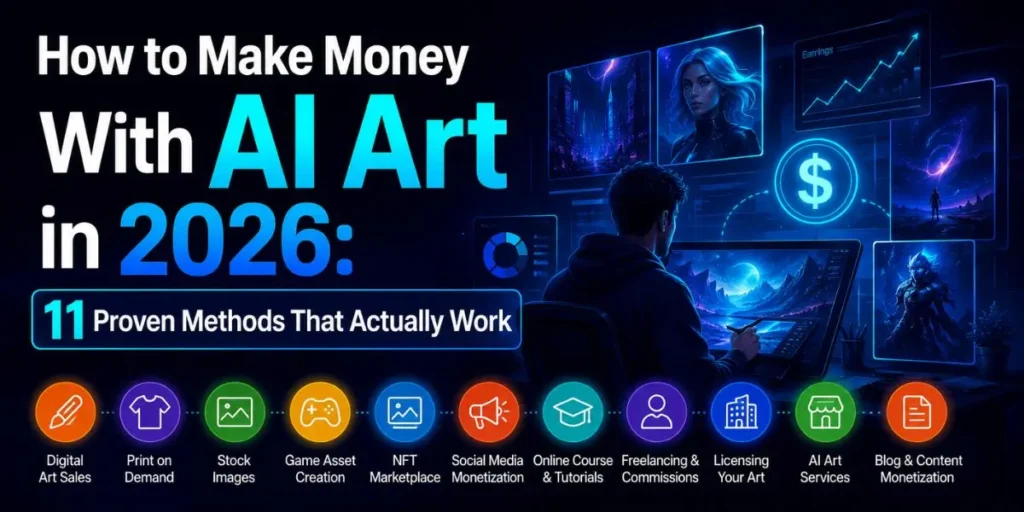
You make money with AI art by selling it as products, not files: print-on-demand royalties, digital downloads on Etsy, and stock images each pay differently, with sellers earning $200 to several thousand dollars monthly. The catch in 2026 is that generic art no longer sells. Niche ownership does.
Most people who try this quit in the first three weeks. Not because the methods are broken, but because they expected sales on day two and got silence instead. I want to fix that expectation before we go any further, because everything that follows only works if you treat it like a business, not a lottery ticket.
This guide walks through every realistic way to turn AI-generated images into income, what each one actually pays, the legal side that almost everyone gets wrong, and a repeatable workflow you can copy. By the end, you will know which method fits your time, your budget, and your patience level.
Table Of Contents
ToggleCan you really make money with AI art in 2026?
Yes, you can make money with AI art in 2026, but the income comes from distribution and niche targeting, not from the images themselves.
AI art is artwork produced with text-to-image tools like Midjourney, DALL-E, Stable Diffusion, or Adobe Firefly, where you describe an image and the model generates it.
Here is the part that trips people up. The image is no longer a valuable asset. Anyone can generate a pretty picture in fifteen seconds now, which means “pretty” is worthless on its own.
What people pay for is a curated product that solves a specific need: a matching set of nursery prints, a clean logo concept, a stock photo of a diverse team in an office.
So the real skill is not prompting. It is knowing what a buyer wants, packaging it well, and putting it where that buyer is already shopping.
Think of AI as the production line that removes the bottleneck, while you handle the part that actually earns money, which is taste and positioning.
And that shift is good news if you are not a trained artist. You compete on ideas and presentation, not on drawing ability.
How much money can you actually make with AI art?
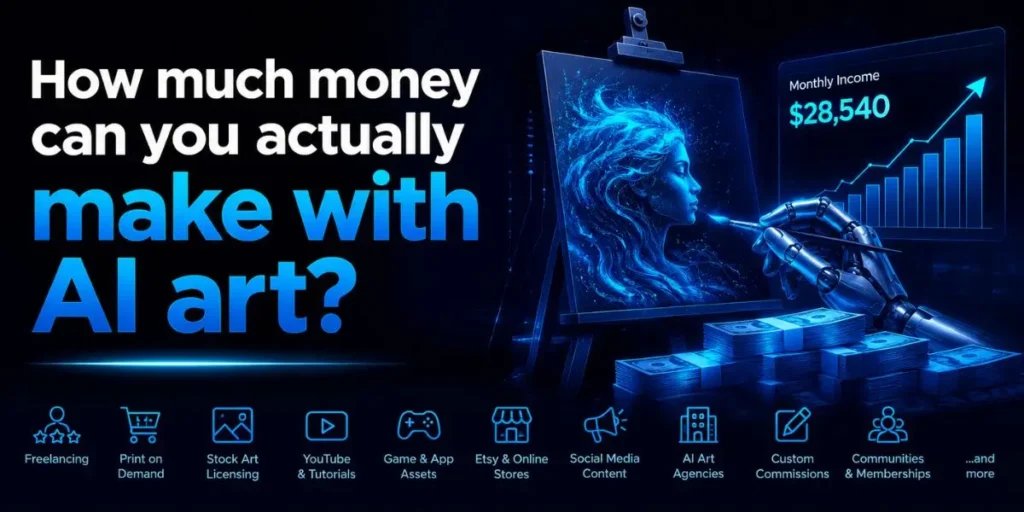
Realistic AI art income ranges from a few hundred dollars a month for beginners to five figures for sellers running multiple revenue streams.
Print-on-demand and stock images pay slowly and passively, while custom commissions and licensing pay more per sale but demand active work.
Honestly, the income numbers floating around the internet are wildly inflated. Some creators do hit thousands per month, but they have hundreds of listings and a year of consistent effort behind them. Here is a grounded breakdown based on how each model actually behaves.
| Method | Startup cost | Realistic monthly range | Time to first income |
|---|---|---|---|
| Print-on-demand | $0 | $50 to $1,500+ | 1 to 3 months |
| Digital downloads (Etsy) | $0 to $20 | $100 to $3,000+ | 3 to 8 weeks |
| Stock contribution | $0 | $50 to $500 | 2 to 6 months |
| Custom commissions | $0 to $30 | $200 to $2,000 | Days to weeks |
| Licensing / exclusive rights | $0 | Highly variable | Weeks to months |
A few things stand out from these numbers. Passive methods like stock and print-on-demand pay almost nothing for the first month or two, then slowly compound as your catalog grows.
Active methods like commissions pay fast but stop as soon as you stop working. The sellers who earn the most blend both, using passive income as a base and custom work as the high-margin layer on top.
But notice the time-to-income column. Every passive method needs months, not days. If you cannot commit to that runway, start with commissions, where your first $50 can land within a week.
What are the best ways to make money with AI art?
The best ways to make money with AI art in 2026 are print-on-demand, digital downloads, stock contribution, custom commissions, and licensing, with newer angles like teaching and local business design rounding out the list.
Each one suits a different mix of skill, patience, and upfront effort. Below are 11 methods, roughly ordered from easiest entry to highest skill required. You do not need all eleven. Pick one, get it working, then add a second.
Method 1: How does print-on-demand work for AI art?
Print-on-demand lets you upload a design once and earn a royalty every time someone buys it on a physical product, with no inventory and no upfront cost. You create the art, the platform prints and ships it, and you keep a markup.
Platforms like Redbubble, TeePublic, Society6, and Merch by Amazon automatically apply a single design to dozens of products, so a single illustration can appear on t-shirts, mugs, stickers, and posters at once. Royalties usually range from 15 to 25 percent of the sale price.
The mistake here is going too broad. A generic “cool space cat” design competes with millions of others. A design built for “fans of a specific dog breed in retro 80s colors” competes with almost no one. Narrow wins.
Pro tip: Seasonal designs outperform year-round designs when uploaded early. List Christmas art in October, not December, so the platform’s algorithm has time to index and rank it before buyers start searching.
Method 2: Can you sell AI art as digital downloads?
Yes, digital downloads are among the highest-margin AI art products because there is no manufacturing cost, so nearly the entire sale price is profit after the platform fee. Buyers download a file and print it themselves.
Etsy, Gumroad, and Creative Market are the main homes for this. Popular categories include printable wall art, social media template packs, digital planner covers, coloring book pages, and texture or pattern bundles.
A five-dollar printable costs you nothing to “restock,” which is why margins stay near 100 percent.
The trade-off is that buyers expect polish. A pack of twenty botanical prints has to feel like one cohesive collection, not twenty random flowers thrown together. Coordination is the product.
When I first tried this, I uploaded single images and wondered why nothing moved. Bundling five coordinated pieces and pricing them as a set tripled the perceived value overnight, even though the work per piece was identical.
Method 3: Is stock photography a good income stream for AI art?
Stock contribution is a slow-building passive stream where your AI images earn small amounts per download across platforms like Adobe Stock, Shutterstock, and Wirestock.
A single image earns cents to a few dollars, but a large library compounds.
The counterintuitive truth here is that artistic images barely sell. What businesses actually buy is boring and practical: professional people in office settings, clean product backgrounds, abstract concept visuals for blog headers, seasonal marketing imagery.
Solve a marketer’s visual problem, and your download rate jumps. Wirestock is worth knowing because it lets you upload to multiple stock sites at once, saving enormous time. Adobe Stock pays better but holds a higher quality bar and rejects anything with visible AI artifacts.
So the game here is volume plus relevance. A few hundred well-keyworded, commercially useful images beat a thousand pretty ones nobody searches for.
Method 4: How do you earn from custom AI art commissions?
Custom commissions pay the fastest of any method because clients pay you directly for a specific result, with no catalog-building wait. You offer a defined service and deliver a finished piece.
The strongest commission niches in 2026 are pet portraits in stylized art forms, logo concepts for new businesses, book covers for indie authors, and product mockup scenes for online sellers. Pricing varies by complexity, but here is a realistic range.
| Commission type | Typical price | Turnaround |
|---|---|---|
| Stylized pet portrait | $30 to $150 | 1 to 3 days |
| Logo concept set | $50 to $200 | 2 to 5 days |
| Indie book cover | $100 to $500 | 3 to 7 days |
| Product mockup set | $100 to $150 | 1 to 2 days |
Compared to the passive methods I have tried, commissions feel completely different. You trade time for money, so income stops when you stop. But the cash arrives in days, which makes it the best starting point if you need proof that this works before committing months to passive streams.
Method 5: How do you build a profitable Etsy printables shop?
An Etsy printables shop earns by selling instantly downloadable AI art to a built-in audience of millions of buyers actively searching for digital products.
You list files, Etsy delivers them automatically, and you keep the margin minus fees.
Etsy currently allows AI-generated art but requires you to disclose AI use in your listing and label it as “designed by” rather than “handmade.”
Skipping that disclosure risks having listings pulled, so treat honesty as a business requirement, not a suggestion.
The algorithm rewards shops with more listings, so aim for 20-30 before expecting steady traffic, with top shops running 100 or more.
Each listing should target a different search phrase, because every listing is a separate door into your shop.
Etsy also charges a transaction fee plus a small listing fee per item, so price with those costs baked in rather than discovering them after your first sale.
Method 6: Should you sell AI art on your own store?
Selling through your own store on platforms like Shopify, Payhip, or Gumroad keeps the highest profit share because you skip marketplace commissions, but you have to drive your own traffic.
There is no built-in audience handing you buyers. This method makes sense only after you have proven demand elsewhere. Marketplaces hand you visibility in exchange for fees.
Your own store hands you margin and brand control in exchange for doing your own marketing. One is not better than the other; they serve different stages.
A common path is to use Etsy or Redbubble to find what sells, then funnel repeat buyers to your own store, where you keep nearly everything.
The marketplace becomes your discovery channel, and your store becomes your profit center.
Pro tip: Add a small printed insert or thank-you file with your store link inside every marketplace order you fulfill. It quietly migrates buyers from a platform you rent to a platform you own.
Method 7: How do freelance platforms pay for AI art?
Freelance platforms like Fiverr and Upwork let you package AI art skills into defined gigs that clients buy outright, with rates rising as you collect reviews. You sell a service, not a file.
Fiverr works well for productized offers like “five fantasy portraits for $30” or “a custom pet portrait in three styles for $50.”
Upwork tends to attract more professional clients with bigger budgets, where you position yourself as a creative who uses AI as a tool rather than competing purely on price.
Starting prices have to be low to earn your first reviews, since buyers trust social proof over promises. After five solid reviews, raise your rates.
The early discount buys credibility, and credibility is what lets you charge real money later.
Method 8: Can you make money teaching AI art skills?
Yes, teaching AI art through courses and tutorials is a growing income stream because demand for the skill is outpacing the supply of clear, outcome-focused instruction. You package what you know and sell access to it.
Platforms like Skillshare, Udemy, and Teachable handle hosting and payments. The courses that sell promise a specific result, not a vague overview.
“Generate professional book covers with AI” outperforms “introduction to AI art” because buyers pay for outcomes, not topics.
This one rewards people who have already made money with a method, because your credibility comes from results you can show. Teaching before you have done the thing yourself tends to fall flat fast.
Method 9: How do you monetize an AI art brand on social media?
A social media AI art brand earns through sponsorships, affiliate deals, product sales, and course launches once you build an engaged following on Instagram, TikTok, or YouTube.
The audience is the asset, and the art is the content that grows it. The accounts that grow do not just post finished images. They show the process, share prompt techniques, run challenges, and teach.
Process content builds engagement, and engaged followers convert into buyers at far higher rates than passive scrollers who only see a finished picture and keep swiping.
This is the slowest method by far. It can take six months to a year before the audience is large enough to monetize. But it is also the most durable, because an owned audience is not at the mercy of a single marketplace algorithm.
Method 10: How does licensing AI art make money?
Licensing earns by selling usage rights to your art rather than the art itself, which lets you sell the same piece many times or charge a premium for exclusive use. A business pays for permission, not ownership of the file.
This is where the legal side becomes a lever for money, and almost no guide connects the two. A personal-use license sells cheaply.
A commercial license, which allows a business to use the art in ads or products, sells for several times as much.
An exclusive license, in which the buyer is the only one allowed to use it, can command 10 times the base price because the buyer is paying for scarcity.
The non-obvious part is that adding meaningful human editing to your AI-generated image strengthens your legal standing to license it, as I explain in the legal section below.
Stronger rights let you charge for exclusivity with confidence.
Method 11: Can you sell AI art to local businesses?
Selling AI art directly to local businesses is the most overlooked method in 2026 because small companies need visuals constantly and rarely shop on Etsy or stock sites.
You approach them directly with a service they did not know they could afford.
Think about what a local cafe, gym, real estate agent, or salon actually needs: social media graphics, menu designs, ad visuals, seasonal promo images, and website headers.
Most of them currently pay nothing because hiring a designer feels expensive, which leaves a wide gap.
You fill that gap with a simple monthly retainer: a set number of branded graphics each month for a flat fee. Local clients value reliability over flash, and one steady retainer can outearn dozens of one-dollar stock downloads.
Compared to fighting for visibility on saturated marketplaces, this is direct, repeatable, and far less crowded.
Which AI art tools should you use to make money?
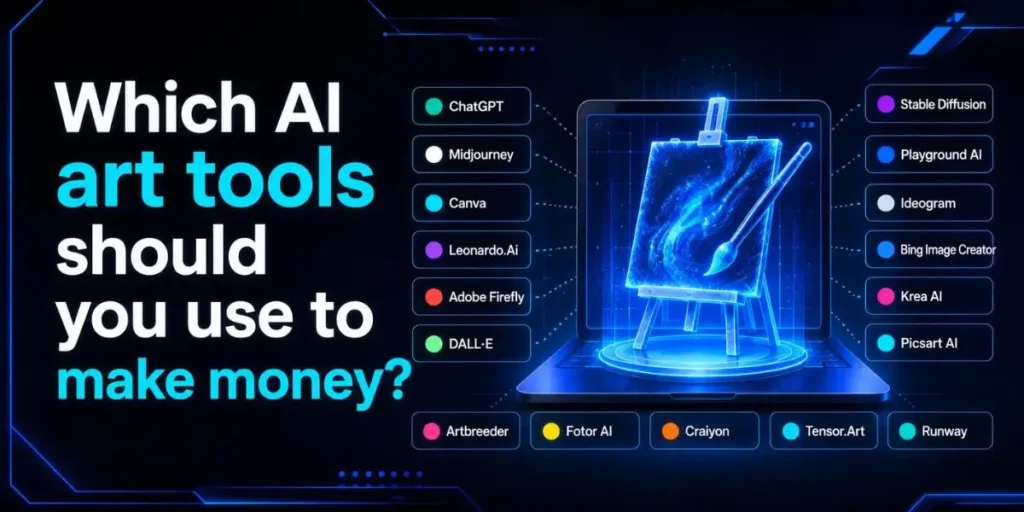
The best AI art tools for making money in 2026 are the ones that grant clear commercial rights and produce print-ready quality, with Midjourney, Adobe Firefly, DALL-E, and Stable Diffusion leading for different reasons.
The tool matters far less than the license behind it. Before you sell a single image, confirm the tool actually permits commercial use. This is where beginners get burned.
They build a whole shop on a free tier that quietly forbids selling, then discover the problem only after a marketplace pulls their listings.
Here is how the main options compare for someone trying to earn.
| Tool | Commercial rights | Best suited for |
|---|---|---|
| Midjourney (paid plans) | Yes, on all paid tiers | Artistic, high-aesthetic work |
| Adobe Firefly | Yes, built for commercial safety | Brand and client projects |
| DALL-E (OpenAI) | Yes, per OpenAI terms | Quick iterations, text in images |
| Stable Diffusion | Yes, open license | High volume, full control |
| Leonardo AI | Yes, on its plans | Game assets, varied styles |
A few specifics worth knowing, verified against the current 2026 terms. Midjourney no longer offers a free trial, and only its paid plans, starting around $10 a month, grant commercial rights.
Free usage on any tool should be treated as non-commercial unless the terms explicitly say otherwise, since some free tiers keep ownership of whatever you generate.
Adobe Firefly is the safest pick for client and brand work because it was trained on licensed and public-domain content, reducing the risk of copyright issues downstream. Stable Diffusion gives you the most control and runs free if you own decent hardware, though the learning curve is real, and it rewards people comfortable with a technical setup.
So the smart move is to master one generator deeply rather than scattering attention across five. Most working sellers settle on a single primary tool for final output, then add a specialist tool only when a specific need arises, such as clean, readable text for posters.
Pro tip: Save your prompts and your editing steps for every piece you sell. If a copyright question ever surfaces, that record helps show the human creative input that strengthens your legal standing, which connects directly to the licensing strategy in the legal section.
One caveat that genuinely protects you: licensing terms shift often, and platforms update rules with little warning.
Read the current terms of service before you build a business on any single tool, then recheck them when you start scaling. A policy that allowed something last year may not this year.
How do you choose a profitable AI art niche?
Choose a profitable AI art niche by combining proven buyer demand with low seller competition, then narrowing until your audience is specific enough to defend.
The narrower and more defined the buyer, the less you compete on price.
Here is a repeatable process most guides skip:
- Start with a buyer, not a style. Pick a group of people with money and a clear interest, such as new parents, D&D players, or wedding planners. Demand follows people, not aesthetics.
- Use marketplace search to confirm demand. Type your niche into Etsy or Redbubble search and read the autocomplete suggestions.
Those suggestions are literally what real buyers type, which reveals genuine demand. - Check competition depth, not just existence. A niche with a few thousand listings and steady sales is healthier than one with a million listings or one with none at all.
You want proven demand without saturation. - Narrow one more level. “Wall art” is hopeless. “Boho nursery wall art in neutral tones” is winnable. Each layer of specificity removes thousands of competitors.
- Test with ten pieces before committing. Create a small batch, list them, and watch the data for two to three weeks. Real sales beat any guess about what should work.
The reason this matters is that niche selection decides the outcome before you make a single image. Pick a saturated generic category, and even brilliant work can go unnoticed.
Pick a defended niche, and average work can still sell, because the buyer has few alternatives.
How to start making money with AI art step by step
- Pick one AI tool and one platform. Start with a free or low-cost generator like Adobe Firefly, DALL-E, or Leonardo, and a single beginner-friendly platform like Redbubble or Etsy.
Spreading across five tools on day one guarantees you finish nothing. - Choose a defended niche. Run the five-step niche process above before you generate anything. The niche shapes every prompt that follows.
- Generate a focused batch. Create 20 to 30 images in your chosen niche, then curate down to your best 10. The quality of selection matters more than the quantity of output.
- Clean up every image. Upscale to print resolution, around 300 DPI, and fix common AI flaws like distorted hands, extra fingers, or stray artifacts before anything goes live. Blurry or glitchy art instantly kills trust.
- Create context mockups. Show wall art on an actual wall, a t-shirt on a person, a print in a frame. Buyers cannot picture the product from a flat file, so the mockup often sells more than the art.
- Write search-driven listings. Use the exact phrases buyers type, structured as style, subject, use case, and format.
A title like “Boho Nursery Wall Art, Printable Digital Download, Neutral Tones” works because it mirrors real searches. - List, then expand weekly. Publish your first 10, then add 5-10 each week. Consistency feeds the algorithm and slowly builds the catalog that compounds into real income.
Each step builds on the last. Skip the cleanup step, and your mockups look amateur. Skip the niche step, and your listings never surface in search. The order is the strategy, not just a checklist.
Is it legal to sell AI-generated art?
Yes, selling AI-generated art is legal in the United States as long as the tool you used grants commercial rights, and your work does not copy trademarked or copyrighted material. The complication is not whether you can sell it, but whether you can own it.
Here is the verified legal picture as of 2026, and it matters for how you price and protect your work. The U.S. Copyright Office, in Part 2 of its Copyright and Artificial Intelligence report published in January 2025, concluded that purely AI-generated images created solely from a prompt are not eligible for copyright protection because they lack the human authorship required by copyright.
Selecting one output from several is not enough either, since choosing a favorite is not, in itself, a creative act. That position was reinforced in court. In Thaler v. Perlmutter, decided March 18, 2025, the D.C. Circuit Court of Appeals affirmed that human authorship is a bedrock requirement for copyright, and that an AI system cannot be listed as an author.
On March 2, 2026, the U.S. Supreme Court declined to hear the case (denied certiorari), leaving the D.C. Circuit’s human-authorship ruling permanently in place. But there is a path to ownership, and this is the money lever.
The same Copyright Office guidance confirms that works with meaningful human creative input can be protected, and the copyright covers the perceptible human expression in the final work.
In February 2025, the Office registered a piece titled “A Single Piece of American Cheese” as a compilation, because the artist’s selection, arrangement, and coordination of AI-generated elements showed enough human authorship to qualify.
So the practical takeaways are clear:
- You can sell AI art even if you cannot copyright it. Selling and owning are separate questions. Plenty of uncopyrightable work sells fine.
- Adding real human editing strengthens your rights. Composing, editing, combining, and refining the output moves you toward protectable expression, which is exactly what lets you license exclusively at premium prices.
- Check your tool’s commercial license. Paid plans on tools like Midjourney generally grant commercial rights, while free tiers often do not. Read the terms before you sell.
- Never use trademarked or copyrighted material. Generating Disney characters, real celebrities, or branded logos is a fast route to takedowns and legal trouble, regardless of the AI involved.
This is general information, not legal advice. If you start earning serious money, a short consultation with an intellectual property attorney is worth far more than anything you read online.
In My Experience
The thing that surprised me most was how little the image quality mattered compared to the listing. I ran two versions of the same wall art set, identical files, one with a flat, plain background thumbnail and one with a styled room mockup and a search-optimized title.
The mockup version outsold the plain one by a wide margin in the first two weeks, even though the actual art was pixel-for-pixel identical. That taught me something the polished guides gloss over. Buyers are not judging your art in isolation.
They are judging whether they can picture it in their lives, whether the title matches what they searched for, and whether the price feels fair for the perceived value. The generation is maybe twenty percent of the work. The other eighty percent is presentation, positioning, and patience.
One frustration worth flagging: the first month genuinely feels like shouting into a void. No views, no sales, no feedback. That silence is where most people quit, and it is also exactly when the platform is still learning what your shop is about. Pushing through that quiet stretch is the actual skill.
What mistakes should you avoid when selling AI art?
Most AI art sellers fail from a handful of repeatable mistakes, and nearly all of them are about strategy and patience rather than talent. Here are the ones that cause the most damage and why they happen.
- Quitting in the first month. This happens because beginners expect fast results, but every passive method needs 3 to 6 months to gain traction.
Avoid it by starting with fast-paying commissions, so you see income while the slow streams build. - Selling generic, undefined art. People default to broad categories because they feel safer, but broad means invisible. Fix it by narrowing your niche until your buyer is as specific as possible.
- Weak or missing mockups. Sellers focus on the art and forget the thumbnail, yet the thumbnail is what buyers actually click. Always show the product in a real context.
- Spreading across too many platforms at once. New sellers chase every opportunity and end up doing all of them badly. Master one platform fully before adding the next.
- Pricing at the bottom. Racing competitors to one dollar feels like a shortcut to sales, but it only enriches the platform and signals low quality. Price for value and raise rates as reviews accumulate.
- Ignoring disclosure rules. Some sellers hide AI use to avoid judgment, then lose listings when platforms like Etsy enforce their policies. Disclose openly; many buyers specifically search for AI art anyway.
- Skipping image cleanup. Distorted hands and visible artifacts slip through because the seller rushes to list. A few minutes of fixing and upscaling protect your reputation and your reviews.
The common thread is impatience. Almost every failure traces back to wanting the result before doing the unglamorous work that produces it.
Workflow example: from prompt to first sale
Here is a complete, realistic flow showing how one product moves from idea to income, structured as input, process, output, and result.
Input: You decide to target “minimalist line-art pet portraits for cat owners,” a niche confirmed through Etsy autocomplete, showing steady searches and moderate competition.
Your starting assets are one AI tool with commercial rights and a free Etsy seller account.
Process: You generate 25 line-art cat illustrations in a single consistent style, then curate the 8 strongest.
You upscale each to 300 DPI, remove a few stray line artifacts, and add light human editing by adjusting composition and combining elements, which also strengthens your legal position.
You build three styled mockups per piece, showing the art framed on a wall.
Then you write each listing using the title formula, disclose AI use, and price single prints at $8 with a three-print bundle at $20.
Output: Eight live Etsy listings, each targeting a slightly different search phrase like “minimalist cat line art print” or “modern cat lover wall art download,” supported by mockups and keyword-rich descriptions.
Result: Weeks one and two stay quiet as Etsy indexes the shop. By week four, the listings start appearing in search, and the first bundle sells.
By month three, with 30 listings live and a few reviews collected, the shop produces steady weekly sales, and you raise prices on the proven best sellers. The income is modest but compounding, and it took zero dollars to start.
This is the entire model in miniature. Pick a defended niche, produce a curated batch, present it well, then survive the quiet stretch until the algorithm catches up.
Frequently Asked Questions
A beginner typically earns $50 to a few hundred dollars in the first few months, growing as the catalog expands. Commissions can pay faster, while passive streams like stock and print-on-demand compound slowly over six months or more.
No, you do not need traditional drawing skills. The core abilities are spotting buyer demand, writing clear prompts, curating the best outputs, and presenting products well. Taste and positioning matter far more than the ability to draw by hand.
Purely AI-generated images are not copyrightable in the U.S. because they lack human authorship. Adding meaningful human editing, arrangement, or composition can make the human-created parts protectable, which is determined on a case-by-case basis.
Etsy is the strongest starting point because it has a massive built-in audience searching for digital downloads. Redbubble is a close second for print-on-demand, since it requires zero upfront cost and handles all fulfillment for you.
Generic AI art is saturated, but specific niches remain wide open. Sellers who target defined audiences, solve particular visual needs, or sell directly to local businesses still find strong demand with far less competition.
Custom commissions can produce income within days. Passive methods like Etsy downloads usually take 3 to 8 weeks for the first sale, and stock contribution can take 2 to 6 months as your library accumulates downloads.

Is an SEO Specialist and AI Tools Researcher with over 4 years of hands-on experience in search engine optimization. As the founder of Smart AI Helper Pro, he tests and reviews AI writing, SEO, and marketing tools to help creators and business owners grow faster with practical, research-backed strategies.