How to Make Money With AI Images in 2026: 9 Proven Methods (and What Each Really Pays)
By SM Mehedi Hasan
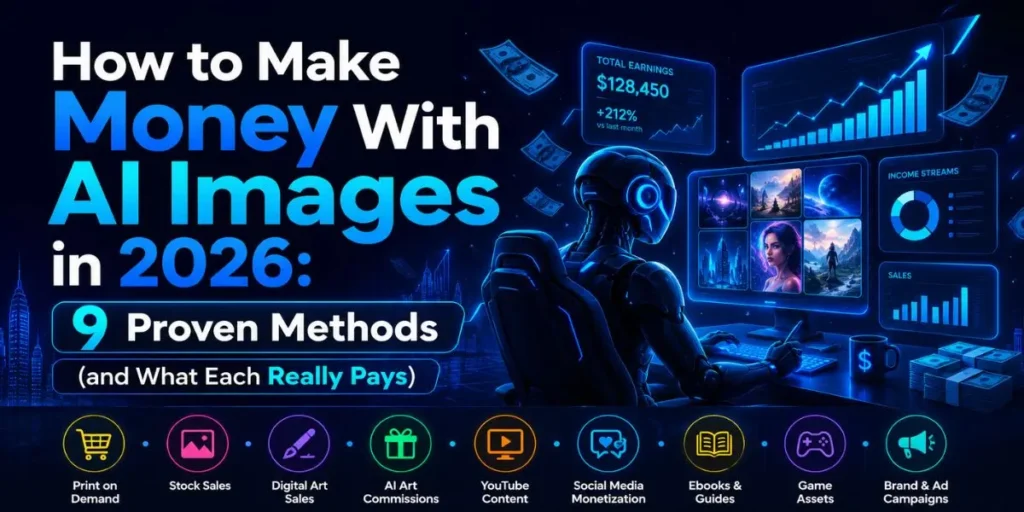
You can make money with AI images by selling stock photos, print-on-demand products, digital downloads, and client work, realistically earning $100 to $1,000 a month after you pick one niche. Generic AI art barely sells now. Tight niches plus volume are what actually pay.
Table Of Contents
ToggleCan you really make money with AI images in 2026?
Yes, you can make money with AI images in 2026, but not the way most YouTube thumbnails promise. The easy money from spraying random images across every marketplace is gone.
What pays now is picking one niche, building a deep catalog, and adding real human editing to the AI output.
Here is the part nobody likes to say out loud. Generic AI stock photos have become nearly worthless because millions of people are uploading the same shiny, over-rendered look. The buyers noticed. So did the platform algorithms.
The creators who are still earning treat this like a small production business, not a magic button.
If you came here expecting a get-rich-quick answer, this guide will probably annoy you. If you want the honest version with real numbers, you are in the right place.
What does “making money with AI images” actually mean?
Making money with AI images means turning text-to-image outputs into a sellable product or service, then distributing that product where buyers already shop.
The image itself is rarely the product. The packaging, the niche, and the distribution are.
Most people picture one path: generate a pretty picture, upload it, get paid. In practice, there are nine distinct income models, and they pay very differently.
Some are passive and slow. Some are active and fast. A few barely work anymore.
Below is the full breakdown, ordered roughly from easiest to start to highest ceiling.
What are the 9 best ways to make money with AI images?
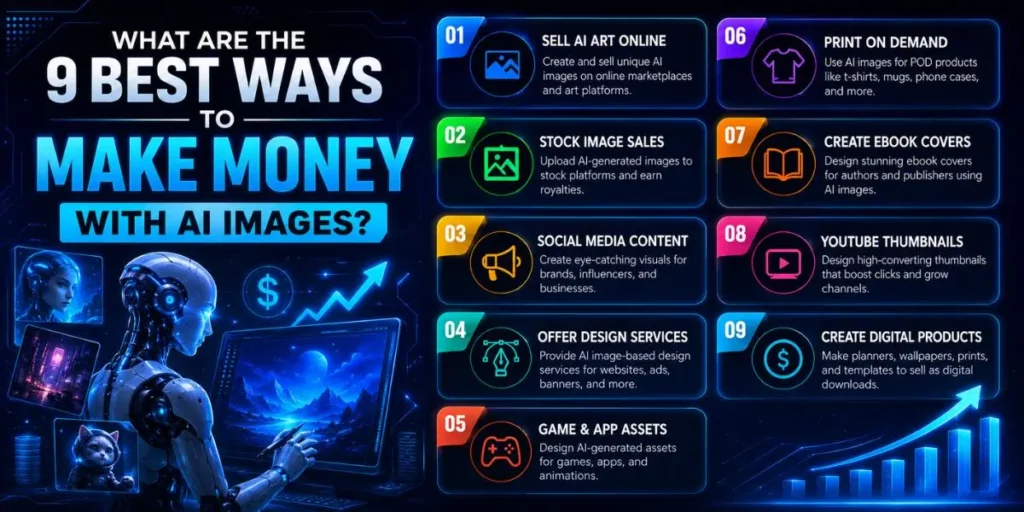
The nine best ways to make money with AI images in 2026 are stock licensing, print-on-demand, digital downloads, low-content books, freelance client work, selling prompts, brand assets like logos and headshots, faceless content channels, and teaching others.
Here is how each one works, what it pays, and who it suits.
1. How do you sell AI images as stock photos?
You sell AI images as stock photos by uploading them to marketplaces like Adobe Stock and Shutterstock, labeling them as AI-generated, and earning a royalty each time someone licenses them. Follow these steps:
- Pick one tight category (for example, “minimal business backgrounds” or “futuristic technology hero images”), not a random mix.
- Generate at the highest resolution your tool allows, then fix obvious flaws like warped hands or garbled text before export.
- Create an Adobe Stock contributor account and tick the “Created using generative AI tools” checkbox at upload.
- Write accurate, specific keywords. Describe what is literally in the frame, not what you wish buyers would search.
- Upload in small, varied batches. Adobe recommends a maximum of 3 iterations from the same prompt, and excessive near-duplicates can flag an account.
Here is what surprises new contributors. Both major platforms now scan your file’s metadata before a human ever sees it.
Submit an AI-generated image without disclosing it, and Shutterstock’s automated system can reject it and issue a strike; three strikes in twelve months risk a permanent ban. Honesty is not optional here. It is mechanical.
There is a catch worth knowing before you commit a weekend to this.
On Shutterstock, fully AI-generated images get routed into a separate collection with lower per-download payouts, and the contributor royalty tier resets every January.
Adobe Stock pays a flatter rate that does not reset, which is why many contributors make it their primary platform. You can read Adobe’s exact rules in their official Adobe Stock generative AI content guidelines.
Realistic earnings: Per-download royalties range from $0.10 to $3, depending on the platform and license. A casual hobbyist might see $10 to $100 a month. Building to $500 or more usually takes hundreds of well-keyworded images and several months.
Pro tip: Treat keywords as your storefront, not an afterthought. A great image with lazy tags is invisible, because the marketplace is a search engine first and a gallery second.
2. How do you make money with AI images on print-on-demand?
You make money with AI images on print-on-demand by placing your designs on physical products like t-shirts, posters, and mugs, then selling them while a fulfillment partner prints and ships each order.
You hold no inventory and pay nothing until a sale happens.
- Generate a design built around a specific buyer, like nurses, gamers, or cottagecore fans, not a generic “cool image.”
- Upscale the file to print resolution. A 512-by-512 image stretched across a 24-by-36-inch poster looks terrible and is refunded.
- Upload to a platform such as Etsy, Redbubble, or Merch by Amazon, or connect a fulfillment service to your own store.
- Write a keyword-rich title and description so the platform’s internal search surfaces your product.
- Test ten designs, kill the eight that flop, and double down on the two that sell.
Most beginners assume the design is what sells. It is not. The niche and the product-market fit do most of the work. A mediocre image aimed at a passionate, underserved audience beats a stunning image aimed at nobody.
Realistic earnings: Profit per item is usually $3 to $10 after the base cost. Wide and unpredictable. A single winning design in a hungry niche can outearn fifty random ones.
3. Which digital downloads sell best with AI images?
The digital downloads that sell best with AI-generated images are wall art printable sets, phone and desktop wallpaper packs, social media template backgrounds, and coloring pages.
These have high margins because you create the file once and sell it unlimited times.
| Product type | Typical price | Why it sells |
|---|---|---|
| Wall-art printable sets (3 to 6 prints) | $5 to $25 | Buyers print at home, no shipping |
| Wallpaper packs (10 to 50 images) | $3 to $10 | Cheap impulse buy, evergreen |
| Coloring pages and books | $4 to $15 | Steady demand from parents and teachers |
| Social media background templates | $8 to $30 | Creators buy in bulk |
When I priced a printable set on Etsy, the platform fees mattered more than I expected. Etsy charges about $0.20 per listing plus a 6.5% transaction fee, so on a $5 download, your margin still clears roughly 90% after costs.
The volume of listings, not the price per item, drives this income. So the move is simple. Bundle. A single $4 wallpaper barely registers, but a themed pack of forty at $9 feels like a deal and earns more per sale.
4. Can you make money with AI images using low-content books?
Yes, you can make money with AI images by illustrating low-content books like coloring books, activity packs, and children’s picture books, then selling them on Amazon KDP or as digital downloads. AI handles the illustrations, and you handle the layout and theme.
- Choose a focused theme such as “mandala coloring pages for stress relief” or “dinosaur activity book for ages 4 to 7.”
- Generate consistent black-and-white line art, which AI handles well for printable PDFs.
- Compile the pages in a free tool like Canva and add a cover.
- Upload to Amazon KDP for print-on-demand paperbacks, or sell the PDF on Etsy and Gumroad.
Honestly, I expected this to be saturated and dead. It is crowded, but tight themes still find buyers, because parents and teachers search for very specific things that broad books do not serve.
Realistic earnings: Royalties of $1 to $4 per book on KDP, or higher margins on direct digital sales. This compounds slowly across a catalog rather than from one title.
5. How do freelancers make money with AI images?
Freelancers make money with AI images by offering fast, niche visual services to businesses on platforms like Fiverr and Upwork, such as social media graphics, blog illustrations, ad creatives, and product mockups.
This is the fastest path to actual cash.
Compared to the passive methods I have tried, client work pays sooner because someone is paying you for a defined result, rather than waiting on a marketplace algorithm.
The trade is that it is an active income. You stop working, you stop earning.
What clients pay for is not the AI. It is your speed, your taste, and your reliability.
The AI is a tool you happen to use, just as a designer uses Photoshop.
Realistic earnings: $15 to $150+ per gig, depending on the deliverable and your reputation. Repeat clients are where the stable income lives.
Worth flagging: Always confirm a client knows the images are AI-assisted and check whether their use case needs commercial rights. Quietly passing AI work off as something else is how freelancers lose accounts and reviews.
6. Is selling AI prompts a real way to make money?
Selling AI prompts is a real but smaller income stream, where you package proven, high-quality prompts and sell them on marketplaces like PromptBase or as digital bundles.
It works because most people cannot write prompts that consistently produce strong results.
After testing this for a while, the honest read is that it is a supplement, not a main source of income.
The prompts that sell are the ones tied to a specific, repeatable output, like “50 prompts for photorealistic product mockups,” not vague creative prompts anyone could guess.
Realistic earnings: A few dollars per prompt or $5-$20 per bundle. Modest, but close to fully passive once listed.
7. How do you make money with AI images by selling brand assets?
You make money with AI images by selling brand assets like logos, professional headshots, social media kits, and packaging mockups to businesses and solopreneurs who need them fast and cheap.
Demand is high because almost every new venture needs visuals.
- Pick one asset type to specialize in, such as AI headshots for LinkedIn or logo kits for small brands.
- Generate and refine until the output looks professional, then package it with mockups.
- Sell it as a one-time gig on Fiverr, or as a template kit on Creative Market or Gumroad.
The thing that caught me off guard here was how much the bundle matters. A bare logo file feels cheap.
The same logo, packaged with a business card mockup, a social profile image, and a simple style sheet, justifies a far higher price.
8. Can AI images power a faceless content channel?
Yes, AI images can power a faceless content channel on YouTube, Instagram, or TikTok, where AI visuals handle the on-screen content while you direct the niche, script, and edit.
Income comes from ad revenue, sponsorships, affiliate links, and your own products.
But here is the limitation that reviews skip. The internet is already flooded with low-effort AI slop, and audiences scroll past it instantly.
A faceless channel only works if you treat it like a real media project with a sharp niche and genuine editing, not an auto-pilot image generator.
If you are choosing between this and freelancing, know the difference. This is a slow-burning asset that may pay nothing for months before compounding. Client work pays this week.
9. How do you make money teaching AI image skills?
You make money teaching AI image skills by selling courses, writing a monetized blog, or building an audience and earning through affiliates and ads.
If you have learned what actually sells, that knowledge has value for the thousands of beginners who arrive every day. This is the method with the longest runway and the slowest start.
A blog or course needs traffic and trust before it earns, but once it does, it can outlast every other method on this list because it is not tied to a single platform’s payout rules.
Which AI image tools are safe to sell with?

Before you sell anything, read the current terms of the exact tool you use, because commercial rights vary and they change. A tool that was previously available for commercial use last year may have changed its licensing terms.
| Tool | Commercial rights | Best for |
|---|---|---|
| Adobe Firefly | Designed for commercial-safe use, licensed training data | Stock, client work, low-risk selling |
| Midjourney | Paid members own their outputs, with a license granted back to Midjourney | High-quality art, prints |
| DALL-E (in ChatGPT) | Commercial use permitted per OpenAI terms | Concept art, quick illustrations |
| Stable Diffusion | Open-source, flexible, you control the pipeline | Bulk generation, custom workflows |
| Ideogram | Commercial use on paid plans | Designs that need readable text |
Before you sell anything, read the current terms of the exact tool you use, because commercial rights vary and they change. A tool that was previously available for commercial use last year may have changed its licensing terms.
Is it legal to sell AI-generated images?
Selling AI-generated images is generally legal in the United States as long as the tool’s license permits commercial use and your image does not copy a real person, brand, or living artist’s protected work.
The bigger surprise is about ownership, not legality. In its January 2025 report on copyrightability, the U.S. Copyright Office reaffirmed that a purely AI-generated image lacks the human authorship needed for copyright, so you cannot register or enforce a copyright on raw AI output.
You can read the official position on the U.S. Copyright Office AI page. What this practically means is that someone else could legally reuse your unedited AI image because you do not own it.
There is a workaround that the same Office has confirmed. When a human meaningfully selects, edits, arranges, or compiles AI elements into a larger creative work, the human-authored arrangement can be copyrightable. So the editing and curation you add are not just quality control. They are the part that the law can actually protect.
A few non-negotiable rules keep you out of trouble:
- Never prompt with the names of living artists, real people, celebrities, or fictional characters from any franchise.
- Run a reverse image search before listing, to confirm your output does not closely replicate an existing work.
- Get a model release if a recognizable real person appears in the image.
This is a fast-moving area, and the Supreme Court declined to hear the Thaler case in March 2026, leaving the human-authorship rule firmly in place.
None of this is legal advice; consult a professional for high-stakes commercial use.
How much can you realistically make with AI images?
Realistically, most people earning with AI images make $50 to $1,000 a month within the first year, with only a focused minority crossing into full-time income. Anyone quoting guaranteed thousands per week is selling a course, not reporting reality.
| Skill and effort level | Realistic monthly range | Time to get there |
|---|---|---|
| Hobby (uploading casually) | $10 to $100 | A few months |
| Part-time (one focused niche) | $100 to $1,000 | 6 to 12 months |
| Full-time (catalog plus services) | $1,000 to $10,000+ | 1 to 3 years |
These ranges line up with what working stock contributors and POD sellers report. The pattern is consistent across methods: the income is real, the timeline is longer than the hype suggests, and consistency beats talent.
In my experience, here is what actually moved the needle
Unlike what most reviews claim, my early uploads earned almost nothing, and the reason was not image quality. It was that I uploaded a scattered mix with lazy keywords. The first images that sold were a small, consistent set aimed at one boring-but-searched category, with metadata that described exactly what was in the frame.
The hidden lesson sat in the analytics. Images that showed up in search but never got licensed slowly sank in ranking, which taught me that inaccurate or wishful keywords actively hurt a portfolio over time.
Accuracy was not just ethical. It was survival for the listing. One frustration is worth naming. The cleanup work is real and tedious. Fixing warped hands, removing nonsense text, and upscaling for print took longer than generating the images, and skipping it was the single fastest way to get rejected or refunded.
What are the most common pitfalls to avoid?
The most common pitfalls when making money with AI images are uploading low-effort volume, spreading across too many niches, ignoring platform AI disclosure rules, and using outputs at the wrong resolution.
Each one quietly kills income.
- Spray-and-pray uploading. Dumping hundreds of random images dilutes your catalog and confuses marketplace algorithms. Buyers who like one image want a matching collection, so depth beats breadth.
- Skipping AI disclosure. Platforms scan metadata automatically. Hiding AI generation risks rejection, strikes, and account bans. Disclose every time.
- Wrong resolution for the product. A low-res file stretched onto a large print looks bad and triggers refunds. Always generate at maximum resolution and upscale for print.
- Prompting protected content. Using artist names, brands, or real people in prompts can result in your work being removed and your account being flagged. Keep prompts original.
- Treating it as passive from day one. Almost every method needs an active workup up front. The passive income comes later, after the catalog or audience exists.
Why do these mistakes happen so often? Because the tools make generation feel effortless, people skip the unglamorous business steps that actually produce sales.
Workflow Example: from prompt to first sale
Here is a realistic end-to-end flow for selling AI wall-art printables, shown as Input, Process, Output, and Result.
Input: A decision to target one niche, “boho botanical line-art prints for nurseries,” plus a free Etsy-ready plan.
Process:
- Generate twelve botanical line-art images at maximum resolution in your chosen tool.
- Edit each one: clean stray marks, ensure consistent style, upscale to 300 DPI for printing.
- Group the best six into a coordinated set to make them look like a collection.
- Build a simple cover mockup and a clear listing in Canva.
- List the set on Etsy with accurate, specific keywords like “boho nursery wall art printable set.”
Output: One polished, downloadable six-print set priced at $12, with keyword-optimized listing copy.
Result: A single asset that can sell repeatedly with near-90% margin after Etsy fees, and a repeatable template you can clone into the next niche.
This is the whole game in miniature. One niche, real editing, a bundled product, accurate keywords, then repeat.
Frequently Asked Questions
Yes, but as a real side business, not a quick scheme. Generic images barely earn, while niche-focused, well-edited catalogs and client services still produce steady income for consistent creators.
Usually not for raw output. The U.S. Copyright Office holds that purely AI-generated images lack human authorship, though your creative editing, arrangement, or compilation can be protectable.
Adobe Stock is often preferred because its royalty rate is flatter and does not reset annually, while Shutterstock offers more traffic but lower per-download payouts for fully AI-generated content.
A beginner typically earns $10 to $100 a month at first. Reaching $500 or more usually takes a focused niche, hundreds of assets, and several months of consistent effort.
Yes. Adobe Stock and Shutterstock both require AI disclosure and automatically scan metadata. Hiding it risks rejection, account strikes, and permanent bans.

Is an SEO Specialist and AI Tools Researcher with over 4 years of hands-on experience in search engine optimization. As the founder of Smart AI Helper Pro, he tests and reviews AI writing, SEO, and marketing tools to help creators and business owners grow faster with practical, research-backed strategies.