Will Accounting Be Replaced by AI? The 2026 Truth for Accountants
By SM Mehedi Hasan
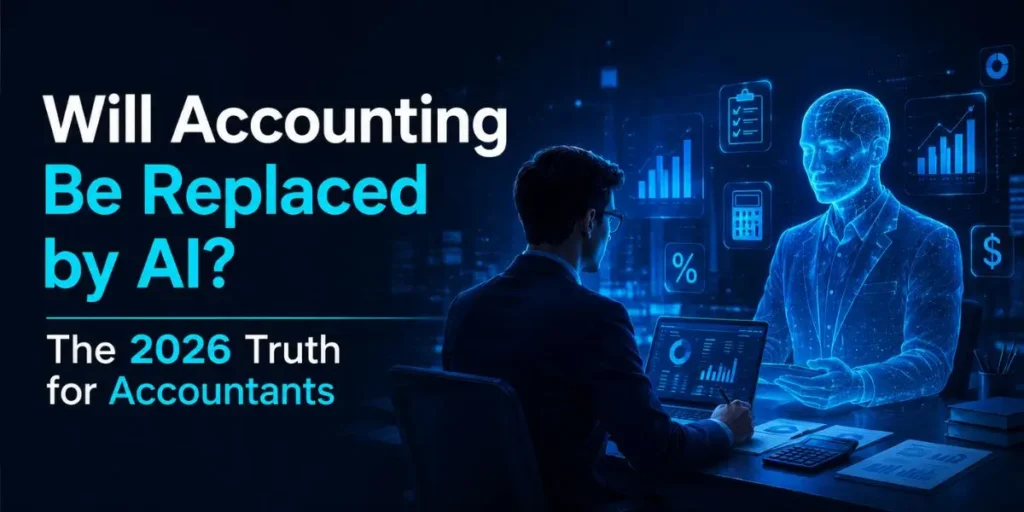
No, AI will not replace accountants, but it is already replacing accounting tasks. The US Bureau of Labor Statistics projects 5% job growth for accountants through 2034, while bookkeeping clerk roles decline 6%. That gap is the whole story: routine data work is shrinking fast, and judgment-based advisory work is where the jobs and money are moving.
Every accountant has felt that quiet drop in the stomach after scrolling past a LinkedIn post about the “death of the profession.” A chatbot passes the CPA exam. Software closes the books overnight.
Someone in the office jokes about not needing staff accountants anymore, and nobody laughs. But the numbers tell a calmer, more specific story than the headlines do. AI is not coming for the accountant. It is coming for the parts of the job most accountants never enjoyed in the first place.
The question worth asking in 2026 is not “will I be replaced,” it is “which parts of my week are already being done by a machine, and what am I doing with the time that opens up.”
Table Of Contents
ToggleWill AI Replace Accountants in 2026?
No, AI will not replace accountants in 2026, and the labor data points the opposite way from collapse. According to the US Bureau of Labor Statistics, employment of accountants and auditors is projected to grow 5% from 2024 to 2034, faster than the 3% average across all occupations.
That works out to roughly 124,200 openings each year and about 72,800 net new jobs over the decade. So where does the replacement fear come from? Mostly from watching AI do the visible, mechanical parts of accounting well. And it does them well. That visibility fools people into thinking the whole job is at risk, when only a slice of it actually is.
Here is the distinction that matters. AI is replacing tasks, not accountants. Data entry, transaction coding, invoice matching, and first-pass reconciliation are being automated at speed.
Advisory judgment, audit sign-off, tax strategy, and client trust are not. A profession does not disappear because its lowest-value tasks get automated. It shifts upward. That shift is already underway, and the accountants who understand it are pulling ahead of the ones who are waiting for it to blow over.
What Does the 2026 Data Actually Show?
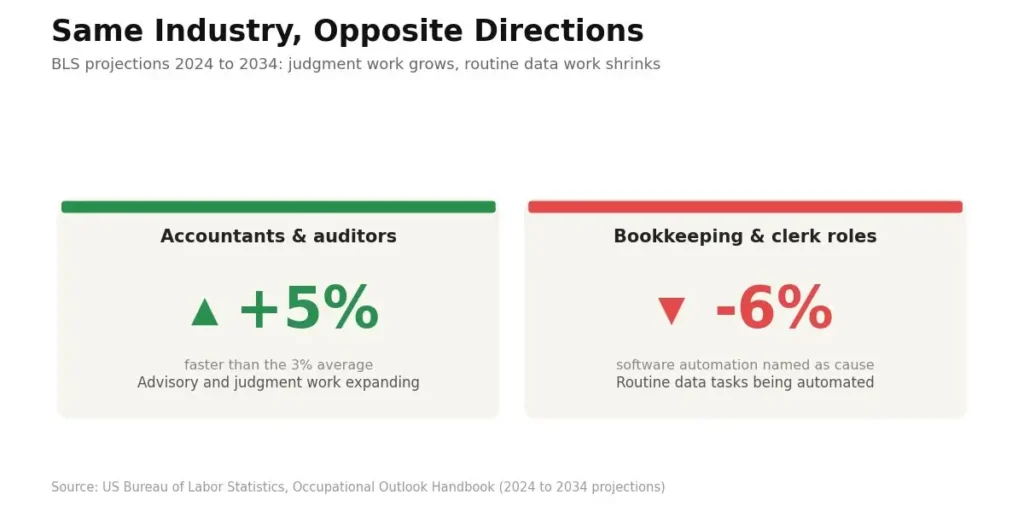
The data shows a profession in transition, not in crisis. Two BLS projections sit side by side and explain almost everything about what AI is doing to accounting careers.
| Accountants and auditors | +5% growth | Advisory and judgment work expanding |
| Bookkeeping and clerk roles | -6% decline | Routine data tasks being automated |
The clerk number is the one people skip past. Government forecasters project that bookkeeping, accounting, and auditing clerk jobs will decline by 6% through 2034, and they name software automation as the direct reason. That is about 94,300 clerk jobs expected to disappear even as accountant roles grow. Same industry, opposite direction.
Adoption is moving fast enough to feel it quarter to quarter. Wolters Kluwer’s Future Ready Accountant report found AI adoption in accounting firms jumped from 9% to 41% in a single year. Intuit’s 2025 survey of 700 US accounting professionals showed 46% now use AI every day. That is nearly half the profession, not a fringe of early adopters.
And the outside-world view lines up. The World Economic Forum’s Future of Jobs Report 2025 lists accounting, bookkeeping, and payroll clerks among the fastest-declining job categories through 2030. Note the word: clerks. The forecast for the credentialed, advisory end of the profession is growth, not decline.
Why Are Bookkeeping Jobs Shrinking While Accounting Jobs Grow?
Because AI is excellent at rules and terrible at judgment. Bookkeeping is largely rules-based: record this, categorize that, match these two numbers. That is exactly the shape of work a model handles cheaply and at scale.
Accounting, at its higher levels, runs on interpretation, and it’s there that automation still stumbles.
Think of it as a line. One side holds repetitive, structured, high-volume processing. The other holds ambiguous, context-heavy, accountable decision-making.
AI is steadily eating everything on the first side and barely touching the second. Your career safety depends less on your job title and more on which side of that line your day-to-day work sits.
Which Accounting Tasks Is AI Already Doing?
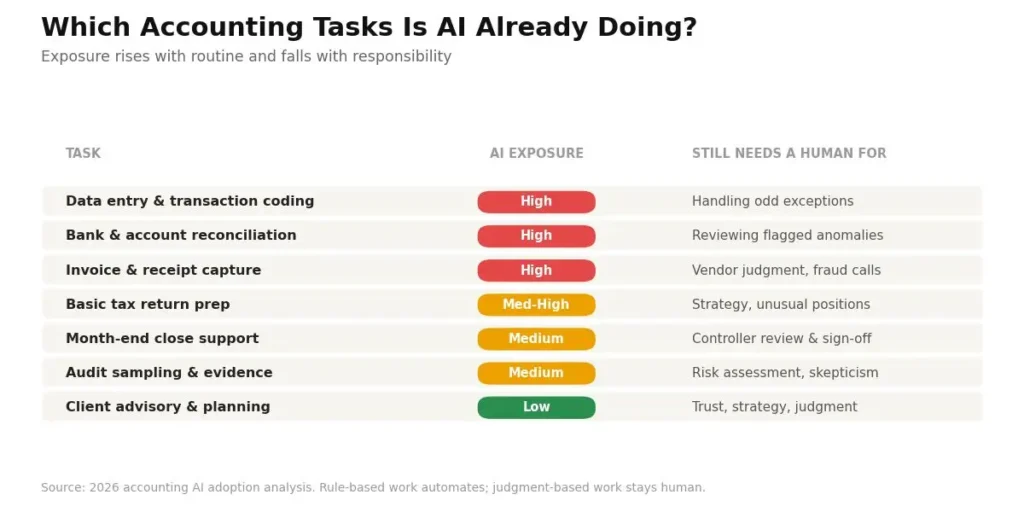
AI is already handling most of the repetitive, structured work inside a modern firm. The clearest way to see your own exposure is to look at the work itself, not the job title on your business card.
| Data entry and transaction coding | High | Handling odd exceptions |
| Bank and account reconciliation | High | Reviewing flagged anomalies |
| Invoice and receipt capture | High | Vendor judgment, fraud calls |
| Basic tax return prep | Medium to high | Strategy, unusual positions |
| Month-end close support | Medium | Controller review and sign-off |
| Audit sampling and evidence | Medium | Risk assessment, skepticism |
| Forecasting and variance notes | Medium | Business interpretation |
| Client advisory and planning | Low | Trust, strategy, judgment |
Optical character recognition now reads receipts and invoices with near full accuracy, automatically pulling vendor names, amounts, and dates. Whole months’ worth of documents are processed without anyone typing a line.
On the audit side, platforms like KPMG’s Clara review 100% of transactions rather than a small sample, so an auditor who once checked 50 invoices out of 50,000 can now have all 50,000 scanned, with only the odd ones surfacing.
There is a genuinely striking data point behind the anxiety. When researchers tested large language models on the CPA exam, GPT-4 averaged 85.1% across all sections, including 91.5% in Auditing and Attestation, after an earlier model had failed the same exam.
Passing an exam and carrying professional responsibility for a signed opinion are different things, though. One is pattern recall. The other is liability.
In My Experience: What Happened When I Handed a Reconciliation to AI
Honestly, when I first ran a messy bank reconciliation through an AI bookkeeping tool, I expected it to fumble.
It didn’t. Instead, it cleared the routine matches in seconds and, more usefully, flagged a duplicate vendor payment I had genuinely overlooked. That part earned the hype.
Then it quietly miscoded a recurring software subscription as a one-off office expense and confidently stated the misclassification. No hesitation, no flag, no “I’m unsure here.”
If I had blindly trusted the output, that error would have walked straight into the financials. The tool was fast and mostly right, which is exactly what makes it dangerous without review.
Speed plus confidence plus an occasional wrong answer is a combination that punishes anyone who stops checking. The value was real. So was the need for a human who knew what “correct” looked like.
Which Accounting Jobs Are Most at Risk From AI?
The most exposed roles are the ones built almost entirely on repetitive, structured processing. If a week is 70% journal entries, reconciliations, and document review, that week sits squarely in automation’s path.
Here is the honest ranking, from most exposed to most protected:
- Bookkeepers and data-entry clerks.
Highest exposure. Invoice capture, categorization, and matching are the exact tasks software does cheapest. This is the group the BLS projects to shrink. - Entry-level and staff accountants.
Changing fast, not vanishing. The grunt work that once filled the first two years now runs automatically, so the role shifts from “doing” to “reviewing.” Stanford research found that hiring for junior, AI-exposed roles, including accounting, fell 16% over two years. - Routine tax preparers.
Standard return prep is heavily automatable. Complex, multi-jurisdiction, and advisory tax work is a different job entirely and stays human. - Audit clerks doing sampling.
The mechanical testing is automating. The judgment about what the anomalies mean is not. - CPAs, controllers, and advisory accountants.
Most protected. Signing authority, IRS representation, professional liability, and strategic counsel are far beyond what a model can provide.
Notice the pattern. Exposure rises with routine and falls with responsibility. The credential still matters, but a CPA who also knows how to drive AI tools is worth dramatically more than one who avoids them.
Is AI Causing Job Losses or Filling a Labor Shortage?
AI is arriving exactly as accounting faces a people shortage, which flips the usual replacement story on its head. The profession has been bleeding talent: the AICPA reports that roughly 75% of current CPAs are at or near retirement age, and more than 300,000 accountants left the field between 2019 and 2024.
Fewer students enter the pipeline each year, and firms are struggling to fill seats they already have. Set the automation trend against that backdrop and the panic reads differently. AI is not producing a crowd of unemployed accountants. It is absorbing work that firms cannot staff anyway.
When routine tasks are automated, a shrinking workforce covers the same volume, and the experienced people who remain are pulled toward the advisory work clients pay a premium for. Burnout sits underneath all of it. Tax season and audit crunch push weeks to 60 or 80 hours for months at a stretch, and that grind is a big reason people walk away.
AI that clears first-pass reconciliation and data entry overnight takes genuine pressure off teams. Used that way, the technology is not pushing accountants out the door. It is one of the reasons some of them stay.
A Stanford Graduate School of Business study captures the upside cleanly. Accountants who used AI to finalize monthly statements completed the process 7.5 days faster and spent 8.5% less time on routine processing. The senior professionals gained the most, because they knew when to trust the output and when to override it. That is not the signature of a job being replaced. It is leverage.
What Can AI Not Do in Accounting?
AI cannot carry accountability, and in accounting, accountability is the entire product. A model can draft a number. It cannot be responsible for that number in front of the SEC, the IRS, or a client whose business depends on it. That single gap protects the core of the profession.
Four areas stay firmly human:
Professional judgment on ambiguous standards.
Revenue recognition under ASC 606 turns on contract intent. Fair value measurement rests on assumptions. Materiality thresholds, lease classification, and contingent liabilities all depend on context that a pattern-matching system struggles to read. AI can support these calls. It cannot own them.
Ethical reasoning and skepticism.
A model generates confident answers even when it is wrong, which is the definition of a hallucination. It has no instinct for “this looks off.” Professional skepticism, the habit of doubting a number until it earns trust, is a human trait, and it is exactly what audit and tax work run on.
Legal accountability and representation.
CPAs sign audit opinions, represent clients before the IRS, and hold professional liability under state licensure. When AI-generated advice triggers an audit, the taxpayer carries the consequence, not the software vendor. Regulators hold people responsible, and current SEC rules keep accountability with management, not the machine.
Client relationships.
Clients rarely want only accurate numbers. They want someone who understands their business, anticipates problems before they occur, and can explain what a figure actually means for a decision. AI handles the “what.” A good accountant delivers the “so what” and the “now what.”
When Would AI Actually Replace Accountants?
AI would only threaten the core accounting role if regulators allowed software to assume legal responsibility for financial statements, which is not close to happening.
That is the honest answer most articles skip. So instead of a vague “someday,” here are the real leading indicators to watch. Think of them as canaries in the coal mine.
- Big Four firms cutting traditional entry-level hires.
One of the Big Four has signaled the end of an end-to-end AI audit process. If firms genuinely start reducing junior headcount rather than redeploying it, that is a meaningful domino. - Regulators accepting AI-signed opinions.
The moment an audit opinion or SEC filing can be legally certified by a system rather than a licensed human, the accountability moat starts to drain. There is no sign of this yet. - A collapse in the wage premium for AI-skilled accountants.
Right now, the premium is climbing, which suggests the market values humans who wield AI, not those being replaced by it. - Bookkeeper-level roles vanishing outright, then audit and tax following.
Watch the bottom of the ladder. If clerk automation spreads upward into judgment work without a human check, that is the precursor to worry about.
Until several of these move together, “replacement” is a headline, not a forecast. What is happening instead is redistribution: the boring work leaves, the valuable work stays and grows.
How Can Accountants Future-Proof Their Careers?
- Learn to drive one AI tool well before adding more.
Routine research and drafting eat hours you could spend on advisory work. Open the AI assistant already inside your existing software, run one real task through it this week, and check the output against what you know. You should see a task that took an hour drop to minutes, with you reviewing instead of grinding. - Shift your billable time toward advisory work.
Compliance is commoditizing while advisory is where firms are growing revenue. Pick one client and move a conversation from “here are your numbers” to “here is what these numbers suggest you do next.” You should notice the client valuing the second conversation far more than the first. - Build review and skepticism into a habit.
AI’s confident errors are the real risk, so your judgment becomes the safeguard. Never accept an AI output without tracing it back to source data. You should catch at least one confident-but-wrong result early, which is exactly the value you now provide. - Specialize in complexity.
Routine is automatable; nuance is not. Deepen expertise in an area that resists clean rules, such as multi-entity consolidation, forensic work, or industry-specific tax. You should find that the harder the problem, the safer the role. - Protect and use your credential.
A CPA license carries legal authority and trust that no model replicates. Keep it current, and pair it with visible AI fluency. You should become the person a firm reaches for, not the one it automates around.
Pro Tip: Start with the AI assistant embedded in the software you already pay for, whether that is Intuit Assist, Sage Copilot, or Microsoft Copilot for Finance.
You do not need a new tech stack to begin. You need to use the one you have differently.
Pro Tip: A useful test for any task on your plate: if you could write a clear rule for how to do it, AI will eventually do it. If it requires reading a situation, it stays yours. Sort your week by that test, and you will see your own risk map instantly.
According to PwC’s Global AI Jobs Barometer, workers with AI skills command a wage premium that has been rising sharply. In accounting, that premium is the market paying you to combine the credential with the tools, not choosing between them.
Common Pitfalls When Accountants Adopt AI
Most AI failures in accounting are trust failures, not technology failures. A tool rarely breaks. The user’s assumptions do. Here are the mistakes that show up again and again, and how to sidestep them.
- Trusting confident output without review.
AI gives wrong answers with the same certainty as it gives right ones. It happens because the model predicts what looks correct, not what is true. Always validate against source documents before a number leaves your desk. - Feeding client data into public tools.
Pasting confidential financial information into a consumer chatbot can breach client confidentiality and data protection rules. This happens when people treat a public AI like a private calculator. Use tools with proper data controls, and check your firm’s policy first. - Letting review skills atrophy.
The more AI handles, the easier it is to stop thinking critically, which is fatal in a field where accuracy is not optional. Keep doing enough of the underlying work to know when the output is wrong. - Assuming the tax code is current.
Some models lag years behind current law, so an AI tax answer can be confidently outdated. Treat AI research as a starting point, then verify against the live code. - Choosing a flashy tool over a fitting one.
Firms buy the tool with the best demo, not the one that solves their actual bottleneck. Map your slowest repetitive process first, then choose the tool that removes it.
Workflow Example: Using AI for a Month-End Close
Here is a realistic end-to-end flow, the kind a staff accountant runs in a firm that has properly adopted AI.
Input: A month of bank statements, credit card feeds, vendor invoices, and receipts, uploaded into an AI-enabled accounting platform.
Process: The system reads every document with OCR, codes transactions by recognizing patterns from prior months, runs three-way matching across invoices, purchase orders, and delivery records, and automatically reconciles the bank feed.
It then drafts a plain-language variance note, flagging that marketing spend rose and one vendor payment looks duplicated.
Output: A near-complete draft close, with routine transactions categorized, reconciliations matched, and a short list of exceptions surfaced for human eyes.
Result: The accountant skips hours of data entry and reconciliation and spends that time on the exceptions instead.
The duplicate payment is caught, the miscoded subscription is corrected on review, and the controller signs off on a close that finishes faster and with a sharper eye on what actually matters.
Machines did the volume. A human owned the judgment and the sign-off.
So, Should Accountants Worry About AI?
Worry is the wrong response. Adaptation is the right one. The accountants losing ground in 2026 are not the ones using AI; they are the ones avoiding it while their routine work quietly gets automated around them.
The money is already moving in that direction. Median revenue from advisory services rose 61% from 2022 to 2024, according to the CPA.com and AICPA Client Advisory Services Benchmark Survey.
Firms are not shrinking as AI spreads. They are repricing what an accountant is for.
The profession has absorbed technology shocks before, from the calculator to the spreadsheet to cloud accounting, and each time the role moved up the value chain rather than off the map.
AI is the same pattern at higher speed. The boring work leaves. Judgment, relationships, and accountability remain, and they are worth more now than before.
Your license, along with your fluency with these tools, is the most durable position in the field.
Frequently Asked Questions
No. The BLS projects 5% growth for accountants and auditors through 2034. AI automates routine tasks like data entry and reconciliation, but professional judgment, audit sign-off, and client advisory work remain human responsibilities that regulators require.
Bookkeepers, data-entry clerks, and routine tax preparers face the highest risk because their work is rules-based and repetitive. BLS projects that clerk roles will decline by 6% through 2034, with software automation identified as the direct cause.
ChatGPT can summarize financial documents, draft journal entries, and answer basic questions, but it cannot reliably interpret complex standards or guarantee compliance. It also hallucinates confidently, so any output needs to be reviewed by a qualified accountant before use.
Yes, increasingly. AI-skilled accountants command a rising wage premium, and firms favor professionals who can drive these tools. You do not need to code, just to use one AI tool well and review its output critically.
No. CPAs have the legal authority to sign audit opinions and represent clients before the IRS, backed by professional liability insurance that software cannot provide. The credential is protective, especially when paired with AI fluency and advisory skills.

Is an SEO Specialist and AI Tools Researcher with over 4 years of hands-on experience in search engine optimization. As the founder of Smart AI Helper Pro, he tests and reviews AI writing, SEO, and marketing tools to help creators and business owners grow faster with practical, research-backed strategies.