Will AI Replace Software Engineers? An Honest 2026 Answer
By SM Mehedi Hasan

No, AI will not replace software engineers in 2026, but it is already replacing specific tasks and gutting entry-level hiring. The U.S. Bureau of Labor Statistics still projects 15% job growth for software developers through 2034, yet new computer science graduates now face a 6.1% unemployment rate. The career survives. The on-ramp got narrower.
That is the short version. If you want the honest, evidence-backed version, keep reading, because the real story is stranger than either the doomers or the hype merchants are telling you.
Here is the tension nobody wants to sit with: the same year that CEOs announced they would stop hiring engineers, federal data projected hundreds of thousands of new engineering jobs. Both things are true. Understanding why both are true is the whole answer.
Table Of Contents
ToggleWill AI Replace Software Engineers or Not?
AI is replacing tasks, not the profession, and the difference decides your career. The cleanest way to think about it is in three layers: task displacement first, role redesign second, and full job elimination only in narrow cases.
Most coverage collapses these into one scary headline. They are not the same thing. Task displacement is already here. AI writes boilerplate, scaffolds APIs, drafts unit tests, and refactors code faster than any human.
Role redesign is underway now as well: engineers spend less time typing and more time specifying, reviewing, and directing AI agents. Job elimination, the thing everyone fears, is real but concentrated at a specific rung: entry-level implementation work.
So when someone asks “will software engineers be replaced by AI,” the accurate answer is: the job is being rewritten, not deleted. But the rewrite is brutal for one group and a gift for another.
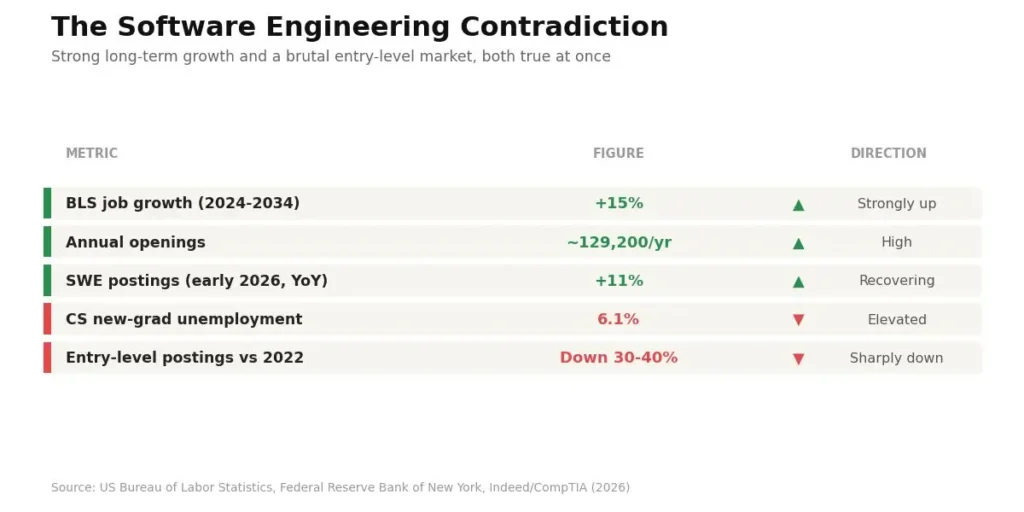
Let me show you the contradiction in one place, because this table is the entire debate compressed:
| BLS job growth (2024–2034) | +15%, ~287,900 new roles | Strongly up |
| Annual openings | ~129,200 per year | High |
| CS new-grad unemployment | 6.1% | Elevated |
| Entry-level postings vs 2022 | Down ~30–40% | Sharply down |
| SWE postings YoY (early 2026) | +11% | Recovering |
Sources: U.S. Bureau of Labor Statistics, Federal Reserve Bank of New York, Citadel Securities analysis via CNN. Look at those rows together. Growth and pain, side by side. That is not a data error. That is the shape of the transition.
What Is AI Actually Doing to Software Engineering Right Now?
AI has gone from an optional helper to a default tool in about 2 years. Stack Overflow’s 2025 Developer Survey found that 84% of developers are using or planning to use AI tools in their workflow, up from 76% the year before, and 51% of professional developers now use AI tools every single day.
But adoption does not mean love. Positive sentiment toward these tools actually dropped to around 60% in 2025, down from over 70% in prior years. That drop is the interesting part. It reflects real experience, not hype fatigue.
Developers used the tools enough to learn exactly where they break. And they break in predictable places. The same survey found 66% of developers say AI output is “almost right but not quite,” and roughly 45% say debugging AI-generated code takes them longer than writing it themselves.
That gap between “looks correct” and “is correct” is where the entire profession still lives.
Which Coding Tasks Has AI Already Taken Over?
AI now reliably handles the repetitive middle of software development. These are the tasks that used to fill hours and now fill minutes:
- Boilerplate and scaffolding.
Spinning up a CRUD API, generating a form component, writing a standard Dockerfile, wiring config. Well-known patterns with small variations. AI nails these on the first try more often than not. - Unit tests and test data.
Generating tests for functions with clear inputs and outputs is close to a solved problem. So are fixtures, seed data, and stubs. - Documentation and comments.
README files, API docs, function summaries. Tedious, necessary, delegatable. - Translation and refactoring.
Converting between languages, renaming variables across a codebase, extracting methods, reformatting. Low risk, highly automatable. - Multi-file feature work.
Tools like Cursor, Claude Code, and Copilot can traverse a repo and implement a scoped change across several files with reasonable coherence, provided a human specifies the task and reviews the output.
In a controlled GitHub study, developers completed a JavaScript HTTP server task 55% faster with Copilot than without it. That is a real gain on a real class of work.
What Can AI Still Not Do in Software Engineering?
The work that survives, and grows more valuable, is the work that needs judgment, context, and accountability. This is not a motivational cliché. There is hard evidence behind it.
System design and architecture stay human. Deciding how services decompose, where state lives, which trade-offs to accept, and how a system evolves over years. AI can discuss patterns.
It cannot own the decision or bear the blame when it is wrong. Complex distributed debugging stays human. When a bug spans three services, a message queue, and a flaky external API, the work is a hypothesis-driven investigation across incomplete signals. That is not code generation.
Security is a growing problem, not a solved one. Veracode’s 2025 analysis found that 45% of AI-generated code samples failed security tests and introduced vulnerabilities from the OWASP Top 10, with Java hitting a 72% failure rate.
More AI code without more review means more attack surface, not less. And here is the finding that should end the “AI already replaced us” argument. A 2025 randomized trial from METR found that experienced open-source developers took 19% longer to complete real tasks when AI tools were allowed.
On messy, high-context work, the tool added overhead. Speed is not guaranteed. It depends entirely on task fit.
In My Experience
Honestly, when I first started leaning on AI agents for a real feature build, I expected to move twice as fast. What actually happened was that my typing time collapsed and my reviewing time exploded.
I shipped a small internal tool where the AI generated maybe 80% of the code in an afternoon. Then I spent two full days catching a permissions bug it had confidently introduced, one that passed every test the AI also wrote for itself.
That was the lesson that stuck. The tool is fast at producing plausible code and terrible at knowing when plausible is wrong. It has no sense of consequence.
It does not feel the cold dread you feel when you know a change touches auth or billing. So the burden of “is this actually safe” landed harder on me, not lighter.
The engineers I have watched pull ahead in 2026 are not the fastest typists. They are the fastest, most suspicious reviewers.
Why Do CEOs Say AI Will Replace Engineers While Jobs Keep Growing?
Tech leaders make dramatic predictions, and the dramatic ones travel faster than the corrections. If you only read headlines, you would think engineers were already obsolete. The receipts tell a more careful story.
In March 2025, Anthropic CEO Dario Amodei predicted AI would write 90% of all code within three to six months, and essentially all of it within a year. That deadline passed. Independent analysis in late 2025 concluded that the prediction did not hold up, even within Anthropic itself, once you exclude throwaway scripts.
At Davos in January 2026, Amodei shifted the framing to “6 to 12 months away” from AI doing end-to-end software engineering. Notice the pattern: the timeline keeps rolling forward.
Meanwhile, the people running the biggest engineering orgs quietly walked back their claims. Salesforce CEO Marc Benioff said in late 2025 that he would not hire more engineers because Agentforce had increased engineering productivity by about 30%.
But by April 2026, he was calling continued hiring at top AI labs the “canary in the coal mine“, admitting the models “still cannot operate autonomously.”
He even moved to hire 1,000 new grads. That is not the behavior of someone who believes engineers are finished.
Here is what the loudest voices actually said versus what happened:
| Amodei (Anthropic) | 90% of code by mid-2025 | Missed; timeline pushed to 2026-2027 |
| Benioff (Salesforce) | No new engineers in FY2026 | ~30% productivity gain, but now hiring grads |
| Nadella (Microsoft) | ~30% of code AI-written | Real, but code volume still grew |
| Pichai (Google) | 25%+ of code AI-generated | Real, headcount still large |
| Jassy (Amazon) | 14,000 corporate cuts | Called it culture-driven, “not AI-driven, not yet” |
The honest read: AI genuinely raised productivity 20% to 45% (a range McKinsey also lands on), but “more productive engineers” is very different from “no engineers.” Even Amazon, which cut 14,000 corporate roles, had its CEO explicitly say the cuts were about culture and layers, not automation.
Is the Software Engineering Job Market Actually Collapsing?
The market is not collapsing, but it has split violently in two. Treat “the software job market” as one number, and you will always reach the wrong conclusion. The junior and senior markets are operating in different economies right now.
For experienced engineers, demand is healthy. Tech unemployment sat around 2.8% in mid-2025, well below the national rate, and software engineer postings on Indeed were up 11% year over year in early 2026.
IBM went so far as to triple its US entry-level hiring, and the University of Washington placed a record 370 graduates into engineering roles in a single year, with an estimated 75% to 80% landing jobs within months.
For new graduates, the picture is genuinely hard.
CS grads have a 6.1% unemployment rate, per Federal Reserve Bank of New York data, and computer engineering grads have a 7.5%, both above the roughly 5.7% rate for recent grads overall.
SignalFire found new-grad hiring at big tech is down more than 50% from 2019 levels, with new grads now just 7% of big-tech hires.
Handshake data showed entry-level software roles down roughly 30% year over year, and internships down 30% since 2023.
Why Are Entry-Level Jobs Disappearing First?
Entry-level work is vanishing because AI is best at exactly the tasks juniors used to be hired to do. A recruiting director put it plainly: an entry-level engineer traditionally came in to help with testing, documentation, and basic bug fixing to learn the system.
Today AI does all of that. Teams that once needed 15 engineers now run with five, with seniors directing AI agents. There is a second cause that has nothing to do with AI. The 2021 to 2022 overhiring boom ended in mass layoffs, flooding the market with experienced engineers.
When a company can hire a laid-off senior for a role, the new grad competing for the same slot loses. Stanford’s Digital Economy Lab found that early-career workers aged 22 to 25 in the most AI-exposed jobs experienced employment declines since late 2022, while older, less-exposed workers continued to grow.
One telling detail: BLS projects the separate “computer programmer” category to decline about 6% this decade, citing automation, even as “software developer” grows 15%. The industry is quietly retiring the pure-implementation job and keeping the design-and-ownership job.
What Is the Broken Ladder Problem Most Articles Miss?
Here is the insight almost nobody connects: if you stop hiring juniors today, you have no seniors in five years.
A 60% to 70% collapse in junior hiring across 2024 to 2026 means a matching shortage of experienced engineers in the early 2030s. Companies are optimizing this quarter’s headcount by mortgaging their future talent pipeline.
That creates a strange opportunity. The developers who do break in now and learn to operate AI agents while building real system judgment will hit a market in a few years that is desperate for exactly their profile.
The bottleneck is painful going in and lucrative coming out.
Are the Tech Layoffs Really About AI?
Most tech layoffs are not primarily AI-driven, and the data on this is clearer than the headlines suggest. When a company announces cuts and mentions AI in the same breath, the press connects the two.
The executives running those companies often tell a different story when pressed.
The raw numbers first. Layoffs.fyi tracked roughly 429,608 tech layoffs in the 2023 peak, then about 152,000 across 2024, then around 122,549 in 2025, a roughly 20% year-over-year decline.
By mid-2026, the tracker recorded over 117,000. So the trend is down from the peak, not accelerating, which is the opposite of what a mass-automation story would predict.
Now the attribution. Crunchbase analysts estimated that only about 25% of early-2026 cuts traced to AI and automation, with the other 75% driven by ordinary cost discipline and the long hangover from 2020 to 2022 overhiring.
When Block cut 4,000 jobs in early 2026, the cuts spanned various roles rather than concentrating in the AI-exposed programming units you would expect if AI were the cause.
When Intuit announced 3,000 cuts alongside AI deals, its CEO pushed back on the easy narrative, saying the cuts targeted coordination-heavy roles and excess management layers, “none of it had to do with AI.”
Amazon’s Andy Jassy said the same about 14,000 corporate cuts: culture and agility, not automation. Why does this distinction matter for your career? Because if AI were truly the driver, the smart move would be to flee the field.
Since the cuts are mostly cyclical and structural, the smart move is the opposite: position for the recovery that BLS and Citadel data already show beginning.
CompTIA projected net tech employment would still grow about 1.9% in 2026, adding roughly 185,000 jobs.
Pro Tip: When you read a layoff headline, check whether the cuts concentrated in AI-exposed roles or spread evenly across the company. Even distribution almost always means budget, not automation.
That single check will keep you from making a panicked career decision based on a misread.
None of this means AI has zero effect on hiring. It clearly compresses the junior rung. But conflating a cyclical correction with an AI takeover leads people to abandon a growing field at exactly the wrong moment.
Who Is Most at Risk and Who Benefits Most From AI?
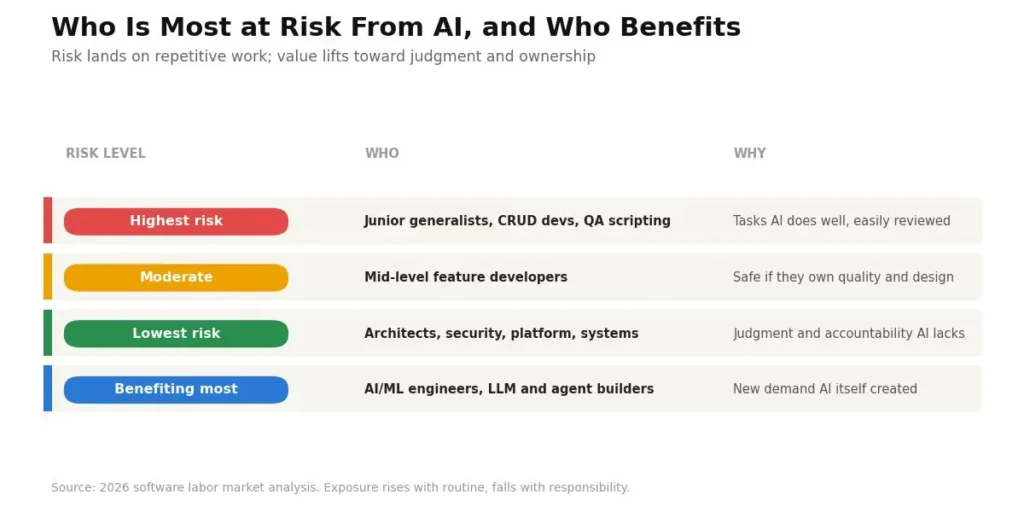
Risk in this shift is not evenly spread, and your specialty matters more than your job title. The pressure lands on repetitive, template-shaped work and lifts off judgment-heavy, ownership-heavy work.
| Highest risk | Junior generalists, CRUD-heavy devs, repetitive QA scripting | Tasks AI does well; easily reviewed |
| Moderate | Mid-level feature developers | Safe if they own quality and design |
| Lowest risk | Architects, security, platform/reliability, distributed-systems | Judgment and accountability AI cannot carry |
| Benefiting most | AI/ML engineers, LLM app builders, agent designers | New demand AI itself created |
The people winning outright are the ones building with AI rather than competing against it. LinkedIn’s 2025 data showed AI skills now appear in about 42% of software job descriptions, up from 8% in 2022.
Multiple pay studies put the salary premium for engineers with real AI skills in the double digits. Specialized language skills also command premiums in 2026, with Rust, Go, Scala, and Erlang all paying meaningfully above market because the talent pool is thin.
When Will AI Actually Replace Software Engineers?
There is no credible date for full replacement, and the honest answer is a range with heavy uncertainty. What we can measure is the trajectory of what AI can do, and where it keeps hitting walls.
The capability curve is steep. On SWE-bench Verified, a benchmark of real open-source issues, leading models now resolve over 70% of problems, up from around 33% a year earlier. METR’s research suggests top models are moving toward handling multi-hour engineering tasks. Gartner predicts that by the end of 2026, 40% of enterprise apps will run task-specific AI agents, up from under 5% in 2025.
But capability on benchmarks is not the same as reliability in production. The other 60% of enterprise apps still need human gatekeeping through review, testing, and release controls.
Gartner also expects AI-related legal claims tied to weak guardrails to rise sharply, which is why regulated industries like finance, healthcare, and aerospace move slowly no matter how good the model gets. Someone has to sign off on the risk, and a model cannot be sued. Here is the contrarian point worth sitting with: even if AI writes 100% of the code someday, that would not eliminate software engineering.
Coding is one slice of the job. Amodei himself admits the human still has to “specify what you’re doing, what the overall app is, what the design decisions are, and whether the design is secure.” Turning ambiguous business reality into correct system behavior is the actual profession. The typing was never the point.
Should You Still Become a Software Engineer in 2026?
Yes, but the entry strategy matters far more than it used to. Mid-career computer science pay still lands around $120,000, and the median software developer salary is $133,080 per year, according to BLS. The upside is intact.
The launch friction is what changed. If you are choosing this path now, be clear-eyed about who it rewards. It rewards people who ship real projects, specialize early, and treat AI as a power tool.
It punishes people who expect a generic degree plus a coding bootcamp certificate to hand them a $120,000 job, because that era is over.
What Mistakes Should New Developers Avoid?
Several common pitfalls sink people trying to break in right now, and each one traces back to a wrong assumption about how the market changed.
- Assuming a degree alone is enough. It is not, because companies now post junior roles and fill them with experienced hires. Build public proof: shipped projects, open-source contributions, real deployments. Evidence beats credentials in a saturated market.
- Spray-and-pray applications. Sending 200 identical applications into a black box fails because the queue is flooded. One warm conversation with an actual hiring manager beats a hundred cold submissions.
- Refusing to use AI tools. Some purists avoid AI on principle and fall behind. The market wants engineers who direct agents fluently, not ones who ignore them.
- Learning only to prompt, not to review. Prompting is the easy half. The valuable skill is catching the subtle logic error, the missing edge case, the insecure default the AI slipped in. Read code critically, or you add no value to the machine.
- Ignoring specialization. Generalists get squeezed hardest. Depth in security, ML, infrastructure, or a specific domain moves you off the exposed rung.
How Should Software Engineers Future-Proof Their Careers?
Your best move depends entirely on where you are in your career, so match the play to the stage.
Students and career switchers should build evidence, not just knowledge. Turn class assignments into public case studies. Contribute to open source. Ship something real that an employer can inspect. Chase an internship hard, because in 2026 “no internship” reads as a credibility gap, not a small one.
Junior engineers should learn to work with agents, not just assistants. That means scoping AI tasks, managing context across a session, and reviewing AI-generated diffs with suspicion. The junior of 2026 is expected to bring system-design awareness that was mid-level knowledge in 2020.
Mid-level engineers should invest in the judgment layer: system design, security, debugging, code review, architectural thinking. These skills rose in value as AI absorbed implementation. This is where you become hard to replace.
Senior engineers are the least exposed group in the profession, and they gain leverage as AI accelerates the teams under them. The move here is to build AI-powered systems, not just supervise them: LLM APIs, retrieval, evaluation, guardrails, and agentic patterns.
Pro Tip worth stealing: Pick one domain and go deep instead of collecting shallow AI certificates. A developer who deeply understands healthcare compliance, payments, industrial control systems, and AI tooling is far harder to replace than someone with 10 generic AI course badges. Depth is the moat AI cannot cross.
Skills that compound across every stage:
| AI-assisted dev fluency | Directing and reviewing agents is the new baseline |
| System design | AI cannot own architecture trade-offs |
| Security engineering | 45% of AI code fails security tests |
| Distributed debugging | Highest-value work AI cannot do alone |
| LLM app building | Where net-new demand is created |
Here is a realistic example of that transition in practice, from a real pattern I have watched play out:
Workflow Example: A Junior Developer Upskilling in 2026
- Input: A CS grad with a degree, basic Python and React, no internship, sending 150 applications with no replies.
- Process: They stop cold-applying. They build a small AI-powered app end to end (an LLM feature with retrieval and guardrails), ship it publicly, write up the architecture decisions, and contribute two fixes to an open-source repo they use. Then they message engineering managers directly, referencing the specific project.
- Output: A portfolio that demonstrates AI-tool fluency plus system thinking, and a handful of warm conversations instead of a black-box queue.
- Result: Interviews that focus on the shipped work rather than the crowded resume pile. The bar was higher, but the proof cleared it.
That is the whole game in 2026. The rungs at the bottom of the ladder got sanded down, so you climb in with evidence the old path never required.
What Do People Get Wrong About AI Replacing Engineers?
Most of the panic comes from oversimplifications that fall apart under real data. Clearing these up matters, because acting on a myth costs you either a career move or years of misplaced worry.
Myth: AI writes 90% of code, so 90% of engineers are gone.
These are unrelated numbers. Even where AI drafts most of the lines, someone still specifies, reviews, secures, and ships.
Productivity rose 20% to 45% in the best studies, not headcount dropping 90%. More code written by AI has not translated into proportional job loss anywhere.
Myth: If you learn AI prompting, you are safe.
Prompting is the easy, commoditized half. The durable skill is judgment: catching the insecure default, the missing edge case, the wrong data assumption. A prompt anyone can copy protects no one.
Myth: The whole software job market is collapsing.
Only the junior rung tightened. Experienced engineers face roughly 2.8% unemployment, and postings ticked up in early 2026. Averaging junior and senior together produces a number that describes neither.
Myth: AI makes every developer faster.
Not on complex work. The METR trial found experienced developers were 19% slower with AI on messy, high-context tasks. Speed depends on task fit, not on the presence of the tool.
Myth: A CS degree is worthless now.
Mid-career CS pay still beats most majors, and BLS projects 15% growth. The degree still opens the door. What changed is that the door now also asks for proof of shipped work.
The pattern across all five myths is the same: a real trend gets stretched into a total conclusion. AI is genuinely reshaping the work. It is not genuinely deleting the profession.
Hold both facts at once, and you will make better decisions than either camp shouting past each other online.
Frequently Asked Questions
No. BLS projects that software developer employment will grow by 15% from 2024 to 2034. AI will keep absorbing routine coding tasks and reshaping the role, but system design, security, and accountability keep humans essential well past 2030.
Yes, but reading and reasoning about code now matters more than writing it from scratch. Most of your interaction with a codebase becomes review, not authorship. You cannot catch an AI’s subtle bug without strong code literacy.
Architects, security engineers, platform and reliability engineers, and distributed-systems specialists are safest. AI/ML and LLM application engineers are in high demand. The most exposed roles are junior generalists doing repetitive, template-shaped implementation work.
Because demand sits at mid and senior levels while entry-level hiring dropped 30% to 40% since 2022. AI absorbs the easy junior tasks, and laid-off seniors compete for the same openings. Experienced engineers still see strong demand.
No. Senior engineers are the least replaceable part of the profession. Their work is system design, architecture, debugging, and cross-team judgment, exactly where AI is weakest. As AI accelerates their teams, their leverage grows rather than shrinks.
This article reflects verified data available as of mid-2026, drawn from the U.S. Bureau of Labor Statistics, the Stack Overflow 2025 Developer Survey, the Federal Reserve Bank of New York, METR, Veracode, Gartner, and reporting from CNN, Fortune, and IT Pro. Job market conditions and AI capabilities are changing quickly, so treat forward-looking figures as projections rather than certainties.

Is an SEO Specialist and AI Tools Researcher with over 4 years of hands-on experience in search engine optimization. As the founder of Smart AI Helper Pro, he tests and reviews AI writing, SEO, and marketing tools to help creators and business owners grow faster with practical, research-backed strategies.