
How Accurate is Ahrefs Keyword Research in 2026?
By SM Mehedi Hasan
Ahrefs keyword research in 2026 is highly accurate for directional trends but rarely provides exact search volumes.
Its strength lies in Traffic Potential and clickstream data, which better account for AI-driven SERP features and zero-click searches than raw Google Keyword Planner metrics.
Search engine optimization looks drastically different today than it did even a few years ago. AI agents now summarize answers before users even scroll, and automated workflows are pumping out content faster than ever.
But here’s the thing. Having more content online does not automatically make ranking easier. It just creates more noise.
Most people assume SEO tools provide exact, scientific search data, but in fact, every platform uses estimates and models. Ahrefs is no exception.
Still, it remains one of the most trusted platforms for shaping content strategies, planning site architecture, and prioritizing SEO campaigns.
So, how accurate is Ahrefs keyword research in 2026? The answer is more nuanced than most marketers think. Some metrics are incredibly useful. Others need manual validation before you trust them with real business decisions.
Table Of Contents
ToggleWhere Does Ahrefs’ Keyword Data Come From?
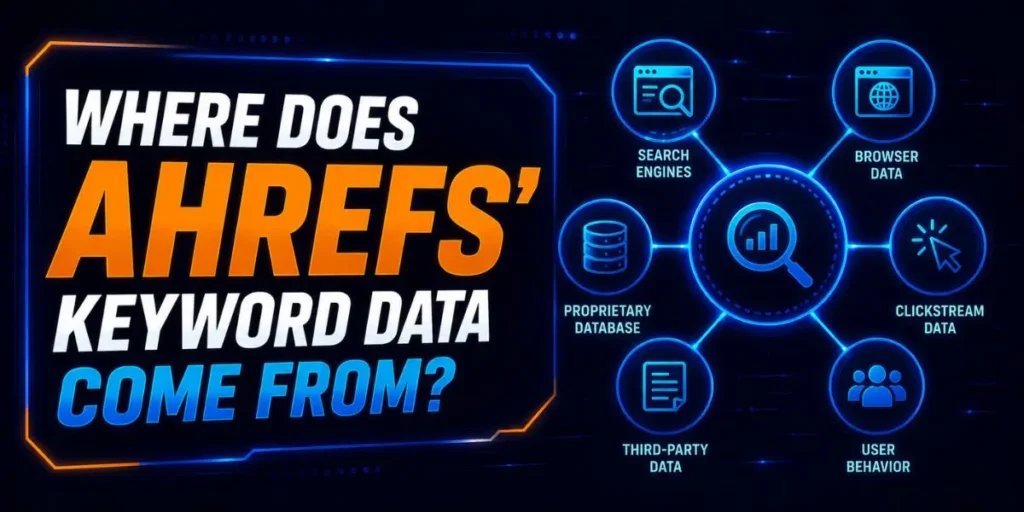
Ahrefs does not pull search volume directly from a hidden Google database. Instead, it builds its keyword index using a combination of its own large-scale web crawler and third-party clickstream data.
Clickstream data is information about the websites and web pages people visit. It comes from browser extensions, plugins, and other software applications that anonymously track users’ online searches and interactions.
Ahrefs aggregates this data to model estimated search demand (how often users search certain keywords) and click activity (which search results users click on) across millions of queries.
Compared to what I’ve tried before, this hybrid system is one of the main reasons Ahrefs uncovers keywords that never appear clearly inside Google Keyword Planner.
It can also estimate click-through behavior and expose zero-volume queries that traditional tools completely miss.
This works well, except when the underlying clickstream sample becomes limited.
Mobile-heavy search behavior can create blind spots because mobile users are less likely to run browser extensions that feed this type of data collection.
In My Experience: Sourcing Data
Honestly, when I first tried to rely solely on Ahrefs to forecast a client’s quarterly traffic, I completely misread the opportunity.
I was building a content cluster for a B2B SaaS company and assumed the clickstream models would fully capture enterprise-level software searches. On paper, several high-intent keywords looked dead.
What I didn’t expect was that many enterprise buyers were searching from locked-down corporate environments where browser tracking extensions were blocked entirely.
Ahrefs showed almost no search demand for terms that later produced dozens of qualified demo requests.
Since then, I have always cross-checked niche enterprise topics with actual sales conversations and Search Console data rather than relying solely on keyword volume.
What Are Ahrefs’ Core Metrics?
Before you can evaluate accuracy, you need to understand what Ahrefs is actually measuring.
Search Volume: An estimated calculation of how many times users search for a keyword each month within a specific country.
Keyword Difficulty (often abbreviated as KD): A score from 0 to 100 that estimates how hard it is to rank for a specific keyword.
This score is based mostly on the strength of backlink profiles—meaning, the number and quality of other websites linking to the current top-ranking pages for that keyword.
Traffic Potential: An estimate of the total organic traffic earned by the top-ranking page from all related keywords, not just the single keyword you entered.
If you’re doing keyword research seriously, this distinction matters because these metrics solve completely different problems.
Search volume measures popularity. KD estimates competition. Traffic Potential measures upside.
And honestly, most beginners obsess over the wrong one first.
How Accurate is Ahrefs Search Volume?
The idea of perfectly accurate search volume has always been misleading. Even Google Keyword Planner relies on grouped estimates and broad ranges instead of exact numbers.
Most people assume Google’s numbers are the gold standard, but actually, Google intentionally bundles related keyword variations together. That grouping inflates broad keyword estimates and hides search intent differences.
Ahrefs tries to reverse-engineer that grouping using clickstream modeling and semantic analysis. As a result, its numbers often look very different from those in Google Search Console or the Keyword Planner.
Broad consumer keywords usually perform fairly well inside Ahrefs because there is enough search behavior data available to model trends accurately.
But highly technical, fast-moving, or niche topics often lag behind real-world demand.
So rather than treating search volume like a guarantee, think of it as directional guidance. Bigger numbers generally mean more opportunity. Smaller numbers usually mean narrower demand. But exact precision? Rarely.
Workflow Example: Using Volume for Direction
Here is exactly how I use search volume data without becoming obsessed with perfect numbers.
- Export a list of bottom-of-funnel keywords with search volumes between 10 and 100 from Ahrefs.
This matters because highly specific commercial terms often convert better than broad informational ones. - Group related keywords into semantic clusters, which are groups of keywords with similar meaning or intent, using a no-code clustering workflow (a method that doesn’t require any programming skills) or spreadsheet logic (built-in spreadsheet formulas and functions).
The goal is to identify overlapping intent, meaning the common purpose or interest behind different keywords, rather than treating each keyword separately. - Prioritize clusters with the strongest combined Traffic Potential. After grouping them, you should start seeing which themes have broader ranking opportunities beyond the visible volume numbers.
- Build a single comprehensive content asset covering the full cluster rather than publishing fragmented articles. Usually, this results in significantly higher traffic than the original keyword estimates suggested.
When I was doing this for a SaaS onboarding guide recently, several keywords showed volumes under 20 individually.
Together, the cluster now pulls hundreds of visits every month because the page ranks for dozens of connected variations that Ahrefs could not fully predict upfront.
Is Keyword Difficulty (KD) Actually Reliable?
Ahrefs calculates Keyword Difficulty mostly by analyzing backlink profiles pointing to the current top 10 ranking pages.
That makes KD mathematically useful. But also limited.
A high KD score does not automatically mean a keyword is impossible to rank for. And a low KD score does not guarantee easy rankings either.
I noticed this constantly when auditing search results manually. Some SERPs are dominated by giant domains with weak, outdated content. Others have low KD scores but extremely strong topical authority that is difficult to displace.
This is where many beginners get trapped. They rely solely on KD, without reviewing the actual Google rankings of the pages.
If you’re evaluating keyword opportunities properly, you should always check:
- Content quality
- Search intent alignment
- Freshness of the ranking pages
- Internal linking structures
- Domain authority gaps
- SERP features like AI Overviews or featured snippets
KD is a filtering tool. Not a final decision-maker.
In My Experience: Battling High KD
The thing that surprised me most was ranking a brand-new finance blog for a KD 72 keyword in under three months.
Every SEO platform basically screamed at me to avoid it. The SERP was packed with major financial institutions carrying enormous backlink profiles.
But when I manually reviewed the results, none of those pages directly answered the user’s actual tax question. They were broad, generic articles trying to rank for everything at once.
So I built a narrowly focused page targeting the exact scenario users were searching for. Then I internally linked it from supporting glossary pages and related financial guides.
And honestly, that specificity mattered more than the KD score itself. The page captured the featured snippet because it solved the problem more quickly and directly than the established competitors.
Why You Should Focus on Traffic Potential
Traffic Potential is arguably Ahrefs’ most valuable metric in 2026.
Pure search volume tells you how often a phrase gets typed into Google. Traffic Potential estimates how much traffic the winning page actually receives across all related keyword variations.
That difference matters more than ever because modern search results are fragmented by:
- AI Overviews
- Featured snippets
- Related searches
- Semantic matching
- Zero-click SERP features
A single well-optimized page can rank for hundreds of long-tail variations simultaneously. Traffic Potential captures that broader opportunity far better than raw keyword volume alone.
How to Identify High-Value Topics
- Filter by low volume: Set your Ahrefs Keywords Explorer filter to a maximum search volume of 50. This matters because highly specific keywords often appear in low-volume niches that larger publishers don’t cover.
After applying the filter, you should start seeing niche phrases with clearer intent instead of broad vanity keywords. - Filter by high Traffic Potential: Set the minimum Traffic Potential to 500. The goal here is to uncover pages that rank for dozens, or even hundreds, of related searches, not just a single isolated term.
Once you apply this filter, the list usually becomes much more commercially useful. - Analyze the SERP: Open the top-ranking page and review what secondary keywords it ranks for. This helps you understand why Google favors that page in the first place.
You should begin spotting recurring subtopics, semantic variations, and hidden user questions driving additional traffic. - Target the broader intent: build your outline around the primary keyword and related variations. If done correctly, your page should feel more complete than the current results, rather than being narrowly optimized for a single phrase.
In My Experience: Finding High-Value Topics
Compared to similar tools I’ve used, Ahrefs’ Traffic Potential completely changes how you evaluate content opportunities.
I was doing keyword research for a cybersecurity company and found an extremely technical keyword showing only 20 monthly searches. Naturally, the client wanted to ignore it because the number looked too small to matter.
But here’s the thing. Ahrefs estimated a Traffic Potential of 1,200 for the top-ranking page. When I dug deeper, I realized that a single article was ranking for over 140 semantic variations of the same technical problem.
So we built a deeply focused guide around the broader intent instead of the exact keyword alone.
Within months, that article became the client’s highest-performing lead-generation asset of the year. Small search volume. Massive business value.
What Other Factors Influence Keyword Accuracy?
Metrics never exist in isolation. Your ability to get value from Ahrefs depends heavily on whether you understand how modern search results actually behave.
Most people assume low KD plus high volume automatically equals a winning keyword, but actually, user intent controls everything.
If someone searches for a login page, pricing dashboard, or branded tool comparison, Google expects navigational or transactional content.
Publishing a generic informational blog post for that type of keyword usually fails immediately.
Ahrefs gives you a snapshot of the SERP in the SERP Overview, which is helpful. But you still need to manually inspect the results page yourself.
And honestly, AI Overviews have complicated this even more in 2026. Some keywords still show high search demand but generate very few organic clicks because Google’s AI answers the query directly in the SERP.
So search volume alone no longer tells the full story. You also have to evaluate:
- Whether AI summaries dominate the query
- If featured snippets absorb clicks
- Whether users need a tool, template, or calculator
- How transactional the search behavior actually is
If you’re ignoring those signals, keyword data becomes misleading very quickly.
Common Keyword Research Pitfalls
Beginners misuse SEO metrics constantly. Usually not because the tools are bad, but because the numbers get interpreted too literally.
Chasing exact volume
Search volume is not guaranteed traffic. It is simply a relative popularity estimate.
If Keyword A shows 1,000 searches and Keyword B shows 100, that only tells you the first keyword is searched more often. It does not mean you will automatically receive 1,000 visitors by ranking for it.
I noticed this becomes especially dangerous when people forecast revenue directly from keyword volume spreadsheets. Actual click-through behavior can vary wildly depending on SERP features and search intent.
Trusting the “Hidden Gem” myth
Finding a KD 0 keyword with 5,000 monthly searches usually sounds too good to be true because… honestly, it often is.
Sometimes, Ahrefs simply has outdated SERP data. Other times, the keyword has fractured intent, making ranking unstable.
Before trusting an unusually easy keyword, manually refresh the SERP data and review the live results yourself. That extra check prevents a lot of wasted content production.
Ignoring zero-volume terms
This is where many experienced SEOs quietly outperform beginners.
Ahrefs’ clickstream modeling struggles with extremely niche or newly emerging searches. Some transactional keywords show zero volume despite having genuine commercial intent.
When I was building content for a SaaS onboarding workflow recently, several “zero-volume” support queries ended up driving qualified conversions because users searching them were already deep into the buying journey.
So if your audience genuinely asks the question, the content can still be worth publishing.
Pro Tip: Try using Ahrefs’ “Include” filter with modifiers like “template,” “calculator,” or “checklist.”
These terms often uncover highly actionable keywords that naturally attract backlinks and engagement without requiring massive search volume.
The Final Verdict on Ahrefs Accuracy
Ahrefs works best as a strategic compass, not an exact prediction engine.
If you obsess over precise search volume numbers or treat KD like an absolute ranking law, you will miss a lot of valuable opportunities hiding underneath broader intent patterns.
The smartest SEO workflows in 2026 use Ahrefs to:
- Understand topical demand
- Discover semantic relationships
- Evaluate SERP competitiveness
- Prioritize Traffic Potential
- Find scalable content gaps.
But here’s the important part. Real success still depends on validating everything against actual search intent and first-party performance data from Google Search Console.
Ahrefs points you in the right direction. Your own testing confirms what actually works.
Frequently Asked Questions
Yes, Ahrefs combines both desktop and mobile search data. However, its clickstream collection has traditionally been stronger on desktop environments, so certain mobile-heavy queries may appear slightly lower than their true demand.
Google Keyword Planner groups semantic keyword variations together and rounds the numbers into broader ranges. Ahrefs attempts to separate those phrases using clickstream modeling, which usually produces more granular estimates for individual searches.
Ahrefs updates high-volume keywords very frequently, sometimes daily. Smaller or highly niche keywords refresh less often, so obscure terms may take weeks for new trends to accurately appear in the database.
Absolutely. Zero-volume keywords are often simply too niche or too new for clickstream models to detect reliably. If your audience genuinely searches for the topic or your customers repeatedly ask the question, the content can still generate meaningful traffic and conversions.

Is an SEO Specialist and AI Tools Researcher with over 4 years of hands-on experience in search engine optimization. As the founder of Smart AI Helper Pro, he tests and reviews AI writing, SEO, and marketing tools to help creators and business owners grow faster with practical, research-backed strategies.