
How Does Ahrefs DR Compare to DA? (Domain Rating vs Domain Authority in 2026)
By SM Mehedi Hasan
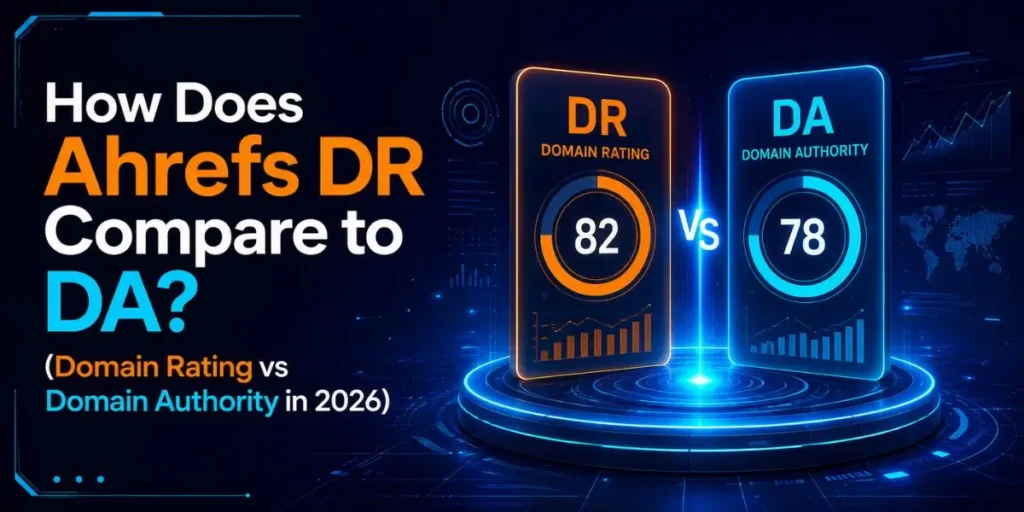
Ahrefs DR (Domain Rating) measures only the strength of your backlink profile and updates within minutes, while Moz DA (Domain Authority) is a machine-learning prediction of how likely a site is to rank in Google and updates roughly once a month. Both run 0 to 100, but a DR 50 is not the same as a DA 50.
If you have spent any time checking websites, you have seen both numbers thrown around like they mean the same thing. They do not.
Ahrefs DR and Moz DA both sit on a 0 to 100 scale, both call themselves “authority,” and both are used to judge a domain in seconds. But the way they are built, what they ignore, and how fast they move are completely different.
Getting this wrong leads to bad link-buying decisions and a lot of confusion when one tool says you are strong and the other says you are average.
This guide breaks down the real difference, why the same site shows two different scores, and which metric actually deserves your attention in 2026.
Table Of Contents
ToggleWhat Is Ahrefs DR and Moz DA?
Domain Rating (DR) is Ahrefs’ metric for a website’s backlink profile strength. Domain Authority (DA) is Moz’s metric that predicts how likely a domain is to appear in Google search results.
That one-line difference is the whole story in miniature. DR asks a narrow question: how strong does this site’s link profile look? DA asks a broader one: how likely is this site to rank overall?
Neither score comes from Google. Google has repeatedly said it does not use any third-party “site authority” number to rank pages. So treat both DR and DA as educated estimates developed by SEO companies, not as ranking factors.
How Does Ahrefs DR Compare to DA?
Here is the side-by-side that actually matters. I kept it tight so it reads fine on a phone.
| Metric Feature | Metric Type A | Metric Type B |
|---|---|---|
| What it measures | Backlink profile strength only | Overall ranking potential |
| Main inputs | Referring domains, link authority | 40+ link signals via machine learning |
| Update speed | Minutes to hours | Roughly monthly |
| Includes traffic/spam? | No | Spam signals yes, traffic no |
| Scale | 0 to 100, logarithmic | 1 to 100, logarithmic |
| Best for | Link prospecting, link tracking | Long-term, relative comparisons |
| Google ranking factor? | No | No |
Most people assume the two scores should roughly agree. In practice, they often do not, and that gap is the single most misunderstood thing about these metrics.
DR is a pure link-graph score. It deliberately leaves out traffic, domain age, content quality, and technical health.
DA tries to model the bigger picture using a machine-learning model that predicts how often Google uses a domain in its results.
In My Experience
Honestly, when I first started checking guest post sites, I trusted DR alone because it moved fast and felt “live.” Then I noticed something.
A few sites with a healthy DR 55 were pulling almost no organic traffic, while a boring-looking DA 38 site was ranking for hundreds of buyer-intent keywords.
That was the moment DR stopped being my only filter. Now I read DR as “how loud are the links” and DA as “does Google seem to trust this place,” and together they tell a far more honest story than either alone.
How Is Each Score Actually Calculated?
Both scores live on a logarithmic 0 to 100 scale, which means climbing from 20 to 30 is far easier than dragging yourself from 70 to 80. After that, the math diverges hard.
How Ahrefs Calculates DR
DR is driven almost entirely by three things:
- Unique referring domains. Ten links from one site count the same as one link. Only the first link from each root domain matters.
- The authority of those linking domains. A single link from a DR 80 site outweighs dozens from DR 10 sites.
- How many sites do those domains link out to? A page linking to thousands of sites passes thinner equity to each one.
So the path to a higher DR is not “more links.” It is a unique, strong domain pointing at you with relatively few outbound links of its own.
To show how brutal the top end is: Ahrefs’ own CMO, Tim Soulo, shared that only about 0.007% of all domains in Ahrefs’ database have a DR of 80 or higher, which works out to roughly 15,000 domains out of more than 207 million.
That is why a DR 75 site is rare air, not a normal target.
Pro tip: Chasing nofollow links to pump DR is mostly wasted effort, since DR is built around followed links from unique domains. Spend that energy earning one link from ten different relevant sites instead of ten links from one.
How Moz Calculates DA
DA works differently. Since the Domain Authority 2.0 update in early 2019, Moz has fed dozens of link-related signals into a machine-learning model and asked it one question: how likely is this domain to appear in Google’s results?
The model includes linking root domains, total links, link quality, and spam signals, then fits itself against real Google rankings. Because it is a prediction trained on the live web, your DA is relative to everyone else’s.
And here is the part that trips people up. Your DA can drop even if you did nothing wrong.
If competing sites improve their profiles faster than you, the model rescales, and your number can slide. It is a leaderboard, not a personal score.
Why Do DR and DA Show Different Numbers for the Same Site?
Because they are built on different crawlers, different link indexes, and different goals. There is no conversion formula between them, and there never will be.
Picture a small affiliate site. Suppose it has a tight cluster of strong, relevant backlinks but thin content and almost no rankings yet. Ahrefs might score it DR 48 because the links look strong.
Moz might score it DA 22 because the model doesn’t yet see it ranking well in Google. Same site, two truths, both technically correct for what each tool is measuring.
This is exactly why the rule is: compare DR to DR, and DA to DA. Comparing a DR 50 against a DA 50 is meaningless. They are different currencies.
In My Experience
The thing that surprised me most was how differently the two react to a single big link. After a client landed a feature on a high-authority news site, their DR ticked up within a day or two.
The DA? It sat frozen for almost a full month before it moved. If I had only watched DA, I would have wrongly assumed the link did nothing.
Watching both taught me to judge link wins on DR speed and trust DA only for slow, big-picture trends.
Which Metric Should You Actually Use?
Short answer: Use both, but match the metric to the decision you are making. Here is the cleanest way to decide.
| Use Case / Goal | Recommended Metric Tool |
|---|---|
| Tracking link-building progress | Ahrefs DR |
| Vetting a guest post or link target | Check both |
| Estimating long-term ranking strength | Moz DA |
| Comparing yourself to direct competitors | Moz DA |
| Spotting fast link spikes or drops | Ahrefs DR |
If you are doing link prospecting, DR is the cleaner input because it answers the narrow link question directly and fast.
If you are sizing up whether a niche is winnable over the next year, DA’s broader model tends to age better.
So the smart move is not picking a winner. It is reading them as two different sensors on the same engine.
Do DR and DA Still Matter in the Age of AI Overviews?

Yes, but their job is shrinking, and this is where most articles stop short. In 2026, a growing slice of search happens inside AI Overviews, chatbots, and generative answers that do not always show ten blue links at all.
In that world, getting cited as a source inside an AI answer can matter as much as a traditional backlink. Neither DR nor DA was designed to measure “how citable is this brand to a language model.”
So a site can have a modest DR and still get pulled into AI summaries because it is a clear, trusted entity on a topic.
Here is the non-obvious takeaway most competing guides miss. DR and DA are increasingly useful for relative health checks and almost useless for predicting AI visibility.
If your whole strategy is “raise the number,” you are optimizing for a scoreboard that AI search barely reads.
Worth knowing: Both metrics have been shown in industry tests to explain only a small slice of actual ranking variance, and some experiments suggest a score can be artificially inflated cheaply with manipulated links.
Treat a stranger’s high DR or DA with healthy suspicion until you check the real traffic and link quality behind it.
Common Pitfalls to Avoid
These are the mistakes I see beginners make over and over, and why they happen.
- Comparing DR to DA directly. They use different indices, so the numbers are not interchangeable. Always compare like with like.
- Treating either as a Google ranking factor. Neither one feeds Google’s algorithm. Chasing the score instead of traffic is the classic trap.
- Panicking when DA drops. DA is relative, so it can fall when others rise. Check your actual rankings before assuming you got penalized.
- Buying links to inflate DR. A high DR with junk links and zero traffic is a red flag, not a win, and it can collapse when toxic links get discounted.
- Ignoring traffic entirely. A DR 60 site with no organic visitors is often worse for a backlink than a DR 30 site that actually ranks.
The root cause behind most of these is the same: people read a single number and stop thinking. The fix is to always pair the score with real traffic and link quality data.
A Real Workflow Example: Vetting a Guest Post Site
Let me walk through how this plays out end to end, the way I actually do it.
- Input. A site offers you a guest post. They brag about DR 58. That is the only number on the table so far.
- Process, step one. Pull the site in Ahrefs and confirm the DR is real, not faked by spammy links. Look at referring domains and how natural the link profile looks. This matters because a bought DR collapses the moment those links get discounted.
- Process, step two. Now check Moz DA for the same domain. Say it comes back DA 19. That gap between DR 58 and DA 19 is a warning sign that the links look strong, but Google may not actually trust the site much.
- Process, step three. Open the organic traffic graph. If a “DR 58” site pulls only 80 visits a month, the authority is on paper, not in reality.
- Output. You now have three data points instead of one: link strength (DR), ranking trust (DA), and proof of life (traffic).
- Result. You decline the weak site and reinvest in a DR 40 site that has steady traffic and a matching DA. Slower bragging rights, far better link.
That full flow takes about five minutes and saves you from links that look good in a screenshot and do nothing for rankings.
Final Take
DR and DA are not rivals; there is no winner between them. There are two lenses. DR shows you raw link strength in near real time.
DA gives you a slower, broader read on ranking trust. Use DR to move fast on link work, use DA for long-range judgment, and never let either number replace the one thing that actually pays the bills: real organic traffic.
Frequently Asked Questions
Neither is “more accurate,” they measure different things. DR is more accurate for raw backlink strength. DA is better for predicting overall ranking potential. Use both for the full picture.
No. They come from different tools, indices, and formulas, so the numbers are not interchangeable. Always compare DR to DR and DA to DA, never across the two.
No. Google has confirmed it does not use any third-party authority score. Both are independent estimates built by Ahrefs and Moz to model link strength and ranking likelihood.
DA is a relative score. If competing sites strengthen their profiles faster than yours, Moz rescales, and your number can slip even when your own SEO is unchanged.

Is an SEO Specialist and AI Tools Researcher with over 4 years of hands-on experience in search engine optimization. As the founder of Smart AI Helper Pro, he tests and reviews AI writing, SEO, and marketing tools to help creators and business owners grow faster with practical, research-backed strategies.