How Does Character AI Make Money? (2026 Breakdown)
By SM Mehedi Hasan
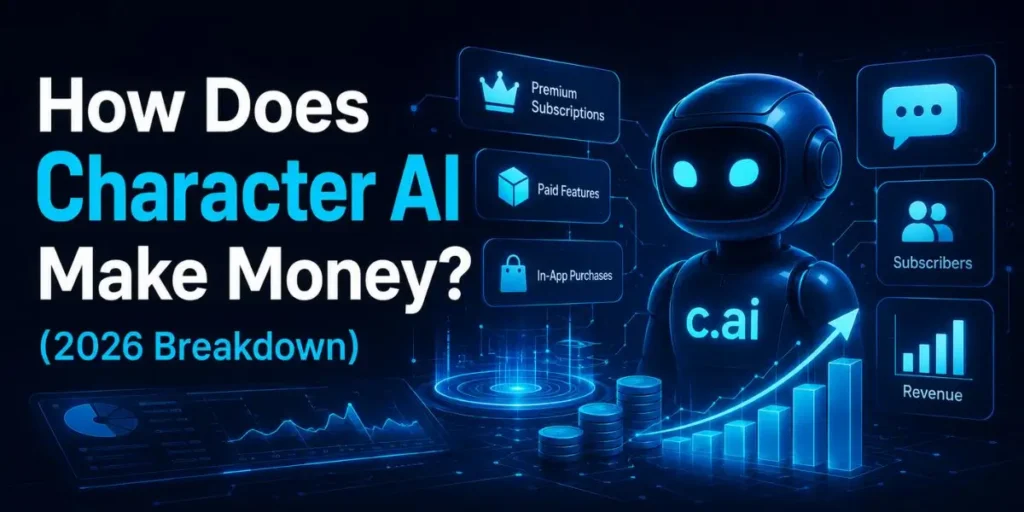
Character AI makes money mainly through its $9.99/month c.ai+ subscription, plus newer advertising in its social feed (brands like Yelp and Webtoon) and in-app microtransactions. A landmark $2.7 billion Google licensing deal in 2024 reshaped its finances, yet fewer than 2% of free users actually pay.
Table Of Contents
ToggleHow does Character AI make money? (The short answer)
Character AI earns revenue from Five sources: subscriptions, advertising, microtransactions, and a one-time technology licensing deal with Google. No single one carries the company.
They work as a layered system because a chat platform with tens of millions of users costs a fortune to run, and most of those users never pay a cent.
Here is the part most people skip over. Character AI is not a typical software business where each new user adds to profits. Every message a free user sends costs real computing resources, so the platform has to find ways to make the free user base worth something without charging them directly. That single tension explains every monetization choice it has made.
What Are Character AI’s main revenue streams?
Character AI runs five practical money sources in 2026, ranked roughly by how much they actually contribute today.
| Revenue stream | What it is | Maturity in 2026 |
|---|---|---|
| c.ai+ subscription | $9.99/month premium tier | Core, most reliable |
| Social-feed advertising | Brand ads in the Feed | Growing |
| Microtransactions | Small in-app payments | Fastest-growing |
| Google licensing deal | $2.7B one-time cash + tech share | One-off, huge impact |
| Enterprise / future paths | API, B2B, creator tools | Early/experimental |
How much does c.ai+ cost, and what do you get?
c.ai+ costs $9.99 per month and gives you faster replies, priority access during server busy periods, and early access to new features. It launched back in May 2023 and remains the most dependable slice of Character AI’s income. Subscribers also get extras like voice calls and group chat rooms ahead of free users.
But subscriptions alone were never going to be enough. When fewer than 2 in 100 free users upgrade, even at a $9.99 price point for a 20-million-user base, there’s a gap between revenue and server costs. So the company treats c.ai+ as a steady floor, not the whole house.
How does advertising work without ruining the chat?
Advertising on Character AI mostly lives in the social Feed, not in your active conversation. The platform began selling Feed placements in 2024, and real brands like Yelp and Webtoon have run ads there.
The logic is simple: roleplay users fiercely guard their immersion, so an ad dropped mid-conversation would break the one thing that keeps them coming back. Compared to the cleaner, ad-free experience early users remember, this shift felt jarring to the community. And the company knows it.
By keeping ads on discovery surfaces and in the moments between bots rather than in the chat itself, it aims to generate ad revenue while nudging frustrated users toward the paid, ad-free tier.
Pro tip: If ads in the Feed bother you, the cheapest fix is not a third-party tool or a workaround. It is simply c.ai+, which the platform deliberately positions as the “remove the friction” upgrade. That positioning is the whole point of the ad strategy.
What are microtransactions on Character AI?
Microtransactions are small, optional payments for specific in-app actions rather than a full subscription commitment. Think of paying to unlock a premium interaction, regenerate a response, or access certain voice and image features. This is the fastest-growing part of the model in 2026, and it borrows directly from gaming.
The psychology here is worth pausing on. Most people resent a paywall that locks them out, but they tolerate a menu of small upgrades that feel optional. So instead of asking casual users to commit $9.99 a month, the platform lets them spend a little, occasionally, on the moments they care about.
That converts the huge middle group who would never subscribe but might drop a dollar.
Does Character AI license its technology? (the Google deal)
Yes, and this was the single biggest financial event in the company’s history. In August 2024, Google paid Character AI roughly $2.7 billion in cash for a non-exclusive license to its technology, while also rehiring co-founders Noam Shazeer and Daniel De Freitas, along with part of the research team.
The Information confirmed the figure publicly. Here is why it mattered so much. Rather than a full acquisition, which would have triggered a long regulatory review, Google structured it as a licensing arrangement.
That handed Character AI a massive cash cushion and reduced its model and infrastructure pressure, giving it breathing room at a moment when its costs threatened the company’s existence.
How much money does Character AI actually make?
Character AI’s revenue grew from about $15.2 million in 2023 to an estimated $30 million to $50 million in 2025, depending on the source and the calculation method.
Because the company is private, every figure here is a third-party estimate, not an official disclosure.
Sacr estimated the company would hit a $30 million annualized run rate by July 2025 and would reach roughly $50 million by year’s end. BInness of Apps reported about $50 million for 2025, a 66% jump from the prior year.
The numbers differ because “annualized run rate” and “full-year revenue” are not the same thing, and analysts pull from different data vendors. Treat the range as the honest answer, not a single clean number.
Why is a company worth $1 billion making only tens of millions?
This is the part that confuses almost everyone, and no competing guide explains it plainly.
Character AI carried a roughly $1 billion valuation in 2025 while generating around $30 million in run-rate revenue. That is about a 33x revenue multiple, which is steep even by AI standards.
Investors are not paying for current revenue. They are paying for engagement, the user base, and the option value of monetizing all that attention later.
The valuation actually slipped from a 2024 peak near $2.5 billion, mostly because the high cost of running large language models and the dominance of free users made the path to profit look harder than the hype suggested.
Why does a free app need so many revenue streams?
The answer comes down to three uncomfortable numbers: a conversion rate under 2%, an average revenue per user near $0.72, and computing costs that climb with every single message.
Stack those together, and you get a platform that cannot survive on any one income source.
Most users will never pay, which sounds like a problem until you see it from the platform’s side. Those free users generate the content, the engagement, and the ad inventory that make the whole thing valuable.
So the free crowd is not dead weight; it is the raw material. The challenge is squeezing real money out of attention without charging for it directly, and that is exactly why subscriptions, ads, and microtransactions all have to coexist.
So when people ask why a “free” app keeps adding paywalls and ads, the real story is not greed. It is arithmetic.
A 20-million-user base spending an average of around 75 minutes a day is enormous, and enormous usage is enormously expensive to host.
What did the $2.7 billion Google deal actually change?
The Google deal changed who runs Character AI and what kind of product it is trying to be. When Shazeer and De Freitas left for Google in 2024, the monetization roadmap passed to a new leadership team under real pressure to hit revenue targets.
The company is now led by CEO Karandeep Anand, who came from Meta. Under that leadership, the product drifted away from a pure “chat with a character” research tool toward something closer to a social discovery platform, complete with a Feed, native sharing, and sponsored placements.
If you have noticed the app feeling more like a social network lately, that is not your imagination. It is a deliberate pivot toward monetizable engagement.
Two recent developments that most articles have not caught up to are worth noting. In August 2025, reports indicated that the company was weighing options, including a possible sale or a new fundraising round. In June 2026, Noam Shazeer left Google again, this time for OpenAI, underlining how fluid the leadership and talent picture around the company remains.
Worth knowing: The “founders left, then one of them later jumped to OpenAI” arc is not just trivia. It signals that the people who built Character AI’s original product philosophy are no longer steering it, which is the clearest explanation for why the platform now optimizes for revenue in ways early users dislike.
Can you make money on Character AI as a creator?
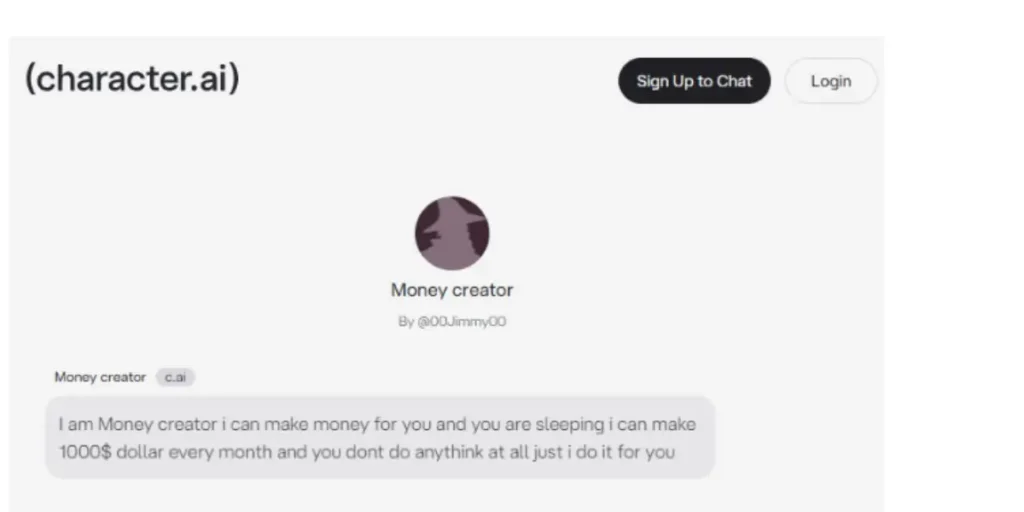
No, Character AI does not currently pay creators or offer a revenue-sharing program, so you cannot directly earn cash from the characters you build.
This is the question hiding inside the main search, and almost every competing article answers it in a single throw. The fuller truth deserves more.
Creators have built more than 18 million characters on the platform, some with hundreds of millions of chats, and none of those creators get paid.
In 2026, there is an internal virtual economy where users can tip or support creators with in-app credits, but there is no “cash out” button that converts popularity into real money in your bank account.
Compare that to how creators actually earn elsewhere, and the gap is obvious:
- On Character AI: recognition, in-app perks, and a large audience, but no direct payout.
- On YouTube or TikTok: ad revenue share and creator funds that pay real money.
- On AI influencer or model platforms: brand deals and licensing where the creator owns the asset.
So if your goal is income, building characters on Character AI is closer to building a popular subreddit than running a monetized channel. The infrastructure hints at a future creator marketplace, but as of now, the platform earns from creators’ work without sharing the upside.
Does Character AI sell your data to make money?
There is no confirmed evidence that Character AI directly sells your personal data, but like most AI platforms, it uses your conversations to improve its models under its privacy policy.
The distinction matters, and it is one most quick answers blur. “Selling data” usually means handing identifiable user information to a third party for cash. That is not what the public record shows here.
What does happen is that conversation data feeds model training and product improvement, which is standard across the industry and disclosed in the terms you agreed to.
The advertising it runs is based on platform attention and context, not on auctioning off your chat logs.
If data privacy is a real concern for you, the practical move is to read the current privacy policy and adjust your data controls, rather than assuming the worst or that nothing will happen. Both extremes miss the actual setup.
How does Character AI compare to Replika, Chai, and Janitor AI?
Character AI is the largest of the major character-chat platforms, but its rivals monetize very differently, especially when it comes to content rules. Here is a clean, verified comparison.
| Platform | Money model | Allows NSFW |
|---|---|---|
| Character AI | Subs + ads + microtransactions | No |
| Replika | Subscription-only | Limited |
| Chai | Token-based, ~15-20% cheaper | Yes |
| Janitor AI | API / referral-based | Yes |
The strategic split is about content policy. Replika reportedly earns roughly $24 to $30 million a year with about 2 million monthly users on a subscription-only model, giving it higher revenue per user but a smaller user base.
Chai and Janitor AI allow more permissive content and aggressively monetize that openness, whereas Character AI refuses to do so.
That refusal is a business decision, not only an ethical one. Mainstream advertisers like Yelp and Webtoon will only run ads on brand-safe inventory, and the Google relationship depends on a clean platform.
A site full of adult content cannot sell standard display advertising, so Character AI trades some immediate revenue for a safer brand position.
In My Experience
Honestly, when I first started paying attention to how this platform monetizes, the thing that struck me was how little the free experience signals. You can chat for hours and barely notice a money model at work, which is the whole design. The cost is invisible to you and crushing to them.
The shift I actually noticed over time was the Feed becoming more central and the ad placements showing up where discovery happens, not inside a roleplay. That lines up exactly with what the company has said publicly about protecting immersion.
And the voice and image features sitting behind a soft paywall felt less like a wall and more like a gentle upsell, which is precisely the microtransaction logic in action. Watching a “free chat app” quietly turn into a layered storefront, without ever feeling like a hard paywall hits you, is the most interesting part of the whole business.
Common pitfalls people get wrong about Character AI’s money
Most of the confusion about Character AI’s revenue stems from a handful of repeated mistakes. Here are the ones worth avoiding, with why each happens and how to think clearly instead.
- Assuming “free” means “no revenue.” People see a free app and conclude it is nothing. The mistake comes from applying normal app logic. In reality, free users generate ad inventory and microtransaction conversions, so the free tier is a revenue engine, just an indirect one.
- Believing subscriptions fund the whole thing. This happens because $9.99 timesBut only 2% subscribe, so subscription revenue covers only a fraction of the computing costs. Revenue covers only a fraction of the computing costs. Why ads and microtransactions exist at all. Figure as gospel. You will see $32 million in one article and $50 million in another. Neither is wrong; they measure different things (run-rate versus full-year) from different data vendors. Quoting one as “the” number is the error.
- Thinking the Google deal was an acquisition. It was a licensing arrangement plus a talent rehire, not a buyout. People conflate the two because the founders left. The structure was deliberate, designed to avoid a long regulatory review.
- Expecting to earn money as a creator. Because other platforms pay creators, users assume Character AI does too. It does not, currently. Building popular characters earns you reach, not revenue.
How the money actually flows: a real example
To make this concrete, here is the full path from a single free user’s session to actual revenue, shown step by step. No competing guide walks through this flow, and it is the clearest way to see the model.
Input: A free user opens the app and starts a long roleplay session, averaging around 75 minutes across the day. They send dozens of messages, each of which consumes computing resources.
The user browses the Feed to discover new characters. Brand ad placements appear in that discovery surface.
The user occasionally encounters a feature gated behind a small payment, such as an extended voice call, and pays a microtransaction. They keep bumping into “priority access” prompts during peak hours.
Output: Across millions of users like this, the platform earns ad revenue from Feed impressions, microtransaction income from the small spenders, and a steady trickle of c.ai + upgrades from the most frustrated or most engaged.
The under-2% who subscribe form the reliable base; everyone else monetizes indirectly.
Result: A single free user who pays nothing directly still produced ad value and possibly a microtransaction, while costing the company the whole time.
Multiply that by tens of millions, layer the one-time Google cash on top, and you get the roughly $30 to $50 million 2025 revenue picture, against costs high enough that the company is still not consistently profitable.
One thing I’d flag: Notice that the user in this flow never felt “charged” in the way a paywall charges you. That is the entire art of the model.
The money is extracted from attention and optional upgrades, so the free experience stays intact enough to keep the attention flowing.
Is Character AI’s business model sustainable?
Character AI’s model is improving but not yet proven sustainable, because revenue growth is real, while consistent profitability is not.
The company is generating tens of millions and growing fast, yet compute and moderation costs keep pace, and the under-2% conversion rate caps how far subscriptions can stretch.
The likely direction for 2026 and beyond points toward microtransactions and native advertising carrying more weight, voice and image features becoming primary paid drivers, and possible business-to-business or enterprise uses of the technology.
The Google infrastructure relationship lowers the cost side of the equation, giving us time to buy.
The genuine risk is the same one that created the model: users who treat immersion as non-negotiable. Push ads or paywalls too hard, and they migrate to lighter alternatives. Push too softly, and the revenue gap stays open.
That balancing act, plus the unsettled leadership and talent picture, is why a “possible sale or fundraising” was reportedly on the table in 2025.
The business is interesting and growing, but its long-term independence is still an open question.
Frequently Asked Questions
Through a $9.99/month c.ai+ subscription, advertising in its social Feed (brands like Yelp and Webtoon), in-app microtransactions, and a one-time $2.7 billion Google licensing deWhile 2025 revenue is estimated at $30 million to $50 million, high computing and moderation costs mean the company is not yet consistently profitable.y is not yet consistently profitable.yet.
No. Character AI does not offer creator payouts or revenue sharing. Building popular characters earns you reach and in-app recognition, but no direct cash.
Like most AI platforms, there is no confirmation. Like most AI platforms, it uses conversation data to improve its models, in accordance with its privacy policy. $1 billion in 2025, down from a 2024 peak near $2.5 billion, reflecting high model costs and a user base that is mostly free.
This guide reflects the best publicly available information as of 2026. Character AI is a private company, so revenue and valuation figures are third-party estimates that may change. This is general information, not financial or investment advice.

Is an SEO Specialist and AI Tools Researcher with over 4 years of hands-on experience in search engine optimization. As the founder of Smart AI Helper Pro, he tests and reviews AI writing, SEO, and marketing tools to help creators and business owners grow faster with practical, research-backed strategies.