
How Long Does It Take Content to Rank? (Ahrefs Data + 2026 Reality)
By SM Mehedi Hasan

Most content takes 3 to 6 months to start ranking, and longer to reach Google’s top 10. Ahrefs data shows only 1.74% of new pages hit the top 10 within a year.
Low-competition keywords can rank in weeks, while competitive terms often need 12 months or more.
Publishing a post and then hitting refresh on your rankings every hour? Most of us have done it.
The honest answer to how long it takes content to rank is less exciting than what a lot of blogs promise, but it is far more useful once you see the actual numbers behind it.
So let’s skip the lazy “it depends” reply. Below is real data from large studies, what it means for your 2026 timeline, and the moves that genuinely speed things up.
Table Of Contents
ToggleHow long does it take content to rank in Google?
Most content takes 3 to 6 months to gain real traction, and highly competitive keywords often need a year or longer. Easy, low-competition terms can break through in a few weeks if your page aligns well with intent.
Here is a realistic breakdown by scenario:
| Keyword / Site Type | Estimated Timeframe |
|---|---|
| Low-competition, long-tail keyword | 2 to 8 weeks |
| Medium-competition keyword | 3 to 6 months |
| High-competition keyword | 6 to 12+ months |
| Brand new site, low authority | Add 3 to 6 months |
But these are ranges, not promises. Your real timeline depends on competition, your site’s authority, content quality, and how closely you match what searchers actually want.
And anyone guaranteeing a top spot in 30 days is selling you something. Rankings shift constantly, so a fixed date is a red flag, not a feature.
What does the Ahrefs ranking study actually say?
Ahrefs studied millions of URLs in 2025 and found that ranking has gotten harder, not easier, since their original 2017 research. The data is blunt about it.
Here are the key findings, paraphrased from their study:
- Only 1.74% of newly published pages reached the top 10 within a year, down from 5.7% back in 2017.
- When the data was filtered to real, non-empty English pages, that figure rose to roughly 6.11%, which is a fairer number to use.
- Of the pages that did break into the top 10, about 41% got there within the first month.
- Around 73% of pages currently sitting in the top 10 are more than 3 years old.
- The average #1 ranking page is now about 5 years old, up from just 2 years in 2017.
Most people assume new content struggles because Google is “slow.” But the real story is competition. The web is older, denser, and harder to crack than it was a few years ago.
How old are the top-ranking pages?
Older content now dominates the first page, and the gap keeps widening. If your strategy is “publish and pray,” the age data alone should change your mind.
| Website Age | Percentage | Trend Status |
|---|---|---|
| Under 1 year old | 13.7% | Down from 22% |
| More than 3 years old | 72.9% | Up from 59% |
So new pages are getting squeezed out of the top results. Ahrefs also noted a clear pattern: the higher a page ranks, the older it tends to be. That is not a coincidence.
It is Google rewarding pages that have proven their value over time through links, updates, and steady engagement.
Indexing vs ranking: are they the same thing?
No. Indexing means Google has found and stored your page in its database. Ranking means Google has decided where to place that page for a specific search.
These two things move at completely different speeds, and confusing them causes a lot of panic.
Here is the practical difference:
- Indexing: usually 24 hours to a few weeks, depending on your site’s authority and crawl frequency.
- Ranking: typically 3 to 12 months for a position that actually sends traffic.
Google’s John Mueller has said that most quality content gets indexed within about a week. So if your page is indexed but invisible, you do not have an indexing problem.
You have a ranking problem, and those are solved very differently.
If you are checking “site:yoursite.com/post” and seeing your URL, relax. Google has it. The waiting game now is about trust and competition, not discovery.
Pro tip: Use Google Search Console’s “URL Inspection” tool to confirm indexing in just a few seconds. If it says indexed but you see zero clicks, stop requesting re-indexing and start improving the content instead.
How long will it take for content to appear in AI Overviews?
There is no fixed timeline, mostly because AI Overviews heavily draw on pages that already rank well. In practice, you usually need a traditional ranking first before you can earn a citation.
And here is where almost every competing article stops short. The data on this is genuinely contradictory, and nobody likes to admit it.
Ahrefs found that roughly 76% of AI Overview citations come from pages already sitting in the top 10. But a separate BrightEdge study suggests up to 80% of AI Mode citations come from URLs ranking outside the top 10.
Both can be true, because AI Overviews and the newer AI Mode are different surfaces with different behavior.
What does that mean for your timeline? Two things:
- For standard AI Overviews, rank first. Citation tends to follow visibility rather than replace it.
- For AI Mode and other answer engines, a strong structure can get you cited even before you crack the top 10.
So the play is not “rank or get cited.” It is a rank and structure for extraction at the same time. Answer the query in your first 150 words, use clean headings, and back claims with real numbers.
That is what makes a page easy for an AI model to lift and quote.
🧠 In My Experience
Honestly, when I first started tracking AI Overview citations, I expected my highest-traffic page to win them automatically.
It did not. A thinner page with a crisp, answer-first paragraph got cited instead, while my “complete guide” got skipped because the answer was buried under 600 words of intro.
That taught me something the studies hint at but rarely spell out. AI models reward extractability, not effort.
After I moved the direct answer to the top of three pages, two of them started showing up in Overviews within a couple of weeks. No new backlinks, no new word count, just structure. The frustrating part is that it is inconsistent.
One page jumped fast, another sat untouched for a month with nearly identical formatting.
How can you rank content faster?
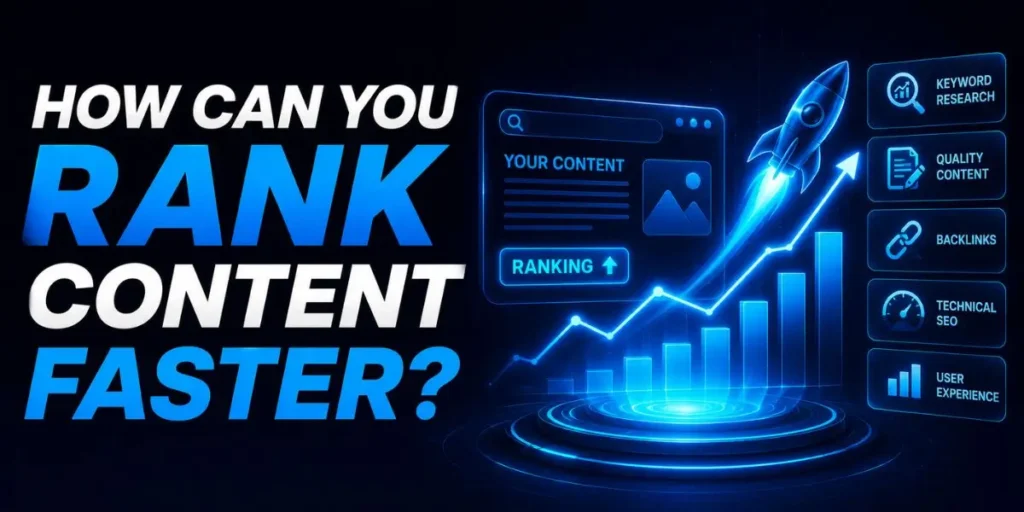
- Target low-competition keywords first. Easy terms rank faster and build the topical authority you need for harder ones later. Pick keywords your site can realistically win, then watch them climb within weeks instead of months.
- Answer the query in your first 100 words. Google and AI models both reward pages that resolve intent quickly. Put the direct answer up top, and you give yourself a shot at featured snippets and AI citations early.
- Match search intent exactly. Look at the current top 10 and notice the format Google is rewarding, whether that is a listicle, a tutorial, or a comparison. Match that format, then beat it on depth, and you remove the biggest reason pages stall.
- Build internal links from your strongest pages. Point links from your existing high-authority posts to the new one. This passes relevance and helps Google find and trust the page faster, which can shave weeks off the climb.
- Update the page at the 6-month mark if it is stuck. Ahrefs found that the chances of breaking into the top 10 drop sharply after about six months. So treat that mark as a refresh deadline, not a failure point. Add new data, tighten the answer, and resubmit.
- Earn a few relevant backlinks. You do not need hundreds. A handful of links from genuinely related sites signals trust, and trust is exactly what separates the 1.74% that rank from the 98% that do not.
Each of these compounds. Skip them, and you are relying purely on time, which the data says is not on your side.
What mistakes slow down content the most?
Beginners lose months to the same handful of errors, and most are completely avoidable once you know them.
- Expecting a straight line up. Rankings bounce. A page might sit at position 35, then vanish, only to reappear at 12. This is Google’s testing phase, not a sign your content failed. Panicking and rewriting too early resets that progress.
- Chasing keywords that are too hard. New sites that target high-competition terms burn months for nothing. Remember, 94% of pages never rank for high-volume keywords. Start small, then climb.
- Never update old content. Stale pages slide. Since the top 10 is dominated by older, maintained content, a page you abandoned after publishing is competing against pages that get refreshed regularly.
- Publishing thin content. Short, surface-level posts rarely earn trust. The fix is not more words for the sake of it. It is covering the question and its follow-ups better than the current top results.
- Ignoring what searchers actually want. Writing a how-to when Google is ranking comparison tables means you will never rank, no matter how good the writing is. Intent beats effort every time.
Pro tip: Before you write a single word, open the top 5 results and note what they all include. The overlap is your minimum requirement. The gap between them is your opportunity to win.
A realistic ranking timeline example
Let’s walk through a real flow to give the theory shape. Say you publish a 1,800-word guide targeting a low-competition keyword on a one-year-old site with modest authority.
- Week 1 (Input): You publish, submit the URL in Search Console, and add two internal links from older posts. Google indexes it within a few days.
- Weeks 2 to 6 (Process): The page appears around position 30 to 50. Impressions are starting to show in Search Console, but clicks are near zero. This is normal. Google is testing your relevance.
- Month 3 (Output): The page settles around position 12 to 18, often on page two. You start getting a trickle of clicks. This is the moment to check which related queries are showing impressions.
- Month 6 (Result): You refresh the page using those query insights, add a section answering a question you missed, and tighten the opening answer. Within a few weeks, the page moves into the top 10 and traffic grows steadily.
That is the realistic path for a winnable keyword. Harder terms stretch every stage. Easier ones compress them. But the shape stays the same: index fast, test slowly, refresh, then climb.
🧠 In My Experience
The thing that surprised me most was how predictable the six-month wall turned out to be. I used to give up on pages stuck on page two, assuming they were lost causes.
Then I started treating month six as a scheduled refresh instead of a deadline I had failed.
On one site, I refreshed five page-two posts in a single afternoon, just updating stats and rewriting the intro to answer the query directly. Three of them moved to page one within a month.
The other two did not budge, which is the part nobody warns you about. Refreshing works often, not always.
Compared to the “wait and hope” approach I used before, scheduled updates gave me far more wins, but it is not a guaranteed switch. Some pages simply need links that the refresh cannot manufacture.
Frequently Asked Questions
Rarely. New pages usually get indexed within a day, but indexing is not the same as ranking. Reaching a useful position almost always takes weeks to months, even for easy keywords.
Usually, it’s a competition or an intent mismatch. Check if the top results use a different format than yours, confirm the keyword is winnable for your site, and refresh the page if it is stuck on page two.
Yes. Refreshing stale pages with new data and a clearer answer often pushes them up, especially around the six-month mark when ranking chances otherwise start to drop.
Generally, 3 to 6 months for easy terms, and 6 to 12 months or more for competitive ones. New sites lack authority, so add a few extra months versus an established domain.
Not for Google. AI Overviews mostly cite pages that already rank in the top 10, so traditional SEO still drives them. Structure your content to be easily quoted and rank first.

Is an SEO Specialist and AI Tools Researcher with over 4 years of hands-on experience in search engine optimization. As the founder of Smart AI Helper Pro, he tests and reviews AI writing, SEO, and marketing tools to help creators and business owners grow faster with practical, research-backed strategies.