Who Owns AI-Generated Content? (Copyright Explained)
By SM Mehedi Hasan
No one owns purely AI-generated content under US law, because copyright requires a human author, and a machine cannot be one. Work created solely by AI is in the public domain, free for anyone to copy. The catch: add real creative editing, and your human contribution becomes protectable.
That single rule decides who owns AI-generated content in almost every situation you will run into in 2026. But the rule has layers, exceptions, and a fresh stack of court rulings that most articles still get wrong.
Let me walk you through exactly where ownership starts, where it stops, and how to protect the work you actually create.
Table Of Contents
ToggleWho Owns AI-Generated Content Under US Law?
You own AI-generated content only to the extent a human shaped it with real creativity, not the prompt alone. The US Copyright Office and the federal courts both treat fully machine-made works as having no copyright owner.
It falls into the public domain the instant it is created. This comes straight from how copyright vests. Under US law, the copyright in an original work belongs to the author the moment the work is fixed in a tangible form (17 U.S.C. §201).
The problem for AI output is the word “author.” Copyright has always assumed a human behind the work, and a generative model does not qualify.
So the ownership question really splits into three smaller ones:
- Can the output be owned by anyone at all?
- If yes, which human owns the protectable parts?
- And separately, did the AI company infringe anyone’s rights to build the tool?
Most guides answer only the first. The interesting answers live in the next two.
What’s the Difference Between Owning and Copyrighting AI Content?
Owning and copyrighting are not the same thing, and mixing them up is the main source of confusion online. You can “own” an AI image in the sense that a platform’s terms let you use and sell it. That is a contract. Copyright is a separate legal right that lets you prevent others from copying it.
Here is the distinction in plain terms:
- Contractual ownership:
The AI tool’s Terms of Service grant you rights to use the output. This is permission from the company, not protection from the law. - Statutory copyright:
A legal monopoly the government grants to human-authored works. This is what lets you sue a copycat.
You can easily have the first without the second. A paid Midjourney user, for example, gets broad rights to sell their images, yet may have no copyright to stop a competitor from lifting the exact same image.
Can You Copyright AI-Generated Content?
No, you cannot copyright content that an AI generated on its own from a prompt. The Copyright Office will refuse registration for work with no meaningful human authorship, and a federal appeals court backed that position.
The reasoning is consistent across every recent decision. In its January 2025 report, Copyright and Artificial Intelligence, Part 2: Copyrightability, the Copyright Office concluded that prompts function as instructions that convey unprotectable ideas.
Typing “a cat in a spacesuit, photorealistic” gives the machine a direction, not the kind of creative control that makes you the author of the result. But there is a real exception, and it matters.
If you take AI output and add human creativity on top, such as editing, arranging, combining, or writing original text around it, those human-made parts can be protected. The AI-made parts still cannot.
Does the AI Company Own the Content You Create?
Generally, no: the AI company does not own your output, though it usually retains a license to it. Most major platforms grant output rights to users through their terms, then reserve a license to use your prompts and results to improve their services.
OpenAI is the clearest example. Its Terms of Use state that, as between you and OpenAI, you own the Output, and OpenAI assigns to you any rights it has in that Output. Sounds airtight.
The hidden gap is that OpenAI can only assign rights that exist, and if the output has no copyright, there is nothing solid to assign.
So you walk away owning something you cannot defend. That gap sits at the center of every ownership debate happening right now.
Who Are the Possible Owners of AI-Generated Content?
Four candidates emerge whenever people argue about AI ownership, and only one ever wins. Knowing why the others lose saves you from bad assumptions about your own rights.
| Entity | Ownership / Copyright Status | Legal Basis / Context |
|---|---|---|
| The user | Only the human-edited parts | Prompting alone is not authorship; editing can be |
| The AI developer | No (keeps a license only) | Most terms assign output to the user |
| The AI model | Never | A machine has no legal personhood |
| No one | Yes, by default | Pure AI output is public domain |
The user is the only party who can claim ownership, and only by adding genuine creative work. The developer steps back through its own contract. The model is out because it cannot hold property, sign anything, or be sued.
And “no one” is the quiet default that surprises people most, since it means free reuse by anyone.
Honestly, the “no one owns it” outcome trips up more business owners than any other point. They assume that paying for a tool buys them a defensible asset. It often does not.
How Much Human Input Makes AI Content Copyrightable?
There is no fixed percentage, which frustrates everyone who asks.
The Copyright Office looks at whether a human contributed the “traditional elements of authorship,” not whether you hit some magic number of edits or prompts.
What counts as meaningful human authorship usually includes:
- Writing original text, captions, or dialogue around the AI output.
- Creatively selecting, arranging, and coordinating multiple AI pieces into a larger work.
- Substantially modifying the output so the result reflects your own choices.
- Combining AI elements with your own photography, illustration, or design.
What usually does not count:
- The prompt itself, no matter how detailed.
- Picking one image from a batch of four.
- Minor touch-ups too small to notice.
- Hitting “regenerate” until you like the result.
The line is fuzzy on purpose, because creativity is hard to measure. If you are doing client work or building products, this matters because your protectable layer is only as strong as the human creativity you can document.
Pro tip: Keep a simple record of what you changed. Screenshots of your edits, before-and-after versions, and notes on your creative decisions become evidence if you ever need to prove the human authorship behind a registration.
What Do the Latest AI Copyright Court Cases Say? (2025-2026)
Three cases shape the entire landscape right now, and two of them are brand new. If an article skips these, its advice is already outdated.
Thaler v. Perlmutter: The Final Word on AI Authorship
This is the case that settled the core question, and it is now as final as it gets. Computer scientist Stephen Thaler built an AI system called the Creativity Machine, listed the machine as the sole author of an image, and asked the Copyright Office to register it.
The Office said no. Thaler lost in district court, then lost again at the D.C. Circuit on March 18, 2025, where the panel ruled that the Copyright Act of 1976 requires every eligible work to be authored “in the first instance” by a human being. Then came the capstone: on March 2, 2026, the US Supreme Court declined to hear the case.
What that denial means in practice is simple. The human-authorship requirement stands at the highest level the courts can take it, and “AI alone cannot be an author” is settled law for the foreseeable future.
Allen v. Perlmutter: The Line-Drawing Case Still Pending
Allen is the case to watch, because it asks the question Thaler never reached: how much human input is enough? Artist Jason Allen used more than 600 prompts to refine his Midjourney image “Théâtre D’opéra Spatial,” which won a state fair art competition, then sought a copyright.
The Copyright Office refused, and Allen is fighting that refusal in Colorado federal court. His argument is that heavy, iterative prompting, combined with deliberate composition, crosses into real authorship. Thaler involved zero claimed human input, so Allen says his situation is different.
If Allen wins even partly, the door opens for prompt-heavy creators to claim some protection. If he loses, the message hardens that prompting, by itself, is not authorship no matter how much of it you do.
Zarya of the Dawn: Where the Split Ownership Idea Started
This earlier case showed exactly how the “human parts only” rule plays out.
Kristina Kashtanova registered a graphic novel called Zarya of the Dawn that used Midjourney-generated images, and the Copyright Office initially granted the registration.
A few months later, the Office partly reversed. It protected the human-written text and Kashtanova’s selection and arrangement of the elements, but stripped protection from the Midjourney images themselves.
Those images, it said, were the product of prompts, not human authorship. So one published book ended up half-protected and half in the public domain. That split is the model for almost every AI-assisted work today.
In My Experience
What I didn’t expect was how fast the “settled” answer keeps shifting at the edges. When I first started tracking this for content I publish, I assumed one solid ruling would lock everything down.
Then Allen kept moving through the courts and reminded me the center is settled, but the boundary is wide open.
Here is the workflow that taught me the lesson. I had a batch of AI-assisted blog graphics and wanted to know if I could stop scrapers from reusing them.
I traced each one back to how it was made: pure AI generations versus images I had recombined and reworked in an editor. The pure ones had no defensible claim at all. The reworked ones had a real, if narrow, argument.
The frustrating part was realizing that the prompt effort I had poured in counted for almost nothing on its own. Hours of prompt tuning, legally invisible.
Twenty minutes of genuine editing in a design tool, suddenly protectable. That mismatch between effort and legal weight is the thing most creators discover too late.
Did AI Companies Steal Copyrighted Work to Train Their Models?
This is the other half of “who owns AI content,” and most articles barely touch it. Ownership of the output is one question.
Whether the AI was built on other people’s copyrighted work is a completely separate legal fight, and 2025 produced the first real answers.
Bartz v. Anthropic and Kadrey v. Meta: The Fair Use Rulings
Two California federal judges ruled within days of each other in June 2025, and both found that training AI on copyrighted books can be fair use.
In Bartz v. Anthropic, Judge William Alsup called the training use “quintessentially transformative,” reasoning that learning patterns from text to build something new is not the same as republishing it.
But the rulings were narrow, not a blank check. Judge Alsup drew a hard line on how the books were obtained.
Training on lawfully acquired books was fair use; downloading millions of pirated copies and keeping them in a permanent library was not.
In Kadrey v. Meta, Judge Vince Chhabria reached a similar fair use result but warned that AI output competing with the original works could still cause market harm in future cases.
So the training question landed in a gray zone with a clear warning attached. Fair use may cover the learning step, but piracy and market harm remain live risks.
The $1.5 Billion Settlement That Changed the Stakes
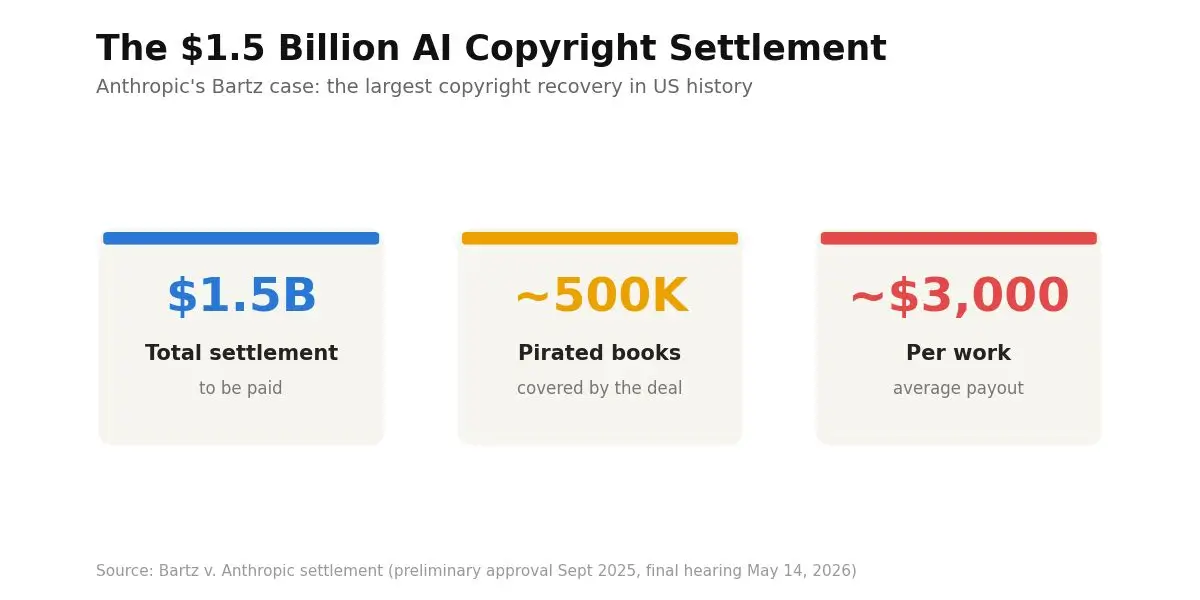
Anthropic agreed to pay at least $1.5 billion to settle the piracy side of the Bartz case, a figure that reset expectations for the industry as a whole. The deal covers roughly 500,000 pirated books at about $3,000 per work, and a judge granted preliminary approval in late September 2025, with a final approval hearing scheduled for May 14, 2026.
This is reportedly the largest copyright recovery in US history. The lesson for everyone watching is sharp: even when AI training itself may be legal, how the training data was collected can carry enormous liability.
One thing worth flagging: these rulings also confirmed that businesses stay liable for infringing AI outputs they publish. If your AI tool generates something substantially similar to an existing copyrighted work and you use it commercially, you can be on the hook, not the AI company.
Do AI Platform Terms of Service Give You Ownership?
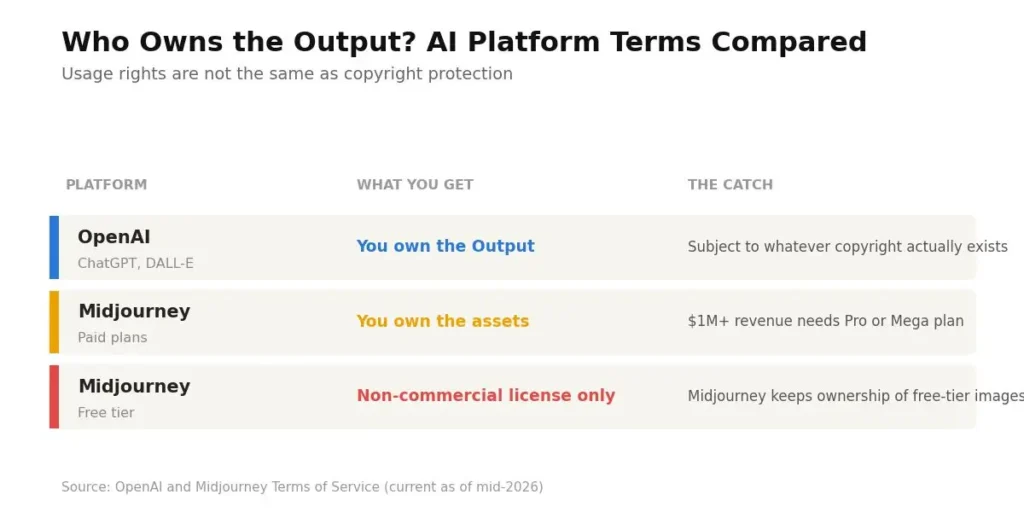
The terms give you usage rights, not copyright protection, and the difference is everything. Each platform writes its own rules about what you can do with the output, but none of them can hand you a copyright the law refuses to recognize.
Here is how the major image and text platforms compare:
| Platform & Tier | Ownership Terms | Limitations / Legal Provisos |
|---|---|---|
| OpenAI (ChatGPT, DALL-E) | You own the Output; OpenAI assigns its rights to you | Subject to whatever copyright actually exists |
| Midjourney (paid plans) | You own assets “to the fullest extent possible under applicable law” | Companies over $1M revenue need Pro or Mega |
| Midjourney (free tier) | Non-commercial license only (CC BY-NC 4.0) | Midjourney keeps ownership of free-tier images |
Notice the careful wording. Midjourney’s “to the fullest extent possible under applicable law” is doing heavy lifting, because under current US law the AI-generated portion may not be ownable at all.
The terms are honest about that limit if you read closely. Compared to platforms I have reviewed before, the pattern is always the same.
The contract gives you commercial freedom to use the work, and stays quiet on whether you can stop anyone else from using it too. Those are different powers, and only the second one is true copyright.
How Do You Protect AI-Assisted Content You Create?
- Generate your draft, then add real human creativity.
Take the AI output as raw material and reshape it. Rewrite the text in your own voice, edit images in a design tool, and combine pieces into something the machine did not produce on its own. This is the step that creates a protectable human layer. - Document your creative contribution.
Save your before-and-after versions, note what you changed, and keep your edited source files. Why this matters: if you ever register or defend the work, you need evidence of the human authorship, not just a claim. - Disclose the AI portions when you register.
The Copyright Office requires applicants to identify AI-generated material and disclaim it. After documenting your edits, file for registration only for the human-authored parts. Trying to hide the AI involvement can void the whole registration. - Check the platform’s terms before using it commercially.
Confirm your plan actually grants commercial rights. A free Midjourney account, for instance, blocks commercial use entirely, so you would see a takedown risk if you sell those images. - Add a human review step for infringement.
Before publishing, ensure the output is not substantially similar to any existing work. You should see original, distinct content, because you remain liable for infringing outputs even if the AI created them.
That flow turns shaky AI output into something with at least a defensible core. It will not protect the machine-made parts, but it protects the parts that are genuinely yours.
Common Pitfalls When Claiming Ownership of AI Content
Most ownership mistakes come from a few predictable assumptions. Each one feels reasonable, and each can cost you real money or a registration fee.
- Assuming the prompt makes you the author.
It does not, no matter how detailed it is. The Office treats prompts as ideas, and ideas are never protected by copyright. Avoid it by building your claim around editing and arrangement, not prompting. - Confusing platform ownership with copyright.
Terms of Service give you a license, not a legal monopoly. People discover the gap when a competitor copies their “owned” image, and there is nothing to enforce. Read the terms knowing they only grant usage rights. - Skipping AI disclosure on registration.
Some creators hide the AI involvement hoping for a cleaner approval. If the Office learns of it later, it can cancel the entire registration. Disclose the AI parts and register only the human contribution. - Ignoring how the tool was trained.
A cheap or obscure generator may have shaky training data, raising your output-infringement risk. Stick with platforms that are transparent about training and that offer indemnification where possible. - Treating “public domain” as worthless.
Unprotected AI output is not always a problem. For internal drafts, idea generation, or disposable assets, it is fine. The mistake is building a brand-defining asset on something anyone can legally copy.
The thread connecting all of these is the same false belief: that using an AI tool automatically creates an owned, defensible thing. It creates a usable thing. Defensible is a separate job.
Workflow Example: Registering an AI-Assisted Article
Here is a realistic end-to-end flow for a content creator who wants to protect a blog post built with AI help.
Input: A 2,000-word draft where AI generated the rough body text, and you have a custom header image made partly in Midjourney.
Process: You rewrite roughly 60% of the body in your own voice, add your own research, examples, and structure, and edit the header image in Photoshop by recomposing elements and adding original text.
You save every version along the way. Then you prepare a copyright application that claims the human-written text and your arrangement, while disclaiming the raw AI-generated passages and the unedited AI portions of the image.
Output: A registration application covering your human-authored text, your selection and arrangement of the content, and your edited contributions to the image, with the AI-generated material clearly identified and excluded.
Result: You hold a defensible copyright in the human-authored layer of the work. You can act against someone who copies your original text and structure.
You cannot stop reuse of the raw AI passages, but those were never the valuable part anyway. The protectable core is exactly the part that carried your creativity.
A small habit that pays off: version your files with clear names like “draft-AI-raw” and “draft-human-edited.” When a registration question comes up months later, that naming alone reconstructs your authorship story in seconds.
So Who Actually Owns AI-Generated Content?
The honest answer is that it depends entirely on the human in the loop. Pure AI output belongs to no one and lives in the public domain.
AI output that you genuinely shaped with creativity gives you copyright over your contribution, and nothing more.
That framework, held through the D.C. Circuit’s Thaler ruling, survived the Supreme Court’s refusal to revisit it in March 2026, and shows up in every Copyright Office decision in between.
The open frontier is the Allen case, which may finally tell us how much prompting and curation counts as authorship.
For now, treat AI as a powerful tool that produces unprotected raw material. Your value, and your ownership, comes from what you do with it after the machine stops.
This article explains general copyright principles and reflects guidance and rulings current as of mid-2026. It is not legal advice. For a specific situation, consult an attorney licensed in your jurisdiction.
Frequently Asked Questions
Yes, if your platform plan grants commercial rights. Paid Midjourney and OpenAI plans allow it. Selling is separate from copyright, though, so others may legally copy unmodified AI images you sell.
No. OpenAI’s terms assign ownership of the output to you. It keeps a license to use your content for service improvement, but it does not claim ownership of the text or images you generate.
Yes, under current US law. Work created solely by AI, with no meaningful human authorship, has no copyright owner and is in the public domain, meaning anyone can reuse it freely.
There is no fixed amount. The Copyright Office looks for meaningful human creativity such as rewriting, arranging, or substantially modifying the output. The prompt alone never qualifies, regardless of length or detail.
Yes, and several have been. Courts in 2025 found AI training can be fair use, but Anthropic still paid $1.5 billion to settle claims tied to pirated books, showing real liability remains.

Is an SEO Specialist and AI Tools Researcher with over 4 years of hands-on experience in search engine optimization. As the founder of Smart AI Helper Pro, he tests and reviews AI writing, SEO, and marketing tools to help creators and business owners grow faster with practical, research-backed strategies.