
Who to Target When Selling Generative AI Services
By SM Mehedi Hasan
The best customers for generative AI services are companies that already use AI but cannot prove it pays off, a group McKinsey sized at nearly half of all organizations in 2025. Target this adoption-without-ROI gap first, because these buyers have budget approved, real urgency, and no working solution yet.
Most people selling generative AI services start with the wrong question. They ask “which industry is hot right now” when they should be asking “which buyer is already bleeding money on a problem I can fix.” Those are not the same group.
And the gap between them is exactly where deals close fast or stall for months. I have watched plenty of sellers spray cold outreach across every business with a website, then wonder why nobody replies.
The companies most likely to pay you for generative AI services in 2026 are a narrow, identifiable slice. This guide shows you who they are, who signs the check, who to avoid, and how to build a target list you can actually work through this week.
Table Of Contents
ToggleWho actually buys generative AI services in 2026?
The buyers are businesses with a high-volume, repetitive workflow that costs them real money, plus a leader who already believes AI can help but lacks the in-house skill to make it work. That belief matters more than the budget line.
When a prospect still needs convincing that AI is worth trying, you are doing education, not selling. When they already tried something, and it underdelivered, you are selling.
According to McKinsey’s State of AI 2025 survey of 1,993 organizations across 105 countries, 88% of companies now report regular AI use in at least one business function, up from 78% the year before.
Adoption is basically everywhere. So “do you use AI” is no longer a useful filter. The useful filter is what happens after adoption.
Here is the part most sellers skip. That same McKinsey survey found that only 39% of organizations attribute any measurable EBIT impact to AI, and for most of them, the effect is under 5%.
Only about 6% qualify as genuine “AI high performers.” So you have near-total adoption sitting on top of mostly invisible returns. That tension is your map. If you sell generative AI services, your prospect is rarely the company that has not started.
It is the company that started, got stuck, and now has a frustrated executive who already lost a little face for championing a tool that did not deliver.
Why is “already using AI but stuck” the strongest buying signal?
Because that buyer has every condition a fast sale needs, all at once. They have a budget that was already approved for AI, so you skip the “is this worth spending on” fight.
They have a sponsor who is personally invested in proving AI works. And they have a concrete failure you can point at, which makes your pitch specific instead of theoretical.
Compared to chasing cold “AI-curious” prospects, this group converts faster and churns less. The cold prospect needs three months of nurturing before they believe the category. The stuck prospect needs one good demo that solves the exact thing their last attempt botched.
McKinsey’s own data reinforces why this works. High performers were nearly three times as likely as peers to fundamentally redesign workflows around AI rather than bolt a tool onto an old process.
Most companies bought a tool and changed nothing else, which is precisely why their results stayed flat. You are not selling them another tool. You are selling the operational work that makes the tool finally pay off, and that is a service, not a subscription.
Pro Tip: Before you pitch anyone, ask “what did you already try with AI, and where did it fall short?” The answer hands you your entire sales narrative. Prospects who cannot answer it are too early; either requalify them or move on.
Which industries should you target first when selling generative AI services?
Start with industries that combine three traits: high-frequency manual work, clear cost or revenue stakes, and decision-makers who can approve spending without a six-month committee.
When all three align, the sales cycle shortens, and your case study writes itself. Below is a practical first-target list. These are not the only verticals that buy, but they are the ones where a focused seller tends to land early wins.
| Industry | Core pain point | Gen AI service that sells |
|---|---|---|
| Healthcare and med-spas | Patient intake, scheduling, repetitive admin | Intake chatbots, appointment automation, documentation support |
| Real estate | Slow lead response, listing content volume | Lead qualification bots, listing and email copy generation |
| Professional services | Knowledge buried in documents, billable-hour pressure | Internal knowledge retrieval, proposal and report drafting |
| Ecommerce and retail | Support ticket volume, product content at scale | Support triage agents, product descriptions, personalized upsell |
| Marketing and creative agencies | Content production bottlenecks | Content workflows, campaign drafts, repurposing pipelines |
Notice what these share. None of them are “tech companies building AI.” They are ordinary businesses drowning in a process.
That distinction matters, because the company building its own AI rarely hires you, while the dental group answering 200 calls a week absolutely will.
Healthcare and med-spas
This vertical pays well because the pain is loud and the compliance pressure is real. A med-spa losing leads because nobody answers the phone after 6pm feels that loss in lost bookings every single day.
Generative AI intake and scheduling assistants address a measurable revenue leak, making the return obvious.
The catch is regulation. Anything touching patient data needs guardrails, consent handling, and clear limits on what the system can say. That requirement is not a barrier.
It is your moat, because it scares off the cheap competitors who only know how to wire up a basic chatbot.
Real estate and property
Real estate agents lose deals to response time, and they know it. A lead that waits 30 minutes for a reply is often gone.
Generative AI lead qualification and instant follow-up hit a pain that agents already obsess over, so you spend zero time convincing them the problem is real.
Deals here tend to be smaller per project, but volume is high, and word travels fast inside brokerages. Land one team, deliver, and referrals tend to follow without much extra effort on your part.
Professional services (legal, accounting, consulting)
Lawyers, accountants, and consultants sit on mountains of documents and bill by the hour, which creates a perfect tension. Every hour spent hunting through old files is an hour not billed at full rate.
Internal knowledge retrieval and drafting assistants turn that dead time back into capacity.
This group is skeptical and detail-driven, so expect more questions about accuracy and data handling. But when you clear that bar, these clients are sticky, and they pay for retainers without flinching.
Ecommerce and retail
Ecommerce stores feel support volume as a direct margin hit. Generative AI support triage that handles the repetitive “where is my order” questions frees human agents for the cases that actually need them.
The math is easy to show, which shortens the sales cycle. Product content is the second opening. Stores with thousands of SKUs need descriptions, and they need them fast.
That is a clean, low-risk first project that opens the door to bigger automation work later.
Marketing and creative agencies
Agencies are an unusual target because they both buy and resell. They feel the content-production bottlenecks acutely, and many would rather pay an expert to build a workflow than figure it out on their own.
Sell them the system, and some will quietly resell your capability to their own clients.
The risk is that a chunk of agencies think they can do it themselves. Qualify for the ones overwhelmed enough to outsource, and skip the ones still in the “we’ll figure it out internally” phase.
Finance, insurance, and lending
Honestly, this is the vertical sellers underestimate most. Finance and insurance firms run on documents, compliance checks, and repetitive customer questions, all of which generative AI handles well when it is built carefully.
A custom assistant trained on internal policies, with strict rules about what it can and cannot say, removes the compliance fear that stops these firms from buying a generic tool.
What makes this group attractive is willingness to pay for safety.
They will gladly spend more on guardrails, audit trails, and human-in-the-loop review, because a single wrong automated answer in a regulated context can create real legal exposure.
Sell the controls as hard as the capability, and the premium price feels justified to them.
Logistics, field services, and operations-heavy businesses
These businesses live and die by scheduling, dispatch, and status updates, which are exactly the high-volume tasks generative AI streamlines.
A logistics firm fielding hundreds of “where is my shipment” questions, or a field-service company juggling dispatch, has a pain that repeats thousands of times a month.
The opening here is less about flashy content and more about quiet operational relief. Pitch the hours saved and the errors avoided, not the technology.
Operations leaders respond to “your team stops doing this repetitive thing” far more than to anything about models or prompts.
What company size should you sell to: SMB, mid-market, or enterprise?
Pick based on the deal size you need and the sales cycle you can survive. Each tier trades money against time and complexity, and the wrong fit will starve a new business or overwhelm a solo operator.
| Segment | Typical deal profile | Tradeoff to expect |
|---|---|---|
| Small business (SMB) | Smaller projects, fast decisions | Lower budgets, more clients needed, price sensitivity |
| Mid-market | Meaningful budgets, one or two approvers | The sweet spot for most independents and small teams |
| Enterprise | Large contracts, long commitments | Procurement, security reviews, multi-month cycles |
For most people starting out, mid-market is the smart center of gravity. SMBs decide quickly but pay little and churn on price. Enterprises pay a lot but bury you in security questionnaires and legal review before a dollar moves.
Mid-market companies have real money, a problem worth solving, and usually one or two people who can say yes. But there is a nuance worth respecting.
If you have deep credibility in one niche, enterprise becomes reachable even as a small shop, because specialization beats size in a buyer’s eyes.
A solo operator known as “the AI person for orthodontics” can win deals a generic ten-person agency cannot.
Who is the real decision-maker for generative AI services?
The person who signs depends almost entirely on company size, and pitching the wrong title wastes weeks. In a small business, the owner decides and pays in the same conversation.
In an enterprise, the person who loves your demo often has no budget authority.
| Company size | Who usually signs | Who can quietly block you |
|---|---|---|
| Small business | Founder or owner | Nobody, the owner is everything |
| Mid-market | Head of Ops, VP, or department lead | Finance, if ROI is fuzzy |
| Enterprise | Director or VP with a sponsor | Procurement, IT security, legal |
So aim your outreach at the title that matches the size. For SMBs, talk to the owner directly and keep it about money saved or made.
For mid-market, the operations or department leader feels the pain daily and can champion you upward. For enterprise, you need an internal sponsor who will carry your case into rooms you will never enter.
One mistake I see constantly: sellers pitch the most technical person because the topic is AI. Technical people enjoy the conversation, ask sharp questions, and then cannot approve a purchase. Find the person who owns the broken outcome, not the person who understands the technology.
Pro Tip: When a prospect says “send me information,” ask one question first: “Who else needs to be comfortable before this moves forward?” Their answer reveals the real decision map, and it saves you from having to sell hard to someone who was never going to sign.
How do you find these buyers using buying triggers and intent signals?
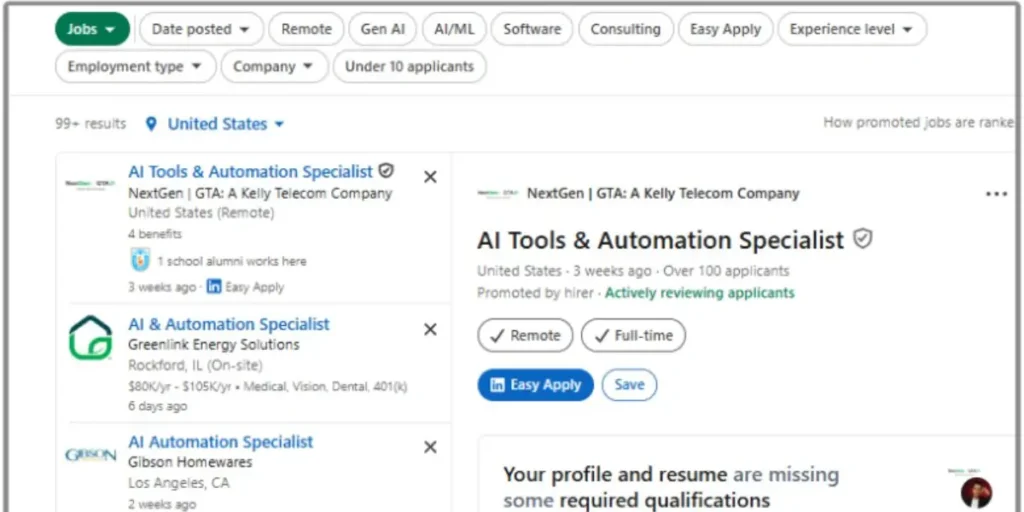
Watch for events that signal a company just developed the pain you solve, then reach out while the wound is fresh.
Cold lists go stale fast, but a triggered list reaches people at the exact moment they are looking. These signals tell you a buyer moved into your window:
- They posted an AI-related job.
A company hiring for “AI” or “automation” roles has budget and intent but no solution yet, which is the ideal moment to offer a service in its place. - They just raised funding.
New capital means new spending on efficiency, and growth-stage companies feel manual bottlenecks hard. - A new operations or growth leader joined.
Fresh leaders want early wins, and an AI project is a visible, fast one to claim. - A competitor of theirs publicly adopted AI.
Nothing motivates a buyer like a rival getting praise for moving first. - They are hiring heavily for a repetitive role. Scaling a manual team is a flashing sign that automation would save them money.
The logic behind these signals is simple. Each marks a moment when a company’s pain became urgent, and its budget became available.
Reaching out before that alignment means you educate; reaching out during it means you sell.
Where do you find these signals? Job boards show hiring intent. Funding announcements are public. LinkedIn shows leadership changes the day they happen.
You do not need expensive intent-data tools to start. You need a habit of checking these sources for the niche you chose.
Who should you NOT target when selling generative AI services?
Avoid prospects who lack a budget, authority, or a real problem, because each one drains weeks without converting. Knowing who to skip saves you more time than any outreach trick. These are the anti-targets worth disqualifying early:
- The tire-kicker with no budget.
They love AI, want endless calls, and never had money to spend. Enthusiasm is not a buying signal.
- The do-it-yourself company.
If their team already builds internally, you are competing with free labor they trust more than you.
- The sub-$2,000 expectation.
Practitioner reports consistently note that roughly half of inbound prospects expect tiny budgets that cannot fund real work. Quote your real price early and let the self-selecters drop out.
- The “automate everything overnight” buyer.
An unrealistic scope means an unhappy client, no matter how well you deliver. Their expectations were broken before you arrived.
- The company has no repetitive process.
If their work is genuinely custom every time, generative AI has nothing high-volume to optimize, and the project will underwhelm.
So qualify out as ruthlessly as you qualify in. A new seller’s instinct is to chase every lukewarm reply, but the fastest path to revenue is spending all your hours on the narrow group that has money, authority, and pain together.
In My Experience
The thing that surprised me most was how often the loudest, most excited prospect turned out to be the worst fit. Early on, I treated every “this is amazing, tell me more” reply as a near-win. Most of them went nowhere.
They wanted to talk about the future of AI, not pay to fix a problem this quarter.
What changed my results was inverting the qualification. Instead of looking for excitement, I started looking for irritation.
The prospect who said “honestly we tried a chatbot last year and it was useless, our team hated it” closed in two calls.
The frustration meant the budget was real, the problem was real, and the bar I had to clear was a competitor who had already failed.
One limitation I ran into: triggered outreach works beautifully, but the window is short. A company that posted an AI role and received 50 applications fills it quickly, and once they have an internal hire, your service pitch weakens.
So I learned to move on a signal within days, not weeks. Sit on it, and the opening closes.
Common Pitfalls When Choosing Who to Target
Most targeting mistakes come from chasing breadth when the money is in focus. New sellers cast wide because narrowing feels risky, but a vague target list produces vague outreach that nobody answers.
These are the errors that quietly kill pipelines:
- Targeting “businesses that need AI.”
That is everyone, which means it is no one. Vague targeting produces generic messaging that gets ignored. Pick one vertical and one painful process to start.
- Pitching the technology instead of the outcome.
Buyers do not want a generative AI service. They want fewer support tickets or faster lead responses. Lead with the result, mention the method second.
- Ignoring company size when picking decision-makers.
Sending an enterprise-style proposal to a five-person business, or pitching an owner-level message to an enterprise gatekeeper, signals you do not understand them. - Skipping disqualification.
Chasing every reply feels productive and accomplishes little. Most of your hours should sit on the few prospects who can actually buy. - Confusing adoption with opportunity.
Because almost everyone “uses AI” now, that fact tells you nothing. The opportunity is in the gap between using AI and getting value from it.
Why do these mistakes happen so reliably? Because narrowing feels like leaving money on the table, when it actually concentrates your effort where money exists. The seller who targets “everyone” competes with everyone.
The seller who targets “intake automation for dental groups” owns a tiny market with almost no competition.
Workflow Example: Building a 50-Account Target List
Here is a full, repeatable flow for turning a chosen niche into a list of real, reachable buyers. This is the exact shape of the process, from raw input to a finished list you can start contacting.
Input: One niche decision. Say you pick “mid-market ecommerce brands struggling with support volume.” That single sentence sets the industry, the company size, and the pain.
Process:
- List 50 brands in that niche using LinkedIn, ecommerce directories, and store-finder tools, filtering for the right employee count.
- Check each for a trigger signal: recent funding, a support-role hiring spree, or a new operations leader.
- Find the operations or customer-experience lead at each one, since that is the title that owns support pain at mid-market size.
- Tag each account by signal strength, marking which ones show active pain right now versus passive fit.
- Draft outreach that names the specific pain (“handling support tickets as you scale”) rather than the service (“our AI solutions”).
Output: A ranked list of 50 named accounts, each with a real decision-maker, a known pain, and a personalized opening line.
Result: Instead of blasting a generic message to a thousand strangers, you contact 50 qualified buyers with messaging built for their exact situation.
Reply rates rise because the message reads like it was written for one person, because it was. That focus is what separates outreach that books calls from outreach that gets deleted.
Pro Tip: Build the list before you write a single message. Sellers who write outreach first and find targets later end up bending their pitch to fit whoever they found. Pick the buyer, then craft the message, never the reverse.
How does the AI adoption gap change your targeting in 2026?
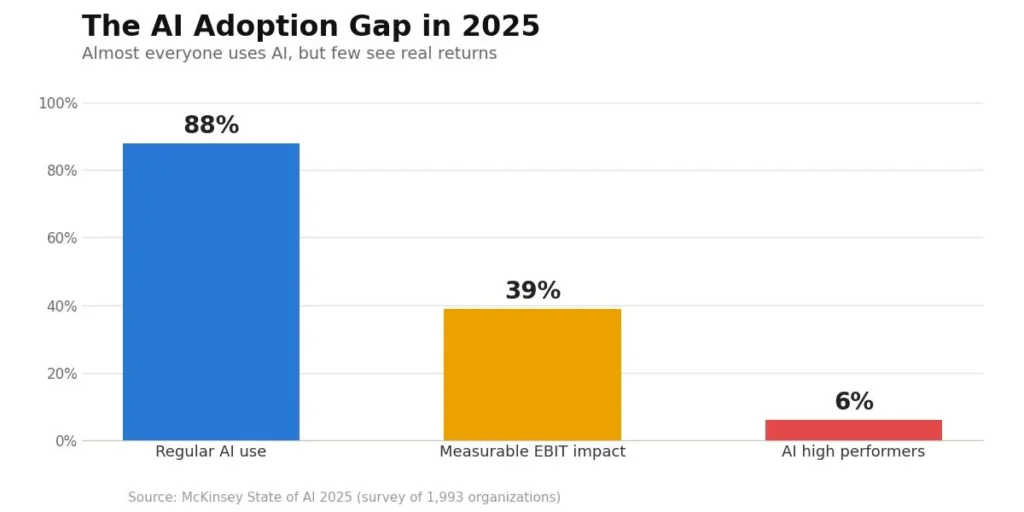
It moves your best target from “early adopters” to “stuck adopters,” and that shift is the single most useful change in 2026. Two years ago, the opportunity was selling AI to companies that had never touched it.
That window is mostly closed, because adoption hit 88% and education-based selling no longer differentiates you.
The opening now sits inside that 49-point gap between the 88% who adopted and the 39% who see real EBIT impact. Those are companies with tools they cannot extract value from. They do not need to be sold on AI as a concept.
They need someone to make their existing investment finally work, and that is a delivery problem, which is exactly what a service provider sells.
So your messaging in 2026 should not say “you should use AI.” It should say “you already use AI and it is not paying off yet, and here is the operational work that fixes that.” Speak to the gap, not the category.
The category is settled. The gap is wide open.
Where do these buyers actually spend their time?
They cluster in a handful of predictable places, and going where they already are beats interrupting them where they are not. You do not need a giant ad budget to reach the right targets.
You need to show up in the channels your chosen niche already trusts. Here is where the strongest service buyers tend to gather:
- Industry-specific communities and forums.
Every vertical has its watering holes, from subreddits to private Slack groups to trade associations. A dental-practice owner asking peers about missed-call solutions is a buyer in the middle of a search. - LinkedIn, filtered by role and trigger.
Operations and growth leaders openly share their problems. Watch for complaints about manual work, then enter the conversation with help, not a pitch. - Local and niche business events.
For service-heavy verticals, a single relevant conference or local meetup can produce warmer leads than weeks of cold email. - Referrals from your first delivered project.
Within a tight niche, one happy client talks to competitors and peers constantly, which turns a single win into a pipeline. - Existing networks where you already have credibility.
If you came from an industry, your old contacts trust you faster than any stranger will, and that trust shortens every sale.
The reason these channels work is the transfer of trust. A cold prospect has no reason to believe you.
A prospect who finds you inside a community they respect, or through a peer who vouched for you, starts the conversation already half-sold.
So weight your effort toward warm and semi-warm sources before you ever touch cold outreach.
How should you position your offer for each buyer type?
Match your message to what that specific buyer loses sleep over, because the same service sounds different to a founder than it does to a compliance officer.
A pitch that lands with one target falls flat with another, even when the underlying work is identical. This table shows how to reframe the same generative AI service for different buyers.
| Buyer type | What they care about most | How to frame your offer |
|---|---|---|
| Founder or owner | Money saved or earned, speed | “This recovers revenue you are losing right now” |
| Operations leader | Hours freed, fewer errors | “Your team stops doing this repetitive task” |
| Compliance-driven buyer | Risk, control, accuracy | “Built with guardrails so nothing goes off-script” |
Notice the pattern. None of these framings lead with the technology. The founder hears revenue. The operations leader hears relief. The compliance buyer hears safety.
Your generative AI service might be the exact same build under the hood, but the words that open the door change completely depending on who is listening. This is where most sellers leak deals.
They write one pitch about “cutting-edge AI capabilities” and send it to everyone, which means it resonates with no one. Rewrite the opening line for the person, and the same outreach starts booking calls.
Pro Tip: Keep a short swipe file of three opening lines, one per buyer type. When a new lead comes in, you spend ten seconds picking the right frame instead of writing from scratch, and the message always speaks to that person’s actual worry.
How do you score a prospect in under five minutes?
Run every lead through three fast checks, and pursue only the ones that clear all three.
A quick scorecard stops you from sinking hours into prospects that were never going to convert. Score each lead on budget, authority, and pain, then act on the total.
| Signal | Strong (pursue) | Weak (deprioritize) |
|---|---|---|
| Budget | Spends on tools already, or just funded | Wants everything cheap or free |
| Authority | Owns the outcome or has a sponsor | Curious but cannot approve spending |
| Pain | A specific repetitive process hurts now | Vague interest in "trying AI" |
If a lead is strong on all three, it goes to the top of your list and gets a personalized message today. If it is strong on two, it is worth a nurture but not your best hours.
If it is strong on only one, it is almost always a time sink dressed up as an opportunity. And here is the discipline that separates sellers who hit revenue from those who stay busy: you have to actually deprioritize the weak ones.
The temptation to chase a friendly, enthusiastic lead with no budget is strong, because it feels like progress. But the scorecard exists precisely to protect you from that feeling. Trust the three checks over the warm-and-fuzzy reply, and your close rate climbs without any extra outreach volume.
Frequently Asked Questions
A small or mid-market business in an industry you already understand, with one repetitive process and an owner or department lead who can approve spending fast. Existing domain knowledge significantly shortens the sales cycle.
Mid-market is usually the best starting point. It offers real budgets without the long procurement and security reviews enterprises require, and decisions often need only one or two approvers rather than a committee.
Healthcare, real estate, professional services, ecommerce, and marketing agencies tend to buy fastest, because each has high-volume repetitive work, clear cost stakes, and accessible decision-makers who feel the pain daily.
Look for three things together: an approved or available budget, a person with authority to sign, and a specific repetitive problem. Missing any one of the three usually means a long chase with no sale.
Because adoption now sits at 88% while only 39% see measurable financial impact. The companies stuck in that gap have budget, urgency, and a past failed attempt you can fix, which makes them easier to close.
Final word: focus beats reach
If you remember one thing, make it this. Selling generative AI services is not about reaching the most businesses. It is about reaching the few who have money, authority, and a painful, repetitive process at the same time.
Almost everyone uses AI now, so usage tells you nothing. The buyers worth your time are the ones who adopted, got stuck, and are quietly looking for someone to make it work.
Pick one vertical. Pick one painful process. Find the people who own that pain, watch for the signals that say their budget just opened, and ignore everyone who only wants to talk.
Narrow targeting feels risky, but it’s actually the safest path you have, because the seller who tries to reach everyone competes with everyone, while the specialist competes with almost no one.

Is an SEO Specialist and AI Tools Researcher with over 4 years of hands-on experience in search engine optimization. As the founder of Smart AI Helper Pro, he tests and reviews AI writing, SEO, and marketing tools to help creators and business owners grow faster with practical, research-backed strategies.