
Why Is Semrush Not Accurate for Agency SEO? The Honest Truth for 2026
By SM Mehedi Hasan
Semrush is not fully accurate for agency SEO because its traffic and keyword numbers come from clickstream sampling and modeling, not direct Google data. Independent tests show estimates can run over 150% too high or around 50% too low, so agencies must validate every client number against Search Console.
I have run Semrush across dozens of client accounts, from local plumbers to multi-location SaaS brands.
The tool is brilliant for one thing and shaky for another, and most agencies never figure out which is which until a client questions a number in a report.
That gap between what Semrush shows and what Google Search Console confirms is exactly where trust gets lost.
So let me walk you through where the inaccuracy actually lives, why it hits agencies harder than solo bloggers, and how to keep using Semrush without getting burned in front of a client.
Table Of Contents
ToggleWhat Does “Semrush Accuracy” Actually Mean for an Agency?
Semrush accuracy refers to how closely its estimated metrics match real Google data like Search Console clicks and GA4 sessions.
For agencies, accuracy matters in three places: traffic estimates, keyword volume and difficulty, and competitor analysis used in pitches and reports.
Here is the part most people skip. Semrush never claims to show your client’s true Google numbers. It shows a model. A model built from sampled data, then scaled up with machine learning.
That distinction sounds small, but it changes how you should read every chart you hand to a paying client. When a freelancer is off by 40% on their own blog traffic, nobody cares.
When an agency presents a competitor analysis that overstates a rival’s traffic by 150%, and the client later checks it against a different source, your credibility takes the hit. Same data, very different stakes.
Why Is Semrush Not Accurate for Agency SEO?
Semrush is not accurate for agency SEO because it estimates traffic and keyword data from third-party clickstream sources rather than pulling directly from each client’s Google Search Console or Analytics.
Those estimates drift the most on small sites, niche industries, and fresh content, which are common in agency portfolios. Most people assume an expensive tool means precise numbers.
That assumption breaks the moment you compare Semrush to a verified Search Console export. A UK SEO agency called Varn ran one of the cleaner public tests on this.
Across 15 websites, they found Semrush overestimated organic traffic by an average of roughly 152% when it was wrong on the high side, and underestimated by about 52% when it leaned low.
That is not a small wobble. On a site pulling 10,000 organic clicks a month, the Varn test saw overestimation land near 107%. So your client report could show double the traffic that Google actually counts.
And the bigger the site, the more Semrush tended to inflate. But here is the thing worth saying out loud. None of this makes Semrush a bad tool. It makes Semrush a modeling tool. The mistake is treating a model like a meter reading.
Where Does Semrush Get Its Data From?
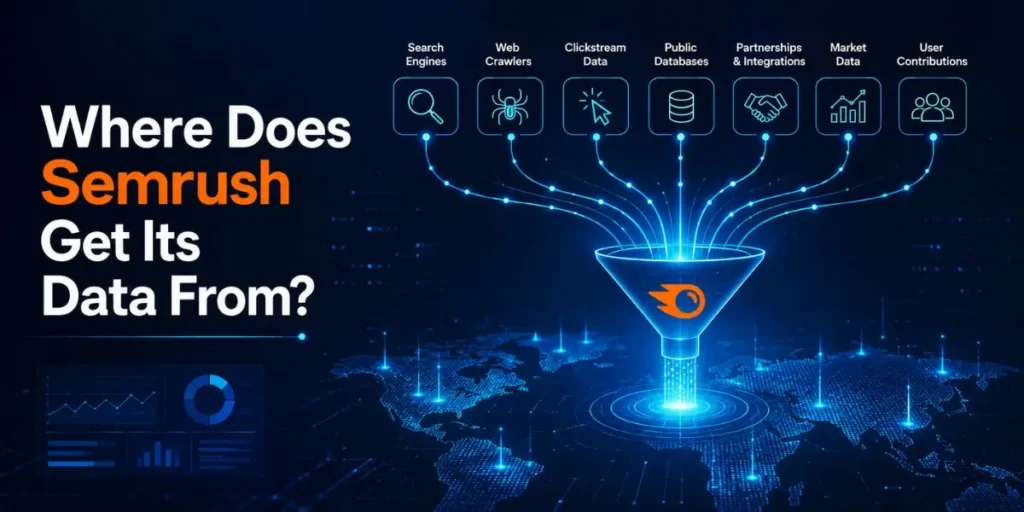
Semrush builds its traffic estimates from a panel of anonymized internet users plus partnerships with clickstream data providers.
According to Semrush’s own documentation, this panel covers over 200 million users across more than 190 countries, feeding billions of recorded web events into a neural network that estimates visits and behavior.
Think about what that actually is. It is a giant sample of browsing activity from browser extensions, antivirus tools, and apps. Semrush sees a slice of the internet’s clicks, then scales that slice up to guess the whole picture.
When your client’s audience sits inside that sample, the numbers look decent. When it does not, the numbers wander.
Honestly, this is the single most important thing for an agency to understand, and it explains almost every weird number you will ever see. Three data realities flow from it:
- Small sites fall outside the sample. If a client’s site gets a few thousand visits a month, there may not be enough clickstream signal to model it well.
- Niche B2B industries get thin coverage. Specialist sectors have fewer panel users browsing them, so estimates get shaky or show zero.
- Fresh and trending content lags. Semrush leans on 12-month search volume averages, so a keyword surging right now can still display a low or stale number.
The backlink side runs differently and frankly more reliably. Semrush crawls roughly 10 billion web pages daily into a database of over 43 trillion backlinks, using its own crawler instead of borrowed clickstream.
That is why link data tends to hold up better than traffic data in client work.
How Inaccurate Is Semrush Traffic Data, Really?
Semrush traffic estimates typically deviate 20% to 60% from real analytics on most sites, with larger swings on small or niche domains.
Multiple independent tests in 2025 and 2026 confirm the pattern: directional trends are reliable, but absolute numbers often are not.
I pulled together what the public tests actually found, because vague claims help nobody. Here is how the main studies line up.
| Source / Test | What They Measured | Result Found |
|---|---|---|
| Varn (15 sites vs GSC) | Organic traffic estimate | Avg 152% over when high, ~52% under when low |
| Ahrefs internal study | Traffic deviation median | Semrush ~69% median deviation (Ahrefs ~50%) |
| Magnifyi (client GA data) | Absolute traffic estimate | Off by 20% to 50%, zero shown on some live sites |
| BloggingX (own GSC) | Monthly clicks | 3.71k real vs 2.1k shown, ~43% under |
Notice the disagreement between those numbers. One test shows heavy overestimation, another shows underestimation. That inconsistency is the real story. Semrush is not wrong in one predictable direction you could correct for.
It is wrong in different directions on different sites, which makes it dangerous to trust blindly in a client deck.
One more detail worth flagging. The Ahrefs figure comes from Ahrefs, a direct competitor, so read it as a competitor’s framing rather than neutral ground.
I include it because the deviation pattern matches what independent agencies found, not because Ahrefs is unbiased here.
In My Experience
Honestly, when I first started handing Semrush traffic charts to clients, I assumed the numbers were close enough.
Then, a client connected their own GA4 and asked why my report showed 18,000 monthly visits while Google showed under 9,000. I had no good answer in the room, and that stung.
What I learned that day changed my whole reporting setup. Semrush had pulled this client’s traffic from clickstream modeling, and their audience was a narrow regional B2B crowd that barely registered in the panel.
The trend line was actually correct; traffic was rising month over month, but the absolute figure was nearly double reality.
Since then, I have led every client report with Search Console as the source of truth and use Semrush only for competitive context. The conversation never went sideways again.
Is Semrush Keyword Volume and Difficulty Accurate?
Semrush keyword volume is reasonably accurate for high-volume terms but unreliable for long-tail, niche, and trending keywords because it reports a 12-month average rather than current demand.
Keyword Difficulty is a useful guide, not a guarantee, since it is a modeled 1 to 100 score.
Compared to what I have tried before, Semrush still gives the largest keyword database in the game, with over 25 billion keywords as of 2026.
For sheer discovery and US-market coverage, very little touches it. But size and accuracy are not the same thing.
The 12-month average is the quiet trap. Say you are building content for a client in a fast-moving space like AI tools.
A keyword exploding in demand right now might still show a low volume in Semrush, because the number is smoothed across a full year that includes months when nobody searched it.
You could skip a winning topic because the tool made it look dead.
Keyword Difficulty has its own quirks. Semrush builds the score from the authority and backlink profiles of the top 10 ranking pages, weighing around 100 SERP signals. It is genuinely helpful for prioritizing a content calendar.
Some practitioners find that it runs aggressively, where keywords scored 70 still rank with modest authority. So treat KD as a starting filter, then eyeball the actual SERP before committing client budget.
Pro Tip: Before you trust any client keyword volume, cross-check the top three terms in Google Keyword Planner and Search Console.
If Semrush and one direct source roughly agree, you can build on it. If they clash badly, the keyword sits in a thin-data zone, and the volume is a guess.
Traffic Analytics vs Domain Analytics: Which One Are You Actually Reading?
Semrush shows two different traffic numbers, and most agencies confuse them. Domain Analytics estimates traffic from keyword rankings, showing what a site could earn from organic search.
Traffic Analytics estimates real visits across all channels from clickstream data. They rarely match, and reading the wrong one wrecks reports.
This is the insight almost every competing article skips, and it causes more client confusion than any single bug. Here is the difference in plain terms.
| Feature | Domain Analytics | Traffic Analytics |
|---|---|---|
| Data basis | Keyword rankings and CTR models | Clickstream panel data |
| What it shows | Estimated organic search potential | Estimated total visits, all channels |
| Best agency use | SEO opportunity sizing | Competitor benchmarking |
When I was auditing a competitor for a client pitch, I quoted the Domain Analytics organic number, then a teammate quoted the Traffic Analytics total in the same deck.
The two figures were thousands of visits apart, and the client noticed instantly. We looked sloppy, even though both numbers were technically Semrush data. Pick one source per report and label it clearly.
Why Does Semrush Inaccuracy Hurt Agencies More Than Solo Bloggers?
Semrush inaccuracy hurts agencies more because agencies present the data to paying clients who can verify it, stake their reputation on it, and lose trust when numbers do not match.
A solo blogger only answers to themselves, while an agency’s reputation rides on every figure in a client report.
If you are running an agency, this is where the accuracy question stops being academic and starts costing money. Walk through the real touchpoints:
- Pitches and proposals. You quote a prospect’s competitor as getting 50,000 monthly visits to justify your strategy. If that number is inflated by 150%, your whole growth promise rests on fiction.
- White-label client reports. Your branded dashboard shows traffic that does not match the client’s own GA4. The client trusts Google over you, every time.
- Retainer justification. You report rising Semrush traffic to prove your work is paying off. If Semrush smoothing masks a real dip, you are reporting progress that the client’s revenue does not feel.
- Multi-client scale. Across 30 client accounts, small per-site errors compound into a pattern of reports nobody fully trusts.
And there is a cost layer too. Semrush charges per extra user seat, often in the 45 to 100 dollar range per month, which adds up fast for a team. A blogger pays for one seat and never feels this. An agency feels it on every hire.
Pro Tip: Never put a raw Semrush competitor traffic number in a proposal without labeling it an estimate.
Write “estimated organic visibility, source: Semrush” right under the figure. That one line protects you if the prospect cross-checks it later.
How Accurate Is Semrush Position Tracking and Local SEO Data?
Semrush position tracking is its most accurate feature, usually landing within one to two positions of real rankings because it simulates a clean, non-personalized Google search from a set location.
Local rank data is solid when you set a specific ZIP code rather than a broad city or region.
This is the good news, and it deserves equal airtime. Unlike traffic, rankings are something Semrush observes fairly directly.
The tool runs a search from a defined location with no personalized history, then records where the site lands. Reputable rank trackers hit 90% or better accuracy on this.
You might still see a mismatch between Semrush and what you Google yourself. That is not a bug.
Your own search is personalized by your history, device, and exact location, while Semrush deliberately strips all that out to give a clean baseline. For client tracking, the clean baseline is what you want.
One caution for local clients. Set tracking to a precise ZIP code, not a whole city or state. Broad location settings blur local pack results, and local businesses live or die by the local pack.
The narrower your location input, the closer the data sits to what the client’s real customers see.
How to Use Semrush Accurately for Agency SEO
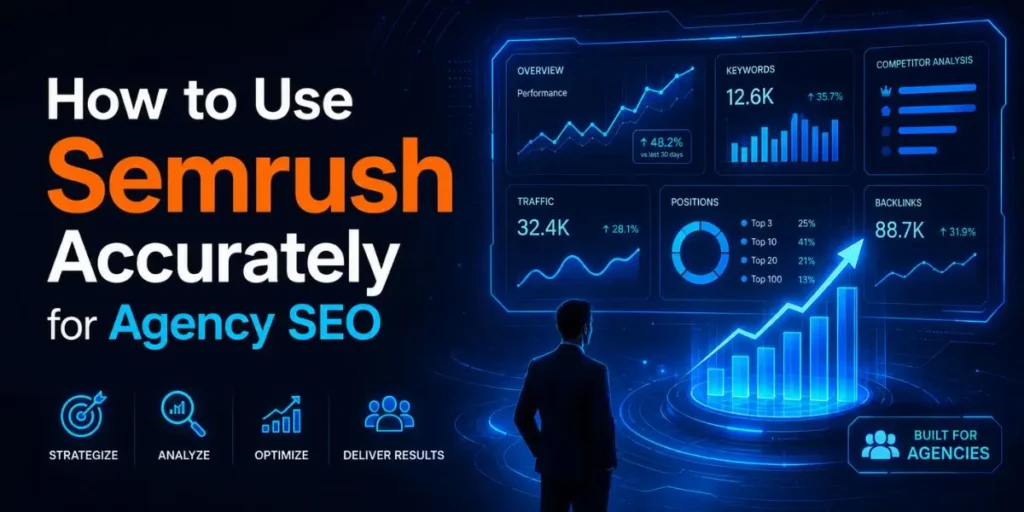
- Connect Google Search Console and GA4 to every client project. This pulls real client data into Semrush, so your reports lead with verified numbers, not just estimates. After connecting, your dashboard will show a clear gap between Semrush estimates and Google’s actual figures, which tells you exactly how much to trust the modeled data for that site.
- Use Semrush estimates only for competitor data you cannot verify. You will never have a competitor’s GSC, so estimates are all you get there.
Treat those numbers as directional, label them as estimates, and the moment you analyze your own client, switch to connected Google data.
- Cross-check every key metric against one direct source before reporting. Pull the client’s top keywords in Keyword Planner and their traffic in GSC. When Semrush roughly agrees with Google, report with confidence. When it does not, flag the metric as an estimate so the client is never surprised.
- Set position tracking to exact locations and consistent devices. Lock in ZIP codes for local clients and pick mobile or desktop, then keep it fixed. This removes the noise that makes rankings look like they jump randomly, so trend lines stay clean across monthly reports.
- Read trends, not single numbers, in every client conversation. Semrush is consistent in direction even when absolute figures drift.
Present “organic visibility is up 18% quarter over quarter,” rather than a precise visit count, and your reporting stays honest and defensible.
Each step builds on the last. You start by anchoring to truth (connected Google data), then you contain the estimates to where they belong (competitors only), then you protect yourself with cross-checks and clean tracking, and finally you frame everything as trends so no single shaky number can blow up a client meeting.
Semrush vs Other Tools for Agency Accuracy
No third-party SEO tool reports perfectly accurate traffic, since only Google holds the real data.
The practical question is which tool fits agency workflows best. Here is how the main options compare for accuracy-sensitive agency work.
| Tool | Accuracy Strength | Agency Fit |
|---|---|---|
| Semrush | Backlinks, rankings, US keyword depth | All-in-one, PPC, big databases |
| Ahrefs | Backlink data, long-tail KD | Link building, content research |
| SE Ranking | Rank tracking, AI Overview detection | Cheaper seats, white-label value |
| Google Search Console | True client click and impression data | Mandatory truth source, free |
I keep coming back to the same setup after years of testing.
Semrush or Ahrefs for competitive intelligence and discovery, a lighter rank tracker like SE Ranking when seat costs matter across a team, and Google Search Console as the non-negotiable source of truth for anything you report on a client’s own site. No single tool wins. The stack wins.
Common Pitfalls Agencies Make With Semrush Data
These are the mistakes I see agencies repeat, and each one is avoidable once you know the cause behind it.
- Treating estimates as ground truth in reports. This happens because the numbers look so precise and official. Always validate client metrics against GSC before they reach a client’s eyes.
- Mixing Domain Analytics and Traffic Analytics in one deck. Agencies do this without realizing they are two different models. Pick one source per report and label it.
- Trusting search volume on trending keywords. The 12-month average hides surges, so teams skip rising topics. Sanity-check fresh trends against Google Trends.
- Quoting inflated competitor traffic in pitches. Overestimation makes rivals look bigger than they are, which sets unrealistic client expectations. Frame competitor numbers as estimates, always.
- Using broad location settings for local clients. City-level tracking blurs the local pack. Use ZIP codes so the data reflects real customer searches.
- Reporting absolute visit counts instead of trends. A single shaky number invites scrutiny. Trends are where Semrush is genuinely reliable, so lead with movement.
A Real Agency Workflow Example
Theory only goes so far, so here is the exact flow I use when onboarding a new client and building their first report. This is the Input to Result path in full.
Input: A new local dental client hands over access to their site. They have no idea of their real traffic, and previously got a report from another agency claiming 12,000 monthly organic visits from Semrush.
Process: I connect their Google Search Console and GA4 into a fresh Semrush project.
Then I compare the connected Google clicks against Semrush’s standalone Traffic Analytics estimate. I set position tracking to their city ZIP code on mobile, since dental searches are mostly local and mobile.
Output: Search Console shows roughly 4,800 real monthly clicks. Semrush’s standalone estimate had been showing close to 12,000, which is where the old agency’s inflated number came from. Position tracking reveals they sit on page two for their three money keywords.
Result: I report the honest 4,800 baseline as the true starting point, explain that the old number was a modeled estimate, and set a trend-based goal: move those three keywords to page one and grow verified GSC clicks by 30% in two quarters.
The client trusts the report because every number traces back to their own Google data, and the competitor context stays clearly labeled as an estimate.
How Accurate Is Semrush AI Overview and GEO Tracking in 2026?
Semrush AI Overview and AI visibility tracking are useful as an early signal, not a hard performance metric, in 2026.
It shows where a brand appears in AI search results like Google AI Overviews and chat-based answers, but the data is newer and less battle-tested than traditional rank tracking.
This is the angle most agencies are scrambling to figure out right now, so it deserves a clear-eyed look.
Semrush rolled its AI visibility toolkit into its core offering, letting you track presence across AI-driven search and large language model answers. For agencies, that sounds like exactly what clients are asking about.
But treat it carefully. Appearing in an AI Overview does not map cleanly to sessions in a client’s Analytics.
A page mentioned in an AI answer might pull strong leads while showing almost no measurable click traffic, which makes it hard to report as a standard performance number.
So use AI visibility as a “where search is heading” signal in client conversations, not as a line item you promise to grow by a fixed percentage.
One competitor’s accuracy note matters here, too. Some 2026 agency tests found lighter tools like SE Ranking surprisingly strong on AI Overview detection while costing far less per seat.
If a client’s whole concern is AI search visibility, the most expensive tool is not automatically the most accurate one for that specific job.
Pro Tip: When a client asks about ranking in ChatGPT or Google AI Overviews, show the Semrush AI visibility data as a directional trend and pair it with a real lead-quality conversation.
That keeps the discussion honest while still demonstrating you are ahead of the 2026 shift toward answer engines.
What Does Semrush Get Right for Agencies?
Semrush is highly reliable for backlink analysis, rank tracking, keyword discovery, site audits, and competitor research at scale. Its accuracy weakness is narrow and specific: standalone traffic estimates.
Everything built on direct crawling or observation tends to hold up well in agency work. I want to be fair here, because a one-sided takedown would mislead you.
After using Semrush across client accounts for years, the features I trust without much second-guessing are the ones rooted in real crawling rather than clickstream modeling. The distinction is consistent.
| Semrush Feature | Accuracy for Agencies | Why |
|---|---|---|
| Backlink data | Strong | Own crawler, 43 trillion links |
| Position tracking | Strong | Directly observes SERPs |
| Keyword discovery | Strong | Largest US keyword database |
| Site audit | Good | Crawls the actual site |
| Traffic estimates | Weak | Modeled from sampled clickstream |
So the rule of thumb writes itself. When Semrush observes something directly, like a backlink, a ranking, or a broken page on the client’s own site, trust it.
When Semrush estimates something it cannot see directly, like a competitor’s true visit count, it treats it as a smart guess. Hold those two ideas at once, and the tool serves you well.
So, Should Agencies Still Trust Semrush in 2026?
Yes, agencies should still use Semrush, but as a competitive intelligence and discovery tool rather than a source of truth for client traffic.
Pair it with Google Search Console for verified client data, and Semrush becomes one of the most useful tools in an agency stack.
After all this, I am not telling you to drop Semrush. I use it almost daily. The keyword database, backlink crawler, and position tracking carry real weight, and the competitive intelligence is hard to match for US-market work.
The problem was never the tool. It was the expectation.
So here is the honest takeaway. Semrush models the internet; it does not measure your client’s slice of it. Use it to understand the landscape, to size opportunities, and to spy on competitors you can never get direct data from.
Then anchor every client-facing number to Google’s own data. Do that, and the accuracy question stops being a threat to your reputation and becomes just another thing you handle like a pro.
Frequently Asked Questions
Not on its own. Semrush traffic is a clickstream estimate that can swing 20% to 150% off real numbers. For client reports, lead with Google Search Console data and use Semrush only for competitor context you cannot otherwise access.
Because Semrush never pulls from your Analytics. It models traffic from a sampled clickstream panel, while Google Analytics counts real visits directly. Small and niche sites show the biggest gaps between the two.
Neither is perfectly accurate, since only Google has real data. Ahrefs often edges ahead on backlink and long-tail keyword data, while Semrush leads on US keyword depth, PPC research, and all-in-one reporting for agency workflows.
It is solid for high-volume terms but weak on trending or niche keywords, because Semrush reports a 12-month average instead of current demand. Cross-check fresh topics against Google Keyword Planner or Google Trends before committing.
Position tracking and backlink data. Rankings are usually within one to two spots of reality, and the backlink crawler covers over 43 trillion links. Traffic estimates are the least reliable feature for agency use.

Is an SEO Specialist and AI Tools Researcher with over 4 years of hands-on experience in search engine optimization. As the founder of Smart AI Helper Pro, he tests and reviews AI writing, SEO, and marketing tools to help creators and business owners grow faster with practical, research-backed strategies.