Will Cybersecurity Be Replaced by AI? What Actually Happens by 2030
By SM Mehedi Hasan
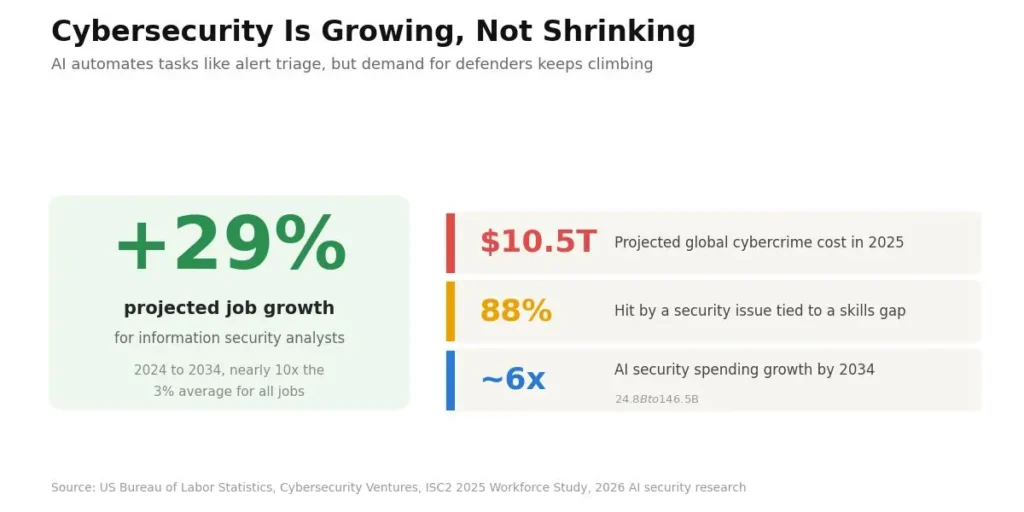
No, AI will not replace cybersecurity, and the data points the opposite way. The U.S. Bureau of Labor Statistics projects information security analyst jobs to grow 29% from 2024 to 2034, nearly 10 times the 3% average for all occupations. AI is automating specific tasks like alert triage, not the profession. The honest catch: entry-level work is changing fast.
That last line is where most articles go quiet, and it is the part you actually need. So this guide splits the question into two: is the field being replaced (no), and are certain tasks and junior roles being reshaped right now (yes).
Both are true at once, and pretending otherwise is why so many “AI won’t replace jobs” posts feel hollow.
Table Of Contents
ToggleWill AI replace cybersecurity jobs?
No, AI is not replacing cybersecurity jobs, but it is redrawing what those jobs look like. Machine learning can scan logs, flag anomalies, and prioritize thousands of alerts in seconds.
It still cannot judge whether an anomaly is an attacker or an employee working late, determine how much business risk a vulnerability poses, or stand before a board and explain a breach.
Most people assume “AI can do the detection, so the human is optional.” The workflow proves the reverse. AI produces more signals, and more signals need more people who can interpret them, tune the models, and own the decision when the model is wrong.
The numbers back this up. The ISC2 2025 Cybersecurity Workforce Study, built on a record 16,029 respondents, found that 88% of professionals saw a real security consequence in the past year tied to a skills shortage.
That is a talent gap, not a talent surplus. AI is being adopted because teams are stretched, not to shrink them. And demand keeps climbing for a blunt reason: attackers are winning economically.
Cybercrime is projected to cost the world $10.5 trillion in 2025, according to Cybersecurity Ventures. If that were a country, it would rank as the third-largest economy on Earth. You do not defend against a threat that size with fewer humans.
Why do people keep asking if AI will replace cybersecurity?
The question keeps trending because three things collided at once, and the fear is understandable even when the conclusion is wrong.
- Generative AI made automation visible.
When a chatbot writes working code and drafts phishing emails on demand, it is easy to assume it can also run a security team. Visibility got mistaken for capability. - Agentic AI arrived in the SOC.
Autonomous agents that plan, act, and chain tasks together moved from demos into real security operations centers during 2025 and 2026. That felt different from a passive tool. - Layoffs and budget cuts clouded the picture.
The ISC2 data shows that budget cuts and layoffs did hit security teams, but that was an economic decision, not AI replacing anyone. People conflated the two.
Here is the piece that gets lost. Headlines frame AI as either a miracle or an extinction event, and the truth sits in the boring middle: AI is changing the scope of the work while the headcount need keeps rising. When you separate the media story from the hiring data, the panic loses its footing.
What cybersecurity tasks can AI actually do in 2026?
AI now handles the high-volume, pattern-heavy work that used to eat an analyst’s entire shift. This is real and genuinely useful, so let us be specific rather than vague.
| Task | What AI does well | Where humans stay essential |
|---|---|---|
| Alert triage | Ranks thousands of alerts by severity in seconds | Confirming which alerts are real threats |
| Threat detection | Spots anomalies in traffic, logs, and behavior | Interpreting novel or context-specific attacks |
| Incident response | Auto-isolates hosts, blocks malicious IPs | Owning the response strategy and hard calls |
| Vulnerability triage | Correlates flaws with active exploit data | Deciding fix order against business risk |
| Phishing filtering | Catches known malicious patterns at scale | Spotting targeted social-engineering attempts |
Notice a pattern in that right-hand column. Every AI strength has a human dependency bolted to it. The tool speeds up the first 80% of a task and hands the judgment-heavy 20% back to a person. That 20% is where careers live. One caveat worth stating plainly.
AI relies on historical data, so it is strong at threats that resemble the past and weak at genuinely new ones. Zero-day exploits, by definition, have no prior example to learn from, which is exactly when a skilled human has to step in.
What cybersecurity work can AI not replace?
AI cannot replace the parts of cybersecurity that depend on context, accountability, and human trust. These are not soft extras. They are the core of the job’s existence.
- Contextual judgment.
Is this login from the CEO traveling, or an attacker using stolen credentials? The raw signal looks identical. Only a human who knows the organization can reliably tell the difference. - Novel threat reasoning.
When an attack has never been seen before, there is no pattern to match. Someone has to reason from first principles. - Accountability.
When an AI system makes a wrong call, a person still answers for it to regulators, executives, and customers. You cannot subpoena a model. - Communication.
Translating a technical vulnerability into a business risk a CFO understands is a human skill, and it is becoming more valuable, not less.
Compared with the tools I relied on even two years ago, today’s AI is dramatically faster at surfacing “something looks off here.”
But deciding what that something means, and what to do about it, has barely moved toward automation at all. The gap between detection and decision is still human territory.
Is AI coming for entry-level cybersecurity jobs?
Yes, and this is the honest part most articles skip. Agentic AI is compressing traditional entry-level SOC work, specifically routine alert triage and rule-writing, the exact tasks that used to be a junior analyst’s training ground.
Ram Varadarajan, a security-firm CEO speaking at the 2026 RSA Conference, put it directly: routine tasks like alert triage and rule-writing are increasingly automated, which compresses entry-level roles, while higher-level positions expand around governance, exception handling, and accountability for AI-driven decisions.
So the field is growing 29% overall, and the bottom rung is getting narrower at the same time. Both are true. If you are trying to break in during 2026, that combination matters more to you than any “AI won’t replace cybersecurity” headline.
But here is why this is not the disaster it sounds like. The junior role is not vanishing; it is moving up. Entry-level increasingly means supervising an agent instead of manually reading logs, which is a higher-skill starting point, not a lower one.
The people who struggle are those waiting for the old SOC-analyst job to come back unchanged. The people who thrive learn to direct the automation on day one.
In My Experience
Honestly, when I first started leaning on an AI-assisted detection tool, I expected it to hand me clean answers. It handed me confident noise.
The tool flagged a “critical” data-exfiltration alert overnight, and I spent forty minutes tracing it before realizing it was a scheduled backup job the model had never been taught to recognize. That moment reframed the whole “replacement” debate for me.
The AI was fast and wrong, and it had no idea it was wrong. My value was not doing what it did; it was catching what it missed. After a few weeks of correcting it, the false positives dropped sharply, but only because a human was in the loop teaching it.
Left alone, it would have kept crying wolf, and eventually someone would have stopped listening, which is how real breaches slip through. The tool did not reduce the need for judgment. It relocated it.
Is AI creating new cybersecurity jobs?
Yes, AI is generating entire job categories that did not exist a few years ago, and this is the growth story competitors underplay. Every AI system a company deploys becomes something new to defend.
- AI security and AI-SPM.
Securing the models, training data, and pipelines themselves against prompt injection, data poisoning, and model theft. - Agentic AI governance.
Deciding what autonomous agents are allowed to do, under which identity, with what permissions, and who is accountable when they act. - Non-human identity management.
Every AI agent needs credentials and access. Legacy identity systems were never built for machine-to-machine authentication at this scale. - AI red-teaming.
Deliberately attacking your own AI systems to find weaknesses before adversaries do.
The money is following the work. Research published in 2026 estimates global spending on AI in cybersecurity growing from roughly $24.8 billion in 2024 toward $146.5 billion by 2034, per a survey of agentic AI and cybersecurity.
Markets do not expand sixfold around a technology that eliminates its own workforce. They expand because the technology creates new problems that need new specialists.
Which cybersecurity roles will grow, shrink, or transform by 2030?
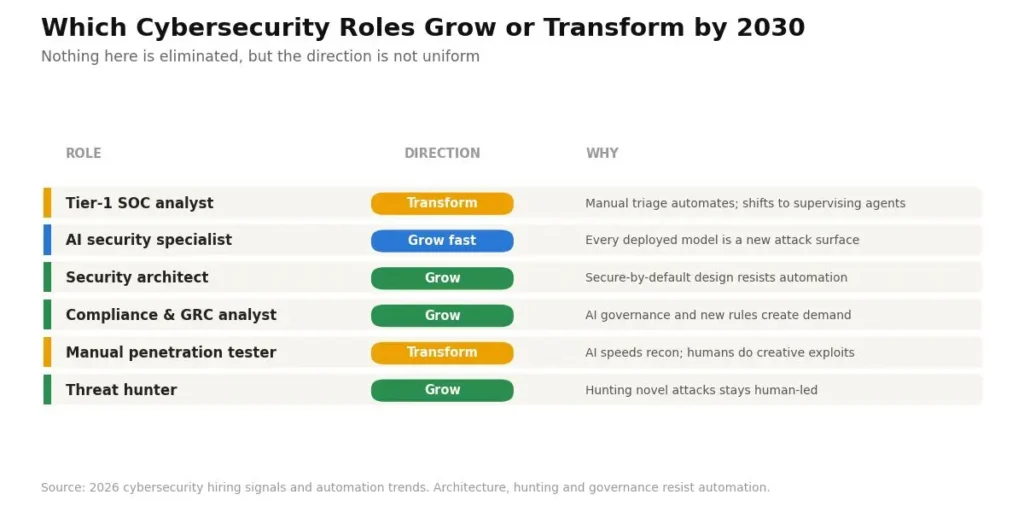
Most cybersecurity roles will transform rather than disappear, but the direction is not uniform, and knowing which way your role bends is worth more than any general reassurance. Here is a grounded breakdown based on current automation trends and hiring signals.
| Role | Direction by 2030 | Why |
|---|---|---|
| Tier-1 SOC analyst | Transform | Manual triage automates; role shifts to supervising agents |
| AI security specialist | Grow fast | Every deployed model is a new attack surface to defend |
| Security architect | Grow | Designing secure-by-default systems resists automation |
| Compliance and GRC analyst | Grow | AI governance and new regulations create fresh demand |
| Manual penetration tester | Transform | AI speeds recon; humans focus on creative exploitation |
| Threat hunter | Grow | Proactive hunting for novel attacks stays human-led |
Read that table as a map, not a verdict. Nothing on it says “eliminated,” and the two roles marked “transform” are shifting toward higher-skill work, not toward the exit.
If your current title sits in the “transform” column, lean into the supervising-and-governing side of the job before the market forces the change on you. There is a reason architecture, hunting, and governance all sit in “grow.”
They share a trait AI struggles with: they require deciding what should happen, not just detecting what did happen. Prediction and pattern-matching are AI’s turf. Intent, design, and accountability are still ours.
How does the AI arms race affect cybersecurity careers?
The AI arms race makes cybersecurity careers more secure, not less, because attackers now use the same tools defenders do. This is the dimension a “will AI replace us” framing completely misses.
Criminals use AI to write more convincing phishing, generate malware variants, and automate reconnaissance at machine speed. A 2026 Dark Reading poll found 48% of security professionals rank agentic AI as the top attack vector heading into the year, outranking deepfakes and every other concern.
When offense scales with AI, defense has to scale with AI too, and someone has to run that defense. So the equation is not “AI replaces defenders.” It is “AI-armed attackers force organizations to hire AI-fluent defenders.”
Every leap in offensive AI is a hiring signal, not a layoff notice. The threat surface is expanding faster than automation can cover it, which is the opposite of a shrinking-jobs scenario.
Common Pitfalls: How People Misread the AI vs Cybersecurity Question
Several predictable mistakes trip people up here, and each one comes from a specific wrong assumption. Spotting them early saves you from bad career or budget decisions.
- Assuming “the field” and “one job” are the same thing.
The field grows while individual task lists shrink and shift. Conflating them produces false panic. Read the two questions separately. - Trusting AI output without verification.
Beginners let the model’s confidence stand in for correctness. AI states false positives with the same certainty as real threats, so unchecked automation is how genuine attacks slip past. - Waiting for the “old” job to return.
Some people delay learning AI-assisted workflows, hoping the classic SOC role comes back unchanged. It will not. That hesitation is the real career risk, not the AI itself. - Deploying AI agents as if they were plain tools.
Organizations that hand an agent broad permissions and no oversight get burned. An agent that can execute code and access systems needs guardrails, monitoring, and clear accountability from day one. - Skipping the human-in-the-loop for high-impact actions.
Letting AI transfer data, delete records, or change access policies without human approval can turn a single bad model decision into a cascading failure.
Each pitfall has the same root cause: treating AI as a finished replacement instead of a powerful, fallible teammate that needs direction.
Workflow Example: How a Modern SOC Actually Uses AI
Here is a realistic end-to-end flow showing where AI acts and where the human takes over. This is the shape of the job in 2026, not theory.
- At 2 a.m., monitoring detects unusual outbound data transfers from a finance department server, generating 300+ raw alerts across the SIEM.
- Process: The AI layer correlates those alerts, filters out low-priority noise, ranks the cluster as high-severity, auto-isolates the affected host to stop potential exfiltration, and drafts a summary of what it has seen.
- Output: Instead of 300 scattered alerts, the on-call analyst opens one prioritized incident with context attached and a suggested containment already applied.
- Result: The analyst confirms it is a real compromised credential, not a false alarm, escalates to incident response, updates the detection rule so the pattern is caught earlier next time, and briefs leadership in the morning. Total human time: minutes, not hours.
Look at where the human sits in that flow. The AI compressed the grunt work from hours to seconds, and the analyst spent their energy on confirmation, escalation, tuning, and communication.
Remove the human, and the isolated host might have been a legitimate business process shut down in error, or a real breach dismissed in error. The automation raised the analyst’s leverage. It did not remove the analyst.
How can you stay relevant as AI reshapes cybersecurity?
You stay relevant by moving up the value chain: from doing tasks AI now handles to directing, securing, and governing the AI itself.
The skills below are the ones the 2025 ISC2 study and industry hiring signals point toward, and notably, 70% of professionals in that survey are already pursuing AI qualifications rather than fearing the shift.
- Learn to work with AI security tools.
Get hands-on with SOAR platforms and security-focused AI copilots. Knowing how to direct, correct, and audit these systems is now a baseline skill, not a bonus. - Specialize in AI-specific vulnerabilities.
Study prompt injection, data poisoning, model inversion, and agentic AI risks. Very few professionals can secure AI pipelines on their own, making this a high-leverage niche. - Build the human-only skills.
Threat hunting, security architecture, identity and access management, and translating technical risk into business language stay resilient because they resist automation. - Understand AI governance frameworks.
Familiarity with structures like the NIST AI Risk Management Framework positions you for the compliance and oversight roles that barely existed before.
Pro Tip: Do not try to out-compute the machine. You will lose. Instead, become the person who decides what the machine is allowed to do and who catches it when it is wrong. That role only grows. A different angle worth trying: pick one AI security tool and break it on purpose in a lab. Feed it edge cases, watch where it fails, and document the failure modes.
That hands-on failure-hunting teaches you more about the human-AI boundary than any course, and it is exactly the instinct employers now pay for. One more, because it is easy to overlook: keep a written record of every time AI got something wrong in your work.
Patterns emerge, and those patterns become your expertise, your interview stories, and your argument for why your role is not going anywhere.
So, will cybersecurity be replaced by AI?
Cybersecurity will not be replaced by AI, but it is being rebuilt around it, and the timeline matters. Through 2026 and toward 2030, expect AI to absorb routine detection and triage, entry-level work to shift toward supervising automation, and demand for AI-fluent security professionals to keep outpacing supply.
The professionals at risk are not the ones AI replaces. They are the ones who refuse to change with it.
Every previous wave of security automation, from firewalls to antivirus to cloud monitoring, was predicted to shrink the field, and every wave grew it instead, because each new defense created new attack surfaces to protect. Agentic AI is following the same script, just faster.
If you take one thing from this: stop asking whether AI will replace cybersecurity, and start asking which version of the cybersecurity professional you want to become. The tool-runner or the tool-director. Only one of those roles is expanding.
Frequently Asked Questions
No. AI will automate routine tasks like alert triage, but the U.S. BLS projects 29% job growth for security analysts through 2034. Human judgment, accountability, and novel-threat reasoning keep the profession expanding.
Yes. Cybersecurity remains one of the fastest-growing U.S. fields, with median pay above $120,000, according to BLS data. AI raises demand for skilled defenders because attackers also use AI.
Routine, repetitive roles are most exposed, mainly tier-1 SOC alert triage and manual rule-writing. These tasks are being automated, shifting entry-level work toward supervising and governing AI systems instead.
Partially. AI-driven defense is essential against AI-powered attacks, but it needs human oversight. Attackers use agentic AI to scale threats, so defenders pair AI speed with human judgment for accountability.
Threat hunting, security architecture, identity management, AI governance, and communicating technical risk to executives. These depend on context and accountability that AI cannot replicate, making them resilient to automation.
This article covers a technology and career topic and reflects publicly reported data from the BLS, ISC2, Cybersecurity Ventures, and industry research current as of 2026. Job market conditions vary by region and change over time.

Is an SEO Specialist and AI Tools Researcher with over 4 years of hands-on experience in search engine optimization. As the founder of Smart AI Helper Pro, he tests and reviews AI writing, SEO, and marketing tools to help creators and business owners grow faster with practical, research-backed strategies.