Can You Use AI Art for Book Covers? The 2026 Legal and Publishing Reality
By SM Mehedi Hasan
Yes, you can use AI art for book covers, and Amazon KDP allows it if you disclose it at upload. The catch most authors miss: a purely AI-generated cover cannot be copyrighted in the US after the Supreme Court’s March 2026 ruling, so anyone could legally copy your cover.
That one legal fact changes how you should approach the whole decision. Most articles on this topic still treat the copyright question as an open court battle. It is not open anymore.
Below is the full picture for 2026, built from the actual US Copyright Office guidance, the latest Amazon KDP rules, and the real license terms of the tools you would use.
Table Of Contents
ToggleCan you legally use AI art for a book cover in 2026?
Yes, using AI-generated art for book covers is legal in the United States, and no law prevents you from using an AI-generated image on your book. The question was never really “is it allowed.”
The real questions are whether you can own that cover, whether your publishing platform accepts it, and whether the AI tool’s license lets you sell it. Think of it as three separate gates: legality, ownership, and platform rules. You pass the legality gate easily. The other two are where authors trip.
Here is the distinction that runs through everything: there is a difference between using an AI cover and owning one. You can use almost any AI image commercially if the tool’s license permits it. Owning it, in the copyright sense, is a much higher bar. Keep those two ideas apart, and the rest of this guide makes sense.
Most people assume AI falls into a legal gray zone where a lawsuit could appear at any moment. The gray zone shrank a lot in 2026. Federal courts and the Copyright Office have now given consistent answers on the core questions, so you can plan around real rules instead of rumors.
Can you copyright an AI-generated book cover?
No, you cannot copyright a book cover made entirely by AI from a prompt, because US copyright law requires a human author. The US Copyright Office has stated clearly that purely AI-generated material, in which a machine determines the expressive elements, is not eligible for copyright protection (copyright.gov/ai).
This got its final answer in early 2026. On March 2, 2026, the US Supreme Court denied certiorari in Thaler v. Perlmutter, leaving in place the D.C. Circuit ruling that the Copyright Act requires a human author (SCOTUSblog case file). The case involved an image its creator said was made autonomously by an AI system with no human editing. The courts said no copyright.
Honestly, when I first started reading older articles on this, half of them described the human-authorship fight as “still being decided.” It is not.
The Supreme Court’s closing the door on Thaler is the single most important update for authors, and it is the update that most competing posts have not yet caught up to. But there is a big opening inside that ruling, and it matters for you.
What’s the difference between AI-generated and AI-assisted covers?
An AI-generated cover is one the tool creates from your prompt with no meaningful human creative work, while an AI-assisted cover uses AI for some pieces that a human then arranges, edits, and shapes into a final design.
That line decides your copyright. The Copyright Office analyzes these case by case. Typing a prompt, even a long, detailed one, does not make you the author of the output.
The Office made this point again with the Zarya of the Dawn graphic novel: the human-written text and the human “selection, coordination, and arrangement” of images were protected, but the individual Midjourney images inside were not.
So the practical path to a cover you can actually protect looks like this:
- Generate raw elements with AI (a background, a texture, a figure, a mood)
- Bring those elements into design software.
- Add your own typography, layout, color grading, composition, and edits.
- Keep the human creative decisions front and center.
Compared to publishing a raw AI image untouched, this route gives you a real authorship claim over the finished cover as a whole. The AI parts still are not yours alone, but the assembled design can be.
One more live case to watch: Allen v. Perlmutter, where an artist used more than 600 iterative prompts to refine a single image, is still pending in a Colorado federal court.
It may eventually clarify how much prompting counts as human control. For now, prompting alone is not enough.
What’s the real risk if your AI cover can’t be copyrighted?
The real risk is simple and rarely mentioned: if your cover has no copyright protection, another person can legally take that exact image, slap a different title and author name on it, and publish their own book with it.
Your cover stops being uniquely yours. A book cover is a marketing asset. Its whole job is to make your book stand out on a shelf full of competitors.
When the image sits in the public domain because no human authored it, that distinctiveness has no legal fence around it.
This is not a hypothetical courtroom worry. It is a branding problem. Picture spending months building a series look, then finding a stranger’s box set using your identical AI background.
You would have no infringement claim on the image itself. There is a second layer here too.
Because AI tools can generate similar outputs, two authors using the same tool and similar prompts can end up with covers that look like siblings by accident. That collision risk is higher with raw AI output than with a human-built design.
Pro Tip: If you go the AI route anyway, do enough human editing that the final cover is genuinely yours as a composed design.
That editing is not just about quality. It is what gives you authorship rights and makes your cover harder to legally clone.
Does Amazon KDP allow AI-generated book covers?
Yes, Amazon KDP allows AI-generated book covers, and KDP does not ban AI content. What KDP requires is disclosure: you must tell Amazon during upload if your cover, interior images, text, or translations were generated by AI (KDP Content Guidelines).
Many outdated articles still claim that Amazon prohibits AI-generated books. That was never quite right, and it is definitely wrong in 2026. KDP’s own guidelines confirm that AI-generated images include cover and interior artwork, and they ask you to disclose, not to avoid them.
Here is exactly how the disclosure works at upload:
- Open your title in the KDP publishing flow and go to the content section.
- Find the AI-generated content question thatappears during setup.
- Check the box for Images if any part of your cover or interior art was generated by AI.
- Check Text or Translations separately if those apply to your book.
- Finish and submit. The declaration is recorded on Amazon’s side.
Complete these steps, and you are compliant. Skip them when AI is used, and you risk your book being removed; repeat violations put your whole account at risk.
Two facts calm most authors down here. First, the disclosure is internal. Amazon does not print an “AI-generated” badge on your product page, and it has stated the disclosure does not affect your royalties or search ranking.
Second, disclosure is not an admission of wrongdoing. It is just a checkbox. The thing that surprised me most about the KDP process was how quiet the disclosure is.
You brace for some public label on your listing, and there is nothing. Buyers never see it. It lives in your dashboard for Amazon’s records. One caution that trips up fast publishers: Amazon throttles accounts that upload too many new titles too quickly, roughly three new titles in a 24-hour window.
Even a legitimate series can hit that wall. And KDP’s separate rule against high-volume, low-quality AI spam still applies, disclosed or not. Enforcement tightened through 2025 and escalated again in 2026.
Does an AI cover need disclosure even if I edited it heavily?
Yes, if AI created the image, KDP treats it as AI-generated even after substantial edits. KDP’s line is about who created the content, not how much you polished it.
If the tool produced the picture, disclose it. If AI only helped you refine your own work, that counts as AI-assisted and does not need disclosure.
How do other platforms handle AI covers?
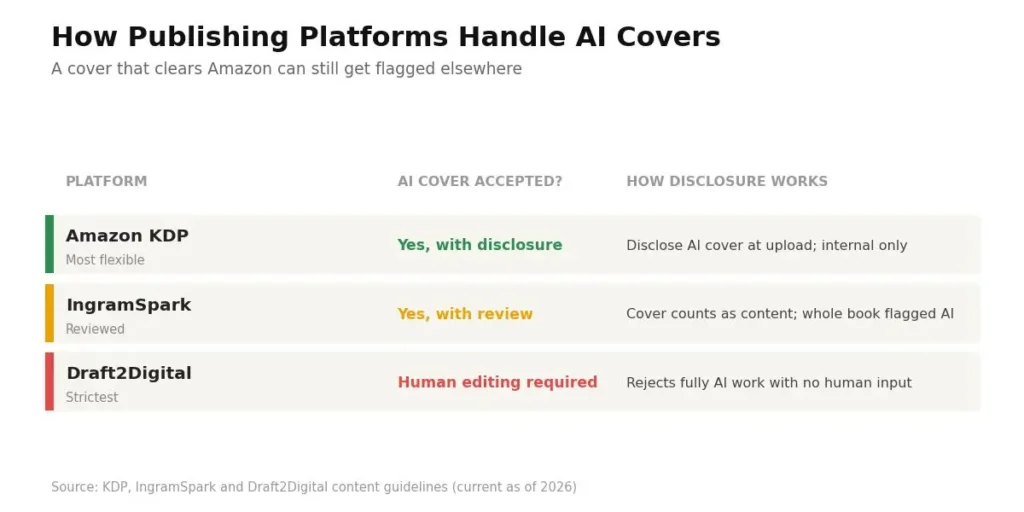
Other platforms handle AI covers differently from Amazon, and this is where authors going wide get caught off guard. KDP asks you to disclose the cover specifically. Some distributors treat the cover as part of the whole book, which changes what you have to declare.
The differences matter if you publish beyond Amazon. Here is the current landscape in a compact view.
| Platform | AI cover accepted? | How disclosure works |
|---|---|---|
| Amazon KDP | Yes, with disclosure | Disclose AI cover art at upload; internal only |
| IngramSpark | Yes, with review | Cover counts as content, so an AI cover means the book is flagged AI-generated |
| Draft2Digital | Human editing required | Rejects content generated entirely by AI without meaningful human involvement |
On IngramSpark, cover art is classified as part of your product’s content. If your cover is AI-generated, you may need to declare the book itself as AI-generated, and IngramSpark’s system tends to be binary: a title is AI-generated, or it is not, with no “partial” option.
Ingram’s catalog integrity team reviews titles on an ongoing basis, and removed titles can be appealed. Industry watchers say the rule mostly targets mass-produced junk, not human-authored books that use AI for a single element.
Draft2Digital sits stricter still. It will not accept work generated entirely by AI that has not gone through real human editing, and since it uses Ingram’s catalog for print distribution, covers fall under that umbrella too.
If you’re publishing wide across several stores, this matters because a workflow that clears Amazon can still get flagged elsewhere. Check each platform’s current policy before assuming your cover applies everywhere.
Which AI image tools can you legally use for covers?
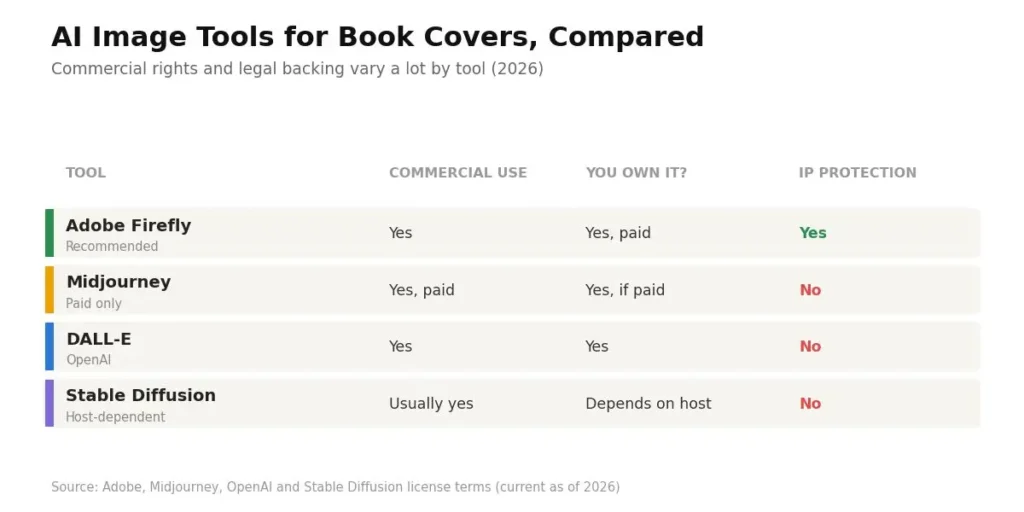
The tool you pick decides your commercial rights, and the differences are bigger than most authors expect. Owning the copyright is one question. Whether the tool’s license even lets you sell the image is a separate one, and some tools quietly say no on their free tiers.
Here is how the major generators compare for commercial book cover use in 2026.
| Tool | Commercial use (paid plan) | Who owns the output | IP indemnification |
|---|---|---|---|
| Adobe Firefly | Yes | You, on paid plans | Yes, on paid Creative Cloud plans |
| Midjourney | Yes, paid only | You, if you pay | No |
| DALL-E (OpenAI) | Yes | You, the generator | No |
| Stable Diffusion | Usually yes | Depends on host | No |
A few specifics worth knowing before you commit:
Adobe Firefly is trained on licensed Adobe Stock content, public domain content, and openly licensed material, rather than scraped web images. Paid plans include IP indemnification, meaning Adobe agrees to back you if a third party claims your Firefly output infringes their rights.
It is the only mainstream generator offering that contractual backstop. The free tier limits commercial use and keeps a watermark you cannot remove. Midjourney grants paid subscribers full commercial rights and, after a February 2026 terms update, explicitly states that subscribers own their outputs.
But free and trial users own nothing: Midjourney keeps those images under a non-commercial Creative Commons license, so you cannot sell a cover made on the free tier. There is no infringement indemnification.
DALL-E, through OpenAI, grants the user ownership of outputs and is fine for commercial use, though without Firefly’s legal protection. Stable Diffusion rights depend on which interface or host you use, so read that specific service’s terms.
In My Experience
After using several of these tools to build cover mockups, the gap between “it looks great” and “it is safe to publish” became obvious fast.
Midjourney gives the most striking images, but getting a usable cover composition often takes many regenerations, because faces, hands, and full figures come out wrong on early tries.
You reroll until the random output lands close enough, then fix the rest yourself.
Firefly behaves like the cautious one in the room.
The outputs can feel a little generic next to Midjourney, which makes sense given its narrower, licensed training set. That same narrowness is exactly why its indemnification is credible.
For a cover I actually intended to sell, I chose Firefly as the base image and handled the typography and layout by hand.
What I did not expect was how badly most image tools handle text on a cover. Typography baked into an AI image usually looks warped or misspelled.
The reliable move is to generate art only, then add your real title text in design software. That single habit fixes the most common “this looks AI-made” giveaway.
How do you make an AI book cover that’s actually safe to use?
You make a safe AI cover by using AI only for raw art elements, then doing the real design work as a human, and disclosing appropriately at upload.
This approach protects your rights, clears platform rules, and produces a cover that looks intentional rather than auto-generated.
The goal is an AI-assisted design, not a raw AI dump. Here is a realistic end-to-end example.
Workflow Example
- Input: A cozy mystery novel set in a seaside town. Budget is tight, so a full custom illustration is off the table, but the cover still needs to look genre-appropriate and distinct.
- Process: Generate a moody harbor-at-dusk background in Adobe Firefly on a paid plan. Discard the weak tries, keep the strongest frame. Import it into your design tool. Adjust the color grade to match the genre, crop and reframe for the trim size, add a hand-picked serif title, place the author name, and layer a subtle texture over the whole thing.
- Output: A finished cover where the AI background is one element inside a human-composed design, with your typography and layout doing the heavy lifting.
- Result: A cover you can defend as human-authored at the design level, that clears KDP with an image disclosure, and that does not scream “AI” because the composition and type are yours.
Notice the sequence. You never publish the raw generation. Every step after “generate” is a human creative decision, and those decisions are what give the final cover its authorship footing and its polish.
Pro Tip: Keep a folder for each cover with your prompts, the raw generations, and your edited layers.
If a platform ever questions your work, or you decide to register the book’s copyright later, that paper trail documents your human contribution and saves you a real headache.
Do you have to worry about trademarks and real people on AI covers?
Yes, and this is the fastest way to get a cover rejected. Likeness and trademark conflicts are among the most common cover-side rejections.
Do not prompt for copyrighted characters, recognizable brand logos, or real identifiable people.
An AI-generated image that resembles a protected character or a living celebrity can trigger a takedown, regardless of how it was created.
What mistakes should you avoid with AI book covers?
The biggest mistakes with AI covers come from confusing “allowed” with “protected,” and from skipping the human work that makes a cover both safe and sellable. Most of these are avoidable once you know they exist.
Here are the pitfalls that catch authors most often, and why each one happens:
- Assuming you own the cover.
Authors see “commercial use allowed” and think they hold copyright. Those are different things. A raw AI cover can be legally copied by anyone, because no human authored it. - Publishing raw output untouched.
This happens because AI images look finished. But unedited output gives you no authorship claim, often collides with lookalike covers, and reads as AI-made to careful buyers. - Selling free-tier images.
People forget that free plans on some tools grant no commercial rights. Midjourney’s free tier, for instance, keeps ownership of your image and licenses it for non-commercial use only. - Forgetting the disclosure.
Authors disclose the use of AI-generated text but overlook the cover. KDP explicitly counts cover art as AI-generated content, and a missing disclosure can pull your book. - Ignoring platform differences.
A cover that clears Amazon can still get flagged on IngramSpark or Draft2Digital, because those platforms treat the cover as part of the whole book. - Prompting protected material.
Asking for a known character, a brand mark, or a real person invites a rejection or worse. Trademark and likeness issues are among the top causes of cover takedowns.
Avoid those six, and you have sidestepped almost every real AI cover problem authors run into.
Should you use AI art for your book cover?
Whether you should use AI art for your cover depends on your budget, your genre, and how much your readers care. It is legal and platform-accepted with disclosure, but “allowed” is not the same as “always a good idea,” and the honest answer has trade-offs on both sides.
The case for AI covers is real. If you are a self-publisher with no budget for a designer, AI-assisted art can get a decent, genre-appropriate cover onto your book fast and cheaply.
For backlist titles, midlist experiments, or a series where you reserve human designers for lead books, a two-tier approach makes practical sense, and more small publishers are quietly doing exactly that.
The case against is also real, and it is not only about ethics. There is a genuine reader-perception risk. In parts of the writing and reading community, an AI-generated cover signals that the book itself might be AI-generated, whether or not that is true. Some readers will pass on your book on that assumption alone.
Writers’ organizations and the Graphic Artists Guild have taken firm positions against AI covers, and that sentiment shapes reviews and word of mouth. Quality is the other honest limitation.
A skilled human designer will usually understand your genre’s visual language, your specific characters, and your brand better than a prompt can. AI is good at atmosphere and backgrounds. It is weaker at exact characters, coherent typography, and the subtle genre cues that sell a book at a glance.
If you’re weighing this for a book you care deeply about, the middle path tends to win: use AI for elements, do real human design on top, disclose where required, and be honest with yourself about your audience’s tolerance.
That gives you speed and cost savings without publishing something you cannot protect or stand behind. None of this is legal advice, and AI rules move quickly.
Before you publish, it is worth confirming the current position directly at the US Copyright Office AI page and your platform’s live content guidelines, since both continue to evolve (Congressional Research Service overview).
Frequently Asked Questions
Yes. Amazon KDP accepts AI-generated covers as long as you disclose the AI-generated image during upload. The disclosure is internal, is not shown to buyers, and does not affect your royalties or ranking.
Not if it is purely AI-generated from a prompt. US law requires human authorship. But if you edit and arrange AI elements into a human-designed cover, that finished design can qualify for copyright protection.
No. Platforms like KDP require internal disclosure to them, not a public label on your book. You are not obligated to announce it to readers, though some authors choose to for transparency.
Adobe Firefly is generally considered the safest because it is trained on licensed and public-domain content and offers IP indemnification on paid plans. Midjourney and DALL-E allow commercial use but without that legal backstop.
Legally, yes, if it is unprotected. A purely AI-generated cover is not copyrighted, so another person could reuse the same image. Adding substantial human design work is what gives you an ownership claim and protection.
This guide is general information, not legal advice. Copyright and platform policies around AI change often, so verify the current rules with the US Copyright Office and your publishing platform before you publish.

Is an SEO Specialist and AI Tools Researcher with over 4 years of hands-on experience in search engine optimization. As the founder of Smart AI Helper Pro, he tests and reviews AI writing, SEO, and marketing tools to help creators and business owners grow faster with practical, research-backed strategies.