Can You Use AI Art Commercially? (Legal Guide 2026)
By SM Mehedi Hasan
Yes, you can use AI art commercially in 2026, as long as your platform’s paid plan grants commercial rights. But under US law, you usually cannot copyright a purely AI-generated image, meaning competitors can legally reuse the same picture unless you add real human editing on top.
That two-part answer trips up most people. They ask one question (“can I use it?”) and assume it answers a second one (“can I own it and stop others from copying it?”).
Those are separate legal questions with different answers, and mixing them up is where businesses get burned. This guide walks through both, using the actual 2026 rulings, platform terms, and marketplace policies that decide what you can safely do with AI-generated images.
Table Of Contents
ToggleCan You Legally Use AI Art for Commercial Purposes?
Yes, using AI art commercially is legal in the United States and most countries, provided your generator’s terms of service allow it. There is no US law that bans the sale or publication of AI-generated images. The catch sits in your platform’s contract, not in copyright law itself.
Think of it as two gates you have to pass through. The first gate is permission: does the tool you used give you the right to use its outputs for money? That is a contract question, answered by the terms of service.
The second gate is ownership: do you hold a copyright that lets you stop anyone else from copying that image? That one is answered by intellectual property law, and in 2026 the answer for a raw AI image is usually no.
Most people assume that if a tool lets them download an image, they automatically own it. Not true. A platform can hand you a commercial license while you hold zero enforceable copyright in the picture.
You can put it on a product tomorrow, and so can your competitor if they get hold of it. So the honest headline is this. Using AI art for business? Almost always fine. Protecting that art from copycats? Only if a human did enough creative work to earn a copyright. Keep those two ideas in separate boxes, and the rest of this guide makes sense.
What Does “Commercial Use” of AI Art Actually Mean?
Commercial use means deploying an AI-generated image to make money, promote a business, or fulfill paid client work. That covers advertising, product packaging, book covers, merchandise, website graphics, social media posts for brands, print-on-demand items, and client deliverables.
The definition is broader than most creators expect. Many platforms define “commercial” to include any organizational activity, even non-profit fundraising or an event flyer that never directly sells anything. If money, a brand, or an organization is attached to the output, treat it as commercial and check your rights first.
Here is a distinction people miss. Personal use and commercial use are not always split by whether you sell the image. A YouTube thumbnail on a monetized channel counts as commercial.
A sponsored Instagram post counts as commercial. An internal company slide deck can count too, depending on the platform’s wording. If you are building anything with a revenue stream, assume the commercial rules apply.
And free tiers change everything. On many generators, the free plan either bans commercial use outright or adds a watermark to the output, signaling that it is not licensed for paid work.
The safe rule: if you are on a free plan, assume you have no commercial rights until the platform says otherwise in writing.
Using AI Art vs Owning the Copyright: Why They’re Not the Same Thing
Owning the right to use an image and holding the copyright to it are two different legal concepts, and the gap between them is the single most important idea in this topic.
A commercial license lets you use a picture. Copyright lets you stop others from using it. A commercial license is permission granted by your AI platform through its terms of service. When a tool says “commercial rights included,” it means you will not be violating the contract by putting the output in an ad or a client project.
That is all it means. It says nothing about whether you can sue someone who copies that same image.
Copyright is the exclusive legal right that attaches to a creative work and lets the rights holder control reproduction, distribution, and adaptation.
It is what powers licensing deals, client IP transfers, and infringement claims. Without it, you have no exclusive claim to anything.
Now put them together, and you get four possible situations:
- License yes, copyright no.
The most common case for raw AI images. You can use it commercially, but so can anyone else who obtains it. No exclusivity. - License yes, copyright yes.
You heavily edited or composited the output, and your platform permits commercial use. Strongest position. - License no, copyright yes.
A highly modified work that might be copyrightable, but your platform’s terms restrict commercial use. You still cannot deploy it in paid work. - License no, copyright no.
Free-tier output used in business. Worst case, and easy to fall into by accident.
If you are doing client work where the client expects to receive transferable rights, this distinction becomes a real liability. You cannot transfer copyright you never had. Address it in the contract before the project starts, not after.
What Does US Law Say About AI Art Copyright in 2026?
US law in 2026 requires human authorship for copyright, so a purely AI-generated image cannot be registered or protected, whereas AI-assisted work with meaningful human input can.
This position is now supported by Copyright Office guidance, a Supreme Court refusal, and a line of lower court rulings.
Let me break the current legal picture into its three moving parts, because they constantly get blended together.
What Did the US Copyright Office Decide?
The US Copyright Office concluded that works produced entirely by AI, with no meaningful human creative input beyond a prompt, are not eligible for copyright.
Human authorship is treated as the foundation of any copyright claim. In its Part 2 report on copyrightability, published on January 29, 2025, the Office set out three practical buckets (copyright.gov/ai):
- Not protected: prompts alone. No matter how long or detailed the prompt, an unmodified AI output does not qualify.
- Protected: the human-authored elements in an AI-assisted work, such as creative selection, arrangement, and modification.
- Partially protected: a work that mixes AI-generated material with substantial human contribution receives protection limited to the human parts.
The Office also released a Part 3 report on May 9, 2025, addressing the use of copyrighted material in AI training. That report affects the AI companies more than it affects you as a user, but it is worth knowing it exists.
The precedent that led to this decision was the Zarya of the Dawn decision back in February 2023. Artist Kristina Kashtanova used Midjourney to generate every illustration in a comic, then arranged them with her own text.
The Copyright Office protected her text and the selection and arrangement, but refused protection for the Midjourney images themselves, because the trial-and-error prompting did not give her enough control over the specific visual expression.
What Did Thaler v. Perlmutter Settle?
On March 2, 2026, the US Supreme Court declined to hear Thaler v. Perlmutter, leaving the lower-court rulings in place.
Those rulings held that a work with no human creator cannot be copyrighted, and that the developer of the AI cannot claim copyright just by having built the system.
Stephen Thaler had sought protection for an image called “A Recent Entrance to Paradise,” generated by his AI system.
By refusing the appeal, the justices reinforced a standard the same court had already applied to AI-generated patents in 2023: only humans can be recognized as authors or inventors.
This is about as settled as the “no copyright for pure AI output” rule in the US right now.
Where Do the Training-Data Lawsuits Stand Now?
The big class-action cases against AI image companies are still unresolved and active in 2026, which keeps a small residual risk hanging over commercial users.
These cases are about whether training on copyrighted images is legal, not about who owns the outputs, but the two can collide.
Two worth tracking:
- Andersen v. Stability AI
(Northern District of California). Filed by visual artists including Sarah Andersen against Stability AI, Midjourney, DeviantArt, and Runway. The plaintiffs filed a third amended complaint on February 27, 2026, and the case has entered discovery, with a trial reportedly set to begin on September 8, 2026. - Getty Images v. Stability AI.
In the UK, the English High Court handed down judgment on November 4, 2025, giving Getty a narrow, partial win on trademark grounds while dismissing its main secondary-copyright and passing-off claims. The parallel US case in California has not yet produced substantive rulings.
The practical takeaway for you: the odds that a future ruling retroactively poisons the AI images you use today are low and dropping, but they are not zero.
That uncertainty is one reason some businesses lean toward platforms with cleaner training data, which we will get to.
Which AI Art Platforms Allow Commercial Use?
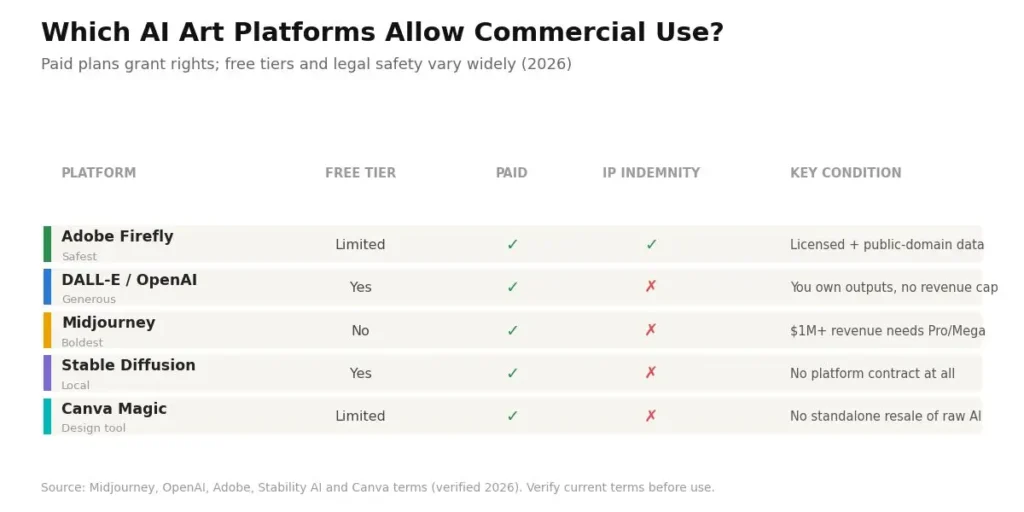
Most major AI art platforms grant commercial rights to paid subscribers, but the specifics of free tiers, revenue thresholds, ownership, and legal protections vary widely.
The table below sums up where the big tools stand in 2026. Verify the current terms on each platform before you build a business on it, as they often change.
| Platform | Free-tier commercial use | Paid-plan commercial use | Key condition | IP indemnity |
|---|---|---|---|---|
| Midjourney | No (non-commercial CC BY-NC 4.0) | Yes | Companies over $1M gross revenue must use Pro or Mega | No |
| DALL-E / OpenAI | Yes | Yes | User owns outputs; OpenAI keeps no copyright | No |
| Adobe Firefly | Limited | Yes | Trained on licensed and public-domain data | Yes (qualifying enterprise/paid plans) |
| Stable Diffusion (local) | Yes | Yes | No platform contract on outputs at all | No |
| Canva Magic Studio | Limited | Yes | Restrictions on standalone resale of raw AI assets | No |
Here is the plain-language version of each.
Midjourney
Midjourney grants commercial rights to every paid subscriber, and its terms were updated in February 2026 to state that users own their outputs and that Midjourney will not assert copyright over them.
Free-trial output is licensed under a non-commercial Creative Commons license, so free users cannot sell.
There is one condition that catches larger operations. Companies with more than $1,000,000 in gross annual revenue must be on the Pro ($60/month) or Mega ($120/month) plan to use Midjourney commercially.
The threshold is based on the entity’s gross revenue, not profit, so a designer at a $5M agency needs the higher tier even for internal work. Midjourney offers no IP indemnification, meaning if a claim lands, you handle it.
DALL-E / OpenAI
OpenAI grants full commercial ownership of images generated by DALL-E and ChatGPT, and this applies to both free and paid users. You own the outputs and can use them commercially without a separate license fee.
That is unusually generous compared to competitors. But remember the copyright layer still applies: OpenAI giving you “ownership” of the file does not hand you a US copyright that survives the human-authorship test. You can use it freely; you may still not be able to stop others from copying it.
Adobe Firefly
Adobe Firefly is the standout for legal safety, because it is trained only on licensed Adobe Stock content, openly licensed material, and public domain works, and it offers IP indemnification on qualifying paid plans.
Indemnification means Adobe agrees to defend you if someone claims a Firefly output infringes their copyright.
The protection is real but narrower than the marketing suggests. It generally covers copyright claims on the output for enterprise and qualifying Creative Cloud plans.
It does not cover free-tier outputs, use through third-party API wrappers, or trademark and right-of-publicity claims.
And if you prompt for a real person, a brand, or a trademarked character, you break Adobe’s guidelines and lose the indemnity. Get the exact scope and any damages cap in writing for the seat you are buying.
Stable Diffusion and Open-Source Models
Stable Diffusion and similar open-source models run locally, so there is no platform agreement governing your outputs at all.
The model license lets you use the software, but no one claims or grants rights to the specific images you generate on your own hardware.
That gives you maximum freedom and zero safety net. No platform will indemnify you, and no contract clarifies your commercial rights, because there is no contract. For serious commercial work, that trade-off cuts both ways.
Canva, Leonardo, and Others
Most newer generators follow the Midjourney model: paid plans include commercial rights, free tiers do not.
Canva’s Magic Studio permits commercial use but restricts standalone resale of raw AI assets under its Content License Agreement.
Always read the specific plan terms, because they shift frequently and a six-month-old blog post about them may already be wrong.
How Do You Legally Use AI Art Commercially?
- Confirm your plan includes commercial rights.
Open your platform’s terms of service and verify commercial use is covered for your specific tier. Check whether a revenue threshold applies to your business. If you see this in writing, you have cleared the permission gate. - Check what your platform prohibits.
Look for bans on generating real people, living-artist styles, trademarks, and certain content types. Prompting around these is where most legal exposure actually comes from, so screen your prompts before you generate. - Add meaningful human creative input.
Do not stop at a single prompt. Iterate the prompt, generate multiple options, select deliberately, then edit: adjust composition, color-grade, composite elements, or combine the output with your own design work. This is what builds a copyright claim. - Review the output before publishing.
Scan for accidental logos, watermarks, trademarks, or recognizable faces you do not have rights to. Run a reverse image search on high-distribution assets to catch anything that closely mirrors an existing work. - Document your process.
Save your prompt iterations, the outputs you rejected and why, your editing steps, and dated copies of the platform terms. This log is your evidence of human authorship if anyone ever questions it. - Disclose where required.
If you are distributing in the EU, or selling on a marketplace that mandates it, label the content as AI-generated. More on that below.
Each step feeds the next. Permission clears you to use the tool, prompt screening keeps you out of infringement territory, human input earns you a copyright, review catches accidental problems, and documentation proves the whole chain if challenged.
Can You Sell AI Art on Etsy, Amazon, and Print-on-Demand Sites?
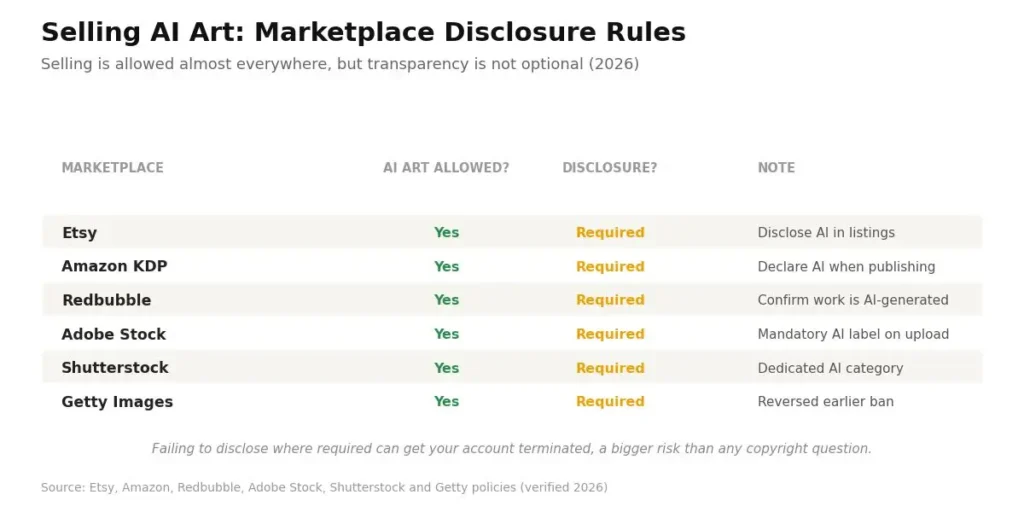
Yes, you can sell AI art on most marketplaces and print-on-demand platforms, but disclosure rules differ sharply by site and getting them wrong risks account suspension.
There is no law against selling AI art anywhere in the US. The rules that bite are the platform policies, not the statutes.
| Marketplace | AI art allowed? | Disclosure required? | Notes |
|---|---|---|---|
| Etsy | Yes | Yes | Must disclose AI involvement in listings |
| Amazon KDP | Yes | Yes | Requires you to declare AI content when publishing |
| Amazon Merch | Restricted | Case-by-case | Obvious low-effort AI listings often rejected |
| Redbubble | Yes | Yes | Requires confirmation that work is AI-generated |
| Society6 | Yes | Varies | Check current AI policy before listing |
| Adobe Stock | Yes | Yes | Mandatory AI labeling on submission |
| Shutterstock | Yes | Yes | Dedicated AI content category with disclosure |
| Getty Images | Yes | Yes | Reversed its earlier ban; now disclosure-based |
The pattern is consistent. Selling is allowed, but transparency is not optional. Failing to disclose when a platform requires it can get your account terminated, which is a far bigger practical risk than any copyright question.
Print-on-demand physical products like t-shirts, mugs, and posters are generally permitted for commercial use on most paid AI subscriptions. Still, verify two things: that your generator’s plan allows print-on-demand and resale specifically, and that the marketplace accepts AI content.
Some services prohibit the resale of raw AI images as standalone products, even when they allow other commercial uses. Stock photography is the highest-complexity case. Beyond each site’s disclosure rules, you have to ask whether you can legally grant commercial licenses to buyers under your platform’s terms.
Misrepresenting the rights you are selling creates liability, and the clean ownership chain that stock buyers expect is exactly what is murky for raw AI outputs.
Do You Have to Disclose That Art Is AI-Generated?
Disclosure is legally required in some situations and merely recommended in others, so it depends on where you operate and where you sell. There is no single global rule, which is why creators get confused.
The clearest legal mandate comes from the EU. The EU AI Act, in force since August 1, 2024, includes transparency obligations requiring labeling of AI-generated content in certain commercial contexts distributed within the EU.
If your work reaches EU audiences, plan for a disclosure notice. In practice, a small label on your site or in your marketing materials is usually enough, though individual member states may interpret the requirement differently.
In the US, there is no blanket federal law forcing you to disclose AI-generated images. But three other layers can still apply. Platforms like Etsy, Amazon KDP, and the major stock sites impose their own disclosure rules as shown above.
Advertising and endorsement standards can require honesty about how content was made when it could mislead consumers. And several US states are actively weighing AI-labeling legislation, so the direction of travel is toward more disclosure, not less.
My take, and it is a slightly contrarian one: voluntary disclosure is becoming a competitive advantage rather than a liability.
Clients increasingly appreciate knowing exactly how much human work went into a deliverable, and building the habit now saves you from scrambling to retrofit labels across a catalog later when a market you sell into makes it mandatory.
What Are the Real Legal Risks of Using AI Art Commercially?
The biggest practical risks are trademark and likeness problems and accidental similarity to training data, not the copyright-registration question that dominates most articles.
This is where I part ways with a lot of the guides out there. Everyone obsesses over “do I own it,” while the risks that actually generate legal letters get less attention.
Here is how I would rank the real exposure, highest to lowest for a typical commercial user:
- Trademark, brand, and right-of-publicity claims.
If your prompt produces a recognizable logo, a trademarked character, or an identifiable real person, you can face a direct claim regardless of copyright. This is the fastest way to get sued and the easiest to avoid: do not prompt for real people, brands, or copyrighted characters. - Accidental similarity to copyrighted training data.
Diffusion models can occasionally output images that closely resemble specific copyrighted images from their training set, especially for heavily represented subjects. If that image is used in a commercial campaign, the original rights holder could pursue you as the publisher. Reverse image search before publishing is cheap insurance. - Style mimicry of living artists.
Prompting “in the style of [living artist]” sits in a gray zone. Artistic style is generally not copyrightable, but doing this at commercial scale invites trademark, unfair-competition, and reputational trouble. Dead-artist styles are safer, though not perfectly clean. - Loss of exclusivity (the copyright question).
Real, but usually the least urgent. If your image lacks copyright protection, a competitor can legally reproduce a similar image, and you have limited recourse. It is a business problem, not a lawsuit problem.
Notice that the top three are all about what is in the image, and the fourth is about what you can do with it afterward.
Most creators spend their worry budget on number four and almost none on numbers one through three, which is backward.
How Do You Strengthen Your Copyright Claim on AI Art?
You strengthen a copyright claim by increasing the amount and visibility of genuine human creative decisions in the final work.
The closer your contribution is to the expressive choices you can actually see in the finished image, the stronger your position.
Practically, that means moving your work up a spectrum of involvement:
- Low involvement (weak claim): one prompt, output used as-is. Almost never protectable.
- Moderate involvement (uncertain): detailed iterative prompting, selecting from many outputs, compositing pieces together, minor manual corrections. Jurisdiction-dependent.
- High involvement (strong claim): AI used as one tool inside a mostly human-directed process, with significant manual creation, editing, and arrangement. The AI output is one element among many.
Concrete moves that help: composite multiple generations into a new arrangement, add original elements like your own text, illustration, or photography, color-grade and retouch with real creative judgment, and use inpainting to reshape specific areas.
Mechanical tweaks, like a one-click filter, usually aren’t enough. Creative modifications, such as painting over portions or combining outputs into an original composition, carry real weight.
Pro tip: keep a dated creative log for every commercial piece, even a rough one. Prompt versions, rejected outputs with your reasoning, and editing history are exactly the evidence that supports a registration or defends against a copycat.
Almost nobody does this, and it costs nothing but a few minutes.
What Should Go in a Client Contract When You Use AI Art?
A client contract using AI art should explicitly state that AI tools were used, who owns the resulting rights, and that the client accepts the limited copyright protection those assets carry.
Silence on AI usage is a liability exposure for both sides, and it is the clause creators most often forget.
At minimum, spell out four things. State plainly whether AI tools contributed to the deliverable. Define who owns what, and be honest that a raw AI output may carry no transferable copyright to hand over.
Set expectations about protection, so the client understands they may not be able to stop others from using similar imagery. And allocate risk, noting who is responsible if a claim arises.
If you are being paid to produce work the client wants to trademark or treat as a core brand asset, that raises the stakes.
For those, either lean on a platform with indemnification like Adobe Firefly, or make sure the human creative contribution is heavy and thoroughly documented, and consider looping in an IP attorney.
Transparency here protects you as much as the client. One thing I have watched happen repeatedly: a delivered creative-process document alongside the final files turns the AI conversation from a liability into a selling point.
In My Experience
Honestly, when I first started delivering AI-assisted images for client projects, I treated the platform’s “commercial rights included” line as the finish line. It was actually the starting line.
The moment a client asked whether they could stop a competitor from reusing a hero image, I realized that permission and protection were two entirely different conversations, and I had only been having one of them.
What surprised me most was how much the documentation mattered, not the artwork. On one product-imagery project, the deliverables that felt safest later were not the prettiest ones.
They were the ones where I had kept the prompt history, the rejected variants, and a clear record of the compositing and color work I did on top.
When a question came up months later about whether the work was “really ours,” that folder answered it in about thirty seconds.
The frustrating part is that none of this is intuitive. You expect the legal weight to live in the image. It actually lives in the process behind the image, and in the fine print of a terms-of-service page nobody reads until something goes wrong.
Common Pitfalls to Avoid
Most AI art-related legal trouble stems from a handful of avoidable mistakes. These are the ones I see repeatedly, and why they happen.
- Using free-tier outputs commercially.
People assume a downloaded image is theirs to sell. On many platforms, the free tier grants no commercial rights, and the fix is simply upgrading to a paid plan before you publish anything for money. - Confusing “I own the file” with “I own the copyright.”
A platform granting ownership of the output is not the same as holding a US copyright. This misunderstanding leads creators to promise clients exclusivity they cannot deliver. - Prompting for real people, brands, or characters.
This is the fastest route to a legal letter, and it’s because the prompt is fun and the output looks great. Screen every commercial prompt for trademarks and likenesses first. - Skipping marketplace disclosure.
Sellers list on Etsy or Amazon KDP without declaring AI involvement, then lose the account. The rules are public, and the disclosure takes seconds, so there is no upside to hiding it. - Ignoring the revenue threshold.
Growing businesses stay on a cheap Midjourney tier past the $1M in gross revenue, quietly falling out of compliance. If your company crosses it, upgrade proactively. - No creative documentation.
Creators generate, deliver, and keep nothing. Then when they need to prove human authorship or defend against a copycat, there is no evidence to point to.
Workflow Example: Producing a Commercially Safe AI Product Image
Here is a realistic end-to-end flow, shown as Input, Process, Output, and Result, so you can see how the pieces connect in practice rather than in theory.
Input: A skincare brand needs a hero image for a new serum. You are on a paid Midjourney plan (company with revenue under $1M, so Standard is fine), and you have a creative brief specifying a clean, minimal aesthetic with a specific color palette.
Process: You write a detailed prompt that reflects the brief, then iterate it 15 times, refining the composition and lighting. You generate roughly forty variations and select five.
You composite elements from two of them, add the brand’s own product-bottle photograph on top, color-grade to match the palette, and retouch by hand.
You run a reverse image search on the final composite. You save every prompt version, the rejected outputs, and your editing history in a dated project folder.
Output: A finished hero image that combines AI-generated background elements with the client’s original product photography and your manual creative direction, plus a documentation folder proving the human contribution.
Result: The brand gets a production-ready asset it can use commercially with confidence.
Because the work carries substantial human authorship, the copyright position on the composite is defensible, the client contract can honestly address ownership, and if anyone questions the provenance later, the folder settles it.
The raw AI background alone would not have been protectable; the combined, human-directed work is a much stronger asset.
How Does AI Art Copyright Differ by Country?
AI art copyright is not harmonized globally, and the same image can carry different protection depending on the country, which matters if you sell internationally.
The spread between the strictest and most permissive jurisdictions is wide enough to change your rights.
- United States: Human authorship required. Pure AI outputs are not registrable. Commercial use is broadly permitted regardless of copyright status. This is the standard most of this guide describes.
- European Union: The EU AI Act adds transparency labeling but does not create a new copyright framework. Protection is judged against the CJEU’s “author’s own intellectual creation” standard, which pure prompting generally fails to meet. Member states vary on the details.
- United Kingdom: The UK is the notable outlier. Its Copyright, Designs and Patents Act includes a “computer-generated works” provision (section 9(3)) granting a 50-year term to whoever made the arrangements for the work’s creation. That is more permissive than the US or EU, though whether modern prompting counts as “making the arrangements” remains untested.
- China: Chinese courts have recognized copyright in AI-generated images when users provide creative input through prompting, a more permissive reading than the US position, though it is not yet unified nationally.
- Japan: Japan is notably friendly to AI training on copyrighted works under broad exceptions. Its position on output copyright follows a human-authorship approach and is less firmly defined.
For teams operating across borders, the safest strategy is to meet the highest applicable standard, which, in practice, means ensuring significant human creative contribution to anything you want protected, anywhere.
Frequently Asked Questions
Yes, in most cases. No US law bans the sale of AI art. You need a platform plan granting commercial rights, and you must follow each marketplace’s disclosure rules. Copyright protection for the art itself is a separate question.
Usually no on major paid platforms. Tools like DALL-E, Midjourney (paid tiers), and Firefly grant you ownership or full usage rights to outputs. Free tiers often differ, with some platforms retaining rights or limiting use to non-commercial purposes.
It depends where you operate. The EU AI Act requires disclosure in some commercial contexts. The US has no blanket federal rule, but marketplaces like Etsy, Amazon KDP, and stock sites require it. Voluntary disclosure is a smart practice.
Potentially, yes. Substantial human editing, compositing, the addition of original elements, or significant transformation can make the resulting work copyrightable for the human-authored parts. Raw, unmodified AI output generally cannot be copyrighted in the US under current 2026 rules.
The original rights holder could pursue an infringement claim against you as the commercial user. Similarity to training data is a real risk. Running a reverse image search before publishing high-distribution assets helps catch obvious matches early.
This guide is for general educational purposes and reflects the legal landscape as of mid-2026. It is not legal advice. AI copyright law is evolving quickly, and specifics vary by jurisdiction. For high-value commercial work or client IP transfers, consult a qualified intellectual property attorney.

Is an SEO Specialist and AI Tools Researcher with over 4 years of hands-on experience in search engine optimization. As the founder of Smart AI Helper Pro, he tests and reviews AI writing, SEO, and marketing tools to help creators and business owners grow faster with practical, research-backed strategies.