How to Start an AI Agency in 2026 (Step-by-Step Guide for Beginners)
By SM Mehedi Hasan

You start an AI agency by picking one narrow niche, packaging a single high-value service, building two proof projects, and landing paid pilots through direct outreach. Most solo founders launch for under $10,000 and sign a first paying client within 30 to 90 days, with no computer science degree required.
The demand is real, and it is bigger than most people building agencies right now realize. Businesses know they need AI. Very few can actually deploy it.
That gap is the entire opportunity, and this guide walks you through closing it, from choosing your niche to charging your first invoice, using pricing and market data verified for 2026.
Table Of Contents
ToggleWhat Is an AI Agency and What Does It Actually Do?
An AI agency is a service business that helps other companies plan, build, and run AI systems they cannot build themselves. Think automation, chatbots, custom workflows, and data-driven decision-making tools, delivered as a done-for-you service rather than software the client has to figure out on their own.
Most people assume an AI agency needs a lab full of machine learning PhDs. In reality, the majority of paid work in 2026 is far more practical: connecting an existing model like GPT or Claude to a client’s real business process and making it reliable.
You are the bridge between a powerful model and a messy, specific business problem. The value you sell is not the AI. It is the outcome. A dental office does not want a chatbot. They want fewer no-shows and a front desk that stops drowning in phone calls. When you frame your service that way, you stop competing on technical buzzwords and start competing on results, which is where the money is.
What Is the Difference Between an AI Agency and an AI Automation Agency?
An AI automation agency is a specific type of AI agency focused on automating repetitive tasks using no-code and low-code tools.
The broader term “AI agency” covers everything from automation to custom development to strategy consulting. So every AI automation agency is an AI agency, but not every AI agency is an AI automation agency.
Here is why the distinction matters for you as a beginner. Automation agencies (often called AAAs) have the lowest barrier to entry because you can deliver real value with platforms like Make, n8n, and Zapier without writing much code.
Custom development agencies charge far more but need actual engineering skill. Knowing which lane you are entering shapes your pricing, your learning path, and your first client conversations.
And you do not have to pick forever. Plenty of founders start as an automation agency, build proof, then move upmarket into custom builds once they can afford to hire.
What Services Do AI Agencies Actually Sell in 2026?
The most common AI agency services in 2026 are workflow automation, customer support chatbots, sales and lead-generation systems, content and marketing automation, and custom AI agents that take actions across tools. Each maps to a clear, measurable business pain.
Here is a quick view of the main service types and who buys them:
| Service | What it does | Typical buyer |
|---|---|---|
| Workflow automation | Removes manual, repetitive tasks | SMBs drowning in admin |
| Support chatbot | Deflects and resolves customer tickets | High-volume support teams |
| Sales / lead-gen system | Finds, qualifies, and follows up on leads | B2B sales teams |
| Custom AI agent | Takes multi-step actions across tools | Mid-market and enterprise |
The unlock in 2026 is agentic AI. These are systems that do not just answer questions; they act: calling APIs, updating records, moving a task from step one to step five on their own.
This shift is exactly why buyers are paying more this year than they did for basic chatbots in 2024, and why a well-positioned agency can charge accordingly.
What Are the Main Types of AI Agencies?
The main types of AI agencies are automation, marketing, sales, development, and consulting, each serving a different client need and requiring a different skill set.
Knowing which type fits your background helps you enter the market where you can win fastest rather than where competition is thickest.
What Is an AI Automation Agency?
An AI automation agency implements no-code and low-code systems that remove repetitive manual work. This is the most beginner-friendly type because you can deliver strong results with tools like Make, n8n, and Zapier without deep engineering.
Common deliverables include email automation, customer service workflows, data entry elimination, and internal process automation. Setup projects usually run $2,500 to $15,000, with monitoring retainers from $500 to $5,000 a month.
The appeal here is speed-to-value. A small business feels the impact of good automation within days, which makes your work easier to sell and prove. If you are unsure where to start, this is usually the smartest entry point.
What Is an AI Marketing Agency?
An AI marketing agency applies AI to tasks such as content creation, ad optimization, personalization, and customer analytics. These agencies use models for copy and creative, plus custom logic for targeting and campaign optimization.
Because outcomes tie directly to leads and revenue, AI marketing services often command rates 20% to 50% higher than traditional marketing services. Marketing professionals have a real edge here.
You already understand campaigns, funnels, and client relationships, so you are adding AI to a foundation you already have rather than learning a whole new business.
What Is an AI Sales Agency?
An AI sales agency drives revenue by automating lead generation, prospecting, follow-up, and sales-data analysis. These agencies often layer AI sales tools and AI SDR systems on top of a client’s existing pipeline to find high-potential leads and handle outreach at scale.
The value proposition is direct: more qualified conversations without more headcount. This type suits anyone with a sales or business-development background, because you understand what a good lead looks like and how deals actually close.
What Is an AI Development or Consulting Agency?
An AI development agency builds custom solutions from scratch, while a consulting agency provides strategy and roadmap guidance. Development agencies handle custom models, complex integrations, and bespoke agents, commanding the highest fees, often $45,000 to $120,000 for mid-market builds and far more for enterprise.
Consulting agencies charge for expertise, with hourly rates ranging from $75 to $500 and retainers from $5,000 to $25,000 per month.
Both require more depth than automation work. Development requires genuine engineering skills, and consulting requires a track record that a beginner usually does not have yet. Most founders grow into these; they do not start here.
Here is how the types compare at a glance:
| Agency type | Entry difficulty | Typical pricing |
|---|---|---|
| Automation | Beginner-friendly | $2,500 to $15,000 build |
| Marketing | Moderate | 20 to 50% above traditional |
| Sales | Moderate | Retainer plus performance |
| Development | Advanced | $45,000 to $120,000+ |
Is It Too Late to Start an AI Agency in 2026?
No, it is not too late, and the numbers make that clear.
The global AI agents market is projected to grow from around $10.9 billion in 2026 to $182.9 billion by 2033, with a compound annual growth rate of nearly 49.6%, according to Grand View Research.
North America alone holds close to 40% of that market. The broader artificial intelligence market is forecast to exceed $600 billion in 2026 and reach $3.6 trillion by 2033, per MarketsandMarkets.
But market size alone is a lazy answer, so here is the honest part most guides skip. Adoption is wide, and execution is thin. Roughly 88% of organizations now use AI in at least one function, and about 72% have at least one AI workload in production as of early 2026.
Yet only a small single-digit percentage qualify as true AI high performers who actually capture value at scale. That gap between “we use AI” and “we get results from AI” is where paying clients live.
There is a catch worth respecting. Gartner projects that more than 40% of agentic AI projects could be canceled by the end of 2027, largely due to unclear ROI, weak data quality, and runaway costs.
Around half of enterprises cite data quality as their single biggest blocker. This is not a reason to stay out. It is a reason to be the agency that scopes tightly, proves ROI early, and does not overpromise.
The founders who win this cycle move deliberately, not fastest. So the market is huge, the failure rate is real, and specialists who deliver measurable outcomes are in short supply. That is close to an ideal setup for a focused newcomer.
How Do You Start an AI Agency Step by Step?
- Pick one narrow niche.
- Choose a single, specific offer.
- Learn just enough skill and build your stack.
- Build two proof projects.
- Set up your legal and business basics.
- Price your service with a clear model.
- Land your first clients through direct outreach.
- Deliver hard, then systematize.
Each step below explains why it matters, exactly what to do, and what you should see afterward before moving on.
Step 1: How Do You Choose a Profitable AI Agency Niche?
Choose a niche by pairing one industry you understand with one repeatable, expensive problem that industry keeps hitting. This is the single most important decision you will make, and generalists lose here almost every time. Why it matters: a generalist “we do AI for anyone” agency competes with offshore providers and every other beginner on price.
A specialist who says “I cut no-shows for dental clinics using AI reminders” is instantly more credible and closes faster. Research and agency operators consistently report that named, specific solutions convert better than broad AI transformation pitches.
What to do: list your existing expertise, industries you have worked in, and problems you have seen firsthand. Then run a simple filter. A good niche has enough reachable businesses sharing the same pain, a buyer who can approve a pilot without a committee, and a problem painful enough that they will pay this quarter.
What you should see: after this step, you can finish the sentence “I help [specific businesses] achieve [specific outcome] using AI.” If you cannot say it in one clean line, you have not narrowed enough yet.
Pro Tip: Validate before you commit. Talk to 10 to 15 potential clients in your target niche and ask about their current bottlenecks and budget. Five real conversations will teach you more than fifty hours of market research.
Step 2: What Offer Should a New AI Agency Lead With?
Lead with one specific, productized offer, not a menu of services.
When you are learning how to start an AI automation agency, a single clear offer is easier to explain, easier to price, and easier to deliver consistently than a buffet of “we can do anything.”
Here is the reasoning. A buyer who hears “we do custom AI solutions” has no idea what they are buying or what it costs.
A buyer who hears “we build a support chatbot that resolves 60% of your tier-one tickets, live in three weeks, for a fixed fee” can say yes today. Specificity removes friction from every stage of the sale.
Pick an offer where value is visible fast. Support deflection, sales follow-up automation, and lead qualification all show ROI quickly because the client can see time saved or leads gained within weeks.
Avoid vague “AI strategy” as a first offer, because strategy is hard to prove and hard to price when you have no track record.
Compared to the scattered approach most beginners take, a single sharp offer also makes your marketing feel more impactful. Every post, every message, every case study points at the same promise, and repetition builds trust.
Step 3: What Skills and Tools Do You Need to Start?
You need working knowledge of your chosen tools, not a degree, plus a lean starter stack. For an automation-focused agency, that means mastering one automation platform, one AI model provider, and a handful of business tools. Dedicate 20 to 30 focused hours, and you can be dangerous enough to deliver.
The skills that matter most in 2026 are prompt engineering (writing instructions that get reliable outputs), basic API integration (connecting an AI model to a client’s tools), and data handling (cleaning and preparing the information the AI will use). Notice that none of these require you to train a model from scratch. You are orchestrating existing ones.
Here is a lean starter stack that will not overwhelm you:
| Layer | Tool options | Rough monthly cost |
|---|---|---|
| Automation | Make, n8n, Zapier | $0 to $50 |
| AI model | OpenAI, Anthropic Claude | Usage-based, $20 to $200 |
| CRM | HubSpot free, Pipedrive | $0 to $30 |
| Payments | Stripe | Per-transaction |
So the honest truth on skills: aim for competence, not mastery. Most successful founders learn their advanced techniques after landing the first client, on the client’s real problem, not before.
Step 4: How Do You Build Proof With No Clients Yet?
Build two or three demonstration projects that solve a real problem in your niche, because clients hire proof, not promises. A working demo showing a 24/7 AI booking system beats any amount of “trust me, I can build this.”
Why this comes before outreach: your first sales conversations will die instantly without something to show. A short screen recording of your system handling a realistic scenario is the single most persuasive asset a new agency can own.
It turns an abstract pitch into a concrete “here is exactly what you get.”
What to do: build the demo around your niche’s actual pain. Targeting restaurants? Build a reservation and FAQ agent.
Targeting e-commerce? Build a product-recommendation or order-status bot. Document each one with before-and-after context: how long the manual process took, and what the AI now handles.
Consider offering your very first build to one friendly business at cost or free in exchange for a testimonial and permission to use real numbers.
That single case study, with a real name and a real result, often pays for itself within a month or two through the credibility it buys you.
Step 5: What Legal and Business Setup Does an AI Agency Need?
Set up a limited liability company, get an EIN, open a business bank account, and prepare basic contracts before you take real client money.
Operating without a legal entity exposes your personal assets, and that risk is not worth saving a few hundred dollars.
In the United States, an LLC is the standard choice for most new agencies because it protects personal assets and simplifies tax filings.
Formation costs roughly $50 to $200 filing directly with your state, or $300 to $500 through a service like LegalZoom or Stripe Atlas if you want it handled for you.
You will also want a business email, a simple one-page website, and lightweight accounting software.
The contracts matter more than beginners think. At minimum, you need a services agreement that defines the scope, payment terms, and who owns what, plus a statement of work for each project.
Because AI systems touch client data, clarify intellectual property ownership and data handling in writing. Spending $500 to $1,500 on a lawyer to review your templates prevents disputes that can cost far more later.
One 2026-specific note: if you serve regulated industries like healthcare or finance, or European clients, compliance is not optional.
HIPAA, GDPR, and the EU AI Act all carry real obligations. You do not need to be an expert on day one, but you do need to know when a project requires them.
Pro Tip: Do not let legal setup become procrastination. You can validate demand and even run a pilot while your LLC paperwork is being processed.
Just make sure the entity and contracts are in place before money and client data start flowing.
Step 6: How Do You Price AI Agency Services in 2026?
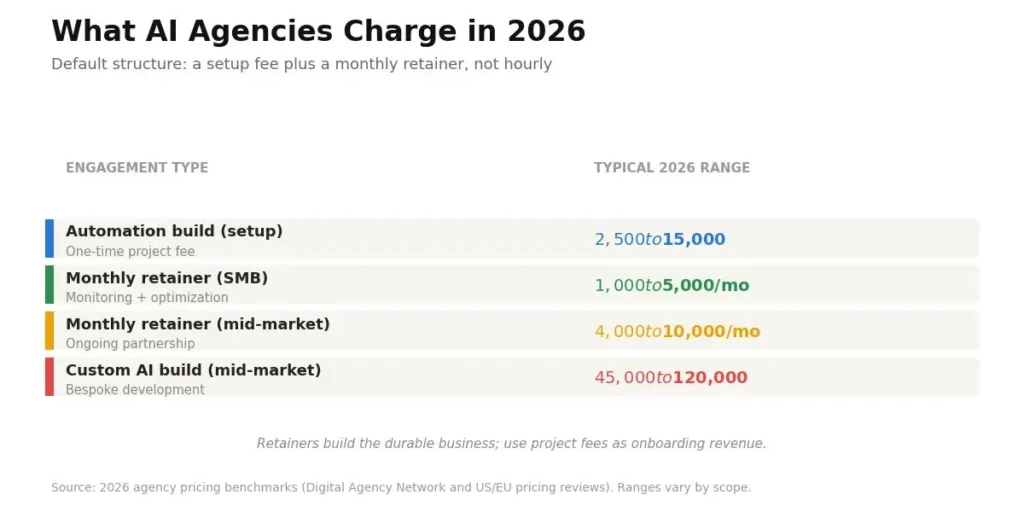
Price with a clear model tied to value, using a setup fee plus a monthly retainer as your default structure. The 2026 market has largely moved past hourly billing, because AI makes you faster and hourly rates punish speed. You want to charge for outcomes, not time.
Based on verified 2026 benchmarks from sources including Digital Agency Network and multiple US and EU agency pricing reviews, here is what agencies are actually charging this year:
| Engagement type | Typical 2026 range |
|---|---|
| Automation build (setup) | $2,500 to $15,000 |
| Monthly retainer (SMB) | $1,000 to $5,000 |
| Monthly retainer (mid-market) | $4,000 to $10,000 |
| Custom AI build (mid-market) | $45,000 to $120,000 |
A few patterns worth internalizing. The median monthly retainer for small- to mid-market businesses across the US and EU is roughly $2,800 to $7,000. Setup fees typically range from $2,000 to $12,000, and some agencies waive them in exchange for a six-month retainer commitment. Consulting hourly rates span a wide range, from $75 to $500 depending on seniority and firm overhead.
The model that builds a durable business is the retainer. Agencies that earn the majority of revenue from retainers report meaningfully higher margins than project-only peers, because recurring revenue is predictable and clients start treating you as a partner rather than a vendor.
Use project fees as your onboarding revenue, then convert satisfied clients to monthly retainers for monitoring and optimization. One honest pricing rule: always present three options, and anchor your real price in the middle. Clients rarely choose the cheapest option, and the premium tier makes your standard offer look reasonable.
Step 7: How Do You Get Your First AI Agency Clients?
Get your first clients through direct, personalized outreach and warm introductions, not by waiting for inbound traffic.
For a brand-new agency with no reputation, proactive outreach closes far faster than content marketing, which takes months to gain traction.
Start with the people who already trust you. Announce your new service to former colleagues, past clients, and industry contacts.
Warm introductions convert at many times the rate of cold outreach, so exhaust your network before spending a dollar on ads. This is the fastest path to that critical first paying project.
For cold outreach, specificity wins. Compare these two messages. Weak: “We offer AI solutions for your business.” Strong: “I noticed your team manually sorts around 200 support tickets a day.
I built a system that handles 70% of that first-pass sorting for similar companies, cutting response time from four hours to twelve minutes.
Worth a quick call?” The second one references a real problem and a real number, and it gets replies.
Here is a 2026 angle almost no competitor mentions, and it can become your unfair advantage: generative engine optimization.
Buyers increasingly discover vendors through AI assistants, and earned media and mentions drive far more AI citations than your own website does.
Getting your agency mentioned in industry roundups, podcasts, and partner content quietly feeds the AI systems your future clients are using to ask for recommendations. Start building that footprint early.
In My Experience: What Actually Happens on Your First Build
Honestly, when I first walked through a real agency workflow end to end, the part that surprised me was how little of the work was “AI” and how much was plumbing.
You spend maybe 20% of your time on the model and 80% on connecting messy data, handling edge cases, and getting a human sign-off in the right place.
The single biggest lesson: data quality quietly decides whether a project succeeds or embarrasses you.
A client will swear their records are clean, and then you open the export and find duplicate contacts, half-empty fields, and three date formats in one column.
Budget 20% to 40% of your project time for data cleaning before you ever touch the automation, and make that clear in the proposal so it never feels like scope creep.
One thing that catches new founders off guard is how much clients value a visible “human in the loop.” For anything touching money, medical records, or legal text, adding an approval step before the AI acts is not a weakness.
It is exactly what makes cautious buyers say yes, because it keeps audits clean and gives them a sense of control. That small design choice has closed more deals than any clever prompt.
How Do You Land and Deliver a First Client? A Real Workflow Example
Here is a complete Input-to-Result flow using a realistic first engagement, so you can see the full shape of the work rather than just theory.
Input: A 12-person accounting firm spends roughly 100 hours a month manually sorting, tagging, and routing incoming client documents (PDFs, receipts, forms) that arrive through email.
At their loaded staff rate, manual handling costs the firm around $3,000 to $3,500 per month and delays client work.
Process: You scope a fixed, bounded project. You build a workflow in an automation platform with an AI classification layer that reads each incoming document, identifies its type, extracts key fields, flags anything unusual for human review, and routes it to the right folder and team member.
You spend the first stretch cleaning and standardizing their existing document labels, then build and test in a staging setup before touching anything live.
Output: The system goes live in about five to six weeks. It automatically handles roughly 75% of incoming documents without human intervention, while flagged exceptions are routed to a person for quick approval.
You deliver documentation and a short training session so the team is not dependent on you for basic questions.
Result: Manual handling drops by around three-quarters, recovering a large share of that monthly cost. You charged a fixed project fee in the low five figures plus a modest monthly retainer for monitoring and quarterly improvements.
The firm keeps you on retainer because the next bottleneck is already visible, and they refer you to two peer firms because the result was specific and measurable.
That referral is your second and third client, earned without a single cold email.
That is the loop you are trying to build: land one tightly scoped win, document the number, convert to retainer, and let the result generate the next client.
Step 8: How Do You Systematize After Your First Wins?
Systematize by turning your first three to five projects into repeatable templates, packages, and documented processes.
Treating every project as fully custom slows you down, crushes your margins, and makes it impossible to ever bring on help. Productization is how a solo hustle becomes an actual agency.
After a handful of similar builds, patterns emerge. The same onboarding questions, the same integration steps, the same client questions during handoff.
Capture all of it: proposal templates, a standard project checklist, a delivery playbook, and a client onboarding doc. This is boring work, and it is the difference between a business and a job you cannot leave.
Once your processes are documented, you can make your first hire without chaos, usually a virtual assistant or junior builder who handles routine tasks so you focus on sales and high-value delivery.
Most agencies make that first hire only when they are turning down work or quality is slipping, not before.
How Much Does It Cost to Start an AI Agency?
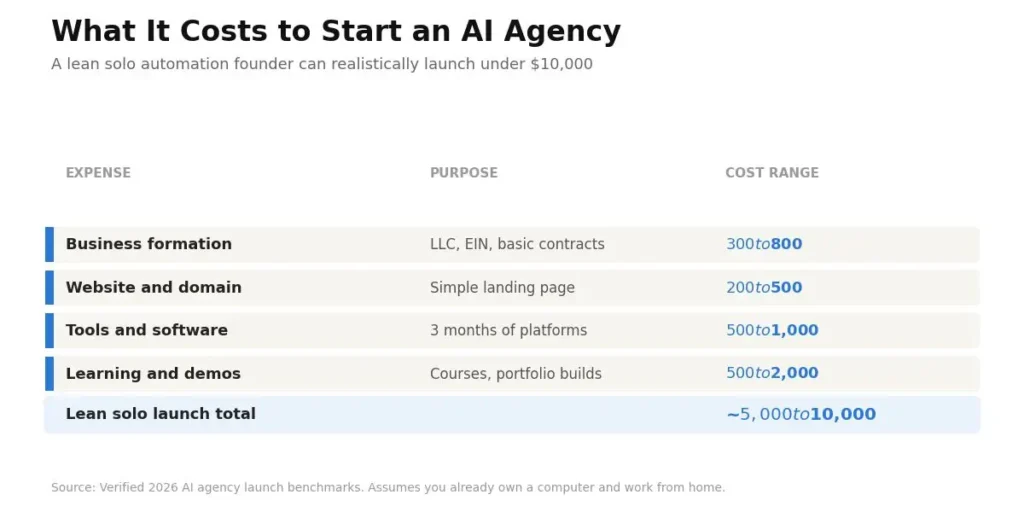
Starting an AI agency costs between $5,000 and $50,000 depending on scale, and a solo automation-focused founder can realistically launch for under $10,000.
There is no inventory, no equipment, and no storefront, so your real investments are skills, tools, and time. That low barrier is a major reason this business is attracting so many newcomers.
Here is what a lean solo launch actually looks like:
| Expense | Purpose | Cost range |
|---|---|---|
| Business formation | LLC, EIN, contracts | $300 to $800 |
| Website and domain | Simple landing page | $200 to $500 |
| Tools and software | 3 months of platforms | $500 to $1,000 |
| Learning and demos | Courses, portfolio builds | $500 to $2,000 |
Add a modest buffer for outreach tools and unexpected costs, and most solo founders land in the $5,000 to $10,000 range, assuming they already own a computer and work from home.
Many start with even less by leaning on free tool tiers until paying clients justify upgrades. A standard launch with professional branding and some custom capability runs closer to $15,000 to $30,000. This buys a polished website, six months of subscriptions, better lead generation, and more thorough legal and accounting setup.
It makes sense if you want to present a serious brand from day one rather than bootstrapping in the open. A premium launch with contractors or early hires can reach $40,000 to $50,000 or more. This only makes sense if you are pivoting an existing business, already have clients lined up, or have raised some funding.
For almost every beginner, starting lean and reinvesting revenue is the smarter, lower-risk path. Do not forget ongoing monthly costs. Between AI API usage, automation platforms, CRM, and accounting, expect roughly $500 to $2,000 a month early on, scaling to a few thousand as your client count grows. Most agencies break even somewhere around $8,000 to $15,000 in monthly revenue.
Pro Tip: Phase your spending against revenue. Use free tiers of every tool until a paying client makes the upgrade obviously worth it. Cash discipline in your first six months buys you the runway to actually reach profitability.
How Long Does It Take to Go From Zero to First Client?
Most founders land their first paying client within 30 to 90 days, though the exact timeline depends on your network, niche, and hours per week. Speed here comes far more from warm connections and a sharp niche than from raw effort, which is worth knowing before you grind yourself into the ground.
An aggressive 30-day timeline is possible if you work close to full-time and can tap into warm relationships. Roughly, you spend the first week on niche selection and validation, the second building one solid demo and your basic setup, the third on heavy outreach and discovery calls, and the fourth closing your first client.
This only works reliably if you already have industry expertise or a strong network to lean on. A standard 60- to 90-day timeline fits most people starting part-time or pivoting careers.
You spend the first couple of weeks on deep niche research and initial learning, then spend the next several weeks building two or three portfolio projects and finishing core training, before moving into a professional setup, outreach campaigns, and sales conversations.
Founders working 20 to 30 hours a week while keeping other income usually land here. A conservative four to six-month timeline applies when you are starting from zero technical knowledge or targeting a heavily regulated niche that requires certifications.
This path trades speed for depth, letting you build real expertise before taking on paying work. It reduces risk, which matters more in high-stakes verticals like healthcare or finance. After that first client, momentum builds through referrals.
Expect to add two to four more clients over the following months, reach a meaningful monthly revenue with a handful of active clients, and hit a sustainable rhythm by the end of your first year with consistent execution.
What Skills and Team Structure Do You Need?
You need a blend of technical, business, and communication skills, and you can start entirely solo. The mistake beginners make is assuming this is a purely technical business.
In practice, the technical work is maybe a third of the job, and client communication and problem framing carry at least as much weight.
On the technical side, aim for competence in prompt engineering, basic API integration, and data handling.
You do not need to train models or write production machine learning code for most agency work in 2026. You need to reliably connect existing models to real business systems and handle the messy edge cases that always appear.
On the business side, you need project scoping, client communication, proposal writing, and basic financial sense. These are what actually get you paid and keep clients happy.
A brilliant build delivered with poor communication and vague scope still produces an unhappy client, while a solid build delivered with clarity and confidence produces referrals.
When should you hire? Bring on help only when you are consistently turning down work or your quality is slipping under the load, not before.
Your first hire is usually a virtual assistant or junior builder handling routine tasks for roughly $2,000 to $4,000 a month part-time.
Your second is often a salesperson or account manager, so you can focus on delivery while someone else fills the pipeline. Building a leadership layer comes much later, once you are consistently at higher monthly revenue.
What Tools Do You Actually Need to Run an AI Agency?
You need one automation platform, one AI model provider, a CRM, a payment processor, and a way to sign contracts. That is genuinely enough to start, and keeping the stack lean keeps your costs and your learning curve manageable.
Here is a practical starter stack and what each piece does:
| Category | Purpose | Common picks |
|---|---|---|
| Automation | Build and run workflows | Make, n8n, Zapier |
| AI model | Reasoning and generation | OpenAI, Anthropic Claude |
| CRM + payments | Track deals, get paid | HubSpot, Stripe |
A word of caution that experienced operators repeat often: do not fall in love with tools. A common beginner trap is spending weeks configuring the perfect stack and building a beautiful website while landing zero clients.
A functional single landing page and a working demo will get you further than any amount of tool tinkering. Invest in solving client problems first, and upgrade your tooling only when real client volume justifies it.
As you grow to serve 10 to 20 active clients, expect total tool costs to climb into the low thousands per month across API usage, automation platforms, and business software. That is fine, because by then those tools are directly tied to revenue.
What Results Can AI Agencies Point To?
AI agencies can point to well-documented results such as major reductions in support resolution time, faster contract review, and near-total elimination of manual document processing. These are the kinds of proof points you use in sales conversations to make an abstract promise feel concrete, even before you have your own case studies.
Take customer support as the clearest example. When Klarna deployed an AI assistant, it handled roughly two-thirds of incoming support chats in its first month, managing around 2.3 million conversations and cutting average resolution time from about eleven minutes to under two.
That scale of deflection is exactly what a support-focused agency sells, and it shows why high-volume, repetitive work is such fertile ground for a first offer. Legal and document-heavy work tells a similar story.
The contract-review platform LawGeex demonstrated the ability to review legal agreements dramatically faster than manual review while maintaining high accuracy, pointing to an opportunity in professional-services automation.
Document classification tools have helped healthcare providers virtually eliminate the manual filing and routing of PDFs that used to eat entire workdays.
Notice the pattern across all three. The winning use cases are high-volume, repetitive, and measurable. That is the sweet spot you want your first offer to sit in, because the ROI is obvious and the client can feel the difference within weeks, not quarters.
When you pitch, borrow this shape: name a specific process, a specific time or cost saved, and a specific payback period. One caution on using outside results: never imply these are your own clients. Present them honestly as what the technology achieves in the market, then let your own small pilot become your first real case study.
Credibility built on honesty compounds. Credibility built on borrowed glory collapses the moment a client checks.
What Are the Most Common Pitfalls When Starting an AI Agency?
The most common pitfalls are overpromising what AI can do, ignoring data quality, trying to be both builder and seller alone, skipping validation, and underpricing out of fear.
Each one is avoidable once you know it is coming, and each one sinks a meaningful share of new agencies.
- Overpromising AI capabilities.
AI is powerful, not magic. Promising to “fully automate” a complex human process sets you up to fail, and unrealistic expectations are a leading reason AI projects get abandoned. Fix it by naming specific limitations in your proposal and building a pilot phase to validate assumptions before full rollout. - Neglecting data quality.
Your AI is only as good as the data behind it, and client data is almost always messier than promised. Skipping a data audit leads to a system that produces confident nonsense. Fix it by auditing data before you quote and factoring cleaning time into every project. - Being a one-person build-and-sell show.
Founders often try to be both the technical builder and the salesperson, but most people are strong at one, not both. This is a genuinely common failure point that experienced operators flag as an early red flag. Fix it by partnering, hiring, or at minimum blocking dedicated time for selling so it never gets crowded out by delivery. - Building before validating demand.
Spending months building a sophisticated product nobody confirmed they would pay for wastes your runway. Fix it by selling before you fully build: show a demo, secure a deposit or letter of intent, then build. - Underpricing out of insecurity.
Charging too little attracts price-sensitive clients who churn and destroy your margins. Fix it by pricing to value and ROI, not to your own nervousness, and by being willing to walk away from clients who demand unreasonable discounts.
The pattern behind all five: stay honest, stay scoped, and prove value in small steps. Agencies that do this survive the 40%-plus project failure rate the market is bracing for. Agencies that promise the moon become part of that statistic.
How Do You Keep an AI Agency Project From Failing?
You keep projects from failing by scoping tightly, validating with a pilot, insisting on clean data, and defining success metrics before you build. This matters more in 2026 than ever, because Gartner projects that over 40% of agentic AI projects could be canceled by the end of 2027, mostly from unclear ROI, weak data, and runaway costs.
Every project you protect from that fate protects your reputation. Start every engagement with a discovery phase, not a build. Map the client’s current process, quantify what it costs them today, and agree on exactly what “success” means in terms of numbers before a single automation is built.
A consultant who wants to skip discovery is making a blind estimate, and blind estimates are how scope creep and disappointed clients happen. Treat data quality as a first-class problem, because around half of enterprises name it as their biggest deployment blocker.
Audit the client’s data before you quote; factor in cleaning time openly; and set expectations that the AI is only as reliable as the information feeding it. Clients respect this honesty, and it saves you from delivering a system that produces confident garbage. Build a human-in-the-loop checkpoint for anything sensitive.
For actions touching money, health records, or legal text, an approval step before the AI acts is not a limitation; it is a feature that keeps audits clean and buyers comfortable. It also dramatically reduces the blast radius when the model gets something wrong, which it eventually will.
Finally, mind compliance from the start. Regulated and European clients have real obligations under frameworks such as HIPAA, GDPR, and the EU AI Act. You do not need to be a compliance lawyer, but you do need to recognize when a project requires one and build that cost and caution into your scope.
An agency known for safe, governed, well-documented AI wins the cautious enterprise budgets that dominate this market.
Pro Tip: Put a short risk register in every proposal naming two or three specific things that could go wrong and how you will handle them.
It feels counterintuitive to highlight risks while selling, but it builds enormous trust and separates you instantly from every hype-driven competitor.
How Do You Scale an AI Agency Past the First Few Clients?
You scale by productizing your best services, shifting revenue toward retainers, and delegating delivery so you can focus on sales and strategy. Scaling is a different game than starting, and founders who confuse the two stall out at the solo-income ceiling.
The first growth phase, roughly from your first client to around $50,000 in monthly revenue, is about systems. Turn your top two or three services into fixed-scope packages, bring on a virtual assistant for admin, and put every lead into a CRM instead of your memory.
Build a real client-success process so customers hit their promised outcomes and become referral engines. The next phase, pushing past $50,000 monthly, requires you to let go of delivery. Hire a capable builder who can run standard implementations independently, which frees you to sell and set strategy.
This is also where inbound finally pays off: publish detailed guides, record tutorials, and speak in your niche so leads start coming to you and reduce your dependence on outreach.
Beyond that, growth is organizational. You add a small leadership layer, spin up specialized teams by vertical or service line, and consider licensing your most valuable process or IP as a productized offering.
The metrics that keep you honest at every stage are customer acquisition cost, lifetime value (aim for at least a 3-to-1 ratio to CAC), gross margin, and client satisfaction.
What Is Next for AI Agencies in 2026 and 2027?
The near-term future belongs to agentic AI, vertical specialization, and governance, and positioning around these now is how you stay ahead.
The agencies that anticipate where the market is going will command premium rates while generalists fight over shrinking margins on commodity work.
Agentic systems are the headline shift. Gartner projects that around 40% of enterprise applications will embed task-specific AI agents by the end of 2026, up from under 5% in 2025.
Agencies that can orchestrate multiple specialized agents to complete real multi-step workflows, not just answer questions, will be the ones charging the most.
Vertical, industry-specific AI is the second wave. Generic models are giving way to solutions fine-tuned for the nuances of healthcare, legal, finance, and other regulated fields.
Deep domain knowledge plus AI creates a moat that generalists cannot cross, which is exactly why niching down early pays off later. Governance and compliance are quietly becoming a service in their own right.
As regulations tighten and failure rates climb, clients increasingly need help deploying AI safely, auditably, and in compliance with the rules.
An agency that offers not just implementation but responsible, compliant, well-governed AI will win the cautious enterprise budgets that dominate this market.
Meanwhile, basic chatbots and simple automations are commoditizing fast, so the durable move is to keep climbing toward higher-value, outcome-driven work.
Frequently Asked Questions
No. Many successful founders come from business or marketing backgrounds and use no-code tools like Make and Zapier. You need working knowledge of your platforms and models, which you can build in a few focused weeks, not a degree.
Most solo founders start for under $10,000, and many launch for a few thousand using free tool tiers. Your main costs are business formation, a simple website, tool subscriptions, and some learning, not expensive equipment or inventory.
Typically 30 to 90 days with focused effort. Founders with strong networks and a clear niche can close in about 30 days through warm introductions. Starting from zero technical knowledge can extend the timeline to four to six months.
No. The AI agents market is growing at nearly 49% annually, and while adoption is widespread, very few businesses can successfully scale AI. Specialists who deliver measurable outcomes remain in short supply and high demand.
The best niche is one industry you already understand paired with one expensive, repeatable problem. Support deflection, sales follow-up, and document automation deliver ROI quickly, making them strong first offers for beginners.
Yes. Many founders start part-time, spending 15 to 25 hours a week on skills, demos, and outreach. Expect three to six months to your first client at that pace, then go full-time once a few clients cover your income.
AI agencies earn recurring revenue mainly through monthly retainers for monitoring, optimization, and new builds, typically $1,000 to $10,000 per client. At scale, most agencies earn most of their revenue from retainers and use project fees as onboarding income.
Spend a few hours weekly following major AI labs, reading a couple of trusted newsletters, and testing new capabilities on real projects. You do not need every technical detail, just enough to know which capabilities solve which business pains.
Start with existing platforms like OpenAI and Claude, and with no-code tools to deliver results quickly and validate your model. Move into custom builds only once you have steady revenue and clients whose needs genuinely exceed what off-the-shelf tools can do.

Is an SEO Specialist and AI Tools Researcher with over 4 years of hands-on experience in search engine optimization. As the founder of Smart AI Helper Pro, he tests and reviews AI writing, SEO, and marketing tools to help creators and business owners grow faster with practical, research-backed strategies.