
Why Is My Domain Rating Dropping in Ahrefs?
By SM Mehedi Hasan
Your Domain Rating is dropping in Ahrefs usually because competitors built stronger links than you, you lost high-quality dofollow backlinks, your referring domains lost their own authority, or Ahrefs recalibrated its scoring.
DR is a relative metric, so it can fall even when nothing has changed on your site.
You open Ahrefs on a normal morning, check Site Explorer, and your DR has slipped from 42 to 38 overnight. No warning. No email. And the first thought that hits most people is “Google penalized me.” It usually didn’t.
The reason your Domain Rating is dropping in Ahrefs is almost always because the link landscape is shifting around you, not because your site is being punished.
Let me walk through every real cause, how to tell a harmless dip from an actual problem, and what to do next.
Table Of Contents
ToggleWhat Does a Drop in Domain Rating Actually Mean?
A drop in Domain Rating means your backlink profile got weaker relative to other websites in Ahrefs’ index, not that your traffic or rankings fell.
Domain Rating (DR) is Ahrefs’ 0-100 score for a site’s overall backlink profile strength. It runs on a logarithmic scale, so climbing from DR 20 to 30 is far easier than moving from 70 to 80.
Here’s the part people forget: DR is comparative. Your score is measured against every other domain Ahrefs tracks. When the rest of the web moves, your number moves too, even if you sit still.
So a falling DR is sometimes just math. Other times it’s a signal worth investigating. The skill is knowing which one you’re looking at.
Why Is My Domain Rating Dropping in Ahrefs? The 6 Real Causes
Your Domain Rating drops in Ahrefs for one of six reasons, and most sites are hit by a mix of two or three at once. Here they are, ranked roughly by how often they’re the culprit.
1. Competitors Did a Better Job at Link Building
This is the most common cause, and the most ignored. According to Ahrefs’ own help docs, when a DR-100 site earns more links, they can’t bump it to DR-101, so they push every other site down a notch instead.
You can lose zero backlinks and still slide because rivals in your niche gained better ones. Nothing broke on your end. The bar just rose.
2. You Lost High-Quality Dofollow Backlinks
Most people assume a backlink is forever. It isn’t. When a high-authority site removes your link, redesigns a page, or lets an article expire, that link equity vanishes, and your DR reacts.
Open your Referring Domains report, filter by the date your drop started, and look at what disappeared. One lost link from a DR-80 publisher can outweigh fifty links from DR-10 blogs.
3. A Dofollow Link Quietly Turned Into Nofollow
Here’s a sneaky one. Ahrefs ignores nofollow links entirely when calculating DR. So a link can still be live, still sending you readers, still sitting on the page, and yet stop counting because the site owner added a rel=”nofollow” tag during a cleanup. The link looks fine to you. To Ahrefs, it’s gone.
4. Your Referring Domains Lost Their Own DR
If the sites linking to you dropped in authority, they now pass you less equity. Think of it like a chain.
When the website pointing at you weakens, the strength flowing through to your domain weakens with it. You didn’t lose the link. You lost the power behind it.
5. Link Dilution on a Page That Links to You
Say a respected site linked to you, and that page once had ten outbound links. Then they updated it to point at 5,000 other domains.
The juice flowing to you is split far more thinly, and Ahrefs lowers your DR to reflect that, even though your link technically still exists. Few articles mention this, but it’s real, and it’s easy to miss.
6. Ahrefs Recalibrated Its Algorithm (the September 2025 Reset)
On September 26, 2025, Ahrefs rolled out a major recalibration of how DR and UR are calculated, and many sites woke up to scores that had fallen by several points overnight, some by much more.
The update sharply reduced the weight of low-quality referring domains, drew a stricter line between dofollow, nofollow, UGC, and sponsored links, and tightened filters against manipulative link patterns.
It was not a penalty. It was Ahrefs squeezing inflated profiles back toward reality. If your dofollow profile barely changed but your DR dipped around that window, this is very likely your answer.
Pro tip: Before you blame yourself, check whether your drop lines up with a known Ahrefs index update. A site-wide pattern across many domains at the same time points to recalibration, not your link building.
Did Your DR Drop Hurt Your Google Rankings?
No. A lower Domain Rating does not directly lower your Google rankings, because Google does not use DR, Moz’s DA, or any third-party metric in its algorithm.
This is the myth that causes the most panic. DR is a tool built by Ahrefs to estimate authority. Google has never confirmed using it.
So your keywords, traffic, and rankings can stay perfectly flat while your DR slides, and that’s normal.
The catch is reputation: link partners, journalists, and clients often eyeball your DR before working with you. A drop can cost you opportunities, even when it means zero traffic.
The table below sorts the two situations you might actually be in.
| Your situation | What it usually means |
|---|---|
| DR dropped, organic traffic stable | Cosmetic. Recalibration or competitor movement. No emergency. |
| DR dropped and traffic dropped together | Two separate issues. Investigate lost links AND a possible Google update or technical problem. |
If your traffic is fine, breathe. The DR number is bruised, not your business.
Is Your Domain Rating Drop Normal or a Real Problem?
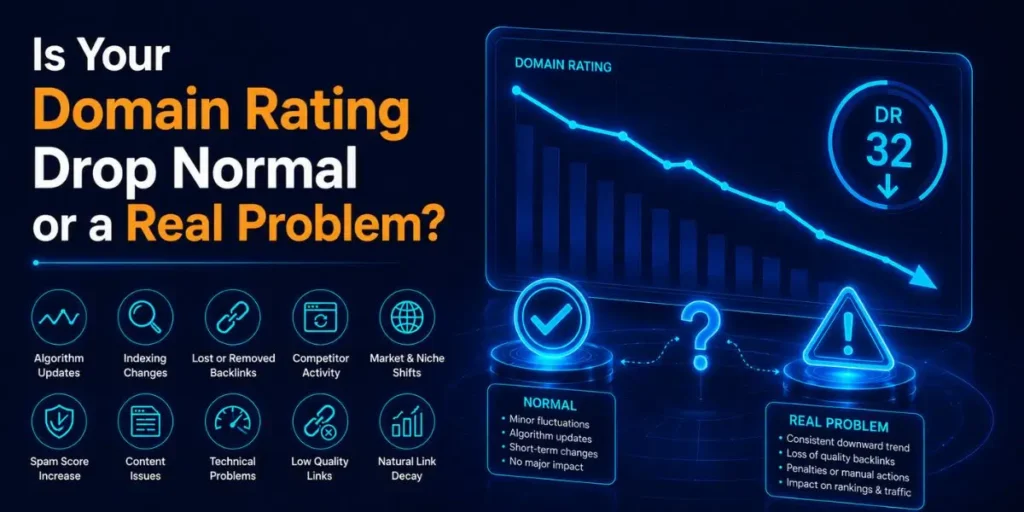
A DR drop is a real problem only when you’ve genuinely lost valuable dofollow links, not when the score moved on its own. Run this quick diagnostic to find out which one you’re facing.
- Pin the date. Open Site Explorer and find the exact day your DR started falling. Cause and timing almost always line up.
- Check the Referring Domains report. Filter to “Lost” around that date. Did you actually lose dofollow domains, or is the count steady?
- Compare against rivals. Pull up two or three competitors. If their DR dipped on the same day, you’re looking at an index-wide recalibration.
- Cross-check Google Search Console. Did clicks and impressions fall too? If yes, the DR drop is the least of your worries, and you have a ranking issue to chase separately.
- Look at link quality, not just count. Losing one strong domain hurts more than losing ten weak ones. Weigh what’s left, don’t just tally it.
After those five checks, you’ll know whether to act or to let it ride.
In My Experience
Honestly, when I first watched a client site fall four DR points in a single day, I assumed we’d been hit by something nasty in Search Console. We hadn’t.
I pulled the Referring Domains report, filtered to “Lost,” and the backlink count was actually up for the month.
The drop was pure recalibration, lined up perfectly with an Ahrefs index refresh, and three competitors in the same niche had slipped on the same date.
What caught me off guard was the client’s reaction. Traffic hadn’t moved a single percent, conversions were steady, yet the four-point dip triggered more stress than an actual ranking loss would have.
That taught me something I now repeat constantly: people emotionally trust the DR number more than their own analytics, and that’s exactly backward.
The dashboard that pays your bills is Google Analytics, not a third-party authority score.
How Do You Recover a Dropped Domain Rating?
Recover a dropped Domain Rating by reclaiming lost links first, then building fresh authority. Work these steps in order.
- Audit what you lost. Use the Lost Backlinks and Referring Domains reports to list every dofollow domain that vanished near your drop date.
- Reclaim the easy wins. Email site owners about removed or broken links. Many will restore them. This is faster and cheaper than earning brand-new ones.
- Fix accidental nofollows. Spot a partner who switched your link to nofollow? A polite message often gets it changed back, especially on editorial placements.
- Build clean, relevant links. Target dofollow links from authoritative, topically-relevant sites. After the 2025 recalibration, quality and relevance matter more than raw volume.
- Monitor your referring domains’ health. If the sites linking to you are slipping in authority, your DR slips quietly behind them. Watch the chain, not just your own number.
Worth remembering: DR recovery is inherently slow. Links take days to weeks to be crawled and folded into your score, and Ahrefs refreshes DR roughly every 24 to 72 hours. Patience beats panic-building every time.
Common Mistakes People Make When DR Drops
Most beginners make the same handful of errors the moment they see red, and each one makes things worse. Here’s what to avoid and why.
- Panic-disavowing links. The biggest one. People rush to disavow links that aren’t toxic at all, permanently telling Google to ignore real authority.
Disavow only confirmed spam or negative-SEO attacks, never healthy links you simply lost.
- Treating DR as a Google ranking factor. It isn’t. Chasing the number instead of your actual traffic wastes weeks on the wrong goal.
- Ignoring link quality and counting only quantity. Losing one DR-70 link can outweigh gaining twenty DR-5 links. The math is logarithmic, not linear.
- Buying cheap bulk links to “recover fast.” After the September 2025 update, low-quality domains carry less weight than ever, so this barely moves DR and can flag manipulation.
- Comparing your DR to a totally different niche. A DR 25 local plumber and a DR 25 SaaS blog are not in the same race. Benchmark against your real competitors only.
A Real Example: Tracing a 6-Point DR Drop
Let me show the full flow on a realistic case so you can copy it.
Input: A niche affiliate blog drops from DR 41 to DR 35 over two days. The owner is convinced Google deindexed something.
Process: Open Site Explorer, set the timeline to the drop window. Referring Domains shows three lost dofollow links, one of them from a DR-72 industry magazine that retired an old roundup post.
Search Console shows clicks holding steady. Two competitors in the same niche checked in; each lost 4 to 5 DR points on the same day.
Output: Diagnosis splits cleanly. Roughly two points came from that single lost DR-72 link, and the remaining four points came from an Ahrefs index recalibration that hit the whole niche.
Result: The owner emails the magazine and gets the link restored within a week, recovering about two points. The other four are accepted as recalibration and ignored, because traffic never moved.
No disavow file. No wasted link-buying budget. Problem correctly scoped in under thirty minutes.
That’s the whole point of a diagnostic: you fix what’s fixable, and you stop stressing about what isn’t.
Should You Even Care About Domain Rating in 2026?
Care about Domain Rating as a directional signal, not a goal you chase. And here’s the contrarian bit most guides won’t tell you.
A DR drop with stable traffic is often a good thing. The 2025 recalibration deliberately deflated profiles padded with junk links, which means cleaner, more honest sites sometimes saw their relative position improve even as the headline number fell across the board.
If your score dropped while your competitors’ dropped harder, you actually gained ground.
In 2026, with AI-driven search surfacing answers directly and entity and relevance signals carrying more weight, the sites winning are the ones earning genuinely meaningful links, not stockpiling them.
So track DR to spot trouble early. Just don’t let a single third-party number run your strategy. The metric is a thermometer, not the patient.
Frequently Asked Questions
Yes. DR is relative, so it falls when competitors gain stronger links or when Ahrefs recalibrates its index, even if your own backlink count stays exactly the same.
No. Google does not use Domain Rating or any third-party authority metric. Your rankings depend on Google’s own signals, so DR can drop while your traffic stays flat.
Ahrefs typically refreshes DR every 24 to 72 hours, though newly earned links can take longer to be crawled and counted into your score.
Only if the lost or new links are genuine spam or a negative-SEO attack. Never disavow healthy links you simply lost, since that permanently removes real authority.
Not at all. New sites start near DR 0-5 and climb slowly. For many local or niche businesses, a DR of 15-25 is perfectly competitive in 2026.

Is an SEO Specialist and AI Tools Researcher with over 4 years of hands-on experience in search engine optimization. As the founder of Smart AI Helper Pro, he tests and reviews AI writing, SEO, and marketing tools to help creators and business owners grow faster with practical, research-backed strategies.