
Ahrefs vs Semrush in 2026: Which One Actually Fits Your Workflow?
By SM Mehedi Hasan
Ahrefs wins on backlink freshness and unlimited verified projects, while Semrush wins on daily rank tracking, PPC data, and local SEO. The deciding detail most reviews skip: Ahrefs updates rankings weekly across all plans, including the $1,499 Enterprise tier. Semrush updates daily starting at $139.
Most people comparing Ahrefs vs Semrush are really asking a narrower question: which one will I still be paying for in twelve months? I have run both across affiliate sites, client work, and my own AI tools blog, and the honest answer is that they stopped being interchangeable sometime in 2025.
But there is a bigger problem with the comparisons you have probably already read. Nearly all of them are based on a picture of Semrush that no longer reflects what Semrush actually sells today, and several are written by people with a direct financial stake in the answer.
So this breakdown does two things. It compares the tools as they exist in July 2026, and it shows you where the standard advice is now flat wrong.
| Tool | Starting Price | Exclusive Deal |
|---|---|---|
| Ahrefs | $29/mo (Starter) | None. Ahrefs states it never runs discounts. Free tier available. |
| Semrush | $139/mo (SEO) | 7-day free trial. Save ~17% on annual billing. |
If you want simplicity, cleaner data, and no forced upsell → go with Ahrefs. If you want breadth, daily tracking, PPC, and local SEO in one login → Semrush is better. If your budget is under $50/month, only Ahrefs has a real answer for you.
Table Of Contents
ToggleWhat Changed in 2026 That Most Ahrefs vs Semrush Comparisons Missed?
Two things changed, and both of them affect your buying decision more than any feature checklist. Semrush is no longer an independent company, and its public pricing lineup has been rebuilt around AI search.
Neither fact shows up in most of the articles ranking for this keyword right now. That is not a small oversight. It changes who you are actually writing a check to.
Who Owns Semrush Now?
Adobe owns Semrush. The acquisition closed on April 28, 2026, in an all-cash deal worth roughly $1.9 billion at $12.00 per share, and Semrush is now a wholly owned Adobe subsidiary (Adobe newsroom).
The deal was first announced in November 2025. Semrush stock, which traded on the NYSE under the symbol SEMR, was delisted on the day the merger closed, and an Adobe designee joined the board, while the prior directors resigned.
Look at the bottom of any Semrush page today, and you will see it: the footer now carries an Adobe business link alongside the Semrush Holdings copyright line. That is not cosmetic.
Adobe’s stated reason for buying was brand visibility in AI search. Their own data cited in the announcement showed AI traffic to U.S. retail sites rising 269% year over year as of March 2026, and they wanted Semrush’s data layer feeding Adobe Experience Manager, Adobe Commerce, and Adobe LLM Optimizer.
What that means for you depends entirely on your size. Adobe sells to the Fortune 100. If you are a solo publisher paying $139/month, you are now a rounding error inside a company whose center of gravity is enterprise contracts.
I am not going to pretend I can predict Semrush’s pricing two years out. Nobody can. But anyone telling you that an Adobe acquisition has zero implications for SMB pricing isn’t being straight with you.
Why Does Semrush’s Pricing Page Look Different From Every Review You Have Read?
Because Semrush restructured it, and almost nobody updated their articles. Go to semrush.com/pricing today, and you’ll be redirected to an SEO & AI Search page with four tiers: SEO at $139, Starter at $199, Pro+ at $299, and Advanced at $549.
Pro, Guru, and Business are no longer in the headline lineup. They still exist as the standalone SEO Toolkit, and Semrush’s own knowledge base still documents them, but they are no longer what a new buyer sees first.
Here is the mapping that matters, straight from Semrush’s subscription documentation: Semrush One Starter gets Pro limits, Pro+ gets Guru limits, and Advanced gets Business limits. The One plans then bundle the AI Visibility Toolkit on top of them.
And that is the tell. Semrush is nudging every new customer toward a bundle that costs $60 more than the plan it replaces. The Starter at $199 includes Pro’s SEO limits plus AI Visibility, which sells standalone for $99.
Buying both separately would run $238.95. The bundle is genuinely cheaper than the parts. It is also $60/month more than what every comparison article on page one still tells you Semrush costs.
What Did Ahrefs Ship While Everyone Was Watching the Adobe Deal?
Quite a lot, and the local SEO one should embarrass a few reviewers. Ahrefs now has GBP Monitor, a Google Business Profile tool, in its own Local SEO navigation section.
Every article you will read says “Ahrefs has no local SEO tools.” That line is now out of date, and it has been repeated so many times it has calcified into received wisdom.
Ahrefs also shipped Bot Analytics for seeing which crawlers hit your site, a Social Media Manager in beta, and an MCP Server so you can query Ahrefs data from ChatGPT or Claude.
There are two spin-off products, too: Letaido, an AI marketing platform that hosts their Agent A, and Firehose for real-time brand-mention tracking. I found a review published in May 2026 claiming Ahrefs had not committed to MCP support.
Ahrefs has a dedicated MCP page, and lists MCP Server row limits directly in its pricing comparison table. That is the level of staleness you are dealing with in this SERP.
Ahrefs vs Semrush: What Are You Actually Choosing Between?
Strip away the marketing, and you are choosing between a data company that built a search engine and a marketing suite that bought its way into every channel.
Ahrefs runs its own crawler and its own hardware. Their infrastructure page lists 662,000 CPU cores, 3PB of RAM, and 504PB of SSD storage, plus a supercomputer called Yep1 that ranked among the world’s fastest by FLOPs on the Top500 list. They claim building it in-house saved them $900 million over three years compared to the cloud.
Semrush partners for a lot of its data. Its own data documentation states that keyword and SERP data comes from third-party providers, traffic data comes from a clickstream panel of over 200 million anonymized users, and advertising data is sourced from trusted third parties.
Backlinks are the exception and are crawled by Semrush’s own bot. Neither approach is automatically better. Owning the pipe gives you freshness and consistency. Partnering gives you breadth fast.
But it explains everything downstream. Ahrefs is deep and narrow because it only ships what its own index can support. Semrush is wide because it can bolt on a data source whenever it wants to enter a category.
Ahrefs Review: The Specialist That Refuses to Discount
Ahrefs launched in 2010 as a backlink checker and never really stopped being a data company that happens to sell software. It is the tool I reach for when I need to know something is true rather than approximately true.
The company is still Singapore-based, still independent, and still publishes hard numbers about its own index that most competitors will not touch.
Key Features
- Site Explorer with a backlink index refreshed every 15 to 30 minutes, crawling 5 million pages per minute. New links show up while a campaign is still running, not weeks later.
- Keywords Explorer covers 28.7 billion filtered keywords across 217 locations, with 110 billion keywords ever seen in the index.
- Traffic Potential, which estimates what a page could earn from a keyword plus all its variants, not just the headline search volume. Noticeably more useful than raw volume for content planning.
- Content Explorer across a 20.1 billion-page content index, with 10 million new pages discovered every 24 hours.
- Brand Radar tracking 350 million monthly AI prompts across seven AI indexes.
- Site Audit with always-on crawling and IndexNow auto-submission on the Project Boost add-ons.
- Unlimited verified projects on every plan, including the $29 Starter.
- MCP Server for pulling Ahrefs data into AI assistants, available from Lite upward.
All index figures above are published on Ahrefs’ data page and were checked in July 2026.
Who It’s Best For
Link builders and technical SEOs, first and foremost. If your day involves prospecting, outreach, or reverse-engineering why a competitor outranks you, Ahrefs answers faster.
Agencies and multi-brand operators get a genuinely underrated advantage: unlimited verified projects on every tier. You can prove ownership of 40 client sites on a $129 Lite plan and track them all.
Solo publishers on a real budget have exactly one credible entry point in this comparison: the $29 Starter plan. Anyone who hates upsells will appreciate that Ahrefs states plainly in its pricing FAQ that it never runs discounts. The price is the price.
Pros and Cons
Pros
- Freshest backlink data in the category, updated every 15 to 30 minutes.
- Unlimited verified projects on all plans, which is a real cost saver at scale
- Cleanest interface of the two, with a shorter learning curve
- Publishes granular, checkable numbers about its own index
- $29 entry point that actually includes Keywords Explorer and Rank Tracker
- 16 years of historical data, with unlimited history on Enterprise
Cons
- Rank Tracker updates weekly on every single plan, including the $1,499 Enterprise tier. Daily requires a Project Boost add-on at $20 to $200 per project per month.
- No free trial at all. Ever.
- Credit system on Starter and Lite meters almost every report you open
- No PPC campaign building, only competitor ad intelligence
- Add-ons stack fast: Content Kit from $99, Report Builder $99, Brand Radar from $199
- The Starter plan is a one-way door. Ahrefs’ own terms state you cannot downgrade from Lite or higher into Starter.
🧠 In My Experience
Honestly, when I first tried Ahrefs after years on Semrush, what hit me was how little it argued with me. I typed a domain into Site Explorer, and the referring domains appeared in about two seconds, with no modal asking me to start a project first.
That speed compounds. On a link prospecting session where I checked maybe sixty domains, the difference between two seconds and six seconds of load time was the difference between staying in flow and losing the thread.
Where it struggled was reporting week. I had a client who wanted Monday ranking movement, and Ahrefs’ weekly refresh meant I was handing over data that could be up to 6 days old. I checked the pricing page three times because I assumed I was misreading it. I was not. Weekly is weekly on all four paid tiers.
The credit system bit me too. On Lite, I burned through a chunk of my 1,000 monthly credits in one afternoon of competitor research, because every report you open is a credit. Standard fixes this with unlimited credits, but that is a $120 jump.
Set against Semrush, the trade reads like this: Ahrefs gives you better data and makes you pay for cadence. Semrush gives you cadence at the base price but charges for depth. If your work is asynchronous, Ahrefs is fine. If someone is waiting on a number, it is not.
Expert Verdict
Pick Ahrefs if link building, competitive research, and clean data are the core of your work and weekly rank updates are acceptable. Pick Semrush if you need daily numbers, PPC, or local SEO without having to buy add-ons.
Semrush Review: The Suite That Now Answers to Adobe
Semrush started in 2008 as a keyword and PPC tool and has grown into the widest marketing platform in its category. Its own materials describe more than 17 years of operation and over 28 million users globally. It is also, as of April 2026, an Adobe company. That is now part of what you are buying.
Key Features
- Keyword data across 142 geographic databases and 27.9 billion keywords, with 808 million domains in the index.
- 43 trillion backlinks, crawled by Semrush’s own bot at roughly 10 billion pages daily.
- Daily rank tracking on every plan, across Google, Bing, and Baidu, with device and ZIP-code-level location targeting.
- AI Visibility Toolkit refreshing 289 million+ prompts monthly across ChatGPT, Gemini, Perplexity, SearchGPT, Google AI Mode, and AI Overviews.
- Prompt Tracking with daily prompt-level data in ChatGPT and Google AI Mode.
- Full PPC workspace, not just ad spying. Over 1 billion Google Ads with history back to January 2012, plus campaign build and export to Google Ads Editor.
- Local Toolkit with Listing Management across 70+ directories, Map Rank Tracker, and a GBP AI agent.
- Traffic Analytics built on a 200 million user clickstream panel across 190+ countries.
- Backlink Audit with toxicity scoring, which Ahrefs has no equivalent for.
Figures above come from Semrush’s data documentation, checked July 2026.
Who It’s Best For
Full-stack marketers running SEO and paid together. Nothing in Ahrefs comes close to the Advertising Toolkit.
Local businesses and the agencies serving them. Listing management, review automation, and map grid tracking are all first-class here, and Ahrefs’ new GBP Monitor is not yet in the same weight class.
Teams that need to prove movement weekly. Daily tracking at $139 with no add-on is a genuine advantage.
Anyone treating AI search as a channel rather than a curiosity. Semrush’s prompt-level daily tracking is more actionable than brand-level benchmarking if you are trying to move a specific answer.
Pros and Cons
Pros
- Larger raw backlink index at 43 trillion, and a much larger domain index at 808 million
- Daily rank tracking on every plan with zero add-ons
- Only real PPC workspace between the two
- Local SEO toolkit with no equivalent in Ahrefs
- 7-day free trial, which Ahrefs simply does not offer
- Historical data back to 2012 on the mid tier
Cons
- Website limits are hard and low. 5 websites on the entry plan, counted whether you own them or not. Ahrefs gives unlimited verified projects at $29.
- Real cost climbs fast. Extra seats run $45 to $100, and on Semrush One, each extra user costs an additional $99 to access AI Visibility features.
- Exports are disabled during the free trial. Semrush’s own documentation confirms it. You cannot properly evaluate the data you are paying to export.
- Local Toolkit bills per location, so a five-branch business pays five times
- More overwhelming to learn. Reviewers consistently rate ease of use as its weakest dimension.
- Now an Adobe subsidiary, with all the roadmap uncertainty that carries for small accounts
🧠 In My Experience
What surprised me most was how quickly the advertised price stopped being the real price. I priced up a modest two-person setup on Semrush One Starter and landed at $199 for the seat, plus $45 for the seat, plus $99 to give that seat AI Visibility access.
That is $343 for what the pricing page presents as a $199 product. I want to be fair here, because the Keyword Magic Tool genuinely earns its reputation.
When I was building a cluster for a “Will AI replace X” series, Semrush handed me intent labels and pre-built clusters that saved me most of an afternoon of manual grouping. Ahrefs made me do that work myself.
But the trial thing annoyed me more than it should have. I started a 7-day trial specifically to stress-test export quality against a keyword list I already had, and exports are switched off during trials. So the one thing I wanted to test was the one thing I could not test.
Site Audit is where Semrush quietly pulled ahead for me. The AI Search Health score appears at the top of the report and flags whether you are blocking AI crawlers, a check I previously did by hand in robots.txt.
Testing this alongside Ahrefs, the split got clear: Semrush is the better tool for a marketer; Ahrefs is the better tool for an SEO. That sounds like a cop-out. It is not.
If your job title has “marketing” in it, you will use maybe six Semrush toolkits and be glad they are in one login. If your job is rankings and links, you will use two of them and resent paying for four.
Expert Verdict
Pick Semrush if you run more than one channel, need daily data, serve local clients, or treat AI visibility as a tracked KPI. Pick Ahrefs if you only do organic search and want the money going into data quality rather than feature breadth.
Which Tool Actually Has the Bigger Backlink Database in 2026?
Semrush does, and it is not close on the raw numbers. Semrush publishes 43 trillion backlinks across 808 million domains. Ahrefs publishes 35 trillion live backlinks across 500.4 million domains post-vetting. Most articles get this exactly backward, and I understand why.
“Ahrefs has the biggest backlink index” has been true at various points and became a reflex. Read Ahrefs’ own wording carefully, and you will see what is happening. They claim “the world’s largest index of live backlinks.” That single word is carrying the whole argument.
Semrush’s 43 trillion is not considered live, and a link to a dead page still counts. So the real comparison is not size. It is freshness versus reach. Ahrefs crawls 5 million pages per minute and refreshes its backlink index every 15 to 30 minutes.
Semrush crawls roughly 10 billion pages daily, which is more pages per day than any other service, but it does not commit to a comparable refresh cadence.
If you need X → here is the call:
- Spotting a competitor’s link campaign as it launches → Ahrefs. The 15-minute refresh is a real operational edge, not a spec sheet line.
- Widest possible historical link footprint → Semrush. 808 million domains versus 500 million is a big gap in coverage.
- Cleaning up a toxic link profile → Semrush. Backlink Audit with toxicity scoring has no equivalent in Ahrefs.
- Finding link gaps against many competitors at once → Ahrefs. Link Intersect compares up to 10 competitors. Semrush’s Backlink Gap does five.
- Broken backlink reclamation → Ahrefs, comfortably. It is what the tool was built for.
Here is the non-obvious part. Neither number is auditable. Both companies publish their own index sizes, and neither submits to third-party verification. Treat both figures as vendor marketing that is directionally useful, and make your decision based on refresh rate and workflow instead.
Which Tool Wins for Keyword Research?
Semrush wins on interpretation; Ahrefs wins on coverage. Semrush indexes 27.9 billion keywords across 142 databases. Ahrefs indexes 28.7 billion filtered keywords across 217 locations.
The keyword counts are close enough to be a tie. The location count is not. 217 versus 142 is a meaningful gap if you work internationally. For US-focused publishers, and I know that is most of you reading this, the picture is murkier than other articles admit.
Ahrefs publishes its US keyword count openly at 2.6 billion, its largest single location. Semrush does not break out a US figure on its official data page at all. You will see “3.7 billion US keywords” quoted for Semrush across a dozen articles.
I could not verify that on any Semrush-owned property. I am not saying it is false. I am saying nobody sourcing it is showing their work, so I will not repeat it as fact. What actually separates them is what happens after the list loads.
Semrush hands you search intent labels, keyword clusters, Personal Keyword Difficulty scored against your specific domain, and a Topical Authority read. Ahrefs hands you a list, a difficulty score, and Traffic Potential.
If you need X → go with Tool A:
- Building a content cluster from scratch → Semrush. Auto-clustering and intent labels remove a whole manual step.
- Deciding whether a keyword is worth the effort → Ahrefs. Traffic Potential accounts for variants, so you see the real ceiling rather than the headline volume.
- Estimating real clicks in a zero-click SERP → Ahrefs. The Clicks metric is unique and honest about how much traffic SERP features are eating.
- Non-US or multi-market research → Ahrefs, on 217 locations versus 142.
- PPC keyword planning → Semrush, with no contest.
The insight most comparisons skip: Semrush’s own documentation says keyword data updates “range from once a day to once a month” depending on keyword popularity.
That is refreshingly honest, and it means long-tail volumes in both tools are older than either interface implies. Do not treat any volume figure from either platform as this week’s truth.
How Do Ahrefs and Semrush Compare for Rank Tracking?
Semrush wins decisively, and this is the single most underreported gap in the entire comparison. Semrush updates rankings daily on every plan from $139. Ahrefs updates weekly across all plans, from the $129 Lite tier to the $1,499 Enterprise tier.
Go look at Ahrefs’ pricing comparison table yourself. The “Update frequency” row reads Weekly across all four columns. I genuinely did not believe it until I checked it directly.
Want daily from Ahrefs? You buy Project Boost, at $20 per project per month for Pro or $200 per project per month for Max. Run ten client sites, and that is $200 to $2,000 on top of your plan.
Keyword allowances are closer than the pricing suggests:
- Ahrefs: 750 (Lite), 2,000 (Standard), 5,000 (Advanced), from 10,000 (Enterprise)
- Semrush: 500 (SEO/Starter), 1,500 (Pro+), 5,000 (Advanced)
So Ahrefs gives you more keywords at a similar price, and updates them less often. That is the trade in one line.
If you need X → go with Tool A:
- Client reporting on a weekly or daily rhythm → Semrush. Weekly-only data ages badly in a Monday meeting.
- Tracking a big keyword set on a budget → Ahrefs. 750 keywords at $129 beats 500 at $139.
- Local rank tracking by ZIP code → Semrush. Ahrefs does not go to that granularity.
- Tracking beyond Google → Semrush, which covers Bing and Baidu. Ahrefs is Google-centric.
- Watching long-term trend lines rather than daily noise → Ahrefs is genuinely fine, and weekly is arguably healthier for your sanity.
And a fair counterpoint, because I do not want to be unfair to Ahrefs here: daily rank tracking encourages bad behavior. Most position changes inside a week are noise.
If you are the kind of SEO who panics at a two-position drop, Ahrefs’ weekly cadence may quietly make you better at your job. That does not excuse charging $1,499 a month and still shipping weekly.
Which Tool Is Better for Site Audits and Technical SEO?
Ahrefs checks more issues; Semrush explains them better. Ahrefs scans 170+ parameters. Semrush scans 140+. Crawl capacity favors Ahrefs at nearly every price point. Ahrefs gives 100,000 crawl credits on Lite, 500,000 on Standard, and 1.5 million on Advanced.
Semrush audits 100,000 pages monthly on the entry plan, 300,000 on the mid-tier plan, and 1 million on the top plan. But raw crawl volume is not usually the constraint. Most sites that read this article have fewer than 5,000 pages.
What separates them is the workflow layer. Semrush ships an AI Search Health score at the top of the audit that flags blocked AI crawlers, a task that has quietly become a real technical SEO task. It also does log file analysis, which Ahrefs does not.
Ahrefs counters with always-on auditing, IndexNow auto-submission, page change monitoring, and Patches, which lets you push fixes live without a developer. The catch is that most of that lives behind Project Boost at $20 to $200 per project.
If you need X → go with Tool A:
- Finding the maximum number of technical issues → Ahrefs, on 170+ checks
- Understanding and prioritizing what to fix first → Semrush. Its fix guidance and to-do lists are more actionable.
- Log file analysis → Semrush. Ahrefs has no equivalent.
- Catching a problem within minutes of it appearing → Ahrefs with Project Boost, if you will pay for it
- Auditing whether AI crawlers can read your site → Semrush in the base audit, or Ahrefs Bot Analytics as a separate view
One detail worth knowing before you audit a big site: Ahrefs’ crawler is capped at 30 URLs per minute by default, and you have to verify ownership to raise it, per Ahrefs’ bot documentation. On a 200,000-page site, it’s a long wait if you skip verification.
Which Tool Is Better for AI Search Visibility?
Ahrefs tracks more prompts; Semrush makes them more actionable. Ahrefs’ Brand Radar covers 350 million monthly prompts across seven AI indexes. Semrush’s AI Visibility Toolkit refreshes 289 million+ prompts across six platforms each month.
Now here is the number nobody breaks down. Ahrefs publishes its AI prompt volume by index, and the distribution is lopsided:
- AI Overviews: 267.0 million
- Gemini: 14.6 million
- Perplexity: 14.6 million
- ChatGPT: 14.5 million
- AI Mode: 14.0 million
- Copilot: 13.2 million
- Grok: 13.0 million
Read that again. 76% of Ahrefs’ AI prompt volume is Google AI Overviews. The ChatGPT coverage everyone gets excited about is 14.5 million prompts, about 4% of the total.
That is not a knock on Ahrefs. It is a knock on how the whole category is marketed. When any vendor advertises “350 million AI prompts,” picture a pie chart that is three-quarters Google.
Semrush does not publish an equivalent split, so I cannot tell you whether theirs is better or worse, only that Ahrefs is the one showing its working. The approaches differ in kind, not just degree.
Ahrefs Brand Radar answers the question: “How visible is my brand across AI, and how does that compare to competitors.” Semrush Prompt Tracking answers “did my brand appear for this exact prompt today, yes or no.”
If you need X → go with Tool A:
- Rank-style daily monitoring of specific prompts → Semrush. 50 to 200 prompts tracked daily depending on tier.
- Brand-level AI share of voice benchmarking → Ahrefs Brand Radar
- Broadest AI index coverage including Grok and Copilot → Ahrefs, on seven indexes
- Full LLM coverage including Claude → Semrush Enterprise only, per its pricing page
- Cheapest way to start → Semrush. AI Visibility is included from $139 on the SEO plan. Ahrefs Brand Radar starts at $199/month on its own.
That last one deserves emphasis because it inverts the usual narrative. On AI visibility, Semrush is the budget option, and Ahrefs is the premium add-on. Ahrefs’ base plans include only 5 to 20 tracked prompts. Semrush’s $139 plan includes AI search performance tracking and sentiment monitoring in the box.
Can Ahrefs Compete With Semrush on PPC Data?
No, and Ahrefs is not really trying. Semrush gives you a PPC workspace. Ahrefs gives you a window into other people’s ads. Ahrefs’ paid index holds 31 million paid pages, 30 million paid keywords, and 7.1 billion paid ads.
You can pull a competitor’s ad copy, target keywords, landing pages, and CPC estimates inside Site Explorer, and the Ads History chart is genuinely good for spotting which campaigns a rival keeps funding.
Then it stops. There is no campaign builder, no Google Ads Editor export, no Shopping module. Semrush’s Advertising Toolkit does all of that.
Over 1 billion Google Ads with history back to January 2012, a PPC Keyword Tool that structures campaigns and ad groups and exports straight to Ads Editor, PLA research for Shopping, and an Ads Launch Assistant.
AdClarity extends it into display, video, and social across 650,000 publishers in 51 markets.
If you need X → go with Tool A:
- Running actual paid campaigns → Semrush. Ahrefs is not an option.
- Spying on a competitor’s ad creative for research → either works; Ahrefs is faster.
- Seeing paid and organic in one tracking view → Semrush
- Google Shopping and PLA intelligence → Semrush, exclusively
Worth saying plainly: if you never touch paid search, this entire section is irrelevant to your decision, and you should not let “Semrush has more features” pull you toward a tool where you will use half of them.
Which Tool Handles Local SEO Better?
Semrush, by a wide margin, but the usual “Ahrefs has nothing” line is no longer accurate. Ahrefs shipped GBP Monitor, currently in beta, for managing Google Business Profiles at scale.
That said, beta is beta. Semrush’s Local Toolkit is a mature product with Listing Management syncing across 70+ directories, a Map Rank Tracker with grid heatmaps, automated review generation and response, and a GBP AI agent that publishes posts and replies on a schedule.
Pricing is the catch, and it is a serious one. Semrush’s Local plans bill per location. Base runs around $30/month per location, and it scales from there. A five-branch dental group is paying five times over before touching the SEO plan.
If you need X → go with Tool A:
- Managing citations and listings across directories → Semrush. Ahrefs has no equivalent.
- Map pack rank tracking with grid views → Semrush
- Review monitoring and AI-assisted responses → Semrush
- Local keyword research and country-level rank tracking → Ahrefs handles this fine and costs nothing extra.
- Managing many GBP listings without per-location billing → watch Ahrefs GBP Monitor, which is currently included rather than metered per location.
I would not switch to Ahrefs for local work today. But if GBP Monitor comes out of beta, bundled into a $129 plan, while Semrush charges $30 per location per month, the math gets interesting fast for multi-location agencies.
Which Tool Is Better for Content Marketing?
Semrush is better for producing content; Ahrefs is better for deciding what to produce. They are genuinely solving different halves of the problem.
Semrush’s Content Toolkit gives you Topic Finder, an SEO Brief Generator, an Article Generator, and the SEO Writing Assistant that grades drafts live inside Google Docs, WordPress, or Word. On the SEO Toolkit track, it is bundled from Guru upward, or sold standalone as a Content Base plan.
Ahrefs comes at it from research. Content Explorer sits on a 20.1 billion-page index and finds what is already winning, which topics have low competition, and who publishes in your space. The AI Content Helper grades against top-ranking pages and is available in the Content Kit add-on for $99/month.
If you need X → go with Tool A:
- Generating briefs and drafts inside one platform → Semrush. Ahrefs has no brief generator at all.
- Finding topics competitors have not covered → Ahrefs Content Explorer.
- Real-time optimization while writing → Semrush SEO Writing Assistant
- Guest post and link prospect discovery → Ahrefs, comfortably
- Content on the entry plan → Semrush. Ahrefs locks Content Explorer behind Standard at $249.
That last point costs Ahrefs real money in this comparison. Content Explorer is one of Ahrefs’ best tools, and it is invisible to anyone on Lite. You are paying $129 and cannot see the feature that would justify it.
What Do Ahrefs and Semrush Actually Cost in 2026?
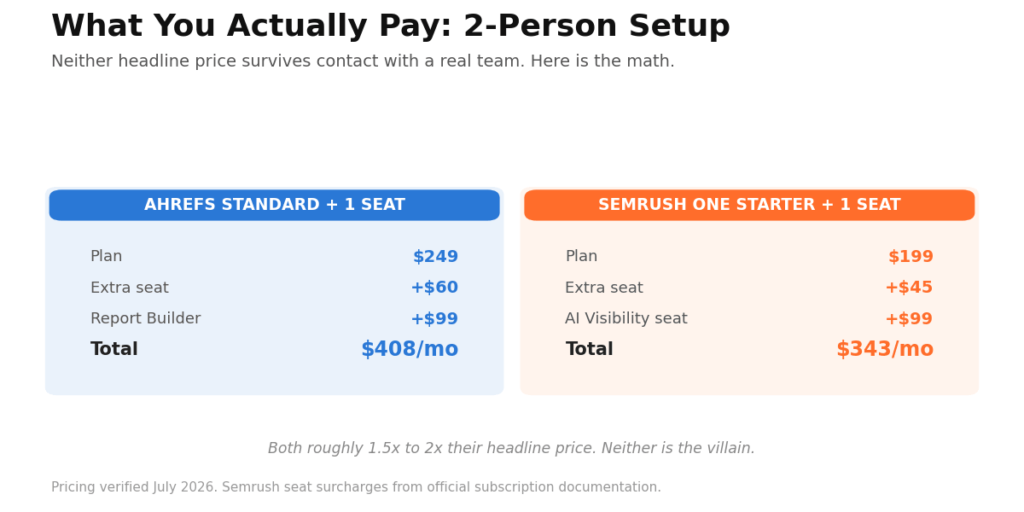
Ahrefs starts at $29, Semrush at $139, but neither headline survives contact with a real setup. Here is the full verified lineup as of July 2026.
Ahrefs (official pricing):
- Ahrefs Free: $0, limited Site Explorer and Site Audit on verified sites
- Starter: $29/mo, 100 credits, monthly billing only, no add-ons purchasable
- Lite: $129/mo, 750 keywords, 5 unverified projects, 100k crawl credits, 1 user
- Standard: $249/mo, 2,000 keywords, 20 unverified projects, 500k crawl credits, unlimited credits
- Advanced: $449/mo, 5,000 keywords, 50 unverified projects, 1.5M crawl credits
- Enterprise: $1,499/mo, annual commitment required, uncapped API, SSO
Semrush (official pricing):
- Free: $0, 1 demo project, 10 reports per day
- SEO: $139/mo, or $117.33 billed annually, 5 websites, 500 keywords
- Starter: $199/mo or $165.17 annually; includes 50 daily prompts and MCP access.
- Pro+: $299/mo, or $248.17 annually, 15 websites, 1,500 keywords, historical data
- Advanced: $549/mo, or $455.67 annually, 40 websites, 5,000 keywords, API
- Enterprise: custom, adds Grok and Claude coverage plus ROI attribution
Now the part the pricing pages do not advertise.
Ahrefs extra seats: $40/mo on Lite (max 2), $60/mo on Standard (max 5), $80/mo on Advanced (max 10), $100/mo on Enterprise (unlimited).
Semrush extra seats: $45 (SEO/Starter), $80 (Pro+), $100 (Advanced), capped at 3 additional users per account. On Semrush One, each additional seat costs $99 just to access the AI Visibility features.
Run the real numbers on a two-person setup:
- Ahrefs Standard + 1 seat + Report Builder = $249 + $60 + $99 = $408/mo
- Semrush One Starter + 1 seat + AI seat access = $199 + $45 + $99 = $343/mo
- Ahrefs Standard + 1 seat + Content Kit + Report Builder + Project Boost on 3 sites = $249 + $60 + $99 + $99 + $60 = $567/mo
Both roughly 1.5x to 2x their headline price. Neither is the villain here. This is just how the category prices now.
Two honesty notes that matter more than the arithmetic:
Ahrefs never discounts. Their pricing FAQ says it outright. Every “Ahrefs coupon code” page you find is selling you nothing, and I would treat any site publishing one as a signal about that site rather than about Ahrefs.
Semrush’s trial disables exports. Confirmed in Semrush’s own documentation. If your evaluation depends on pulling data out and checking it against Search Console, the 7-day trial cannot answer that question.
If you need X → go with Tool A:
- Under $50/month → Ahrefs Starter. Semrush has no answer at this price.
- Testing before paying → Semrush. It is the only one with a trial, export caveat, and all.
- Best value per keyword tracked → Ahrefs. 750 at $129 beats 500 at $139.
- Best value if you need three or more channels → Semrush, easily
- Lowest cost per verified project at scale → Ahrefs, which is unlimited on every tier
Which Tool Is Better for Agencies Managing Multiple Clients?
It depends on whether your clients verify their domains, and this is the sharpest fork in the whole comparison.
Ahrefs gives unlimited verified projects on every plan. If a client grants you Search Console access or lets you drop a DNS record, that site does not count against any limit. Not on Enterprise, not on the $29 Starter.
Semrush counts every website against a hard cap: 5, 5, 15, or 40 depending on tier. Verified or not, owned or not, it counts. Do the math on a fifteen-client agency. Ahrefs Lite at $129 handles all fifteen if they verify. Semrush needs Pro+ at $299 to hit fifteen websites.
That is a $170/month swing, or $2,040 a year. Then reporting flips it back the other way. Ahrefs has no white-label reporting at all. Semrush’s Pro Report, at $20/report/month, gives you branding, custom domains, white-labeling, and AI summaries. For client-facing agencies, that is not a nice-to-have.
If you need X → go with Tool A:
- Tracking many verified client sites cheaply → Ahrefs, and it is not close.
- White-label client reporting → Semrush. Ahrefs cannot do it.
- Daily client-facing ranking data → Semrush, without a $20 to $200 per project add-on
- Local SEO clients → Semrush
- Link building as a service line → Ahrefs
- Agency directory listing for lead gen → both. Ahrefs from Advanced, Semrush for $90/mo.
The pragmatic answer, and the one most working agencies land on, is that you run both and expense them. That is not a cop-out. Brian Dean says the same thing in the Backlinko comparison, and we will get to why that comparison is interesting in a moment.
Do Ahrefs and Semrush Work With AI Assistants?
Both ship MCP servers, so you can query either from Claude or ChatGPT. This is newer than most articles realize, and at least one review published in May 2026 claimed Ahrefs had not committed to MCP at all. It has.
Ahrefs MCP Server is available from Lite upward, with row limits of 100 on Lite, 250 on Standard, 500 on Advanced, and unlimited on Enterprise. Ahrefs Connect provides 100,000 to 2 million API integration units per month, depending on the tier.
Semrush MCP access appears on the Starter plan’s pricing page, and Semrush promotes it heavily as a way to integrate its dataset into AI assistants.
If you need X → go with Tool A:
- Highest MCP row limits → Ahrefs Enterprise, which is uncapped.
- MCP on the cheapest possible plan → Ahrefs Lite at $129 versus Semrush Starter at $199
- Direct API access without Enterprise → Ahrefs Advanced at $449 or Semrush Advanced at $549
- Uncapped API → Ahrefs Enterprise only
This matters more than it looks. If you are building any kind of automated SEO workflow in 2026, the row limit per request is your real bottleneck, and 100 rows on Ahrefs Lite will frustrate you inside a week.
What Most Ahrefs vs Semrush Reviews Will Not Tell You
Now the part I actually think is the most useful thing in this article, and I have not seen a single competing page mention it. The number-one ranking comparison for this keyword is held by one of the tools it compares.
Scroll to the bottom of Backlinko’s Ahrefs vs Semrush article, and you will find this disclosure, in their own words: Backlinko is owned by Semrush, and unless otherwise noted, the content was written by an employee or paid contractor of Semrush Inc.
The footer reads that Backlinko is a trademark of Semrush Inc. That article’s verdict is that Semrush wins. I want to be careful and fair here. The disclosure exists; it is public, and Brian Dean has been transparent about selling Backlinko to Semrush.
He also awards Ahrefs the backlink category, so it is not a hatchet job. But a Semrush-owned publication crowning Semrush the overall winner is not an independent review, and since April 2026, that publication has been an Adobe-owned property recommending Adobe’s product.
It does not stop there. Another top-ranking comparison is published by SE Ranking, a direct competitor to both tools, and it closes with a lengthy section recommending SE Ranking.
Its data is dated as of November 2025 and includes an internal contradiction: one table says Ahrefs has 14 trillion live backlinks, while another says 35 trillion.
Meanwhile, Ahrefs runs its own comparison page at ahrefs.com/vs/semrush, which, unsurprisingly, concludes that Ahrefs wins and now includes the Adobe acquisition as a talking point.
So the top of this SERP is: Semrush’s own property, a competitor’s property, and Ahrefs’ own property. Here is what I want you to take from that, and it is not cynicism. Check the footer before you trust the verdict. It takes four seconds.
Then go read both pricing pages yourself, because they are the only documents in this entire category that neither company can spin. While you are there, notice which numbers each vendor publishes and which they do not. Ahrefs breaks out its AI prompt volume by index and admits 76% is AI Overviews.
Semrush does not. Semrush publishes that its keyword data updates anywhere from daily to monthly. Ahrefs does not. Both disclosures are slightly unflattering and more useful than any review.
I have affiliate incentives too. Everyone in this space does. The difference I can offer is showing you where every number came from so you can check it without taking my word for it.
Ahrefs vs Semrush: Final Verdict
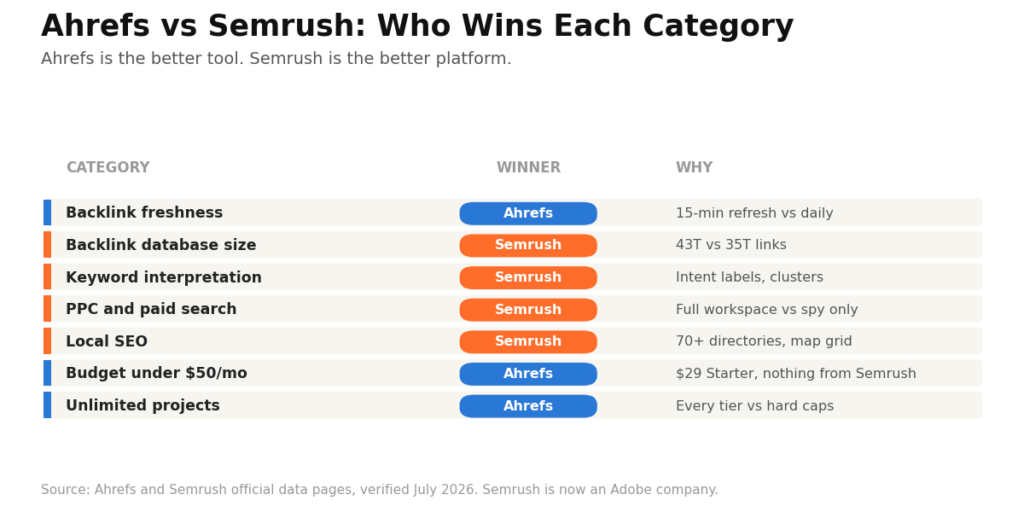
There is no universal winner, and anyone who claims there is one is selling something. There is a right answer for your specific situation, and it usually comes down to four questions.
Budget under $50/month? →
Ahrefs Starter at $29. Semrush’s cheapest real plan is $139. This is not a close call; it is the only call.
Budget-conscious but need professional depth? →
Ahrefs Lite at $129. More tracked keywords than Semrush’s $139 plan, unlimited verified projects, and better backlink data. Accept weekly rank updates.
Solo SEO doing organic only? →
Ahrefs Standard at $249. Unlimited credits, Content Explorer unlocked, 2 years of history. You will not miss the PPC tools you were never going to use.
Solo marketer running more than one channel? →
Semrush One Starter at $199. AI visibility, PPC research, daily tracking, and content tools in one login. Cheaper than assembling the equivalent stack.
Beginner, still learning? →
Ahrefs. Cleaner interface, shorter learning curve, and a $29 tier that lets you make mistakes cheaply. Semrush’s breadth is a liability before you know what you need.
Advanced practitioner who wants everything? →
Semrush Pro+ at $299 or Advanced at $549. The depth is real once you know how to reach it.
Agency with many verified client sites? →
Ahrefs. Unlimited verified projects will save you four figures a year over Semrush’s hard website caps. Budget separately for reporting, because Ahrefs has no white-label.
Agency with local clients or white-label reporting requirements? →
Semrush. Ahrefs cannot do either properly yet.
Team where someone waits on rankings weekly? →
Semrush. Ahrefs’ weekly-only cadence across all plans is a genuine operational problem, and Project Boost, at $20 to $200 per project, is a tax on fixing it.
Is AI search a tracked KPI? →
Semrush if you need prompt-level daily data on a budget; Ahrefs Brand Radar if you want brand-level share of voice across seven indexes and will pay $199 for it.
If I had to strip it down to one line: Ahrefs is the better tool, Semrush is the better platform. Which of those you need depends on whether your job is search or marketing.
And if you can afford both, run both. That is what most professionals at the top of this field actually do, and no comparison article makes money telling you that.
Frequently Asked Questions
Ahrefs. It has a cleaner interface, a shorter learning curve, and a $29 Starter plan that includes Keywords Explorer and Rank Tracker. Semrush’s cheapest plan is $139, and its feature breadth overwhelms most new users.
No. Ahrefs offers no free trial on any paid plan and states in its pricing FAQ that it never runs discounts. The free Ahrefs plan provides limited access to Site Explorer and Site Audit for domains you verify ownership of.
Adobe. The $1.9 billion all-cash acquisition closed on April 28, 2026, at $12.00 per share. Semrush was delisted from the NYSE and is now a wholly owned subsidiary of Adobe.
Semrush, on published figures. Semrush lists 43 trillion backlinks across 808 million domains. Ahrefs lists 35 trillion live backlinks across 500.4 million domains. Ahrefs refreshes its index every 15 to 30 minutes, whereas Semrush does not.
Semrush does, on every plan. Ahrefs updates all plans weekly, including the $1,499 Enterprise tier, and charges $20 to $200 per project per month through Project Boost for faster refreshes.
Yes. Both offer MCP servers. Ahrefs includes MCP in the $129 Lite plan, with 100 rows per request, increasing to unlimited on Enterprise. Semrush includes MCP access from its $199 Starter plan.
All pricing and index figures in this comparison were verified directly against Ahrefs’ and Semrush’s official pricing and data pages in July 2026. Both companies update pricing without notice, so confirm current rates at ahrefs.com/pricing and semrush.com/pricing before subscribing.

Is an SEO Specialist and AI Tools Researcher with over 4 years of hands-on experience in search engine optimization. As the founder of Smart AI Helper Pro, he tests and reviews AI writing, SEO, and marketing tools to help creators and business owners grow faster with practical, research-backed strategies.