
Are SEMrush Historical Ad Copies Accurate?
By SM Mehedi Hasan
SEMrush historical ad copies accurately reflect the actual ad text (headlines, descriptions, and display URLs that an advertiser ran), because that information is captured from real Google SERP crawls dating back to 2012. The numbers attached to them, such as CPC, volume, and traffic, are modeled estimates and are far less reliable.
So the short version is: trust what the ad said, question the numbers around it. That single distinction changes how you should use the Ads History and Ads Copies reports, and most write-ups skip it entirely.
Below is the full breakdown of which parts hold up, which parts drift, and how to verify any ad copy in under two minutes for free.
Table Of Contents
ToggleWhat Are SEMrush Historical Ad Copies?
SEMrush historical ad copies are saved snapshots of the paid search ads a domain ran on Google, viewable month by month, going back as far as 2012.
You find them inside the Advertising Research tool, split across two reports: Ads Copies (the creative text) and Ads History (the 12-month timeline of when those ads appeared).
The Ads Copies report shows each ad as an individual tile. You see the headline in blue, the display URL in green, the description text, and a tab counting how many keywords trigger that ad.
The Ads History report zooms out and gives you a timeline of which domains showed ads for a keyword in Google’s top 8 paid positions, organized by date.
Here is the part that matters for accuracy.
These are not predictions or guesses about what an ad might have said. They are records of ad creatives that SEMrush observed while crawling search results.
That is a big difference, and it is the reason the text itself is dependable while the surrounding metrics are not.
Are SEMrush Historical Ad Copies Accurate?
Yes, the ad copy text is accurate as a historical record, but completeness and the attached metrics are where it gets shaky. SEMrush only captures ads that its crawlers actually saw, so the creatives it shows you are the ones that actually ran.
What it cannot promise is that you are seeing every ad a competitor ever ran, or that the CPC and volume figures are exact. Think of it as a security camera pointed at a busy street. Whatever the camera recorded definitely happened.
But if a car drove past during a gap in the footage, the camera never saw it, and you would never know it was missing. SEMrush ad history works the same way.
What part of the data is actually reliable?
The creative elements hold up well. When SEMrush shows you a headline, a description line, and a display URL from a past campaign, that combination almost certainly ran in the wild. This data comes from crawling live Google SERPs, so it reflects real ads, not synthetic ones.
Honestly, when I first started cross-checking these against ads I had personally seen running, the text matched cleanly almost every time. The wording, the offers, the URL structure: all of it lined up. For studying how a competitor phrased their value proposition or rotated their messaging, this is solid ground.
What part is only an estimate?
The metrics. CPC, search volume, traffic share, and exact ad position are modeled rather than measured. SEMrush builds them from clickstream data, third-party providers, and its own algorithms, then estimates the rest.
And this is where people get burned. A competitor’s ad might show a CPC of zero in SEMrush even though you know that keyword costs real money to bid on.
That usually happens on long-tail or low-volume terms where SEMrush simply does not have enough sample data to model a reliable figure. The ad text is right. The price tag next to it is a rough guess.
Pro tip: Before you cite any CPC or traffic number from ad history in a client report, sanity-check it against the live Keyword Overview tool. If the two disagree wildly, trust neither blindly and flag it as an estimate.
Where Does SEMrush Get Its Historical Ad Copy Data?

SEMrush sources ad data from a mix of methods, not directly from Google. Understanding the source tells you exactly why the text is trustworthy and the numbers are not.
The platform crawls Google search results at scale, capturing both organic listings and paid ads as they appear. To power its paid search module, SEMrush maintains a database of over 1 billion Google ads, with historical records dating back to 2012.
On top of that, it layers clickstream data (browser extensions, apps, and similar anonymous behavioral signals) plus third-party data providers to model traffic and cost.
So the captured ad creative is observed. The metrics wrapped around it are calculated. That split is not a flaw to hide; it is just how every non-Google tool has to work, since none of them get a direct feed from inside Google Ads. One more thing worth knowing:
SEMrush does not provide real-time data. There is always a lag between when something happens in the SERPs and when it shows up in your reports, because collection, processing, and modeling take time. Treat every figure as a slightly delayed snapshot rather than a live reading.
Why Are Some Historical Ad Copies Missing or Incomplete?
Ad copies go missing because SEMrush can only record what its crawler caught during a visit, and no crawler sees everything. This is the single biggest accuracy gap, and almost no review talks about it.
Here are the main reasons an ad you know existed might not appear:
- Crawl timing gaps. If an ad ran for only a few days between crawls, SEMrush may have never indexed it.
- Low ad volume. Ads that are triggered rarely, or only in narrow geographies, often slip through.
- Niche keywords. Terms with thin search demand get sampled less often, so their ad history is patchier.
- Regional limits. An ad shown heavily in one country’s database might be invisible in another country’s database.
- Short campaigns. Flash sales and seasonal bursts are easy to miss if they do not overlap a crawl.
Compared to what I have run into with other PPC tools, this is not a SEMrush-specific weakness. Every estimation tool has it. But it means you should read ad history as “here is what we definitely caught,” not “here is everything they ran.”
A small but useful habit: when ad history looks suspiciously thin for a big advertiser, that usually signals a coverage gap, not a quiet competitor. Cross-reference before you conclude they paused spending.
How Far Back Does SEMrush Ad History Go?
SEMrush ad copy snapshots reach back to 2012, letting you select a specific month and view a competitor’s paid creatives from that period.
The Ads History timeline view, by contrast, always shows a rolling 12-month window for trend spotting. That 2012 depth is genuinely useful for long-term pattern analysis.
You can watch how a brand’s messaging evolved over the years, spot the seasons when they reliably ramp spending, and see which offers stuck around long enough to suggest they actually converted.
But there is a catch with older data. The further back you go, the thinner and less consistent the coverage tends to be, because crawl frequency and database scope in 2013 were nowhere near what they are now.
Recent years are denser and more trustworthy. Treat a 2013 snapshot as directional history, and a 2025 snapshot as something close to a faithful record.
Is SEMrush Ad Copy Data Accurate Across Different Countries?
Accuracy varies widely by country because SEMrush maintains a separate database for each region and crawls them at different depths.
The United States database is one of the most heavily sampled, so US ad history tends to be the most complete and trustworthy of any region.
If you study a competitor in a smaller market, expect thinner coverage.
SEMrush has well over a hundred geographic databases, and the volume of ads captured drops sharply outside the major English-speaking and European markets.
The ad text you do see is still real. There is just less of it, and the gaps are wider.
So a common trap is pulling ad history on the US database and quietly assuming it represents a brand’s worldwide paid strategy. It does not.
A company can run an aggressive campaign in Germany or India that barely registers in the US dataset. When you need a global view, you have to switch databases one region at a time and stitch the picture together yourself.
Worth building into your routine: always confirm which country database is active before you screenshot anything. The little region selector at the top of the report decides whether your data is dense or sparse, and it is easy to miss.
How Do You Check If a Historical Ad Copy Is Reliable?
- Open the ad copy in SEMrush Advertising Research. Note the exact headline, description, and display URL you want to verify.
- Copy the advertiser’s domain. You will use it to cross-reference against a primary source.
- Go to the Google Ads Transparency Center at adstransparency.google.com. No login is needed, and it is completely free.
- Search by the advertiser’s domain, not their brand name. Many companies advertise under a legal entity name (for example, MailChimp ads often appear under Intuit), so domain searches are the most reliable method.
- Match the creative and the run dates. If the headline, description, and timing line up with what SEMrush showed, the copy is confirmed real.
- Treat any SEMrush metric as an estimate, regardless. The Transparency Center verifies that an ad ran, not its CPC or traffic, so keep those flagged as modeled.
This whole check takes about two minutes per ad. The reason it works so well is that the Transparency Center is fed straight from Google’s verified advertiser records, so it acts as a free primary source against SEMrush’s crawled secondary source.
Worth knowing before you rely on it too heavily: the Transparency Center only shows ads from advertisers who completed Google’s identity verification, it has a 24 to 72-hour indexing lag, and you cannot search it by keyword. For confirming whether a specific ad ran, though, it is the cleanest free tool available in 2026.
In My Experience
The thing that surprised me most was how often the ad text matched perfectly while the numbers told a totally different story.
I was auditing a mid-size ecommerce competitor for a client, pulling their historical ad copies to map how their seasonal offers shifted over 18 months.
The creatives were spot on. I later confirmed three of their summer headlines word-for-word in the Google Ads Transparency Center: same wording, same display URL, same rough timing.
SEMrush had genuinely captured what they ran. But the CPC column was a mess for their long-tail branded terms. Several showed zero, which made no sense for a brand actively defending its name in search results.
So I stopped using the SEMrush cost figures in the report and pulled live estimates from the Keyword Overview tool instead. The lesson stuck: ad history is a creative archive first and a metrics source a distant second.
Once I started treating it that way, it became one of the more dependable parts of my competitor research, not less.
SEMrush Ad Copy Text vs Ad Metrics: Which Should You Trust?
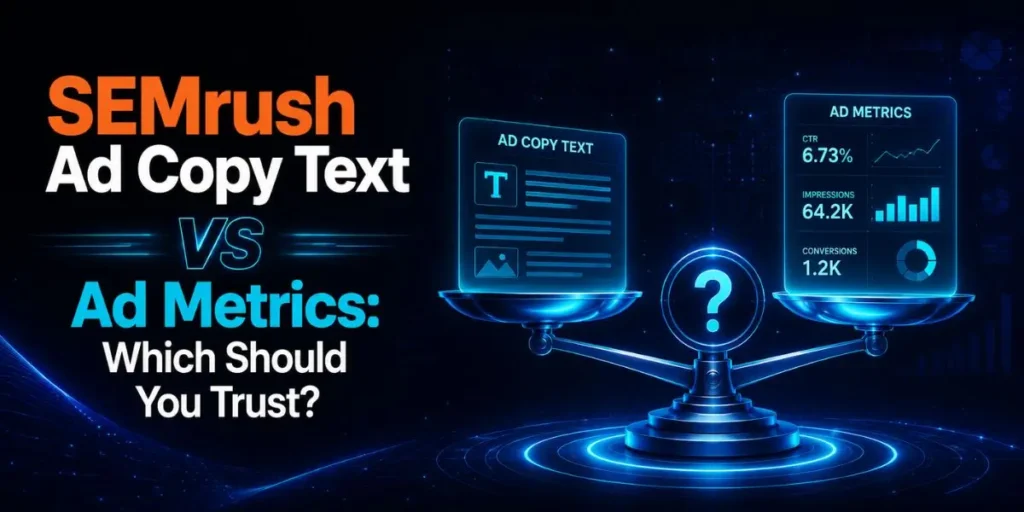
Not every field in the report deserves equal trust. This table breaks down what to rely on and what to verify, so you can read any ad history view at a glance.
| Data field | Type | Reliability | How to use it |
|---|---|---|---|
| Ad headline | Observed (crawled) | High | Trust it for messaging analysis |
| Description text | Observed (crawled) | High | Trust it for offer and tone study |
| Display URL | Observed (crawled) | High | Trust it for landing-page mapping |
| Run date / month seen | Observed (crawled) | Medium to high | Reliable for when seen, not every date |
| Keywords triggering ad | Modeled | Medium | Directional, verify big claims |
| CPC | Modeled estimate | Low to medium | Cross-check, weak on long-tail |
| Search volume | Modeled estimate | Medium | Use as a range, not a fact |
| Traffic share | Modeled estimate | Low to medium | Trend signal only |
| Ad completeness (all ads shown) | Sampled | Medium | Never assume full coverage |
The pattern is consistent. Anything SEMrush physically saw is dependable. Anything it had to calculate is an estimate. Keep that line in your head, and the reports stop being confusing.
Common Mistakes People Make With SEMrush Ad History
Most accuracy complaints actually come from incorrect use of the tool, not from the tool being broken. These are the errors I see most often, and why they happen.
- Treating CPC as exact. People quote the cost figure to a client as if Google reported it. It did not. SEMrush modeled it, and it drifts hard on low-volume terms.
- Assuming the ad list is complete. When a competitor shows only five historical ads, beginners conclude that is all they ran. More likely, the crawler only caught five.
- Ignoring the country database. Pulling ad history on the US database and assuming it reflects global spend. Each region is a separate dataset.
- Reading old snapshots as gospel. A 2013 ad record is far thinner than a 2025 one. Older data is directional, not precise.
- Skipping verification. Citing ad copy in a strategy doc without a 30-second cross-check in the Transparency Center, then getting caught out when a number is off.
The fix for nearly all of these is the same. Separate what was observed from what was modeled, and verify anything you plan to act on or report.
A Real Workflow Example: Auditing a Competitor’s Ad History
Here is the full flow I use, start to finish, so you can see how the accurate and estimated parts fit together in practice.
Input: A competitor domain you want to study, say a SaaS rival bidding on your category terms.
Process:
- Open Advertising Research, enter the domain, and select your target country database.
- Go to the Ads Copies tab and pick a past month to view their historical creatives.
- Pull the headlines, descriptions, and display URLs into a simple sheet. This is your reliable layer.
- Switch to Ads History to see the 12-month timeline and spot when they ramped or paused.
- Note the CPC and volume figures, but tag them clearly as estimates.
- Open the Google Ads Transparency Center, search for the rival’s domain, and confirm a few headlines and run dates.
Output: A creative archive of how the competitor messaged over time, with verified text and clearly flagged estimated metrics.
Result: You can confidently brief a client on what the competitor said, and when they pushed hardest, without overstating cost data you cannot prove. That separation is what keeps the audit honest and useful.
How Accurate Is It Compared to Other Tools?
No single tool sees the full picture, so it helps to know where SEMrush sits. This comparison covers the most common ways people verify or supplement ad history in 2026.
| Tool | Ad copy text | Historical depth | Cost data | Best use |
|---|---|---|---|---|
| SEMrush Ads History | Accurate (crawled) | Back to 2012 | Estimated | Long-term creative and trend analysis |
| Google Ads Transparency Center | Verified (from Google) | Shorter, varies for non-political ads | None shown | Free confirmation that an ad ran |
| SpyFu | Crawled | Multi-year | Estimated | PPC-focused cross-reference |
The smart move is pairing them. SEMrush gives you depth and trend visibility. The Transparency Center gives you free, Google-verified confirmation.
Use SEMrush to find patterns, then spot-check the important claims against Google’s own archive. Neither replaces the other.
One habit that pays off: build your competitor’s creative library in SEMrush for history, but keep the Transparency Center open in a second tab for instant verification. The two together close almost every accuracy gap.
Ads Copies vs Ads History: Which Report Is More Accurate?
The Ads Copies report is more reliable for creative detail, while the Ads History report is better for spotting timing and trends.
They draw on the same underlying crawl data, but they answer different questions, and they fail in different ways.
Ads Copies shows you the full creative tile: headline, description, display URL, and the keyword-trigger count. Since this is built from observed ads, the text is dependable.
The one number to read carefully is the keyword-trigger count, which is modeled and tends to overstate or understate depending on how well SEMrush sampled that ad.
Ads History trades creative detail for a timeline. It tells you which domains appeared in the top 8 paid positions for a keyword across a 12-month window.
This view is excellent for capturing seasonality and bidding rhythm, but it inherits the completeness problem in full.
A blank month on the timeline does not always mean the advertiser went quiet. Sometimes it just means the crawler missed them.
So when accuracy matters most, lean on Ads Copies for what the ad said and Ads History for roughly when it ran. Asking either report to do the other’s job is where people end up with shaky conclusions.
Who Should Actually Rely on SEMrush Historical Ad Copies?
This data fits competitive researchers, agencies, and content strategists better than it fits performance buyers who need exact cost numbers. Knowing who it serves keeps your expectations realistic.
If you run an agency or freelance for clients, the creative archive is genuinely valuable. You can show a client how a rival’s messaging evolved, back it with verified text, and build a smarter positioning angle. For this use, the accuracy is more than enough.
If you are a beginner studying how to write good ads, it is a strong teaching library. You see real headlines and offers that ran long enough to suggest they worked, which beats guessing from theory.
But if you are a hands-on PPC buyer who needs precise CPC to set bids, this is not your primary source. The cost estimates drift too much on the exact terms you care about. Use it for creative intelligence, then pull live numbers from Google Ads itself for the math.
After leaning on this report across dozens of competitor audits, the pattern that holds is simple: it is a creative and strategy tool wearing the costume of a metrics tool.
Judge it on the creative side, and it rarely disappoints. Judge it on the cost side, and you will keep getting frustrated.
Does This Still Matter in 2026 With AI Overviews?
Yes, and arguably more than before. As AI Overviews and AI-driven search reshape how results appear, paid placements and competitor messaging are shifting faster, which makes a reliable historical record of ad creatives more valuable, not less.
But the same accuracy rules apply, just with a newer wrinkle. SEMrush has been expanding into AI visibility tracking, and those AI-related estimates are even earlier-stage than its PPC metrics.
The historical ad copy text remains the dependable anchor. The forward-looking AI traffic numbers are best read as trend signals, not hard measurements.
Unlike what some reviews suggest, the answer is not “AI makes old ad data useless.” It is the opposite. When messaging cycles speed up, the brands that studied what worked historically adapt faster.
Ad history is still one of the most grounded datasets SEMrush offers, precisely because so much of it is observed rather than predicted.
The Verdict: When to Trust SEMrush Historical Ad Copies
SEMrush historical ad copies earn your trust with the creative, but lose it with the math. The headlines, descriptions, and display URLs are observed records of ads that genuinely ran, verifiable for free against Google’s own archive, and reliable enough to build a real competitive strategy on.
The CPC, volume, traffic share, and the assumption of complete coverage are modeled estimates that drift, especially on long-tail terms and smaller markets.
So use it the way it is actually good. Mine it for messaging patterns, offer evolution, and seasonal timing. Cross-check any number you plan to report. And never read a short ad list as proof that a competitor went quiet, because the gap is usually in the crawl, not in their spending.
Read that way, ad history becomes one of the more dependable corners of SEMrush. Read as a precise cost ledger, it will let you down. The tool is honest about what it is once you stop asking it to be something it never claimed to be.
Frequently Asked Questions
They are real. The headlines, descriptions, and display URLs come from crawling actual Google search results, so the ad text reflects creatives that genuinely ran, not synthetic examples.
Zero CPC usually means SEMrush lacked sufficient sample data to model a cost, which is common for long-tail or low-volume keywords. The ad still ran, but the cost figure is unreliable, so cross-check it.
No. SEMrush only records ads that its crawler captured, so short campaigns, niche keywords, and low-volume ads can be missing. Treat the list as a strong sample, not a complete archive.
Use the Google Ads Transparency Center at adstransparency.google.com. Search by the advertiser’s domain, then match the headline and run dates. It is Google-verified and needs no login.
Ad copy snapshots go back to 2012 and are selectable by month. The Ads History timeline shows a rolling 12-month view. Recent data is denser and more reliable than older snapshots.

Is an SEO Specialist and AI Tools Researcher with over 4 years of hands-on experience in search engine optimization. As the founder of Smart AI Helper Pro, he tests and reviews AI writing, SEO, and marketing tools to help creators and business owners grow faster with practical, research-backed strategies.