Can You Sell AI-Generated Art From Midjourney? (Yes, and Here’s How to Do It Legally)
By SM Mehedi Hasan
Yes, you can sell AI-generated art from Midjourney, but only with a paid plan starting at $10/month, which grants commercial rights. Free-trial images cannot be sold. You keep a commercial license, though under current US law, pure AI output is not copyrightable, which changes how you sell.
Most people ask this question hoping for a simple yes or no. The truth sits in the space between two very different things: Midjourney giving you permission to sell, and copyright law giving you protection over what you sell.
Those are not the same, and mixing them up is where creators get burned. I have spent a lot of time selling and helping others sell AI art, and the rules shifted hard in 2025 and 2026.
New court rulings, a massive lawsuit against Midjourney itself, and stricter marketplace policies all landed within months of each other. So this guide sticks to what is actually true right now, with sources for every legal claim, and skips the hype you will find in older posts. Let’s break it down properly.
Table Of Contents
ToggleCan you legally sell AI art made with Midjourney?
Yes, selling Midjourney art is legal as long as you hold a paid subscription. The moment you pay for any tier, Midjourney grants you general commercial rights to the images and videos you generate. Free accounts do not get this, which is the single most common mistake new sellers make.
Midjourney’s most recent Terms of Service, updated on February 12, 2026, keep things creator-friendly when it comes to ownership. The baseline is simple: subscribers generally own the assets they create, including the right to sell them. But a few conditions ride along with it, and one of them catches bigger operations off guard.
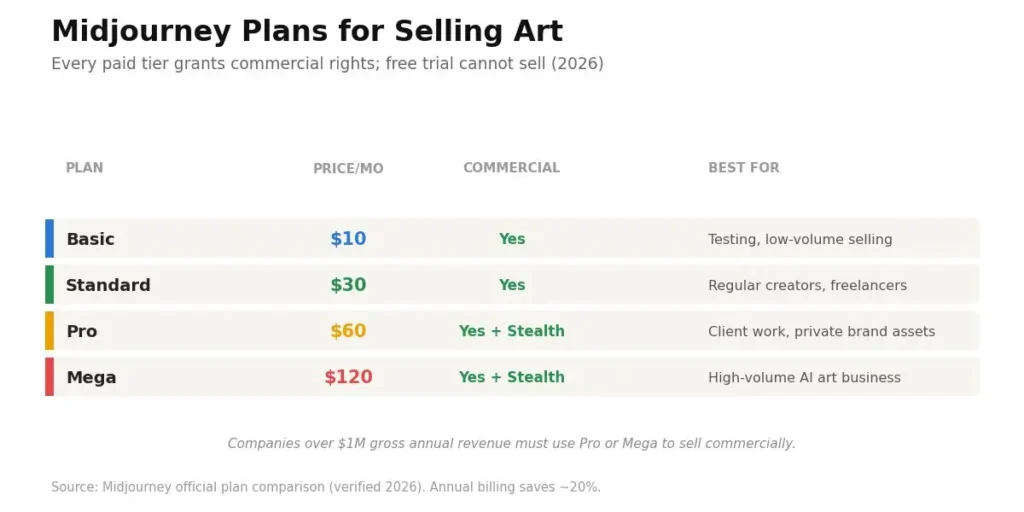
Here is where each paid tier stands on price and commercial use, verified against Midjourney’s official plan comparison:
| Plan | Monthly price | Commercial rights | Best for |
|---|---|---|---|
| Basic | $10 | Yes (general terms) | Testing, low-volume sellers |
| Standard | $30 | Yes (general terms) | Regular creators, freelancers |
| Pro | $60 | Yes + Stealth Mode | Client work, private brand assets |
| Mega | $120 | Yes + Stealth Mode | High-volume AI art businesses |
A couple of details matter more than the price. Companies pulling in more than $1,000,000 USD in gross annual revenue must be on the Pro or Mega plan to sell commercially, per Midjourney’s own terms.
For a solo creator or small shop, that threshold is irrelevant. But if you generate on behalf of a larger business, it is not optional.
And Midjourney removed its free trial back in March 2023, so there is no “try before you buy” path anymore. If you want sellable images, you are paying from day one. The cheapest legal entry point is the $10 Basic plan, or $8/month if you commit to a year upfront for the 20 percent annual discount.
One more edge case worth knowing. If you upscale an image created by another Midjourney user, ownership stays with that original creator, not you. That rarely comes up, but it can bite you in shared community spaces.
Do you actually own the copyright to your Midjourney images?
No, you do not automatically own copyright to pure Midjourney output, and this is the distinction almost every “how to sell AI art” post gets wrong. A paid plan gives you a commercial license, meaning the right to use and sell the image. Copyright protection, the legal power to stop someone else from copying it, is a separate thing that current US law does not hand you for AI-generated work.
The US Copyright Office made its position clear in its report Copyright and Artificial Intelligence, Part 2: Copyrightability, released January 29, 2025. Human authorship is the bedrock requirement. Work generated entirely by AI, with a human only supplying prompts, is not copyrightable.
The Office went further, saying that even detailed, refined, and iterative prompting does not count as authorship, because a prompt does not give you enough control over how the machine expresses the final image.
The courts backed this up. In Thaler v. Perlmutter, the D.C. Circuit Court of Appeals ruled in March 2025 that AI cannot be an author under copyright law, and the court denied a rehearing on May 12, 2025. The precedent stands.
So what does that mean when you are trying to sell?
You can still sell the work. Nothing about listing it is wrong. What you lose is enforcement power.
If someone screenshots your Midjourney piece and sells it themselves, your ability to fight that in court is weak or uncertain, far weaker than it would be for a hand-drawn illustration.
For most sellers, this rarely becomes a real problem, because the license to sell is what actually pays you. The copyright gap only bites when you are trying to stop someone else from copying you.
But there is a way to strengthen your position, and it is more actionable than most articles admit.
How do you make your Midjourney art copyrightable?
You make Midjourney art copyrightable by adding enough genuine human creative input that the final work is no longer “pure AI output.”
The Copyright Office confirmed that human contributions inside an AI-assisted work are protectable, even when the raw generation is not. Here is how to build that protection, step by step.
- Start with the AI image as a base, not the finished product.
Generate your Midjourney piece the normal way. Treat it as raw material rather than the final deliverable. This mindset shift is the whole game, because copyright follows the human expression you add on top of it. - Add substantial human modification.
Bring the image into Photoshop, Procreate, or a similar app, then paint over sections, change colors, restructure the composition, or composite multiple generations into a cohesive piece. The Copyright Office specifically recognizes creative modifications of AI output as protectable. The more your hand shows in the result, the stronger your claim. - Arrange and curate with intent.
If you are building something like a book or a poster series, your creative selection, coordination, and arrangement of images is itself copyrightable, even when individual images are not. The Zarya of the Dawn decision made this clear: the AI illustrations were not protected, but the author’s text and arrangement were. - Register with a proper AI disclaimer.
When you register the finished work with the Copyright Office, disclose the AI-generated portions and claim protection only over your human contributions. Skipping this disclosure is exactly why one famous applicant lost protection for Théâtre D’opéra Spatial in 2023. Honesty on the form protects you.
After these steps, you should hold real, defensible copyright over the human-authored layer of your work, which is the part that gives you legal teeth.
You will not own the raw AI generation, and that is fine. The value lives in what you added.
Here is something worth sitting with. If you are selling low-cost prints or stickers at volume, the copyright gap barely matters, because you are competing on price and speed, not on stopping copycats.
But if you are selling a signature $500 art piece or licensing a brand mascot, that human-input layer is the difference between an asset you can defend and one you cannot.
Is it safe to sell Midjourney art right now?
Selling your own original Midjourney art is generally safe, but you should know that Midjourney itself is fighting one of the biggest copyright lawsuits in AI history, and the details tell you exactly what not to sell.
This is the piece nearly every monetization guide skips, and it is the most important safety context you can have. On June 11, 2025, Disney and Universal filed a joint copyright infringement lawsuit against Midjourney in the U.S. District Court for the Central District of California.
The 110-page complaint accuses Midjourney of training on its libraries and allowing users to generate “endless unauthorized copies” of characters like Elsa, Darth Vader, and Bart Simpson.
Those studios are seeking statutory damages of up to $150,000 per infringed work, as reported by TIME. Then on September 4, 2025, Warner Bros. Discovery filed a separate suit making similar claims.
Midjourney fired back in August 2025, arguing its training is protected transformative fair use and comparing how its model learns to how a human artist studies existing work.
According to the latest court records, the case has moved toward mediation, with a settlement conference and a post-mediation status conference scheduled for August 31, 2026. No final ruling has landed yet.
So why does a lawsuit against Midjourney matter for you, the seller?
Because the whole case is about generating recognizable copyrighted characters. That is the exact behavior that also gets your listings taken down or lands you in legal trouble. The lawsuit is a giant flashing sign pointing at the one thing sellers must avoid.
If Midjourney can be sued for enabling Yoda images, you can absolutely be sued or banned for selling them.
Your original work, a landscape, an abstract pattern, a fantasy scene from your own prompt, sits in a completely different category. That is safe to sell. The danger is entirely on the copyrighted-and-trademarked side.
What can you not sell?
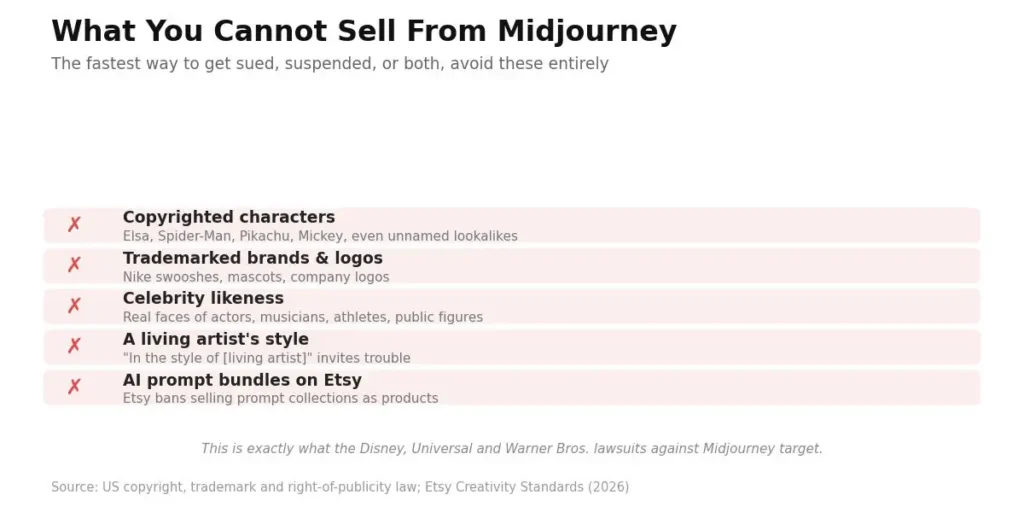
You cannot sell Midjourney art that reproduces content someone else already owns, and violating this is the fastest way to get sued, suspended, or both. This list is short but non-negotiable.
- Copyrighted characters.
Elsa, Spider-Man, Pikachu, Shrek, Mickey Mouse, and every other recognizable character from film, TV, games, or comics are off-limits, even if you never type the character’s name. If the image looks like the character, it carries the risk. - Trademarked brands and logos.
Nike swooshes, brand mascots, and company logos are protected under trademark law, separate from copyright. Removing the brand name does not make a recognizable design safe. - Celebrity likeness.
Generating and selling a real person’s face runs into right-of-publicity laws. This includes actors, musicians, athletes, and public figures. - A living artist’s signature style.
Prompting “in the style of [living artist]” to closely mimic their recognizable look invites both legal and ethical trouble, and many marketplaces now flag it. - AI prompt bundles on Etsy specifically.
Etsy explicitly prohibits selling collections of AI prompts as a product, even though the platform allows AI art itself.
Stick to original concepts, generic subjects, and your own creative direction, and you sidestep the entire minefield.
Where can you sell Midjourney art in 2026?
You can sell Midjourney art on print-on-demand marketplaces, stock sites, your own store, and NFT platforms, but each one now enforces its own AI disclosure rules that stack on top of Midjourney’s permission. Midjourney saying “yes, you can sell” does not override a marketplace saying “disclose it or we remove it.”
Here is where the major platforms stand right now:
| Platform | AI disclosure required? | Key notes |
|---|---|---|
| Etsy | Yes | Disclose in listing description. AI prompt bundles banned. Detection active in 2026. |
| Amazon KDP | Yes | Checkbox in publishing form, covers text, images, and translations. Private to Amazon. |
| Adobe Stock | Yes, with limits | AI labeling required plus extra IP restrictions. Not all AI art qualifies. |
| Redbubble / Printful | Varies | Most allow AI art with disclosure. Check category-specific rules. |
| Your own website | No platform rule | You self-govern, but you are still bound by applicable law. |
What are the AI disclosure rules on each platform?
Each platform wants transparency, but they enforce it in different ways, so read this before you list anything. Etsy allows AI-generated art under its Creativity Standards as “seller-prompted AI creations,” but you must disclose AI use in the listing description.
Etsy tightened these rules on June 10, 2025, updated its Seller Policy on January 14, 2026, and has a further policy version taking effect July 9, 2026, according to its published Creativity Standards.
The platform also rolled out AI image detection in 2026, so hiding it is riskier than disclosing it. A clean disclosure line looks like this: “This design was created with AI-assisted image generation, then edited and curated by the seller.”
Amazon KDP requires you to tick an AI generated content checkbox during publishing if AI produced your text, cover art, or interior illustrations. The disclosure is private between you and Amazon and does not appear on your book’s public page. Enforcement stepped up sharply in 2025 and 2026, and KDP caps most accounts at 3 new titles per day to fight spam.
Adobe Stock is the strictest of the mainstream options. Beyond requiring AI labels, it imposes additional intellectual property restrictions on generative AI submissions, so some Midjourney outputs simply will not qualify.
Read its current contributor policies before you upload a batch.
How do you sell Midjourney art step by step?
Here is the full workflow from a blank Midjourney account to a live, compliant listing that can actually earn.
- Subscribe to a paid plan.
Pick Basic ($10) to test the waters, or Standard ($30) if you plan to generate volume, since Standard adds unlimited Relax mode for images. This unlocks your commercial rights, which is step zero for everything else. - Generate original, non-infringing images.
Build prompts around your own concepts. Avoid named characters, brands, and celebrities entirely. This keeps you clear of the exact risks that lawsuit highlights. - Add human input.
Edit, composite, upscale, or paint over your favorites. This does double duty: it makes the product more unique and strengthens your copyright claim over the human layer. - Choose your platform based on product type.
Print-on-demand for physical goods, Etsy for digital downloads and printables, stock sites for passive licensing, your own store for maximum margin. Match the channel to what you are actually selling. - Write an accurate, disclosed listing.
Describe the deliverable in plain terms (file type, size, print ratio), and include your AI disclosure. Accurate listings reduce refunds and keep you compliant in a single step. - Price for the platform, then publish.
Digital downloads often sit in the $3 to $15 range; POD pricing depends on your margin, and custom work commands a higher price. Set your price, hit publish, and confirm the listing went live without a policy flag. - Promote where buyers actually look.
Pinterest, Instagram, and TikTok drive traffic to art listings far better than posting and praying. Show your process, not just the finished piece.
Follow that order, and you have a listing that is legal, compliant, and positioned to sell.
What are the best ways to make money with Midjourney art?
The most reliable ways to monetize Midjourney art in 2026 are print-on-demand, digital downloads, stock licensing, custom commissions, and self-published book illustration. Each fits a different working style, so here is why each one works and who it suits.
- Print-on-demand (POD): You upload designs to products like t-shirts, mugs, posters, and phone cases, and a partner handles printing and shipping. Zero inventory, low risk, smaller margins. Best for people who want a hands-off, scalable catalog.
- Digital downloads: Sell printable wall art, sticker sheets, clip art, or planner designs as instant downloads. You create once and sell repeatedly, which is close to true passive income. Etsy is the natural home for this.
- Stock licensing: Upload to sites like Adobe Stock, where businesses and designers license your images. Slow to start and heavily saturated now, but genuinely passive once your portfolio grows. This suits patient, high-volume creators.
- Custom commissions: Offer bespoke AI art through Fiverr, Upwork, or your own site. Higher pay per piece, but it trades away passivity for client work. Best if you enjoy direct client relationships.
- Book and cover illustration: Illustrate self-published children’s books, journals, or coloring books through Amazon KDP. This is a large market, though it demands consistent characters across many images, which is where Midjourney alone struggles.
In My Experience
Honestly, when I first started listing Midjourney pieces, I assumed the hard part would be making the art. It was not. The art was the easy 20 percent.
What ate my time was disclosure compliance and picking products people actually search for. My first digital download sat untouched for weeks, not because it looked bad, but because I had listed it in a category nobody browses.
The thing that surprised me most was how much a small human edit changed buyer response.
A raw Midjourney image and the same image after 15 minutes of color grading and cropping looked completely different, and the edited one also gave me a real copyright claim.
That one habit, treating every generation as a starting point instead of a finished product, fixed both my sales and my legal exposure at the same time.
One frustration worth naming: character consistency. When I tried building a themed set where the same mascot appeared across several images, Midjourney drifted every single time.
The face shifted, the proportions changed. For single pieces, it is a non-issue. But anything needing the same character repeated means budgeting serious extra time, or expect to fight the tool.
Common pitfalls when selling Midjourney art
Most sellers do not fail because their art is bad. They fail because of avoidable compliance and strategy mistakes. Here are the ones I see over and over, and why they happen.
- Selling on a free account.
People assume any Midjourney image is theirs to sell. It is not. Free-tier output carries no commercial rights, and this trips up beginners who never read the terms. Fix: subscribe before you sell anything. - Skipping AI disclosure.
Sellers hide the AI origin to make it look more “handmade.” Etsy and Amazon both run detection now, and undisclosed listings are pulled, or accounts are flagged. Fix: disclose plainly, every time. It costs you nothing, and it is required. - Uploading in huge batches.
New sellers dump 50 near-identical designs in a day to “scale fast.” Platforms read that as a spam farm. Etsy sellers report reviews triggered above roughly 20 to 30 AI listings per day, and KDP caps most accounts at 3 titles per day. Fix: pace your uploads. - Using famous characters.
This feels harmless because the tool generates them so easily. It is the single riskiest thing you can do, and it is exactly what the Disney and Warner Bros. lawsuits are about. Fix: original concepts only. - Believing you own full copyright.
Many articles wrongly claim a paid plan gives you copyright. It gives you a license, not protection. Fix: understand the difference, and add human input if enforcement matters to you. - Selling AI prompts on Etsy.
It seems like easy money to package your prompts. Etsy specifically prohibits AI prompt bundles as products. Fix: sell the finished art, not the prompts.
Workflow example: from prompt to first sale
Here is a realistic end-to-end run, laid out as input, process, output, and result, so you can see the full flow rather than the theory.
Input: A $30 Standard Midjourney subscription and a prompt idea for a set of minimalist botanical line-art prints, all original, no brands or characters.
Process: Generate roughly 40 variations, select the 8 strongest, bring each into an editor to clean lines, adjust color, and crop to standard print ratios (so they fit common frame sizes).
Export each as a high-resolution PNG plus a print-ready PDF. Write one accurate Etsy listing per set with a clear AI disclosure line and precise file details.
Output: A single Etsy digital-download listing offering an 8-print botanical bundle, compliant with Etsy’s Creativity Standards, priced at $12.
Result: A live, policy-safe listing that can sell repeatedly with no restocking, no shipping, and no per-sale labor.
The human editing gives you a defensible copyright layer over the arrangement and modifications, and the original subject matter keeps you clear of any infringement risk.
That is the whole loop. Repeat it across niches, and you have a catalog rather than a one-off.
How much can you realistically earn selling Midjourney art?
Realistic earnings from Midjourney art range from a modest side income to a full-time business, but almost nobody strikes gold overnight, and honesty here matters more than motivation.
Sellers who treat it as a real business, with niche research, consistent output, and smart promotion, tend to build steady income. Those who upload random images and wait usually earn little.
A few honest truths. The AI art market grew quickly between 2023 and 2025, so the early “easy money” window narrowed. Stock sites in particular are saturated.
Print-on-demand and digital downloads reward patience and volume, not luck. Custom commission work pays best per hour but caps out at how many clients you can serve.
Your results depend on niche demand, product quality, marketing skill, and how much human value you layer on top.
There is no fixed number, and any article promising you a specific monthly figure is guessing. Treat it as a business, not a lottery ticket, and the math works out far more often.
Frequently Asked Questions
Yes. Only paid plans (starting at $10/month) grant commercial rights. Free-trial images cannot be sold. Companies earning over $1 million in annual revenue need the Pro or Mega plan specifically.
Not automatically. Under US law, pure AI output is not copyrightable because it lacks human authorship. You can protect your human edits, compositing, and arrangement by adding substantial creative input and disclosing the AI components when registering.
Yes, Etsy allows AI-generated art, but you must disclose AI use in your listing description. Etsy bans selling AI prompt bundles as products and uses AI detection, so accurate disclosure is required, not optional.
No. Selling art that reproduces copyrighted characters, trademarked brands, or celebrity likenesses is illegal and results in listings being removed. This applies even if you never type the character’s name and the resemblance is unintentional.
Using Midjourney for original art is generally safe. The Disney and Warner Bros. lawsuits target Midjourney’s training and character-generation, not individual sellers making original work. Avoid generating copyrighted characters, and you stay entirely clear of the risk.
This article is for general information and reflects the state of the law and platform policies as of mid-2026. It is not legal advice.
Copyright and marketplace rules around AI art are still evolving, so verify current terms and consult a qualified IP attorney for decisions specific to your situation.

Is an SEO Specialist and AI Tools Researcher with over 4 years of hands-on experience in search engine optimization. As the founder of Smart AI Helper Pro, he tests and reviews AI writing, SEO, and marketing tools to help creators and business owners grow faster with practical, research-backed strategies.