Is Grammarly HIPAA Compliant in 2026? The Full Answer Healthcare Teams Need
By SM Mehedi Hasan
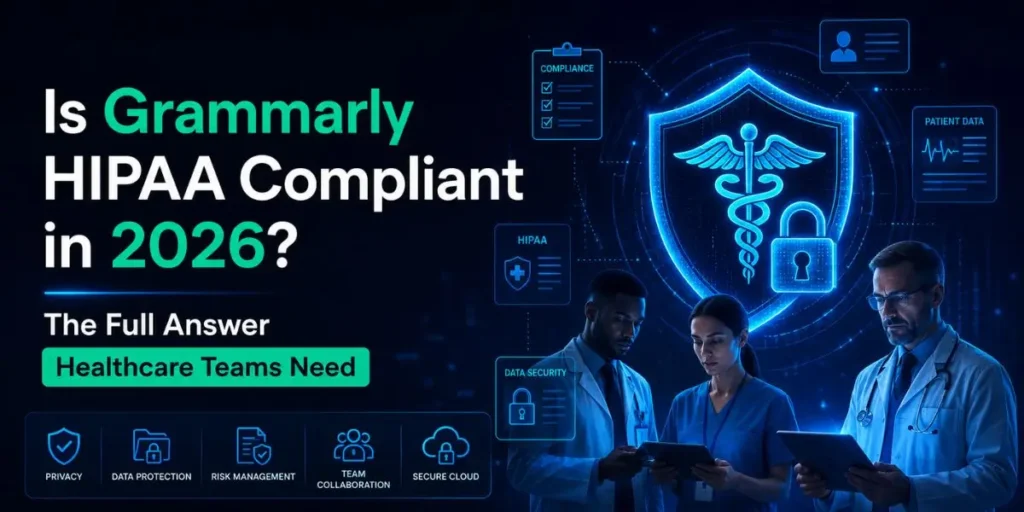
Yes, Grammarly is HIPAA compliant in 2026, but only for organizations on the Business Enterprise plan with at least 100 seats who have signed a Business Associate Agreement (BAA) with Grammarly.
Free, Pro, and standard Business plan users should not use Grammarly to process Protected Health Information (PHI) without a signed BAA in place.
Most articles on this topic give you a yes or a no and move on.
The honest answer is more specific than that, and the nuance matters if you work in healthcare.
Whether Grammarly is usable with patient data depends entirely on your subscription tier, whether you have a signed BAA, and how you’re using the tool day to day.
This guide breaks down the actual compliance status, what the BAA requirement means in practice, Grammarly’s security infrastructure, and what healthcare professionals on lower-tier plans need to understand before they type anything sensitive.
Table Of Contents
ToggleWhich Grammarly Plans Are HIPAA Eligible?
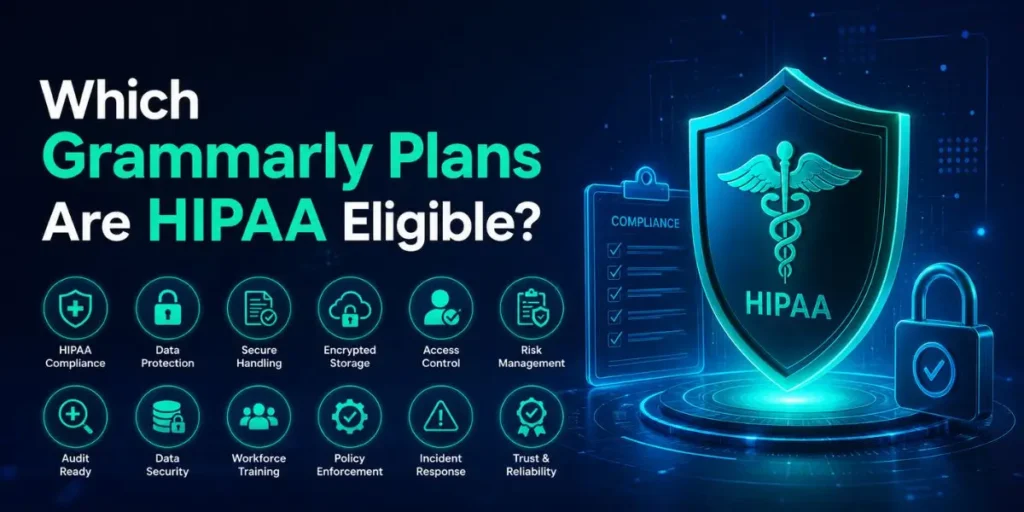
| Plan | BAA Available | Safe for PHI? | Notes |
|---|---|---|---|
| Free | No | No | No BAA possible, no PHI should be processed |
| Pro (Individual) | No | No | No BAA possible, do not use with patient data |
| Business (standard) | No | No | BAA not available at this tier |
| Business Enterprise (100+ seats) | Yes | Conditional | BAA available; PHI use permitted only after BAA is fully executed |
Most small and mid-sized healthcare practices will find the 100-seat minimum a significant barrier.
A solo practitioner, a small dental office, or a team of five clinical writers won’t reach that threshold. For them, using Grammarly with PHI isn’t an option under the current terms.
If you’re part of a large health system, hospital network, or major insurer, the 100-seat minimum is likely manageable.
But even then, the BAA has to be fully executed before PHI can legally flow through the platform. A subscription alone isn’t enough.
In My Experience
The Gap Between “Technically Secure” and “Legally Safe”
Unlike what most reviews say, the compliance question here isn’t primarily about whether Grammarly is secure. It clearly is.
The real problem is that organizations confuse technical security with HIPAA compliance, and those are two different things. A locked house is secure. A locked house with a signed lease is what makes it legal to live there. The BAA is the lease.
I noticed, while researching competitor articles, that almost every one of them leads with “yes, Grammarly is HIPAA compliant” and then buries the 100-seat BAA requirement three paragraphs down, or skips it entirely.
That framing is technically accurate, but for the average healthcare worker who just wants to know whether they can use Grammarly to clean up a patient discharge summary, it is practically misleading.
The honest answer for most individual clinicians and small practices is: you probably cannot legally use Grammarly with PHI under current terms.
Not because Grammarly is insecure, but because they don’t offer BAAs below the 100-seat Enterprise tier. That’s the gap most articles don’t surface clearly enough.
One thing that caught me off guard while reading Grammarly’s own support documentation was this line: “We are looking to optimize this process as we ramp up HIPAA support for our other customers.”
That suggests smaller plans may eventually get BAA access. But as of May 2026, that expansion hasn’t happened. Don’t make compliance decisions based on what might come later.
What Does "HIPAA Compliant" Actually Mean for a Writing Tool?
HIPAA compliance isn’t a simple on/off switch for software.
A tool like Grammarly becomes subject to HIPAA requirements when it touches Protected Health Information, which is any data that could identify a patient and relates to their health condition, treatment, or payment.
Names, dates, addresses, diagnoses, and case notes all qualify.
When a covered entity (such as a hospital, clinic, or health insurer) uses a third-party service to process PHI on its behalf, that service becomes a Business Associate under HIPAA.
And the law requires a formal, signed Business Associate Agreement to be in place before any PHI flows to that service.
So the real question isn’t just “is Grammarly secure?” It’s “has Grammarly entered into a BAA with your organization?” Without that agreement, the security measures don’t matter from a legal compliance standpoint.
You’re still exposed to potential HIPAA violations.
Key Definition
A Business Associate Agreement (BAA) is a legally binding contract that specifies how a vendor handles PHI, what safeguards are in place, breach notification obligations, and what happens if the relationship ends.
Under the HITECH Act, business associates are directly liable for HIPAA violations, with penalties up to $2.13 million per violation category.
Is Grammarly HIPAA Compliant? The Official Position in 2026
Grammarly’s own compliance page states clearly that Grammarly is HIPAA-compliant. The platform has been independently assessed for compliance with HIPAA’s Security Rule, Privacy Rule, and Breach Notification Rule.
But the critical condition follows immediately in their support documentation. Grammarly will only enter into a BAA for Business Enterprise plans. That’s their largest tier, with a minimum of 100 paid seats required.
Anything below that, including the free plan, Grammarly Pro, and the standard Grammarly Business plan, does not qualify for a BAA at this time.
And without a BAA, their own Acceptable Use Policy is explicit: you should not store, transmit, or otherwise process any information via Grammarly that falls within the definition of Protected Health Information under HIPAA’s Privacy Rule (45 C.F.R. Section 164.051).
Critical Warning
If you are a nurse, physician, medical coder, or healthcare administrator using Grammarly Free, Pro, or standard Business on a work device and you type patient names, diagnoses, or case notes into any text field where Grammarly is active, you are potentially processing PHI through a service without a BAA.
That creates HIPAA exposure for your organization regardless of Grammarly’s technical security features.
What Security Measures Does Grammarly Have in Place?
Understanding the technical side matters separately from the legal compliance question.
Even if your organization can’t get a BAA right now, knowing how Grammarly handles data helps assess risk levels for non-PHI healthcare writing tasks.
Encryption
Grammarly encrypts all data in transit using TLS 1.2, the industry-standard protocol. Data at rest in AWS is encrypted using AES-256 server-side encryption.
Grammarly uses AWS Key Management Services for database encryption and secure key management. Enterprise clients can also provide their own encryption keys for additional control over data stored at rest.
Infrastructure and Isolation
All components that process user data operate in Grammarly’s private network inside a secure cloud platform. Each user’s data is isolated from other users’ data.
Servers and network ports are behind load balancers and a web application firewall. The infrastructure runs on AWS US-based data centers.
Certifications and Third-Party Audits
Grammarly holds SOC 2 Type 1 and Type 2 certifications, which validate adherence to strict security and data protection standards through independent audits.
They also hold ISO 27001, ISO 27017, and ISO 27018 certifications covering information security management, cloud security controls, and protection of personal data in the cloud, respectively.
HIPAA compliance has been independently assessed by a third-party auditing firm.
This is separate from the BAA requirement but confirms that Grammarly’s technical and organizational controls meet the HIPAA Security Rule requirements.
Data Access Controls
Grammarly follows the principle of least privilege for internal data access, meaning employees have access only to data necessary for their specific role.
Access rights are regularly reviewed. Content transmitted to Grammarly’s servers for checking cannot be viewed or saved by Grammarly staff without explicit approval.
Worth Knowing
Grammarly does not store the text you type as a readable document on its servers. Text is transmitted to process grammar and style checks, then returned.
What is stored is account information and analytics data about how users interact with suggestions, not the raw content of your writing. This matters for risk assessment even in non-BAA scenarios.
How to Get a BAA with Grammarly: Step-by-Step
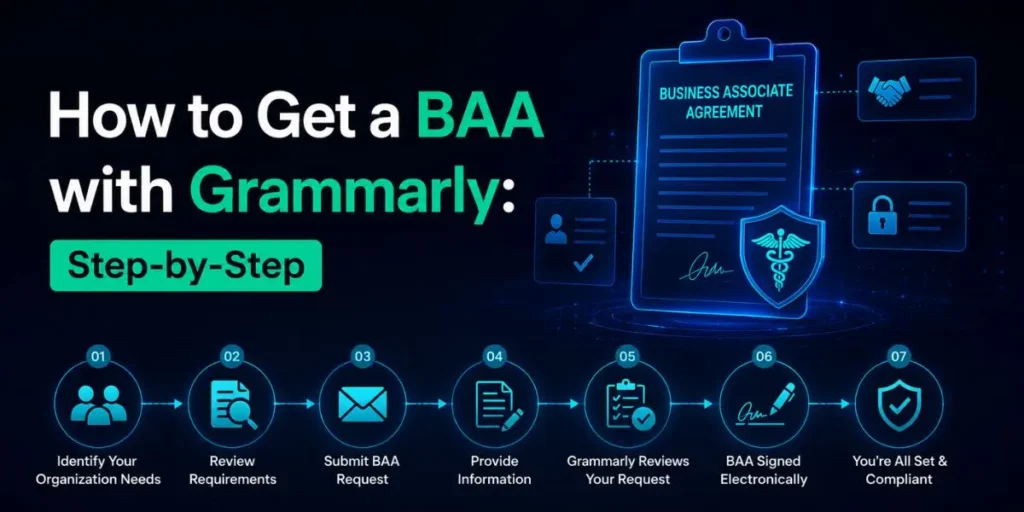
If your organization qualifies for a Business Enterprise plan and needs a BAA, here’s the process.
- Confirm your organization meets the 100-seat minimum. BAAs are only available on Business Enterprise plans. Check with your team or the IT procurement team to see if you have enough users to qualify.
- Contact Grammarly’s enterprise sales team. Go to grammarly.com and look for the Enterprise or Business contact options. You’ll need to discuss pricing, plan structure, and compliance requirements directly with their sales team.
- Request the BAA during contract negotiation. Don’t wait until after signing to ask. Raise the BAA requirement upfront. Request the most recent version of their Business Associate Agreement and review it with your compliance officer or legal counsel.
- Review the BAA against 45 CFR 164.504(e) requirements. The BAA must specify permitted uses and disclosures of PHI, security requirements, breach notification obligations, and termination conditions. Have your legal or compliance team verify these elements before signing.
- Execute the BAA before any PHI is processed. This is non-negotiable. Users should not enter any patient data into Grammarly until the BAA is fully signed and on file.
- Document the signed BAA in your vendor management records. Under HIPAA, covered entities must maintain records of all BAAs. Store the executed agreement and set a review reminder, as BAAs can become outdated when a vendor updates its platform or data-handling practices.
Legal Note
Grammarly recommends submitting BAA requests through their support portal. In some cases, they may require an NDA before sharing the BAA document itself.
Factor that into your timeline if you’re working toward a compliance deadline.
What Can Healthcare Workers on Free or Pro Plans Actually Do?
Most people reading this aren’t running a 100-seat enterprise. So what does the BAA limitation mean practically for individual clinicians, small practices, and solo healthcare writers?
What You Can Still Use Grammarly For
Non-PHI writing is fine. Grammarly is perfectly usable for clinical writing that doesn’t contain patient-identifying information.
Writing a policy document, drafting an internal communication about procedures, editing educational content, improving the language of a grant proposal, or cleaning up a general health article — none of those involve PHI and carry no HIPAA exposure from a Grammarly standpoint.
De-identified data is also not PHI.
If you remove all 18 categories of identifiers that HIPAA defines as PHI (names, dates, geographic data, phone numbers, and so on), the remaining information doesn’t qualify as PHI and therefore doesn’t require a BAA to process through Grammarly or any other tool.
What You Should Not Do Without a BAA
- Typing a patient’s name, date of birth, or diagnosis into Gmail, Word, Slack, or any other application where the Grammarly extension is active.
- Pasting clinical notes containing patient identifiers into the Grammarly Editor web app.
- Using Grammarly to draft discharge summaries, referral letters, or any correspondence that references a specific patient’s health information.
- Running Grammarly on an email containing insurance claim details tied to a named patient.
The risk isn’t that Grammarly is logging patient data or engaging in any malicious activity. The risk is that the absence of a BAA means there’s no legal framework governing how that PHI is handled in the event of an issue.
That’s the exposure point under HIPAA enforcement.
Enforcement Reality
HIPAA violations related to business associate failures carry civil penalties ranging from $100 to $50,000 per violation, with an annual cap of $1.9 million per violation category.
The covered entity is liable even if the BAA failure was with a third-party vendor. “I didn’t know Grammarly wasn’t BAA-eligible on my plan” is not a recognized defense.
Grammarly vs. Other AI Writing Tools for Healthcare Use
| Tool | BAA Available | Minimum Requirement | PHI-Safe? |
|---|---|---|---|
| Grammarly Business Enterprise | Yes | 100+ seats | Yes, with signed BAA |
| Grammarly Free / Pro / Business | No | N/A | No |
| Microsoft 365 (with BAA) | Yes | Enterprise licensing | Yes, with signed BAA |
| Google Workspace (with BAA) | Yes | Business plans | Yes, with signed BAA |
| ChatGPT / OpenAI (consumer) | No | Enterprise tier only | No without Enterprise BAA |
| Anthropic Claude (API) | Select API customers | Specific terms apply | Under specific terms only |
Most general-purpose AI writing and productivity tools follow the same pattern: BAAs are available, but only at enterprise tiers and only after explicit contractual negotiation.
Free and consumer plans across the industry are not designed for PHI handling.
Common Mistakes Healthcare Organizations Make with Grammarly and HIPAA
- Assuming technical security equals legal compliance. AES-256 encryption and SOC 2 certification are real and meaningful. But they don’t replace a signed BAA. Both are required for full HIPAA compliance, not either or.
- Signing up for the Business plan, thinking it includes a BAA. The standard Grammarly Business plan does not qualify for a BAA. Only Business Enterprise plans with at least 100 seats are eligible. This distinction trips up compliance officers who see “business plan” and assume enterprise-level agreements are included.
- Letting staff use Grammarly freely on clinical workstations. Many hospitals and clinics give staff access to Grammarly through a group subscription. Unless the organization has a signed BAA for a qualifying Enterprise plan, staff typing patient information into any application where Grammarly runs as a browser extension or desktop app creates potential PHI exposure.
- Not keeping the BAA updated. Grammarly’s platform capabilities and data handling practices have evolved significantly, especially since the Superhuman rebrand in late 2025. BAAs signed years ago may not reflect current data flows. Review BAAs at least annually and whenever a vendor undergoes significant platform changes.
- Treating de-identification as optional. Some healthcare writers assume that because Grammarly “seems” private, removing PHI identifiers isn’t necessary. De-identification is the cleaner, simpler path for anyone on a non-BAA plan. Remove the 18 HIPAA identifiers, and you’ve removed the compliance risk entirely.
Workflow Example: Using Grammarly Compliantly in a Healthcare Setting
Here’s what a compliant workflow looks like for a hospital communications team with a signed Grammarly Business Enterprise BAA.
- Confirm BAA is executed. Before any staff member accesses Grammarly on the healthcare organization’s account, the compliance officer confirms the signed BAA is on file and covers all users under the plan.
- Provision access through the admin portal. The Grammarly admin controls which users have access and assigns roles and permissions through the administration dashboard. Not all staff need full access, and limiting scope reduces compliance surface area.
- The writer drafts a patient discharge communication. Because the BAA is in place, the clinical writer can use Grammarly’s grammar, clarity, and tone suggestions while editing a document that references patient information.
- Grammarly processes the text via an encrypted connection. Text is transmitted through an encrypted WebSocket connection. It cannot be viewed or saved by Grammarly without approval. Suggestions are returned, and the writer reviews them.
- The document is finalized and saved in the EHR system. Not in Grammarly. The tool is used for writing quality, not for document storage. PHI lives in the compliant EHR, not in Grammarly’s servers.
- BAA is reviewed annually. The compliance team schedules an annual review of the Grammarly BAA, along with other vendor agreements, to confirm that the terms continue to align with current data practices.
The key insight here: Grammarly is a processing tool, not a storage tool. Used correctly with a BAA in place, it fits naturally into healthcare communication workflows without creating new compliance risks.
Frequently Asked Questions
Only if their organization has a signed BAA under a Grammarly Business Enterprise plan with 100+ seats. Individual clinicians on Free or Pro plans should not use Grammarly to process any PHI, no names, diagnoses, or patient-specific information.
Grammarly transmits text to its servers for processing via an encrypted connection, but does not store the raw content of your writing. It stores only account data and interaction analytics. However, without a BAA, transmitting PHI through any channel still exposes the sender to HIPAA violations.
Not under current terms. Grammarly only enters into BAAs for Business Enterprise plans with a minimum of 100 seats. Small practices below that threshold cannot get a BAA and should not use Grammarly with patient data.
Yes. Writing that doesn’t contain PHI, policy documents, internal memos, general health content, staff communications, carries no HIPAA compliance risk. The restriction only applies when patient-identifying health information is involved.
Grammarly holds SOC 2 Type 1 and Type 2 certifications, ISO 27001, ISO 27017, ISO 27018, and is GDPR and CCPA compliant. These confirm enterprise-grade security standards independent of HIPAA requirements.

Is an SEO Specialist and AI Tools Researcher with over 4 years of hands-on experience in search engine optimization. As the founder of Smart AI Helper Pro, he tests and reviews AI writing, SEO, and marketing tools to help creators and business owners grow faster with practical, research-backed strategies.