
How to Use Ahrefs for B2B Keyword Research (2026 Practical Guide)
By SM Mehedi Hasan
Ahrefs helps B2B teams find high-intent, low-competition keywords by pairing Keywords Explorer, Content Gap, and Site Explorer.
Start with real buyer language, filter by keyword difficulty and search intent, then map every term to a funnel stage. The goal is a qualified pipeline, not vanity traffic.
If you have ever opened Ahrefs, typed a broad term, and stared at 40,000 keyword ideas with no clue what to do next, you are not alone. That is the exact moment most B2B keyword research goes sideways.
Learning how to use Ahrefs for B2B keyword research is less about the tool and more about the questions you ask it.
I have run this process for SaaS clients, agencies, and my own projects, and the difference between a useful list and a useless one comes down to filters, intent, and funnel mapping.
So this guide skips the theory. You will get the actual workflow I use, the filters that matter, and the mistakes that quietly waste months.
Table Of Contents
ToggleWhat Is B2B Keyword Research in Ahrefs?
B2B keyword research in Ahrefs is the process of finding and prioritizing the search terms your business buyers use, then ranking them by intent and difficulty instead of raw volume.
It uses Ahrefs data to connect the decisions decision-makers search for with the pages that turn them into leads.
The B2B part changes everything. You are rarely chasing millions of searches. You are chasing the QA Manager, the IT Director, or the VP of Finance, who searches for one specific phrase before booking a demo.
Most people assume more volume equals more value. In B2B, that assumption breaks fast. A keyword with 30 monthly searches and clear buying intent can outperform a 5,000-search term that pulls in students and tire-kickers.
Why Does B2B Keyword Research Need a Different Approach?
B2B keyword research needs a different approach because buyers are fewer, intent matters more than volume, and a single deal can be worth thousands of dollars. You are optimizing for revenue per visitor, not traffic per page.
When I was working on a niche compliance software account, the top “money” keyword had a monthly search volume of just 90. But every visitor was a senior buyer comparing two vendors.
That one page influenced more pipeline than a guide pulling 8,000 monthly visits.
Here is what makes B2B distinct:
- Long sales cycles. Buyers research for weeks and read multiple pages before contacting sales.
- Buying committees. A practitioner, a manager, and an executive all search differently for the same problem.
- Low volume, high value. Many decisive terms show 10-200 searches per month, and Ahrefs sometimes flags them as zero-volume.
- Intent over reach. A “vs”, “pricing”, or “alternatives” query converts far better than a definition.
And honestly, this is the part that beginners underestimate the most. Ranking #1 for a fat informational term feels great, right up until your sales team complains the leads are junk.
Quick tip before you touch the tool: write down your three most profitable customer types first. Every keyword you keep should map back to one of them; if it does not, it does not belong on the list.
How Do You Use Ahrefs for B2B Keyword Research? (Step-by-Step)
- Build seed topics from real buyer language, not guesses.
- Run those seeds through Keywords Explorer to expand the list.
- Filter by Keyword Difficulty and search intent to cut the noise.
- Run Content Gap against 3 to 5 true competitors to steal proven terms.
- Map every surviving keyword to a funnel stage (TOFU, MOFU, BOFU).
- Validate with the live SERP and Reddit before committing.
Below is what each step actually looks like inside Ahrefs, and why it matters.
Step 1: Build Seed Topics From Buyer Language
Why this matters: tools amplify whatever you feed them, so weak seeds produce weak lists. Garbage in, expensive spreadsheet out.
What to do: pull language straight from sales call notes, support tickets, and lost-deal feedback.
Write 5 to 10 seed phrases your buyers actually say, like “test case management” or “vendor risk assessment”. Drop the marketing jargon.
What you should see: a short, unglamorous list of real-world phrases. They feel too simple. That is correct. Those plain phrases are the ones that branch into gold inside Ahrefs.
Step 2: Expand Seeds in Keywords Explorer
Why this matters: one seed can unlock dozens of sub-topics you never knew existed. This is where Ahrefs earns its price.
What to do: paste your seeds into Keywords Explorer, then open the Matching terms and Related terms reports.
Ahrefs pulls from a database of over 110 billion keywords in 2026, so even narrow B2B niches return ideas. Save promising terms to a fresh keyword list. What you should see: a long list of variations. Some will surprise you.
When I ran “test case” for a testing-software client, Ahrefs surfaced a cluster of “test cases for [specific feature]” queries nobody on the team had considered, and those became some of the best-converting pages on the site.
Step 3: Filter by Difficulty and Intent
Why this matters: an unfiltered list is just anxiety in spreadsheet form. Filters turn it into a plan.
What to do: inside your saved list, apply these filters:
- Keyword Difficulty (KD): under 30 for newer sites, under 20 for brand-new domains.
- Volume: 50+ for most B2B niches, but keep low-volume terms if intent is strong.
- Intent: prioritize commercial and transactional modifiers (“best”, “vs”, “pricing”, “alternatives”, “for [industry]”).
What you should see: your list shrinks dramatically, sometimes by 80%. Good. A tight list of 40 strong keywords beats a bloated list of 400 you will never write for.
Here is something worth doing while you filter: check the SERP position history. If positions 4 to 10 are filled with sites weaker than yours, that is your low-hanging fruit. Those are the keywords you can realistically leapfrog.
Step 4: Run Content Gap Against Real Competitors
Why this matters: your competitors already paid to discover which keywords convert. Content Gap lets you borrow that research for free.
What to do: open Site Explorer, enter a competitor domain, and use the Content Gap report. Add 3 to 5 true search competitors, the sites that actually win the rankings you want, not just the brands your sales team names.
Filter for KD under 30 and exclude their branded terms. What you should see: a list of keywords competitors rank for that you do not.
These are validated, market-proven opportunities. Cluster related ones into single pages instead of one thin article per keyword.
Step 5: Map Keywords to the Funnel
Why this matters: a keyword without a funnel stage has no home and no purpose. Mapping tells you what page type to build and what action to expect.
What to do: tag each keyword as TOFU (problem-aware), MOFU (solution-aware), or BOFU (vendor-aware). Use the table further down as your reference.
What you should see: a structured map where every cluster points to a clear page format. BOFU terms become pricing and comparison pages. MOFU terms become solution guides. TOFU terms feed top-of-funnel education.
Step 6: Validate With the SERP and Reddit
Why this matters: Ahrefs’ metrics are estimates and miss conversational, long-tail searches that real buyers type every day.
What to do: search your target keyword in Google and read the live SERP. Then run site:reddit.com [your topic] to see how practitioners phrase their real problems. Add any genuine demand you find back into Ahrefs to check volume.
What you should see: confirmation of intent and a few extra long-tail angles. Sometimes you will discover the SERP wants a listicle when you planned a how-to. Better to learn that now than after publishing.
In My Experience
Honestly, when I first started doing this, I trusted Keyword Difficulty far too much. I skipped a “0 difficulty” term because it looked too easy, assuming it was a data glitch.
A competitor picked it up, and it now sits in an AI Overview pulling steady demo requests.
Lesson learned: in B2B, an oddly low KD on a high-intent term is often an opportunity, not an error. I now check the live SERP before I dismiss anything.
Which Ahrefs Tools Matter Most for B2B Keyword Research?
The five core tools for B2B keyword research are Keywords Explorer, Site Explorer, Content Gap, Rank Tracker, and Site Audit. Used together, they find terms, reveal competitor strategy, and protect your rankings over time.
| Ahrefs Tool | What It Does | Best B2B Use |
|---|---|---|
| Keywords Explorer | Expands seeds into thousands of ideas with volume and KD | Finding low-volume, high-intent niche terms |
| Site Explorer | Shows any domain's top organic keywords and pages | Reverse-engineering competitor winners |
| Content Gap | Lists keywords rivals rank for that you don't | Building a validated content roadmap |
| Rank Tracker | Monitors positions and flags AI Overviews | Tracking money terms and AI visibility |
| Site Audit | Finds technical issues hurting rankings | Clearing crawl and speed issues on key pages |
A quick reality check on accuracy: treat Ahrefs numbers as directional, not gospel. They are excellent for comparing opportunities.
They are weaker than the absolute truth. Confirm real results in Google Search Console and your CRM.
How Should You Map Keywords to the B2B Funnel?
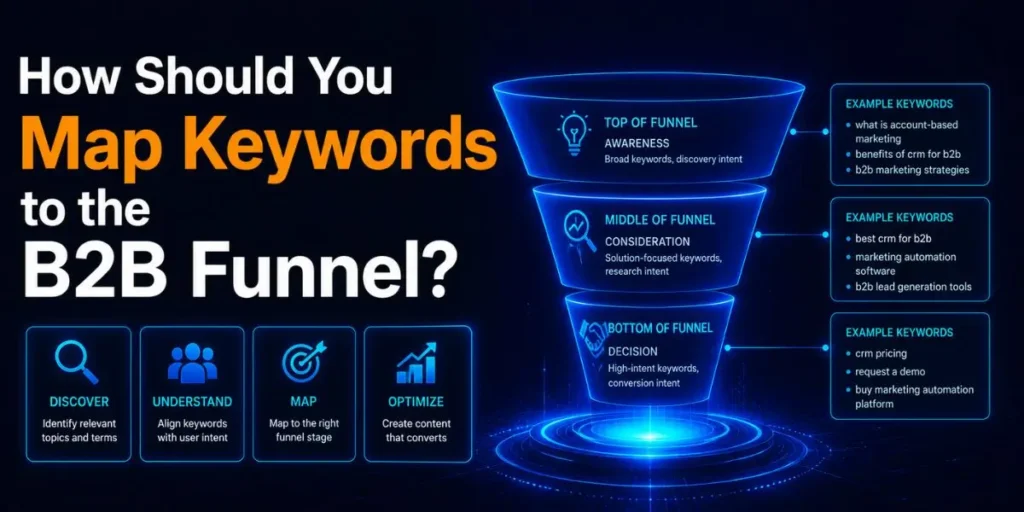
Map keywords to the funnel by matching the searcher’s awareness level to a page type, then to a conversion goal. This stops you from building a blog post when the searcher wanted a pricing page.
| Funnel Stage | Keyword Type | Page Format |
|---|---|---|
| TOFU (problem-aware) | "how to", "what is", "challenges" | Educational guides |
| MOFU (solution-aware) | "best tools", "software for X" | Solution and listicle pages |
| BOFU (vendor-aware) | "vs", "pricing", "alternatives" | Comparison and pricing pages |
Unlike much of the advice you will read, I prioritize BOFU first for small B2B sites. Those pages are easier to rank, face less competition, and sit closest to revenue.
Build the money pages, then work backward into education once they are live.
What About AI Overviews and Ahrefs in 2026?
In 2026, Ahrefs handles AI search through Brand Radar and AI Overview detection inside Rank Tracker, so your keyword research now has to account for whether a term triggers an AI answer at all.
This is the gap most older guides ignore. Google AI Overviews now appear on a large and growing share of queries, and they can noticeably reduce clicks to the top organic result. For B2B, that means two things during keyword research:
- Check if your target keyword triggers an AI Overview. Rank Tracker flags this and shows whether your page is cited.
- Use Brand Radar to see AI visibility. It tracks brand mentions across ChatGPT, Perplexity, Gemini, Copilot, and Google AI Overviews, then shows topic gaps where rivals appear and you do not.
So the smart move in 2026 is to favor keywords with clear commercial intent that AI summaries cannot fully answer. A “best vendor for [industry]” comparison still needs a real page.
A simple definition often gets eaten by the AI box. Structure content with clear definitions, FAQ sections, and comparison tables so AI is more likely to cite you rather than replace you.
Common Pitfalls in B2B Keyword Research
Beginners lose the most time to a handful of repeatable mistakes. Here is where it usually goes wrong and how to fix it.
- Chasing high-volume vanity terms. Why it happens: big numbers feel like progress. The fix: weight every keyword by deal size and intent, not search volume.
- One article per keyword. Why it happens: it feels productive. The fix: cluster related keywords into one strong page so you build topical authority instead of thin, competing posts.
- Trusting KD blindly. Why it happens: A single score is easier than reading a SERP. The fix: always open the live results and judge the actual competition.
- Ignoring the technical base. Why it happens: Content is more fun than audits. The fix: run Site Audit first, because broken pages cap rankings no matter how good the writing is.
- Letting marketing and sales drift apart. Why it happens: keyword data stays in a marketing silo. The fix: feed top buyer questions and objections from Ahrefs into sales scripts and follow-up assets.
A Real Workflow Example (Input to Result)
Here is a full pass for a fictional but realistic client, a mid-size HR software company targeting US buyers.
Input: Seed topic “employee onboarding software” plus buyer language from sales calls like “onboarding compliance” and “remote onboarding”.
Process:
- Ran seeds through Keywords Explorer, saved 180 ideas.
- Filtered for KD under 25 and commercial intent, cut to 38 terms.
- Ran Content Gap against three competitors, found “onboarding software for remote teams” and “BambooHR alternatives”, both untouched by the client.
- Tagged each as MOFU or BOFU and clustered them into four pages.
- Checked the SERP, confirmed the “alternatives” term showed a comparison-style result and no full AI Overview.
Output: A prioritized map of four pages, each tied to a funnel stage and a conversion goal, with KD and intent noted for every cluster.
Result: The “alternatives” comparison page, built from a 70-search keyword, became the highest demo-driving page on the site within one quarter, because every visitor was a buyer comparing vendors at the decision stage.
That is the whole point. Small number, big intent, real pipeline.
Frequently Asked Questions
Yes. Ahrefs is one of the strongest tools for B2B keyword research because its Content Gap and Keywords Explorer reports surface low-volume, high-intent terms that drive qualified leads rather than empty traffic.
Newer B2B sites should aim for KD under 30, and brand-new domains under 20. Match difficulty to your own Domain Rating and prioritize terms where weaker sites rank in positions 4 to 10.
They are estimates, not exact figures. Use them to compare opportunities and prioritize work, then confirm real performance in Google Search Console and your CRM before making big decisions.
Intent. A 50-search keyword tied to buying decisions can drive more revenue than a 5,000-search informational term. In B2B, qualified intent beats raw volume almost every time.
Yes. Organic search still drives most B2B discovery. Use Ahrefs Rank Tracker to spot AI Overview triggers and target commercial keywords that AI summaries cannot fully replace.

Is an SEO Specialist and AI Tools Researcher with over 4 years of hands-on experience in search engine optimization. As the founder of Smart AI Helper Pro, he tests and reviews AI writing, SEO, and marketing tools to help creators and business owners grow faster with practical, research-backed strategies.