Will Medical Coding Be Replaced by AI? The Honest 2026 Answer for Coders
By SM Mehedi Hasan
No, medical coding will not be fully replaced by AI. Routine encounters can already be coded 40 to 60 percent faster with AI assistance, yet the U.S. Bureau of Labor Statistics still projects 7 percent job growth through 2034, while quietly warning that AI may soften future demand for coders.
That last part is the piece almost nobody quotes, and it changes how you should read every “your job is safe” headline. Most articles on this topic give you a comfortable yes-or-no and move on. That is not enough if your paycheck depends on the answer.
What you actually need is the line between the work AI is quietly taking and the work it keeps handing back to humans, because that line is where your career lives for the next decade.
Table Of Contents
ToggleWill medical coding be replaced by AI in 2026?
No, medical coding will not be replaced by AI in 2026, but a slice of the routine work already has been. AI systems now suggest ICD-10, CPT, and HCPCS codes, scrub claims before submission, and auto-capture charges in structured specialties.
What they cannot do is take legal responsibility for a code, and in U.S. healthcare that responsibility never disappears.
Here is the distinction that gets blurred everywhere else. There are two very different things people call “AI coding”:
- AI-assisted coding, where the software suggests and a human reviews and signs off. This is standard in 2026, and it is growing fast.
- Autonomous coding, where the software codes and bills with no human touch. This exists, but only inside narrow, highly structured pockets like screening mammograms or routine lab panels.
The scary version of “AI replaces coders” is autonomous coding spreading everywhere. That is not happening, and the reasons are structural, not just technical. Keep that split in mind, because the rest of this guide hangs on it.
What can AI actually do in medical coding right now?
AI can already handle the high-volume, low-complexity end of coding with real speed. Think of a primary care note that reads “follow-up, type 2 diabetes on long-term insulin.”
An AI engine assigns E11.9 and Z79.4, sets the visit level, and pushes the claim in seconds- work that would take a person a minute or two, thousands of times a day. Below is what the current generation of tools does well, and where a human still sits in the loop.
| Task AI handles | What the human still does |
|---|---|
| Suggest codes from clean documentation | Validate, adjust, and sign off |
| Scrub claims for mismatches before submission | Judge borderline and payer-specific edits |
| Auto-capture charges in radiology and pathology | Audit output for systematic errors |
| Flag denial patterns across thousands of claims | Design the fix and write the appeal |
Notice the pattern in that right-hand column. Every AI strength creates a matching human job that did not exist in the same shape ten years ago. The work is not vanishing so much as sliding one seat over.
How accurate is AI at suggesting codes today?
AI code suggestion is strong on routine, well-documented cases and shaky everywhere else. On a clean, outpatient note, modern natural language processing can reliably extract the diagnosis, the procedure, and the correct code set.
Vendors report coding-time reductions of 40 to 60 percent on those encounters, though those are vendor figures, not independent audits, so treat them as directional rather than gospel.
But accuracy falls off a cliff the moment documentation gets messy, and messy is the norm in real charts. A note that says “possible pneumonia” in one line and “respiratory infection” three lines later is not a rare edge case.
It is Tuesday. AI either guesses the statistically likely path or kicks the record to a human, which is exactly what you want it to do, and exactly why humans stay in the workflow.
Which coding tasks does AI already handle well?
Structured, repetitive documentation is where AI performs best. Radiology and pathology lead the pack because their reports are templated and predictable, so charge capture there is among the first areas to see heavy automation.
Screening services, routine labs, and straightforward evaluation and management visits follow close behind. So if your day is 90 percent clean, repeatable outpatient claims, some of that volume is already being absorbed.
And that is not a reason to panic. It is a reason to read the next two sections carefully.
Where does AI still fail at medical coding?
AI still fails wherever coding stops being pattern-matching and starts being judgment. This is the load-bearing wall of the whole “will AI replace coders” question, and it holds up far better than AI boosters like to admit.
Why can’t AI handle complex or messy documentation?
Complex cases break the very pattern AI leans on, which is exactly why it stumbles on them. The software codes from examples in past data, so anything unusual pushes it outside what it has seen.
Picture an inpatient admission for an autoimmune flare that cascades into complications across several organ systems, pulling in codes from multiple ICD-10-CM chapters with tricky sequencing rules.
An experienced inpatient coder reasons through that. An AI model reaches for the nearest familiar example and often gets the principal diagnosis or the sequencing wrong. Incomplete and contradictory notes make it worse.
When a physician’s impression conflicts with the consultant’s, or when the discharge summary is dictated 4 days late with different details, a human coder knows to query the provider.
They know what to ask and how to phrase it. AI does not query. It either fills the gap with a guess or flags everything as uncertain, which quietly creates more work instead of less.
Why does compliance and payer nuance still need humans?
Compliance needs humans because coding is a legal act, not just a classification task. Every code you submit lives inside ICD-10-CM guidelines, CPT rules, AHA Coding Clinic advice, CMS NCCI edits, LCD and NCD policies, and payer-specific quirks, all of which change constantly and sometimes contradict each other.
When a payer’s coverage policy fights the ICD-10-CM guideline, someone has to make a defensible call and own it under audit. That ownership is the part AI cannot take. Upcoding, unbundling, and similar violations carry audits, fines, and in serious cases criminal exposure.
A model optimizes for whatever it was trained on. A human coder understands where the ethical and legal lines sit, and only a human can be held accountable when a claim is questioned. As long as U.S. healthcare law assigns responsibility to an individual, that individual keeps a job.
What do the latest job numbers really say?
The latest numbers say demand is still growing, but the government has started hedging on AI, and that hedge is the story.
The U.S. Bureau of Labor Statistics projects employment of medical records specialists to grow 7 percent from 2024 to 2034, more than double the 3 percent average across all occupations, with about 14,200 openings each year and roughly 194,800 people already in the role as of 2024 (BLS Occupational Outlook Handbook).
Now the part almost every competing article leaves out. In that same official handbook, the BLS added a caveat in plain language: the growing adoption of AI-powered solutions that make coding more efficient “may affect the demand for these workers.” Read that twice.
The government’s own projection forecasts healthy growth while warning that AI could temper it. Anyone telling you the numbers are a pure green light is only quoting half the source.
Why does demand hold up at all when AI is this capable? Follow the money in the revenue cycle:
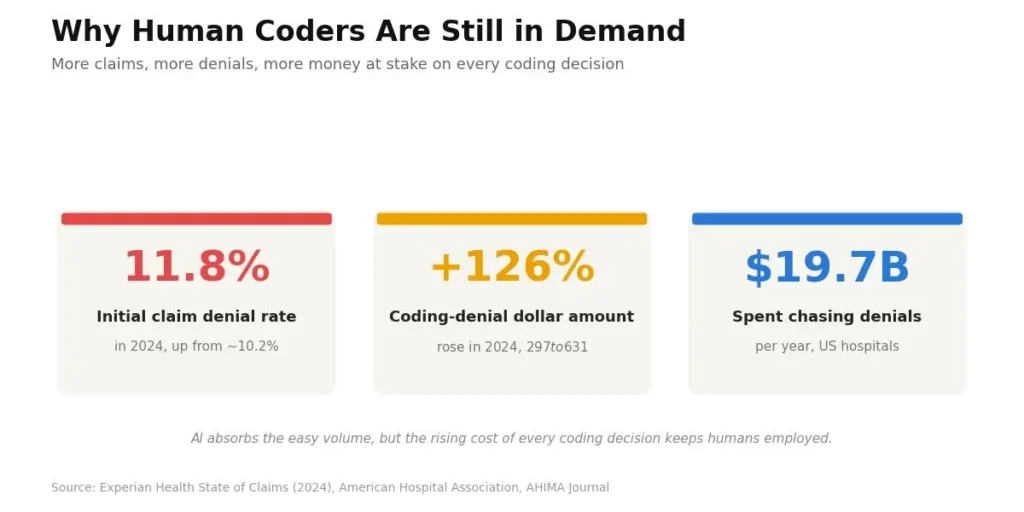
- Initial claim denial rates hit 11.8 percent in 2024, up from around 10 percent a few years earlier, per Experian Health’s State of Claims data.
- The average cost to rework a single denied claim ranges from $25 to $181, depending on complexity, per AHIMA Journal figures, and hospitals collectively spend about $19.7 billion a year chasing overturned denials, per the American Hospital Association.
- Coding-related denials are getting more expensive fast. The AHA reported the average coding-related denial dollar amount rose 126 percent in 2024, to $631 from $297 the year before.
More claims, more denials, more complexity, more money at stake on every coding decision. That is the engine keeping human coders employed even as AI absorbs the easy volume. The role is not shrinking on schedule. It is being pushed up the value chain.
Which medical coding jobs are most at risk from AI?
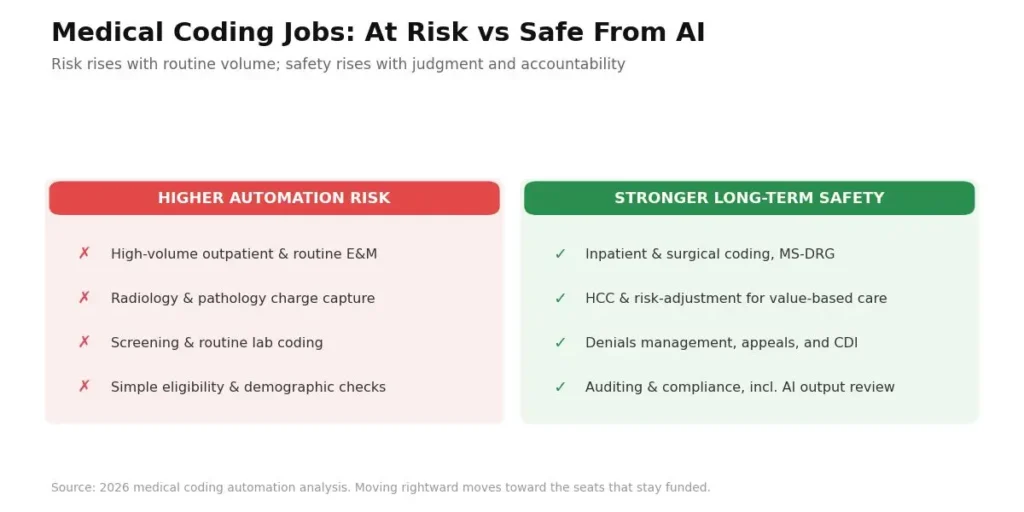
The jobs most at risk are the ones built on high-volume, well-documented, repetitive coding. The safest jobs are the ones built on judgment, complexity, and accountability. Vague reassurance helps nobody, so here is the specific split as it stands in 2026.
| Higher automation risk | Stronger long-term safety |
|---|---|
| High-volume outpatient and routine E&M | Inpatient and surgical coding, MS-DRG assignment |
| Radiology and pathology charge capture | HCC and risk-adjustment coding for value-based care |
| Screening and routine lab coding | Denials management, appeals, and CDI |
| Simple eligibility and demographic checks | Auditing and compliance oversight, including AI output review |
If your work sits mostly in the left column, that is a signal, not a sentence. Coders who move rightward, toward validating AI output, working denials, or specializing in complex inpatient and risk-adjustment work, are moving toward the roles the same trend is creating.
The fastest-growing job in this space right now is arguably the coder who audits what the AI produced, because that person needs to know coding better than an average coder, not less.
In My Experience
Honestly, the thing that surprised me most watching these tools mature is how confidently they handle the boring 80 percent and how gracefully they fall apart on the interesting 20 percent. Feed an AI coder a tidy diabetes follow-up, and it is genuinely faster than any human.
Feed it a real discharge summary with hedged language, a late addendum, and a comorbidity the physician never explicitly linked, and it either freezes or fabricates a tidy answer that a good coder would immediately question.
One thing that keeps standing out is the “confidence gap.” The tools rarely say “I am not sure.” They surface a suggestion with the same steady tone whether the note was crystal clear or a contradictory mess, which means the human in the loop is not optional decoration.
That human is the thing standing between a plausible-looking wrong code and an audit. Coders who treat AI suggestions as a starting draft, not a verdict, get the speed without inheriting the risk. Coders who rubber-stamp output are the ones who eventually get burned.
What is the realistic timeline for AI in medical coding?
The realistic timeline is gradual absorption at the easy end, not a sudden collapse of the profession. Anyone selling you a firm date is guessing. Still, the direction of travel is clear enough to plan around.
- In the next 12 months,
AI-assisted coding becomes the default in most mid-to-large organizations. Routine outpatient and structured specialty volumes keep automating. Human review stays mandatory. - Two to three years:
Autonomous coding expands within narrow, structured niches. Coder job descriptions shift visibly toward audit, denials, CDI, and exception handling. Certifications in complex and risk-adjustment coding gain value. - Five to ten years:
The “coder” title increasingly means a hybrid quality-and-compliance role sitting on top of AI. Pure manual code lookup fades. Human accountability, complex judgment, and regulatory expertise remain firmly human.
Notice what does not appear on that timeline: a year where competent, adaptable coders are simply not needed. The pressure is real, but it rewards movement rather than punishing existence.
What should medical coders do to stay ahead of AI?
The move is to stop competing with AI on speed and start owning the work it cannot do. That means deliberately shifting your skill set toward judgment-heavy, accountability-heavy territory before the easy volume thins out. Here is a concrete path rather than a vague pep talk.
Pro tip: Do not chase learning Python or “becoming technical” unless you enjoy it. The valuable AI-era coder is not a programmer. It is a coder who can out-judge the machine on complex, ambiguous, and high-compliance cases, then explain and defend that judgment.
A simple way to picture the transition is as a workflow you run on your own career.
Workflow example: repositioning yourself in an AI-assisted shop
- Input: You currently code high-volume outpatient claims, the exact work AI absorbs first.
- Process: You add one complex competency deliberately, for example HCC and risk-adjustment coding, and you start reviewing AI-generated codes rather than only producing your own.
- Output: You become the person who validates AI suggestions, catches its systematic errors, and handles the cases it kicks back.
- Result: Your role moves from “produces routine codes” to “guarantees coding accuracy and compliance,” which is the seat that stays funded as automation grows.
Pro tip: Get fluent in denials and appeals. When a claim is denied, someone has to read the payer’s reasoning, cross-reference the record and policy, and build a persuasive argument to overturn it. That is critical thinking, persuasive writing, and deep knowledge of the guidelines, and it is nowhere near AI’s reach.
One more worth saying plainly. Stay current on guideline changes, because “the person who knows why the rule changed” becomes more valuable, not less, in an automated shop.
Every ICD-10-CM update, every new Coding Clinic advisory, every LCD revision is a moment where human understanding beats a model trained on last year’s data.
Should you still start a medical coding career in 2026?
Yes, starting a medical coding career in 2026 still makes sense, as long as you enter with your eyes open and aim past the automatable entry lane. The old path of “learn to look up codes, get a job, coast” is the exact path AI is thinning out. The new path is steeper at the start and more durable at the finish.
If you are entering the field now, a few things matter more than they did five years ago. Certification carries more weight, not less, because employers increasingly need people who can be held accountable for AI-assisted output.
Hands-on practice with real, redacted charts beats memorizing code books, since the value is in judgment on messy documentation. And picking a lane that resists automation early, whether that is inpatient, risk adjustment, or auditing, sets you up for the seats that stay funded.
Pro tip: When you evaluate a training program, ask one blunt question: does it teach you to work alongside AI coding tools, or does it pretend they do not exist? Programs that ignore AI are training you for the shrinking half of the job.
The honest framing for a newcomer is this.
Medical coding is not a dying career; it is a changing one, and the people who will regret entering are those who expected it to stay simple. The people who will thrive are the ones who treat it as a skilled, evolving profession from day one.
Common pitfalls and myths about AI replacing coders
The biggest mistake coders make is believing the loudest version of the story, in either direction. Panic and denial are both expensive. These are the traps worth avoiding.
- Myth: “AI codes at 99 percent accuracy, so I am done.”
It does not, not on real-world messy documentation. Those numbers come from clean-data demos and vendor decks, not audited production charts across specialties. - Myth: “Certification is worthless now.”
The opposite is happening. As coding shifts toward audit, compliance, and complex cases, credentialed expertise gets more valuable, because someone has to be legally accountable for what the AI produced. - Pitfall: Rubber-stamping AI output.
This is the fastest way to inherit the machine’s errors and own them under audit. The value you add is the review, so skipping the review deletes your value. - Pitfall: Waiting to see what happens.
The coders who struggle are not the ones AI replaced. They are the ones who stayed in the fully automatable lane while their peers moved into denials, CDI, and risk adjustment. - Pitfall: Assuming your employer’s timeline is the industry’s.
A slow-moving organization can lull you into thinking nothing is changing. Track the field, not just your own desk.
Avoid these five, and you are already ahead of most of the anxiety-driven conversation happening around this question.
Frequently Asked Questions
No. AI will keep absorbing routine, well-documented coding, but complex cases, ambiguous notes, appeals, payer nuance, and legal accountability stay with humans. U.S. healthcare law requires a responsible human, which structurally protects the role.
Yes, for coders who adapt. The BLS projects 7 percent job growth through 2034, with about 14,200 openings a year. The safest paths lead into auditing, denials, risk adjustment, and AI output validation.
Only the routine, structured portion. AI can code clean outpatient, radiology, and lab encounters quickly and cut coding time for those encounters by 40 to 60 percent. Complex and ambiguous cases still require human coders.
Judgment-heavy skills protect you: complex inpatient and surgical coding, HCC and risk adjustment, denials and appeals, clinical documentation improvement, auditing, and reviewing AI output. These require reasoning and accountability that current AI cannot reliably deliver.
Not directly, but it hedges. The BLS still projects strong 7 percent growth, while noting that rising adoption of AI-powered coding tools “may affect the demand” for these workers. Both things are true at once.
This article covers the medical coding profession and career outlook, not clinical or coverage advice. Coding guidelines, payer policies, and employment data change frequently, so verify current figures against primary sources such as the BLS, AHA, and AHIMA before making career or business decisions.

Is an SEO Specialist and AI Tools Researcher with over 4 years of hands-on experience in search engine optimization. As the founder of Smart AI Helper Pro, he tests and reviews AI writing, SEO, and marketing tools to help creators and business owners grow faster with practical, research-backed strategies.