Will Doctors Be Replaced by AI? What the 2026 Evidence Really Shows
By SM Mehedi Hasan
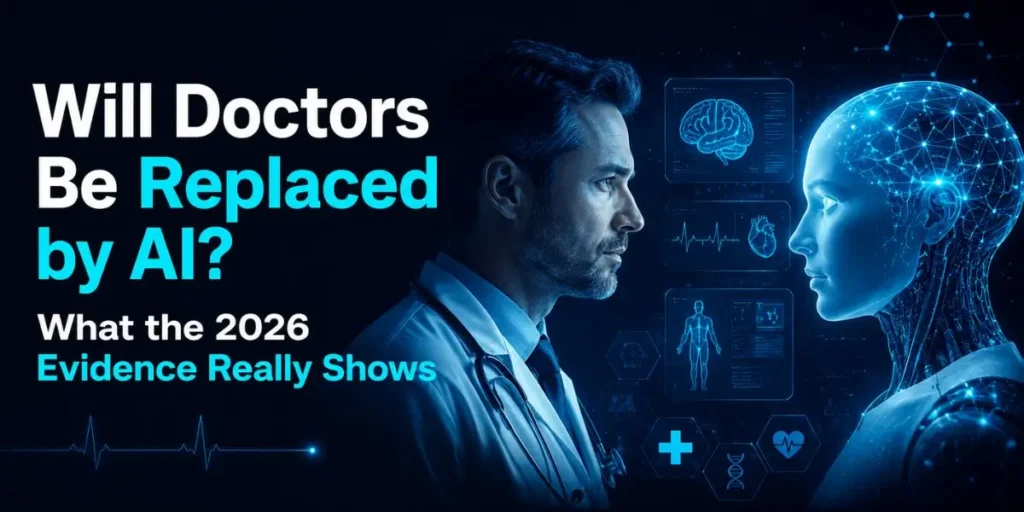
No, doctors will not be replaced by AI, and the 2026 evidence points to augmentation instead of replacement. AI now powers nearly 1,500 FDA-authorized medical devices, yet the U.S. Bureau of Labor Statistics projects physician jobs to grow about 3% through 2034. The role is shifting, not vanishing.
Most people picture a robot in a white coat taking over the exam room. That image is wrong, and it has been wrong for years. What is actually happening is quieter and, in some ways, more interesting: AI is quietly absorbing the parts of a doctor’s day that most doctors never wanted to do in the first place.
I have spent months testing AI symptom checkers, medical chatbots, and general tools like ChatGPT on health questions, and the gap between the headlines and what is actually true is wide.
So let’s look at what the data actually says in 2026, which doctors face the most disruption, when the changes hit, and what any of this means if you are a patient or a future physician. A quick note before we start. This is a technology and career analysis, not medical advice. If you have a health concern, see a licensed clinician.
Table Of Contents
ToggleWill doctors be replaced by AI?
No, doctors will not be replaced by AI, but a large share of their daily tasks already are. The consensus across physician surveys, regulators, and peer-reviewed research is that AI is automating well-defined tasks while the physician keeps ownership of diagnosis, treatment, consent, and accountability.
Think of it less as “human versus machine” and more as a redrawing of the job description. AI takes the repetitive, pattern-heavy work. The doctor keeps the judgment, the physical exam, and the responsibility when things go wrong.
Here is the split, task by task.
| Clinical notes and documentation | High | A physician must verify and sign the note |
| Imaging triage and second reads | High | The clinician owns the final interpretation |
| Literature review and summaries | High | Evidence still has to fit this specific patient |
| Diagnosis in complex cases | Medium | AI lacks exam, context, and legal accountability |
| Physical exam and procedures | Low | Requires hands, senses, and real-time judgment |
| Breaking bad news and consent | Low | Requires trust, empathy, and ethics |
Notice the pattern. The “high impact” rows are all information tasks. The “low impact” rows all involve a human body, a human relationship, or a decision someone has to answer for legally. That line is the whole story.
What can AI actually do in medicine right now?
AI in 2026 can read scans, draft notes, triage symptoms, and summarize research faster than any human, and it is doing all of it at scale. The U.S. Food and Drug Administration’s AI-Enabled Medical Device List now includes close to 1,500 cleared devices, with roughly three out of every four sitting in radiology and imaging.
But raw capability is not the same as replacement. Here is where AI genuinely earns its place, and where the numbers get impressive.
How good is AI at diagnosis and medical imaging?
AI is very good at narrow, visual diagnostic tasks and mediocre at open-ended ones. That single distinction explains most of the confusion in this debate.
On defined imaging jobs, the results are strong.
Sweden’s large MASAI trial found that pairing radiologists with AI for mammography screening caught more cancers between screenings than the standard method of having two radiologists read every scan.
In one chest-imaging study, AI lifted pneumothorax (collapsed lung) detection sensitivity by 26% and cut reading time by 31%. And in an emergency setting, AI plus a radiologist achieved 97.6% accuracy in detecting bone fractures, beating both AI alone (92.7%) and a physician working without AI (93%).
The combination wins, not either side by itself. Now the other half of the picture. A 2025 meta-analysis in npj Digital Medicine pooled 83 studies on generative AI in diagnosis and landed on a sobering headline: an overall accuracy of about 52%.
That is roughly on par with a non-expert physician, while expert clinicians still beat it by nearly 16 percentage points. When cases get messy, AI’s edge disappears fast. So AI is a phenomenal second pair of eyes for a clear-cut scan. It is not a doctor for a confusing patient.
How much of a doctor’s paperwork can AI take over?
AI can already handle a significant share of documentation, and this is where it helps doctors the most. Surveys consistently show physicians name paperwork reduction as AI’s single biggest opportunity, and the reason is simple math.
The average U.S. physician works close to a 58-hour week, and a big chunk of that is not spent with patients at all. It goes to charting, inbox messages, prior-authorization forms, and coding. AI “ambient scribes” that listen during a visit and draft the note in real time have spread rapidly across health systems.
A Mass General Brigham study in JAMA Network Open reported a 21.2% absolute drop in burnout after 84 days of using ambient AI documentation. And that matters for the replacement question in a way people miss.
Every hour AI gives back is an hour the doctor spends on the human parts of care that AI cannot do. The tool is not competing for the job. It is defending it.
Pro tip: When you read a scary “AI beats doctors” headline, check whether the study measured a single narrow task (like reading one scan type) or real, messy clinical reasoning. The gap between those two is where most hype lives.
Where do human doctors still beat AI?
Human doctors still win on physical examination, empathy that changes outcomes, and reasoning through uncertain, non-linear cases. These are not soft “nice to have” skills. Each one is backed by hard evidence, and each one is a wall AI has not climbed.
Why can’t AI do a physical exam?
AI cannot perform a physical exam because it has no body, and a physical exam is an interpretive act, not a data readout. Palpating an abdomen, listening to heart sounds, watching how a patient walks into the room- all of it feeds a diagnosis in ways a chatbot never sees.
Consider two patients with identical lab results. One winces when they shift in the chair. One has skin color that looks slightly off. One says “I’m fine” while avoiding eye contact.
A physician reads those signals and changes course. Of the nearly 1,500 FDA-cleared AI medical devices, not one performs a physical examination. That is not a coincidence. It is a hard limit.
Why does empathy actually change medical outcomes?
Empathy changes outcomes because patients who trust their doctor follow the treatment plan, and following the plan is often what determines whether they get better. This is measurable, not sentimental.
One study following 891 patients with diabetes found that those treated by doctors rated high on empathy hit their blood-sugar target far more often (56%) than patients with low-empathy doctors (40%).
Trust in a physician has been linked to a large difference in whether people actually take their medication. Here is the twist that surprises everyone. In side-by-side tests, patients sometimes rate AI-generated responses as warmer than those from a rushed doctor.
But that is a story about exhausted, overbooked clinicians, not proof that software cares. A doctor reads emotion in real time and folds it back into the diagnosis. AI generates the words for empathy. It does not use empathy as a clinical instrument.
Why does messy, real-world diagnosis still need a human?
Real diagnosis rarely follows a straight line, and AI struggles the moment a case leaves the textbook. One person’s chest pain is cardiac, another’s is anxiety, a third’s is a gallbladder acting up in an unusual way.
Patients present with overlapping symptoms, missing history, and conditions that mimic each other. AI learns from what is already documented and labeled. It is strong on the known and weak on the “something here does not add up.”
A joint Stanford and Harvard analysis of clinical AI found that the performance gap widened exactly when cases got harder: when doctors had to ask follow-up questions, work with incomplete information, or change their minds as new details arrived.
On tests built to measure reasoning under uncertainty, AI behaved more like a medical student than a seasoned physician, and it tended to commit confidently to one answer even when the situation was genuinely unclear. That overconfidence is the danger. A good doctor doubts. Current AI often does not.
Which medical specialties are most at risk from AI?
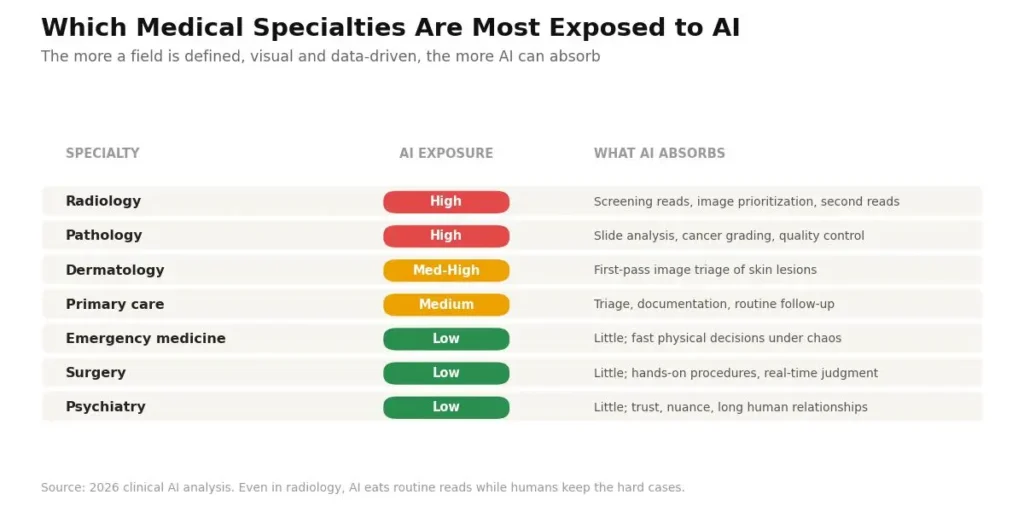
Radiology, pathology, and dermatology are most disrupted by AI, while surgery, emergency medicine, and psychiatry are among the least disrupted. The pattern is consistent: the more a specialty’s daily work is defined, visual, and data-driven, the more of it AI can absorb.
But “most exposed” does not mean “gone.” Even in radiology, the realistic outcome is that AI eats the bottom 30% to 50% of low-complexity reads, the routine screenings and obvious negatives, while humans handle the hard, ambiguous, and high-stakes cases. Here is how the major fields stack up.
| Radiology | High | Screening reads, image prioritization, second reads |
| Pathology | High | Slide analysis, cancer grading, quality control |
| Dermatology | Medium to high | First-pass image triage of skin lesions |
| Primary care | Medium | Triage, documentation, routine follow-up |
| Emergency medicine | Low | Fast, physical, high-stakes decisions under chaos |
| Surgery | Low | Hands-on procedures and real-time judgment |
| Psychiatry | Low | Trust, nuance, and long human relationships |
If you are a medical student weighing a specialty, the smarter question is not “will AI replace this field?” It is “how much of this field’s daily work is made of automatable micro-tasks, and how fast are they shifting to machines?” That framing tells you where to build skills AI cannot copy.
When will AI actually change doctors’ jobs?
AI is already changing doctors’ jobs in 2026, but the change arrives in stages rather than as a single replacement. Splitting it into a timeline makes the near future far less scary and far more useful to plan around.
Now through 2027 (happening today):
Ambient scribes, imaging triage, inbox and message drafting, prior-authorization support, and research summarization are in live use across many systems. The doctor reviews and signs off. This phase is about removing paperwork, not removing people.
2028 to 2030 (scaling up):
AI moves deeper into decision support, flagging drug interactions, surfacing overlooked diagnoses, and predicting patient risk earlier. Regulation tightens in parallel.
The EU’s AI Act phases its strictest medical rules in across 2026 and 2027, and payment systems are starting to add billing codes for AI-assisted services, which is what turns pilots into permanent workflows.
Beyond 2030 (still uncertain):
Fully autonomous AI that manages a patient end-to-end without a human checkpoint remains blocked, and not mainly by technology. It is held back by liability, ethics, and trust, which move much more slowly than algorithms do.
So the honest answer to “when” is: the tools are here now, the workflow shift plays out over this decade, and true replacement is not on any credible near-term calendar.
In My Experience: What I Learned Testing AI Health Tools
Honestly, when I first started running symptom checkers and general AI chatbots through real health questions, I expected either magic or garbage. What I got was neither, and the in-between is the part worth sharing.
The tools are genuinely good at organizing information. I typed in a cluster of vague symptoms one evening, and the AI produced a clean, calm list of possible explanations, sorted by likelihood, with clear “see a doctor now” flags for the dangerous ones.
For a nervous person at 11 p.m., that structure alone has real value. It talks you down from the worst-case spiral that a plain web search usually feeds. But then I did something specific.
I fed the same tool a slightly contradictory set of details, the kind a real patient gives without realizing it, and watched it confidently anchor on one answer and ignore the contradiction. A human clinician would have paused and asked a follow-up question.
The AI just committed. That single moment told me more than any benchmark. These tools do not know what they do not know. One more thing caught me off guard. The AI never once asked me to describe how something looked, moved, or felt in a physical way that it could not process.
It cannot see me wince or watch me breathe. It works only with what I choose to type, which means it inherits every gap and every mistake in my own description. A doctor gathers data I would never think to mention.
The chatbot only ever sees my half of the story. Used as a preparation tool before an appointment, these are great. Used as a substitute for one, they are risky. That distinction is the whole game.
The hidden risk nobody talks about: automation bias.
The biggest overlooked danger of AI in medicine is not that it replaces doctors, but that it quietly makes them worse. This is the part most articles skip, and it flips the usual worry on its head.
When researchers deliberately fed doctors AI recommendations that were wrong in a 2025 study, accuracy dropped, as you might expect. What you would not expect is who dropped the most. Experienced physicians fell further (about 16 percentage points) than less experienced ones (about 9 points).
More expertise did not protect against deferring to the machine. If anything, familiarity bred trust, and trust bred error. This is called automation bias, and it is a real, documented failure mode. A confident screen tells you the answer, and over time your own instinct goes quiet.
The scan you once double-checked, you now wave through. Multiply that across millions of visits, and the risk is not robot doctors. It is human doctors who are slowly deskilling because the tool makes second-guessing feel unnecessary.
The fix is not less AI. It is AI designed to keep the human thinking, plus a culture that rewards the doctor who overrides a wrong machine. That is a much harder problem than building a better algorithm, and it is why “the human stays in the loop” is more than a slogan.
If an AI makes a medical mistake, who is responsible?
If AI contributes to a medical error, the licensed clinician and their institution remain legally responsible, not the software. This single fact does more to prevent full replacement than any technological limit. Accountability is the quiet backbone of medicine.
When a decision goes wrong, someone has to be answerable to the patient, the regulator, and the court. Right now, a chatbot cannot hold a medical license, cannot be sued in a meaningful way, and cannot stand before a board to explain a judgment call.
Until the law assigns liability to an AI system, and there is no serious move to do that soon, a human provider has to sit at the final checkpoint of care. That is not a temporary technicality. It is a structural reason the doctor stays. You cannot remove the person who carries the responsibility and still have a system anyone trusts.
Pro tip: If you ever see a health service claim its AI can diagnose or treat “without a doctor,” treat that as a red flag, not a feature. Legitimate tools always keep a licensed human in the decision, precisely because of liability.
Should patients trust an AI doctor or symptom checker?
Patients can use AI symptom checkers as a helpful first step, but not as a replacement for a licensed clinician. The tools are genuinely useful for organizing your thoughts and deciding how urgently to seek care. They are not safe as the final word on a diagnosis or treatment.
Here is a simple way to use them well:
- Good uses: Understanding what your symptoms might mean, preparing questions before an appointment, deciding whether something needs urgent attention, and getting plain-language explanations of a diagnosis you already have.
- Risky uses: Self-diagnosing a serious condition, adjusting or stopping medication based on a chatbot, ignoring a “see a doctor” flag because the AI sounded reassuring, and treating an emergency with an app instead of calling for help.
If you are dealing with anything severe, sudden, or worsening, skip the app and get real care. For a true emergency, contact your local emergency number. AI is a flashlight for the path. It is not the destination.
Common pitfalls: mistakes people make about AI and doctors
Plenty of smart people get this topic wrong, and almost always in the same predictable ways. Spotting these traps sharpens how you read every AI-in-medicine headline.
- Confusing task automation with job replacement.
AI taking over charting is not AI taking over doctoring. Most “doctors are doomed” claims quietly swap one for the other. - Trusting a narrow benchmark as proof of general skill.
An AI that reads one scan type brilliantly is not close to handling a confusing patient. A single-task win gets stretched into a whole-job claim. - Assuming “most exposed” means “extinct.”
Radiology is heavily affected, yet demand for radiologists remains real. Exposure reshapes a job. It rarely deletes it. - Forgetting the liability wall.
People imagine autonomous AI care and ignore the simple question of who gets sued. That question alone stops the fantasy. - Believing warmer AI text means AI cares.
A polished, empathetic message is not empathy used as a clinical tool. The words are easy. The judgment behind them is not.
The common thread is impatience: grabbing the dramatic version of the story before checking what was actually measured. Slow down on that, and most of the fear falls apart.
Workflow example: how AI and a doctor actually work together
The clearest way to understand augmentation is to follow one real visit from start to finish. Here is a typical primary-care flow with AI woven in, shown as input, process, output, and result.
Input: A patient books a visit for a persistent sore throat and fatigue. Before arriving, they answer an AI intake tool that asks targeted questions and screens for red-flag symptoms.
Process: The AI generates a structured summary for the doctor, flags that strep is possible, and notes nothing urgent. During the visit, an ambient AI scribe transcribes the conversation while the physician actually examines the patient, palpating lymph nodes and checking the throat, things the AI never touches.
Output: The AI drafts the clinical note and suggests a rapid strep test based on the doctor’s entered exam findings. The physician reviews the draft, corrects one detail, orders the test, and signs off.
Result: The visit runs faster, the note is completed before the patient leaves, and the doctor spends their attention on the exam and the patient rather than the keyboard. AI handled the routine.
The human handled the medicine. Neither replaced the other. That is not a futuristic scenario. It is roughly how a modern, AI-equipped clinic already runs today.
How should doctors and future doctors prepare for AI?
The doctors who thrive will be the ones who learn to supervise AI rather than compete with it. The skill that matters most in 2026 is not resisting the tools. It is knowing exactly where to trust them and where to override them.
A few practical moves stand out:
- Learn the tools you will actually use.
AI documentation, imaging support, and clinical decision aids are already in workflows. Comfort with them is fast becoming a baseline expectation, not an edge. - Get fluent in the limits.
Understanding model bias, hallucinations, and validation is what separates a doctor who catches a wrong AI suggestion from one who rubber-stamps it. - Double down on the human skills.
Communication, physical exam mastery, ethical judgment, and manual dexterity are the moat. They are exactly what AI cannot copy, and exactly what patients still need.
Unlike much career advice, this one has a clear direction. The threat is not AI taking the job. It is other physicians who use AI better. Building that skill now is the safest bet available.
Frequently Asked Questions
No. AI automates specific tasks such as documentation, imaging triage, and summaries, but doctors remain essential for physical exams, complex diagnoses, treatment decisions, empathy, and legal accountability. The role changes rather than disappears.
No, though radiology will change more than most fields. AI acts as triage and a second reader, while radiologists integrate patient history, handle uncertainty, and take responsibility for the final interpretation.
AI processes text and images faster than any human, but that does not make it a doctor. Clinical care needs physical exams, judgment under uncertainty, ethics, and responsibility that AI cannot provide.
Not safely. AI can suggest possible diagnoses and spot patterns, but a licensed clinician must examine the patient, order and interpret tests, and own the decision. Never rely on a chatbot as a substitute for an independent doctor.
Surgery, emergency medicine, and psychiatry are among the most protected fields, because they rely on hands-on procedures, high-stakes, real-time decisions, and deep human trust that AI cannot replicate.
The bottom line
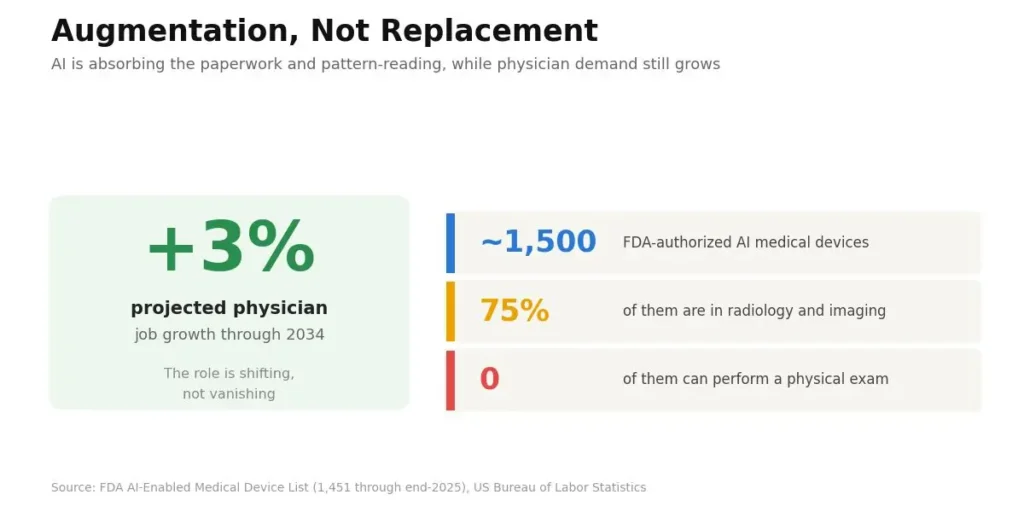
Doctors are not being replaced by AI. Their jobs are being rebuilt around it. The evidence in 2026 is consistent from every direction: regulators list nearly 1,500 AI medical devices, physician employment is still projected to grow, and every serious study lands on the same word: augmentation.
AI handles the paperwork, pattern-reading, and routine reads. The doctor keeps the exam, the hard calls, the empathy that changes outcomes, and the responsibility no algorithm can carry.
The real divide running through this entire debate is simple. Machines are getting better at answering “what does the data say?” Only a human can answer “what should we do for this particular person?”
For patients, that means AI is a powerful tool to prepare with, never a doctor to replace. For future physicians, it means the winning move is to master the tools, not fear them.
The future of medicine is not artificial intelligence instead of doctors. It is doctors with artificial intelligence, and that is a much better future than the headlines suggest.
This article is a technology and career analysis, not medical advice. For any health concern, consult a licensed clinician.

Is an SEO Specialist and AI Tools Researcher with over 4 years of hands-on experience in search engine optimization. As the founder of Smart AI Helper Pro, he tests and reviews AI writing, SEO, and marketing tools to help creators and business owners grow faster with practical, research-backed strategies.