
Will Pilots Be Replaced by AI? Autonomous Flight in 2026
By SM Mehedi Hasan
No, pilots won’t be replaced by AI in 2026, and the gap is wider than headlines suggest. Autonomous flight is arriving first in cargo, not passenger cabins. Reliable Robotics is targeting FAA certification for an uncrewed Cessna Caravan around 2028, while U.S. law still mandates two pilots on every airliner.
The question sounds simple. If the autopilot already flies most of the route, why keep two humans up front? But the answer hiding behind that question is more interesting than “yes” or “no,” and most articles rushing to reassure you skip the part that actually matters: where autonomous flight is real right now, and where it’s still decades out. Let’s get into what’s genuinely happening in 2026, not the sci-fi version.
Table Of Contents
ToggleWill AI Replace Pilots in 2026?
No, AI is not replacing airline pilots in 2026, and no major regulator has approved a single pilotless commercial passenger flight. In fact, U.S. lawmakers moved in the opposite direction this year.
A landmark aviation safety bill passed in early 2026 directs the FAA to ensure a minimum of two qualified, fully rested pilots on commercial airline flight decks at all times, according to the Air Line Pilots Association (ALPA).
Here’s the thing most people miss. Aviation is one of the most heavily automated industries on the planet, and yet the pilot job ranks among the safest from AI displacement. That contradiction is the whole story.
Most people assume automation and job loss go hand in hand. In the cockpit, they don’t. The autopilot has been doing real work for decades, and the pilot count per airliner hasn’t dropped because the hard part of the job was never “hold altitude and heading.”
It’s everything the automation can’t do when things go sideways. So the honest 2026 answer is layered: AI is transforming how pilots work, it’s genuinely flying some aircraft with no one on board, and it’s still nowhere near flying you and 180 other passengers to Orlando by itself.
What Does AI Actually Do in the Cockpit Right Now?
AI already handles routing, weather analysis, and predictive maintenance, but it does not make command decisions. Modern jets have flown with digital fly-by-wire systems, advanced autopilot, and Flight Management Systems since the 1980s.
What has changed recently is the sophistication of the tools that sit alongside those systems.
Here’s where AI is doing real work in commercial aviation today:
| AI Application | What It Does | Who Stays In Control |
|---|---|---|
| Autopilot + FMS | Holds altitude, follows waypoints, manages cruise | Pilot monitors, can override instantly |
| AI weather routing | Suggests fuel-efficient paths around storms | Pilot approves or rejects the route |
| Predictive maintenance | Flags mechanical issues before they cause delays | Engineers and pilots act on the alert |
| Electronic Flight Bags | AI-assisted planning, performance calculations | Pilot verifies every number |
Notice the pattern in that last column. Every single tool is an assistant, not a decision-maker. The AI proposes; the human disposes. And this matters more than it looks. When people picture “AI in the cockpit,” they imagine a robot gripping the yoke.
What’s actually there is quieter: software that shaves twenty minutes off flight planning and catches a failing part two flights early. Useful, invisible, and not remotely the same thing as replacing the person legally responsible for the aircraft.
Can AI Fly a Plane Completely on Its Own Today?
Yes, AI can fly certain aircraft gate-to-gate without a pilot on board, but only in cargo operations under tight conditions, and even then, a remote pilot supervises from the ground. This is the part the “pilots are safe forever” articles gloss over, and it’s the most important development of 2026.
Reliable Robotics, a Mountain View company, has built an autonomy system that guides a Cessna 208B Caravan through taxi, takeoff, cruise, and landing without anyone in the seat.
In April 2026, the company raised $160 million, pushing its valuation near $1 billion, and it’s assembling what its CEO called a “mountain of evidence” for FAA certification, targeted for roughly 2028 (Aviation International News).
But read that carefully. The system still requires a remote pilot in a control center who programs the aircraft and works the radio. Nobody flies the plane by hand from far away, yet a licensed human is still in the loop, accountable, and ready to intervene. Remote pilot is not the same as no pilot.
In March 2026, Reliable and the City of Albuquerque were selected for the FAA’s Advanced Air Mobility Integration Pilot Program to run autonomous cargo routes across New Mexico and Colorado (Business Wire).
That’s the frontier. Not a pilotless airliner, but a pilotless cargo Caravan hauling freight between regional airports, with a person watching from a ground station.
Why Is Autonomous Flight Arriving in Cargo Before Passengers?
Autonomous flight starts with cargo because the barriers to risk, liability, and trust are far lower when no one is on board. This is the single biggest thing most “will AI replace pilots” articles get wrong. They treat autonomous flight as one event. It isn’t. It’s a staircase, and cargo is the bottom step.
Think about why cargo goes first:
- No passengers means lower stakes.
A freight loss is an insurance claim, not a fatality headline. - Regulators can quietly build a safety record.
Years of uncrewed cargo flights generate the data needed before anyone dreams of putting people on board. - Routes are simpler.
Regional cargo hops between quiet airports avoid the complexity of major passenger hubs.
Reliable isn’t alone here. The U.S. Air Force already deemed the company’s uncrewed system airworthy for military operations and signed a $17.4 million contract. Military and cargo aviation have quietly used autonomous aircraft for years.
What’s new is civilian-certifiable technology that integrates into normal airspace. Compared to the passenger side, the difference is stark. A cargo Caravan can be certified this decade.
A pilotless flight carrying your family is a different universe of regulatory, legal, and psychological hurdles, and none of those hurdles will be cleared on a 2026 timeline.
What Is Single-Pilot Operations, and When Could It Happen?
Single-pilot operations, or reduced-crew flying, would let one pilot handle the cockpit during low-workload cruise while the second rests, but it isn’t approved anywhere and faces serious safety objections.
This is the realistic near-term concern for pilot headcount, and even it is smaller and slower than the hype implies. The concept is called Extended Minimum Crew Operations (eMCO). Airbus and Dassault pushed the European Union Aviation Safety Agency (EASA) to study it.
Airbus is even developing an A350 variant designed for it. On paper, it could reduce the number of pilots needed on long-haul flights that currently carry relief crews.
Here’s the reality check. EASA’s own final risk report, published in May 2025, concluded that an equivalent level of safety between eMCO and normal two-crew operations “cannot currently be demonstrated” (EASA).
The agency pushed its timeline toward the end of the decade, around 2030, and shifted focus to developing “smart cockpit” technology first while keeping two pilots on board to gather data.
So even in the aggressive scenario, eMCO would:
- Apply only to long-haul cruise, roughly 12% of global commercial flying.
- Still require two pilots for takeoff and landing.
- Arrive no earlier than the 2030s, if regulators approve it at all.
Pilot unions are fighting hard. ALPA’s “Safety Starts with Two” and the European Cockpit Association’s “One Means None” campaigns exist specifically to block this.
When you hear “single-pilot ops will gut aviation jobs,” remember the regulators studying it just said they can’t prove it’s as safe as what we have now.
Why Can’t AI Just Replace Pilots Even If the Technology Works?
Even if the technology were flawless, three barriers keep pilots in the cockpit: liability law, regulatory certification, and passenger trust. Technology is rarely the bottleneck. The bottleneck is everything around the technology.
Who Is Legally Responsible When an Autonomous Plane Crashes?
Right now, no clear legal framework assigns liability for a failure of a fully autonomous passenger aircraft, and that alone stalls the whole idea. When a pilot is in command, accountability is obvious.
Remove the human, and you’re left with an unanswered question that terrifies insurers and regulators: is it the manufacturer, the software vendor, the airline, or the operator?
Legal systems worldwide simply aren’t built for this. Even in medicine, where AI diagnoses well, governments still require a human doctor to validate the call.
Aviation regulators, responsible for hundreds of lives per flight, are even more conservative. Until liability is settled, “the tech works” doesn’t get you a certified airliner.
Would Passengers Actually Board a Pilotless Plane?
Most travelers say no, and airlines know it. Survey after survey shows a large majority of frequent flyers would refuse to board a fully autonomous or single-pilot commercial flight, even with regulatory approval, and many say they’d refuse even at a lower fare.
This isn’t irrational. It’s a practical risk assessment most people make instinctively: I want a trained human up front whose life is on the line with mine, someone who can improvise when the situation falls outside the manual.
Airlines are extraordinarily sensitive to bookings. Until public attitude shifts substantially, the airlines themselves will resist, regardless of what the technology can do.
Is There Really a Pilot Shortage While AI Advances?
Yes, and this is the paradox that reframes the entire debate: the industry needs far more pilots than it can train, even as AI advances.
Boeing’s Pilot and Technician Outlook projects demand for roughly 649,000 new pilots over the next 20 years, driven by retirements, fleet growth in Asia and the Middle East, and steady hiring in North American regional airlines.
The training pipeline can’t keep up.
A commercial certificate costs tens of thousands of dollars and takes 18 to 24 months, and a regional first officer needs 1,500 flight hours under FAA rules before qualifying for the Airline Transport Pilot certificate. That’s years of flying before reaching a major airline.
Unlike what most reviews suggest, AI augmentation doesn’t dent that math. It makes each pilot more productive, which is exactly what an industry short on pilots wants. When demand outruns supply this badly, the last thing airlines are doing is looking for ways to hire fewer people.
How Much Do Pilots Earn, and Is the Job Still Worth It in 2026?
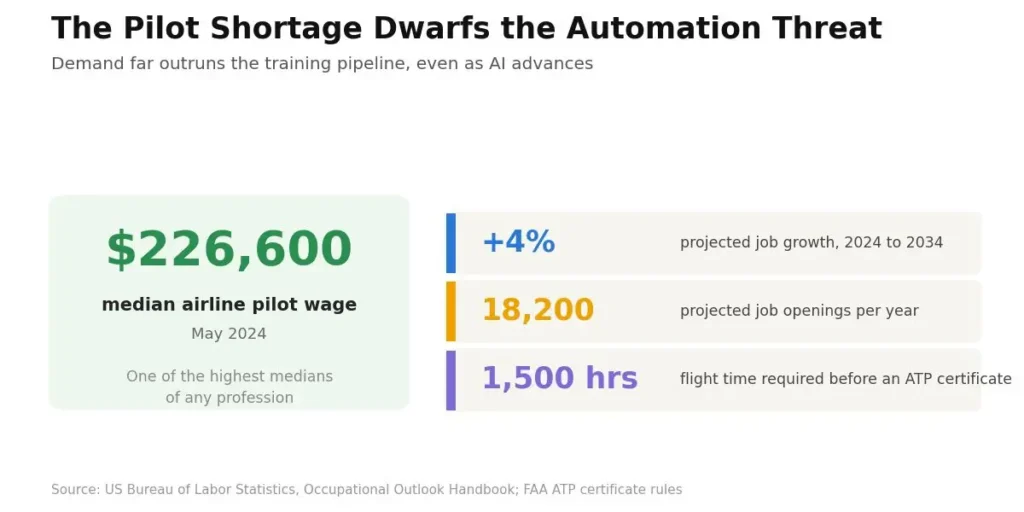
Airline pilots earn a median of $226,600 per year, one of the highest medians of any profession, and the U.S. Bureau of Labor Statistics projects the field to grow 4% through 2034. That’s according to the BLS Occupational Outlook Handbook, the authoritative source for U.S. wage and employment data.
Here’s the current picture:
| Role (BLS category) | Median Annual Wage | Employment Outlook |
|---|---|---|
| Airline pilots, copilots, flight engineers | $226,600 | +4% growth (2024–2034) |
| Commercial pilots (charter, cargo, corporate) | $122,670 | ~18,200 openings/year |
The headline median hides a wide spread. Regional first officers start far lower, often in the $90,000 to $130,000 total-compensation range in early years, while senior wide-body international captains at major carriers can clear $350,000 or more with contract raises and profit sharing.
Worth noting: the top of that ladder is also the most AI-resistant. Long-haul, wide-body operations involve the highest-stakes scenarios, oceanic crossings and severe-weather reroutes, exactly where regulatory and passenger trust in autonomy is lowest. The career ceiling isn’t shrinking. It’s the opposite.
In My Experience
Honestly, when I first started digging into this topic, I expected the data to point toward “pilots are next.” I research how AI reshapes careers and track autonomous-flight companies closely, so I went in assuming the cargo breakthroughs meant passenger flying was a few years behind.
I’m not a pilot, and I want to be straight about that. My angle is the technology and the labor data, not the flight deck. What changed my mind was reading the regulatory documents themselves rather than the press releases. The EASA risk report was the moment it clicked.
Here was the safety agency that wanted to enable innovation, flatly stating it couldn’t demonstrate that removing one pilot from the cruise was as safe as keeping two. That’s not a tech company’s optimistic timeline. That’s the referee saying “not yet, and not close.”
One thing that caught me off guard was how sharply cargo and passenger timelines have split. I’d been mentally lumping them together.
Once you separate them, the story stops being “will AI replace pilots” and becomes “which flying gets automated first, and why the passenger cabin is dead last.” That reframing is the insight I wish more coverage led with.
What Happens During an AI-Assisted Flight, Step by Step?
An AI-assisted flight follows a clear loop in which the software prepares and proposes, and the pilot verifies and commands. Here’s a realistic walkthrough of how the tools flow together on a modern narrow-body flight:
The pilot and dispatch feed the route, weather, passenger and cargo loads, and fuel requirements into AI-powered flight-planning software. The system automatically pulls live weather and traffic data.
Process: The AI generates an optimized route that balances fuel burn, storm avoidance, and schedule. Predictive maintenance systems confirm the aircraft is clear of flagged issues. The pilot reviews every recommendation, adjusts what doesn’t fit, and files the plan.
Output: During the flight, the autopilot and Flight Management System handle cruise while the pilots monitor systems, communicate with air traffic control, and stay ready to take manual control for departure, approach, and landing.
Result: A flight that’s more fuel-efficient and better-informed than a purely manual one, with fewer surprise mechanical events, and a human pilot in command of every decision that carries real consequences. The AI made the flight smarter. It didn’t fly it alone.
That loop is the actual state of “AI in aviation” in 2026. Not a replacement. A very capable co-worker that never gets a vote on the final call.
Common Pitfalls: What People Get Wrong About AI and Pilots
Most of the confusion about this topic stems from treating autonomous flight as a single, imminent event. These are the mistakes that trip people up, and why each one happens:
- Assuming autopilot equals autonomy.
Autopilot holds a course. It can’t diagnose a novel emergency, negotiate with air traffic control during a diversion, or decide to land on the Hudson. People conflate “the computer is flying” with “the computer could handle anything,” and those are miles apart. - Blurring cargo and passenger timelines.
Because a pilotless cargo Caravan is genuinely close, people assume pilotless airliners are too. They’re not on the same step of the staircase. Cargo removes the two hardest barriers, liability and passenger trust, in one move. - Treating “remote pilot” as “no pilot.”
Reliable’s system still needs a licensed human in a control center. The job relocates and changes; it doesn’t vanish. Headlines drop this detail because it’s less dramatic. - Believing the bottleneck is technology.
It rarely is. The holdups are legal liability, certification, and public trust, and they move on multi-decade timelines that no software update can accelerate.
Avoid these four, and you’ll read every aviation-AI headline more clearly than most of the people writing them.
What Should Pilots and Aspiring Pilots Do Now?
The pilots who thrive won’t be the ones who fear AI, but the ones who master it as a tool. The role is shifting from hands-on flying toward expert management of automated systems, and that shift rewards specific skills.
Here’s what actually moves the needle:
- Master automation management.
Knowing precisely when to let the Flight Management System work and when to take the airplane manually is now as important as stick-and-rudder skill. This is the meta-skill that separates strong pilots from average ones. - Build AI-tool fluency early.
Electronic flight bags, AI weather platforms, and advanced planning software are becoming standard. Early adopters move faster through training and checkrides. - Move up the seniority ladder fast.
The wage jump from regional to major airline is enormous, and the major-airline tier is the most AI-resistant. Speed through the hour-building phase pays off twice.
Pro tip: watch the cargo and freight side. UPS, FedEx, and Atlas Air are expanding faster than passenger flying, and experienced pilots with autonomy literacy will be valuable in this sector as it modernizes.
A tip worth acting on early: emerging segments like eVTOL air taxis and urban air mobility are creating new pilot categories, not just threatening old ones. The FAA has already begun pilot programs to test next-generation aircraft, and experienced aviators with AI fluency are well positioned for them.
One more, and it’s easy to overlook: stay engaged with your union on AI policy. The contracts being negotiated now set the precedents for how reduced-crew operations and AI augmentation get bargained in the 2030s. Pilot participation genuinely shapes those outcomes.
What’s the Realistic Timeline for Autonomous Flight?
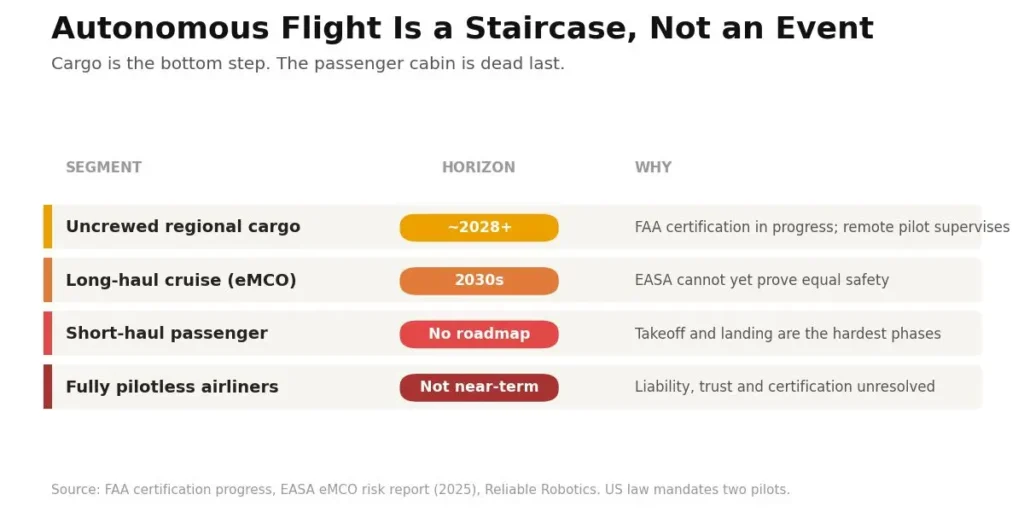
Autonomous flight arrives in stages across a wide range of years, not all at once, and the passenger cabin is last. Here’s the segment-by-segment reality based on current certification progress and regulatory statements:
| Segment | Realistic Horizon | Why |
|---|---|---|
| Uncrewed regional cargo | ~2028 onward | FAA certification in progress; remote pilot supervises |
| Long-haul cruise eMCO | 2030s at earliest | EASA can't yet prove equal safety; two pilots for takeoff/landing |
| Short-haul / regional passenger | No regulator roadmap | Most takeoffs and landings, the hardest phases to automate |
| Fully pilotless airliners | Not on any near-term path | Liability, trust, and certification barriers unresolved |
Read that table top to bottom, and the shape becomes obvious. Cargo is happening. The reduction of long-haul cruises is being studied and resisted. Everyday passenger flying with fewer or no pilots isn’t on any regulator’s schedule within the decade.
Frequently Asked Questions
No. There’s no realistic regulatory or technological path to unattended commercial passenger flight by 2030. Even the most aggressive reduced-crew scenarios keep two pilots for takeoff and landing.
Yes. Boeing projects demand for around 649,000 new pilots over 20 years, the BLS forecasts 4% job growth through 2034, and the median airline pilot wage is $226,600. Demand far outpaces supply.
Somewhat, over the long term. Autonomous cargo is arriving first because risk and trust barriers are lower when there are no passengers. But even certified cargo autonomy still relies on a remote pilot to supervise the flight.
AI processes weather, terrain, and system data in milliseconds, never fatigues, and monitors instruments without distraction. It excels at routine analysis but can’t reason through novel emergencies the way a trained pilot can.
Yes. A 2026 aviation safety bill directs the FAA to keep a minimum of two qualified pilots on commercial airline flight decks, reinforcing human oversight even as automation technology advances.
The Bottom Line
AI isn’t replacing airline pilots in 2026, and the realistic barriers extend well beyond the decade.
What’s actually happening is more nuanced and more interesting: autonomous flight is real in cargo, reduced-crew operations are being studied and fiercely contested, and the passenger cabin remains firmly human. The pilot’s job is changing, not disappearing.
The core of it, being legally accountable, physically present, and decisively in command during takeoff, landing, weather diversions, and emergencies, stays human for the foreseeable future.
Add a pilot shortage that dwarfs the automation threat, and the picture is clear.
The smartest move isn’t to fear AI in the cockpit. It’s to learn to fly alongside it.
Sources: U.S. Bureau of Labor Statistics (Occupational Outlook Handbook), Boeing Pilot and Technician Outlook, Air Line Pilots Association, Reliable Robotics / Business Wire, Aviation International News, and the European Union Aviation Safety Agency. All figures verified against primary sources as of 2026.

Is an SEO Specialist and AI Tools Researcher with over 4 years of hands-on experience in search engine optimization. As the founder of Smart AI Helper Pro, he tests and reviews AI writing, SEO, and marketing tools to help creators and business owners grow faster with practical, research-backed strategies.