
Will AI Replace Data Analysts?
By SM Mehedi Hasan
AI will not replace data analysts in 2026, but it is already automating 30 to 40 percent of routine analyst work, such as SQL writing and dashboard building. The analysts losing their jobs are being replaced by peers who use AI more quickly, not by the tools themselves.
Let me be straight about something before we go deep. The panic around this question is louder than the actual data supports, and the calm reassurance (“nothing will change, relax”) is just as wrong. Both extremes sell better than the truth.
So this guide skips both and shows you what the job market, the tools, and the government numbers actually say in 2026, plus what you should do about it starting this week.
Table Of Contents
ToggleWill AI replace data analysts in the near future?
No, AI is not on track to replace data analysts as a profession, but it is quietly deleting the most repetitive layer of the job. Writing standard SQL, cleaning messy spreadsheets, and rebuilding the same weekly dashboard are the tasks getting automated first.
The work that survives is the part that has always been hard: figuring out which question matters and convincing someone to act on the answer. Here is the framing that actually holds up. AI is not competing with you. Another analyst who uses AI well is competing with you.
That distinction changes everything about how you plan the next two years. The World Economic Forum’s Future of Jobs Report 2025 backs this up in a way most headlines skip over. It projects 170 million new roles created and 92 million displaced globally by 2030, a net gain of 78 million jobs.
Big data specialists and data analysts rank among the fastest-growing roles, while clerical and administrative jobs face the steepest decline. So data work is not on the endangered list. Pure copy-paste reporting work is. But growth in a category does not mean safety for everyone in it. That is the nuance almost every competing article glosses over, and it is where we go next.
What does the latest 2026 data actually say about data analyst jobs?
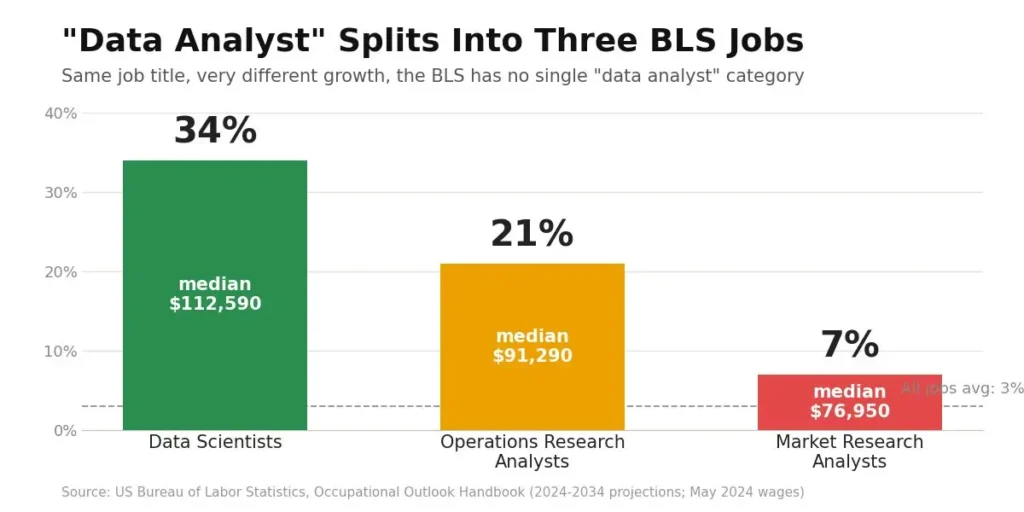
The single most misleading thing in most “AI vs data analyst” articles is the 34% job-growth figure. Writers grab it, slap it on the data analyst role, and call it reassurance. That figure is real, but it belongs to a different job.
Here is the part nobody explains clearly: the U.S. Bureau of Labor Statistics does not track “data analyst” as its own occupation. Your actual work gets split across three official categories, and each one grows at a very different rate.
| BLS occupation (closest match) |
Projected growth 2024 to 2034 |
Median annual wage (2024) |
|---|---|---|
| Data Scientists | 34% (4th fastest in the economy) | $112,590 |
| Operations Research Analysts | 21% | ~$87,640 to $90,440 |
| Market Research Analysts | 7% | varies by industry |
Sources: BLS Data Scientists, BLS Operations Research Analysts, BLS Market Research Analysts.
Notice the spread. If your title is “data analyst” but your work looks like a data scientist (modeling, machine learning, prediction), you are riding a 34 percent growth wave.
If your work is closer to routine market reporting, you are in a 7 percent lane, slower and more exposed to automation. Same job title, completely different risk profile.
Zooming out helps too. BLS groups all computer and mathematical occupations together and projects that whole group to grow 10.1 percent from 2024 to 2034, the second-fastest of any occupational group, compared with just 3.1 percent across all jobs.
Demand for data professionals is expanding, not shrinking. The composition of that demand is what is shifting. So when someone says “data analysts are safe” or “data analysts are doomed,” ask them which of the three BLS buckets they mean. The honest answer depends entirely on that.
Which data analyst tasks is AI already automating in 2026?
AI is automating the mechanical middle of the analyst workflow: query writing, data cleaning, standard visualization, and templated reporting. These are the tasks that used to eat most of a junior analyst’s week, and modern tools handle them in seconds with reasonable accuracy.
Independent estimates put the automation at roughly 30 to 40 percent of the tasks that filled a typical analyst’s week back in 2024. That does not mean 30 to 40 percent of analysts are gone. It means the mix of what you spend your day on has flipped.
Here is what that flip looks like in practice.
| Task | Time it took in 2024 | Time with AI in 2026 |
|---|---|---|
| Writing a standard SQL query | 20 to 30 minutes | 3 to 5 minutes (plus review) |
| Cleaning and formatting a raw dataset | 1 to 2 hours | 20 to 30 minutes |
| Building a recurring weekly report | 3 hours | 45 minutes |
| Profiling a brand-new dataset | half a day | starts with an AI summary you extend |
Look closely, and you will spot the catch. Every one of those “AI does it faster” rows still has a human step attached: review, validation, extension. The tool produces a draft. You catch what it got wrong. That review skill is becoming the actual job. And here is the part that surprised me.
When SQL got cheap, the number of data questions inside companies went up, not down. When anyone in marketing can type a question and get a chart, they ask ten times more questions. Someone still has to check whether those auto-generated answers are trustworthy. That someone is you.
What can AI not do that keeps data analysts employed?
AI cannot decide which question is worth asking, interpret ambiguous results in a business context, or get a skeptical stakeholder to actually change a decision. Those three things are the core of senior analyst value, and no 2026 tool comes close to replicating them.
Break it down, and the pattern is clear.
- Asking the right question.
A model answers what you type. It cannot notice that churn is rising only among customers from one new acquisition channel, then form a hypothesis about why. That leap comes from curiosity and business context, not pattern matching. - Interpreting results in context.
“Revenue dropped 8 percent” is a fact any tool can surface. Knowing that it dropped because your biggest client paused for a security audit that closes next month, so the business is actually fine, requires knowing the client, the pipeline, and the company. AI has none of that. - Communicating to stakeholders.
Analysis is worth zero until someone acts on it. Getting a VP to move budget means understanding their priorities, anticipating their objections, and framing the number as a decision, not a data dump. This is relationship work. - Causal reasoning.
AI can compute that two things correlate. It cannot reliably tell you whether A caused B, whether a hidden variable drove both, or whether it is pure coincidence. That distinction separates a growth insight from an expensive wrong turn. - Ethics and judgment.
Deciding what data to collect, whether a metric is being gamed, or whether a model quietly discriminates against a protected group takes moral reasoning and social awareness that a predictive system does not have.
One data engineer with 17 years of experience put the practical version of this well: in real companies, finding the right data is not at all obvious.
You have multiple tables that look identical, no clear documentation, and you rely on experience and hallway conversations to know which one is correct. That messy, human, context-heavy work is exactly where AI struggles most.
What are agentic analytics tools, and do they change the picture?
Agentic analytics tools are AI systems that take a high-level goal and run a full chain of steps on their own: profiling a dataset, writing and executing queries, generating charts, and returning a written summary.
In 2026, they are the frontier, and they are the reason this conversation feels different from two years ago. Tools embedded in platforms like Databricks, Snowflake Cortex, and Microsoft Fabric now do more than just autocomplete queries.
You hand them an objective, and they attempt the whole workflow end to end. That sounds like the replacement scenario everyone fears. It is not, and the reason is subtle.
When an agent runs a five-step analysis autonomously, your job does not disappear. It moves up a level. Instead of executing each step, you frame the problem the agent should solve, and you review the output it produces.
The bottleneck shifts from “can we run the query” to “can we trust what came back.” Agentic tools raise the ceiling on what one analyst can produce, but they also raise the bar on judgment at the same rate.
Here is a grounded view of who does what in an agentic setup.
| AI tool type | What it handles for you | What still needs your call |
|---|---|---|
| SQL copilots (Copilot, platform assistants) | Draft queries from plain English | Schema logic, join correctness, edge cases |
| BI assistants (Tableau AI, Power BI Copilot) | Suggest charts, summarize dashboards | Which metric matters, how to frame it |
| Agentic platforms (Cortex, Fabric, Databricks) | Run multi-step analysis autonomously | Problem framing, output validation, action |
Compared to the standalone chatbots of a year ago, these agents feel genuinely more capable. But the more autonomous they get, the more valuable the human who can tell whether the autonomous output is actually right becomes. That is not a paradox. It is the whole story.
Which data analysts are most at risk of being replaced?
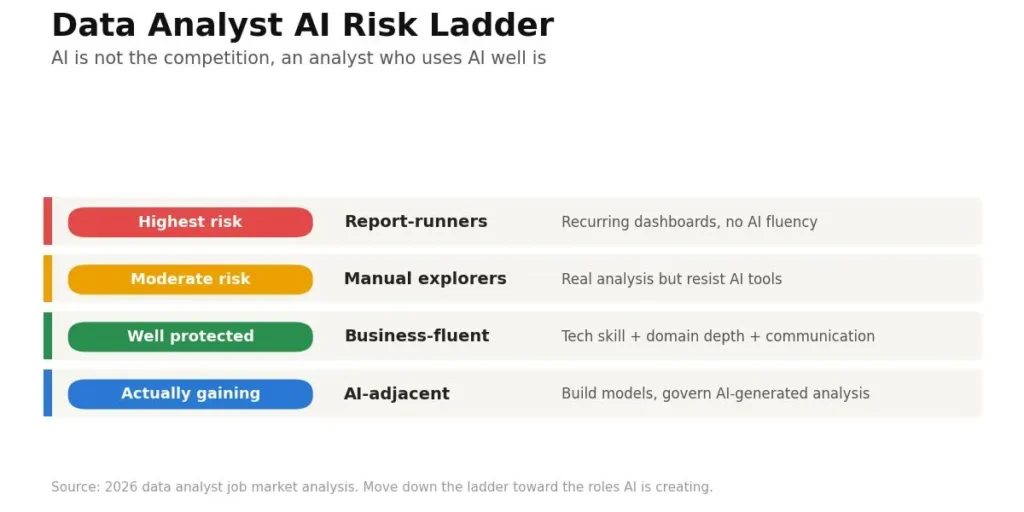
The analysts most at risk are the ones whose entire output is routine reporting: the same dashboards, on the same schedule, from the same data sources, with no move toward statistics, communication, or AI direction.
If your week is mechanical, the mechanical parts are exactly what got automated. Here is an honest risk ladder based on where the 2026 job market is actually moving.
- Highest risk: Pure report-runners. Work is recurring queries and scheduled dashboards, no strategic or stakeholder layer, no AI-tool fluency.
- Moderate risk: Analysts doing real exploratory work but still executing everything manually, resisting AI tools that would free their time.
- Well protected: Analysts who pair technical skill with business domain knowledge, strong communication, and deliberate AI-tool use.
- Actually gaining: Analysts moving into AI-adjacent work: building and evaluating models, designing automated pipelines, or governing AI-generated analysis.
Now the part most articles are too polite to mention: the entry-level squeeze is real and getting sharper. Recruiters report that the pay floor for junior analysts nudged up about $4,000 since 2024, but the bar to get hired rose much more.
Companies that once hired a junior with a coursework portfolio now expect at least one internship, a public GitHub profile, a published Kaggle notebook, and a real reference. The floor is higher, and the door is narrower at the same time.
That is the piece of career advice that keeps getting missed. AI did not close the entry-level door, but it raised expectations for what a “junior” already knows how to do on day one.
In My Experience
Honestly, when I first started leaning on AI for SQL, I expected it to just make me faster. What actually happened was stranger. I got faster on the boring 60 percent, and then all the time I saved got swallowed by a new task that barely existed before: checking the AI’s work.
I ran into this hard on a churn analysis. The tool generated a clean, confident query joining three tables. It looked perfect. It was also silently wrong, because it joined on a customer ID that meant something different in one of the tables.
If I had trusted it, I would have shipped a churn number that was off by a wide margin to a room full of executives. The AI could not have caught that. Only someone who knew the quirks of those specific tables could.
What caught me off guard was how the value of my job relocated. It used to live in my ability to write the query. Now it lives in my ability to know when the query is lying.
That is a harder skill to teach, harder to automate, and frankly more interesting to do. The mechanical part is left. The thinking part got heavier.
How can data analysts stay valuable in the AI era?
You stay valuable by deliberately shifting your skill mix toward the things AI cannot do, and by using AI aggressively for the things it does well. The analysts who win are not those who resist the tools or blindly trust them. They are the ones who direct them.
Here is where to put your energy, ordered by return on effort.
- Learn to validate AI output.
This is the most immediately practical skill in 2026. As more colleagues generate their own analyses, demand for someone who can determine whether the output is correct rises rapidly. Build a repeatable check: verify the methodology, test against a known benchmark, probe edge cases. - Go deep on your business domain.
An AI tool knows nothing about your customers, your unit economics, or your competitive pressure. Sit in on sales calls. Read support tickets. Learn how other teams decide. Domain context is the layer that turns raw output into a real insight, and it is your strongest edge. - Sharpen Python and statistics.
Job-posting data shows that mentions of machine learning in data analyst listings doubled to around 14 percent in 2026. Analysts who can automate their workflows and interpret probabilistic results are moving into a different pay bracket than pure BI tool users. - Invest in communication.
The ability to turn a number into a decision a stakeholder acts on is becoming the highest-value skill in analytics. Practice presenting to non-technical audiences. Learn to make one clear point per chart.
Do not neglect the fundamentals while chasing the frontier, either. The same 2026 posting data shows Excel still appears in over 41 percent of data analyst job listings, Tableau in around 28 percent, and Power BI in roughly 25 percent. The shiny skills get you noticed. The core skills still get you hired.
A real workflow example: how an analyst uses AI end-to-end
Theory is cheap, so here is a full, realistic flow showing where AI fits and where you stay in charge. This is the loop I actually run now.
- Input: A product manager asks, “Why did trial-to-paid conversion drop last month?” The question is vague, the data lives across three systems, and there is no clean dashboard for it.
- Process: I frame the real question first (is it the drop in signups, the drop in activation, or the paywall step). I ask an AI SQL copilot to draft the queries against our schema. It produces three queries in about four minutes. I review each one, fix a join that used the wrong date field, and run them. Then I ask an AI assistant to summarize the pattern across the results.
- Output: The AI surfaces that conversion held steady overall but collapsed for one signup channel launched three weeks ago. It writes a first-draft narrative in seconds.
- Result: I recognize that the new channel attracts lower-intent users, reframe the finding as a channel-quality problem rather than a product problem, and deliver a one-page recommendation to reallocate spend. The PM changes the budget the next day.
Count the human steps in that flow. Framing the question, fixing the join, catching the channel nuance, reframing the story, driving the decision. The AI did the typing. I did the thinking. That ratio is the future of the role in one example.
What mistakes do analysts make when adapting to AI?
The biggest mistake analysts make is trusting AI output without validation, followed closely by ignoring the tools out of fear. Both stem from the same root: treating AI either as an oracle or an enemy rather than a fast, error-prone assistant.
Here are the common pitfalls and why they happen.
- Shipping unverified AI queries.
This happens because the output looks confident and clean, so the instinct is to trust it. Avoid it by treating every AI query as a draft from a fast intern who has never seen your data. Always check the joins and the logic against a known number. - Refusing to use AI at all.
Usually driven by job security fears, this backfires. The analyst who avoids AI does not stay safe; they just get outpaced by peers producing three times the output. Start small: automate one recurring report this week. - Learning to prompt but not to judge.
Many analysts think “learning AI” means getting good at prompts. Prompting is the easy 10 percent. The valuable skill is knowing when the answer is wrong, which no prompt teaches you. - Neglecting communication for tools.
It is tempting to stack up tool certifications, because they are concrete and easy to list. But the analysts commanding the highest pay are the ones who can persuade a room, and that skill gets ignored while everyone chases the next platform. - Chasing the trendy skill while dropping the basics.
People drop Excel to learn a flashy new tool, then lose interviews that still test Excel and SQL fundamentals. Build the frontier on top of the fundamentals, not instead of them.
A useful gut check: if a mistake would embarrass you in front of a stakeholder, it is worth a slow, manual verification even when the AI feels certain. Certainty from a model is not the same as correctness.
Pro tip: Spend one hour a week running AI tools on your actual work tasks, and keep a running note of what it nailed and what it silently got wrong. After three months, you will have a personal map of the tool’s blind spots that no course can give you.
Pro tip: When you validate an AI-generated analysis, write down the one benchmark number you checked it against. Over time, this builds a reusable set of sanity checks that makes your review process fast and hard to fool.
Pro tip: Position yourself as the person who owns AI-output governance on your team. As auto-generated analyses multiply, the analyst who defines how they get validated becomes structurally hard to replace.
How much do data analysts earn in 2026, and does AI change it?
Data analysts in the U.S. earn a median base of roughly $82,000 to $87,000 in 2026, with a range that runs from about $58,000 at entry level to $145,000 and up for senior analysts in major metros.
The number moves with skills and location far more than with job title. Here is the picture across experience levels, pulled from 2026 aggregator data (Glassdoor, Indeed, Salary.com, and recruiter placement reports).
| Level | Typical 2026 base range | What moves the number |
|---|---|---|
| Entry-level | $58,000 to $75,000 | Internship, portfolio, SQL fluency |
| Mid-level | $78,000 to $108,000 | Python, a BI tool, domain depth |
| Senior / lead | $110,000 to $145,000+ | Communication, ML skills, metro |
AI changes this in two directions at once. On one side, analysts who add machine learning and AI tooling to their skill set are commanding the biggest pay premiums in the market right now.
On the other side, the data scientist path still pays roughly $25,000 to $40,000 more than an equivalent analyst role, and that gap narrows only as you pick up modeling and statistical skills.
So the pay lesson matches the job-security lesson. The skills that protect you from automation are the same ones that raise your salary: judgment, communication, and the technical depth to work above the mechanical layer.
Location still matters, but secondary tech metros like Austin, Denver, and Atlanta have closed much of the old gap with San Francisco while keeping cheaper rent.
Frequently Asked Questions
No. The WEF Future of Jobs Report 2025 lists data and AI roles among the fastest-growing through 2030. AI will keep automating routine tasks, but question framing, interpretation, and stakeholder communication stay human.
Yes, with clear eyes. Pure reporting roles are under pressure, but analysts who learn SQL, Python, and AI tool validation enter a field that the BLS projects to grow well above average across its data occupations.
Asking the right business question, interpreting ambiguous results, causal reasoning, ethical judgment, and persuading stakeholders to act. These need context and relationships that AI models simply do not have in 2026.
Yes. Python is the skill most consistently separating analysts exposed to automation from those who are not. It lets you automate your own workflow and move into ML-adjacent work that pays more and resists replacement.
Not disappearing, but getting harder to land. The pay floor has risen slightly since 2024, yet employers now expect internships, a public portfolio, and familiarity with AI tools from candidates they once hired straight out of coursework.

Is an SEO Specialist and AI Tools Researcher with over 4 years of hands-on experience in search engine optimization. As the founder of Smart AI Helper Pro, he tests and reviews AI writing, SEO, and marketing tools to help creators and business owners grow faster with practical, research-backed strategies.