Semrush vs Profound AI for AEO/GEO: Which One Actually Wins in 2026?
By SM Mehedi Hasan
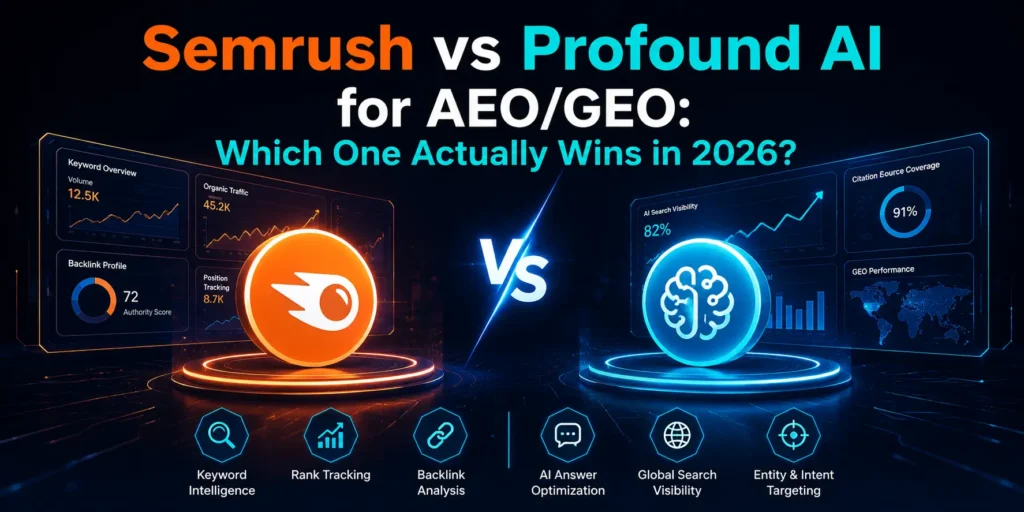
Semrush wins AEO on breadth and price, while Profound wins on depth across up to 10 answer engines. The detail that determines most budgets: Profound’s flagship Prompt Volumes search is behind Enterprise pricing, so the honest fight is between Semrush One at $199/month and Profound Growth at $399/month.
Most comparisons of Semrush vs Profound AI for AEO/GEO open with a slogan: purpose-built versus bolted-on. I tested both while running content sites that depend on AI-referred traffic, and that slogan falls apart the moment you open the pricing tables and read the fine print.
Two things reset the math in 2026, and almost nobody writing about this has caught up. Adobe completed its acquisition of Semrush on April 28, 2026. And Profound’s most-marketed feature is not available on either self-serve plan.
So this comparison is based on what you can actually buy today, not on what the landing pages promise.
Semrush vs Profound: Pricing at a Glance
| Tool | Starting Price | Exclusive Deal |
|---|---|---|
| Semrush One (Starter) | $199/mo ($165/mo annual) | 7-day free trial |
| Semrush AI Visibility Toolkit | $99/mo per domain | No trial, free demo report |
| Semrush Enterprise AIO | Custom (demo) | Adobe Analytics integration |
| Profound Starter | $99/mo (billed yearly) | 2 months free, self-serve |
| Profound Growth | $399/mo (billed yearly) | "Try for free" trial |
| Profound Enterprise | Custom (demo) | 10 engines, SSO, SOC 2 |
If you want simplicity and a single subscription that covers Google Plus AI, go with Semrush One. If you want answer-level depth, AI crawler logs, and autonomous agents, Profound is better. And if you only have $99 to spend, read carefully. Both companies sell a $99 plan. Both are deliberately thin.
Table Of Contents
ToggleWhat Is the Real Difference Between Semrush and Profound for AEO?
The real difference is the measurement scope: Semrush measures your position across search and AI, while Profound measures demand and behavior only within AI conversations.
Semrush is a 17-year-old search intelligence company. Its AI Visibility Toolkit sits inside the same projects, domains, and competitor sets you already track for rankings. You are adding a layer, not opening a second workspace.
Profound is different by construction. Founded in 2024 by James Cadwallader and Dylan Babbs, it does no keyword research, no backlink analysis, no technical site auditing. The platform assumes you already have an SEO stack elsewhere.
But here is where most articles go wrong. They frame this as “legacy SEO tool bolts on AI” versus “AI-native startup.” That framing is emotionally satisfying and practically useless.
Both platforms run structured prompts through answer engines daily and report where your brand surfaces. Architecture only matters if it produces a different answer on your screen. Sometimes it does. Often it does not.
There is a second framing problem worth naming. AEO and GEO get used interchangeably in this space, and the vendors encourage it. Profound markets AEO.
Semrush markets GEO and, post-Adobe, agentic search optimization. Underneath the labels, both are answering the same question: does an AI system mention you when someone asks about your category?
If you need a single dashboard for Google Plus AI, go with Semrush. For AI-only intelligence with server-level attribution, Profound is the better choice.
What Does Semrush Actually Give You for AEO in 2026?
Semrush gives you an AI Visibility Toolkit built on a documented database of 239 million+ prompts and responses across ChatGPT, Gemini, Google AI Overviews, and AI Mode, updated daily.
That figure matters because competing articles still quote “2,500 curated prompts” or “100 million queries.” Both are stale. Semrush’s own knowledge base documentation publishes the current number and the methodology behind it.
Brief Overview
The AI Visibility Toolkit is a $99/month per-domain add-on, or it is bundled with Semrush One plans that also include the full SEO suite. Separately, Semrush sells Enterprise AIO, a custom-priced platform for multi-brand and multi-market teams.
Key Features
- Visibility Overview with an AI Visibility Score (0 to 100) built from Topic Coverage plus Mention Consistency, not a black-box number
- Prompt Research delivering topic-level AI volume, difficulty, and intent, which is keyword research reshaped for prompts
- Competitor Research comparing you against up to four rivals on mentions, citations, and topic coverage
- Brand Performance analyzing share of voice, sentiment, and narrative drivers across Google AI Mode, ChatGPT, Perplexity, and Gemini
- Prompt Tracking running daily through Position Tracking across AI Mode, AI Overviews, Gemini, and ChatGPT Search
- AI Search Site Audit checking your site against eight AI crawlers including OAI-SearchBot, flagging blocked bots, llms.txt problems, and weak structured data
- AI Visibility Index and a free AI Visibility Checker, both usable before you pay anything
Prompt responses are captured from real requests rather than LLM APIs. That is a specific technical claim Semrush publishes, and it directly undercuts the common accusation that only Profound reads real user-facing interfaces.
Who It’s Best For
Solo publishers, in-house SEO teams, and small-to-mid agencies already living inside Semrush. The company positions the toolkit at SMBs, agencies, and mid-market companies by name. Enterprise AIO handles the Fortune 500 tier.
Pros and Cons
Pros:
- Cheapest credible entry into AEO at $199/month bundled with a full SEO suite
- AI visibility tied to the same domains, projects, and competitors you already track
- Site Audit catches AI crawler blocks that pure AEO tools never look for
- Documented, transparent scoring methodology instead of a proprietary index
- 7-day free trial on Semrush One plans
- Brand extraction is context-aware, so it separates Tesla, the company, from Tesla, the scientist.
Cons:
- The $99 standalone toolkit tracks only 25 prompts, not 50. Adding 50 more costs $60/month
- Brand Performance refreshes weekly, not daily.
- No Claude, Copilot, Grok, Meta AI, or DeepSeek unless you move up to Enterprise AIO
- Extra users cost $45 to $100 each, plus an additional $99 per user solely for AI Visibility access.
- No AI referral traffic or crawler log attribution at the toolkit level.
- CSV exports capped at 1,000 rows and 10 exports per day
🧠 In My Experience
One thing that caught me off guard was the seat math. I priced a three-person setup on Semrush One Pro+, and the AI Visibility surcharge alone added $198/month to the seat fees. It is documented on Semrush’s subscription pages, but it is buried so far down that most buyers find it only after signing.
The Site Audit integration earned its keep faster than the visibility reports did. It flagged a blocked crawler on a client site inside the first crawl, which is a fix you make once and benefit from permanently.
Where it struggled was answer context. The dashboard shows that your score has moved. It does not show the actual AI response in front of you the way Profound does, so diagnosing why it moved requires guesswork and manual spot checks.
Set against Profound, the workflow advantage is real and slightly boring. I fixed one technical issue, and it improved both rankings and AI accessibility at once. Profound would have shown me the crawler behavior in richer detail, but it would never have told me the page was broken.
Expert Verdict
Pick Semrush if AI visibility is one channel among several and you want it stitched into work you already do. Pick Profound if AI search is the channel your board asks about by name.
What Does Profound Actually Give You for AEO in 2026?
Profound gives you daily tracking across up to 10 answer engines, server-level AI crawler analytics, and autonomous marketing agents, with the deepest coverage locked to the Enterprise tier.
The company raised a $96M Series C at a $1B valuation on February 24, 2026, led by Lightspeed Venture Partners with Sequoia Capital, Kleiner Perkins, Saga VC, South Park Commons, and Evantic participating. Total funding passed $155 million, per Profound’s own announcement. It serves over 700 enterprises and more than 10% of the Fortune 500.
Brief Overview
Three tiers, published openly: Starter at $99/month, Growth at $399/month, Enterprise custom. Both self-serve prices are billed yearly with two months free. Profound does no SEO, and it does not pretend otherwise.
Key Features
- Answer Engine Insights showing full AI responses with your brand and competitors highlighted inside the text, not compressed into a score
- Agent Analytics tracking AI crawler visits and referral traffic at CDN and server level, unlimited domains on every tier
- Prompt Volumes projecting AI search volume for any keyword on the fly, segmented by region, age, income, and intent
- Profound Agents running content generation, monitoring, and AEO workflows on a credit model, 100 credits on Starter and 400 on Growth
- Opportunities surfacing four named actions per week on Growth
- Profound Index benchmarking brand visibility across answer engines as a public leaderboard
- ChatGPT Shopping visibility tracking, Enterprise only
Agent Analytics integrates with Akamai, AWS, Cloudflare, Fastly, Google Analytics, Google Cloud Platform, Netlify, Vercel, and WordPress. That list appears on Profound’s pricing page and applies across all three tiers, contradicting nearly every comparison article that claims it is Enterprise-gated.
Who It’s Best For
Enterprise brands, growth-stage teams with a dedicated AEO owner, and agencies serving clients where AI answers drive discovery. The published customer list includes Target, Walmart, Figma, MongoDB, Ramp, and U.S. Bank.
Pros and Cons
Pros:
- Full AI responses are visible, so you can read the wording that produced the score.
- Agent Analytics on every tier with unlimited domains and nine integrations
- Prompt Volumes licensed from double-opt-in consumer panels, anonymized and GDPR/CCPA compliant
- Growth includes 3 seats, CSV and JSON exports, and all-time history.
- Enterprise adds SSO/SAML, SOC 2, dedicated Slack, and a 24-hour SLA
- Agency plans exist, with per-client workspaces rather than a single brand cap.
Cons:
- Prompt Volumes search is unavailable on Starter and Growth. Growth gets only “relevant keywords”. The flagship dataset needs a sales call.
- Starter tracks ChatGPT alone, 50 prompts, 1 seat, no exports, no Opportunities.
- Growth caps at three engines: ChatGPT, Perplexity, Google AI Overviews
- Claude, Gemini, Copilot, Grok, Meta AI, and DeepSeek all require Enterprise.
- No API on either self-serve tier
- Languages and regions are capped at one each below Enterprise.
- Zero SEO tooling, so it is always a second subscription.
🧠 In My Experience
Honestly, when I first tried Profound I assumed Prompt Volumes was the reason to pay. Then I read the plan comparison table carefully and found “Searches: None” listed for both Starter and Growth.
That reframed the whole evaluation. The thing every review calls Profound’s unmatched advantage is not something a $399/month customer can query. You get relevant keywords surfaced for you, and that is a genuinely different product from searching the dataset yourself.
Agent Analytics surprised me in the opposite direction. I expected it to be gated, and it simply is not. Unlimited domains on a $99 plan is unusually generous and answers a question that Semrush’s toolkit cannot touch at any price.
Testing this alongside Semrush, the split came out clean. Profound told me which crawler hit which URL and what came back as referral traffic. Semrush told me the page had a redirect chain breaking the crawl in the first place. Neither insight substitutes for the other.
Expert Verdict
Choose Profound when AI search is a named budget line with an owner attached. Choose Semrush when you need AEO plus everything else and cannot justify a second four-figure contract.
Which Tool Tracks More Answer Engines?
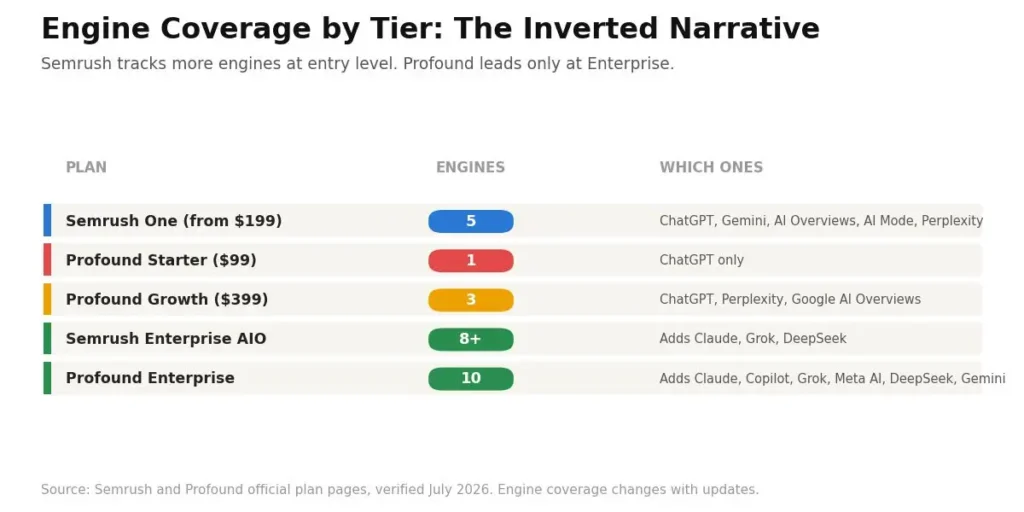
Profound tracks more engines, but only at Enterprise prices. The entry plan covers ChatGPT, Gemini, Google AI Overviews, AI Mode, and Perplexity. Profound Growth covers three. Read that twice, because it inverts the usual narrative.
Semrush’s prompt database spans ChatGPT, Gemini, AI Overviews, and AI Mode. Brand Performance adds Perplexity. Prompt Tracking runs on AI Mode, AI Overviews, Gemini, and ChatGPT Search.
Profound Starter is ChatGPT only. Growth adds Perplexity and Google AI Overviews. Enterprise unlocks the full ten: ChatGPT, Perplexity, Google AI Mode, Gemini, Microsoft Copilot, Meta AI, Grok, DeepSeek, Anthropic Claude, and Google AI Overviews.
And the “Semrush can’t track Claude” line you will read everywhere is only half true. Semrush Enterprise AIO does cover Claude, Grok, and DeepSeek. It is absent from the self-serve toolkit, which is a different claim entirely.
Now the practical angle for a US-focused site.
Independent 2026 referral studies put ChatGPT at between 62% and 92% of trackable AI referrals, depending on the methodology and panel. Gemini and Claude are climbing. Copilot and Perplexity are small and, by several measures, shrinking.
So engine breadth is worth less than the vendors imply. If ChatGPT plus Google surfaces are 80%+ of your AI-referred traffic, paying Enterprise rates for Grok and DeepSeek coverage is buying precision on a rounding error.
If you need broad engine coverage on a small budget, go with Semrush One. For Claude, Copilot, or Grok tracking specifically, Profound Enterprise is the better choice.
Whose Prompt Data Is Better: Semrush’s 239M Database or Profound’s Prompt Volumes?
They measure different things, so “better” depends on the question. Semrush reports topic-level volume. Profound projects prompt-level volume. That distinction is the single most important technical difference between these platforms, and I have not found one competing article that explains it.
Semrush’s position is that individual prompts are too specific and too unique to measure directly. So it clusters related prompts into Topics moving in the same semantic direction, then estimates demand at the topic level by combining third-party AI interaction data with machine learning models.
Profound goes the other way. It licenses conversations from double-opt-in consumer panels, applies probabilistic modeling to correct for demographic and geographic bias, and returns a projected volume for any keyword you enter, calculated on the fly when the keyword falls outside the pre-computed set.
Which one is right? Neither, strictly. Both are models. Profound’s own published figures for its dataset have appeared as 400M+, 1.3B+, and 1.5B+ across different company pages. That spread tells you something genuinely useful: this is extrapolation from a panel, not a count from a ledger.
Semrush is arguably more forthcoming about the limits, describing its own metrics as “reliable directional signals” rather than exact figures, and stating plainly that no platform can provide exact AI visibility numbers.
So treat every prompt volume number on either platform as a directional signal with error bars nobody publishes. If you want to prioritize content by topic clusters, go with Semrush. For demand segmented by region, age, income, and intent, Profound is the better choice, and you will need Enterprise to search it.
How Fast Does Each Tool Refresh Its AI Visibility Data?
Profound refreshes daily on every tier. Semrush refreshes daily for most reports but weekly for Brand Performance. Here is the honest breakdown, drawn from Semrush’s published toolkit documentation:
- Visibility Overview, Competitor Research, Prompt Research: daily, rolling
- Prompt Tracking: daily
- Brand Performance (sentiment and share of voice): weekly
- AI Search Site Audit: on demand, every crawl
Profound runs structured prompts daily across all three tiers. Prompt Volumes updates weekly with typical latency under one week. Why this matters more than it sounds: Profound’s research puts monthly citation drift at 40-60% across major platforms.
Semrush’s own published case study independently cites the same 40 to 60% range, which is a rare moment when two competitors agree on a number. Both vendors agree the ground moves fast. If your sentiment reporting lags by a week, you are reacting to a landscape that has already shifted underneath you.
That said, weekly is not automatically a failure. Sentiment is a slow-moving signal by nature, and daily sentiment readings on a small prompt set mostly measure noise. Position tracking is where daily earns its keep, and both platforms deliver it.
If sentiment velocity matters to your reporting cycle, go with Profound. For daily prompt position tracking at the lowest price, Semrush is the better choice.
Which One Actually Tells You Where Your AI Traffic Comes From?
Profound does, and Semrush’s AI Visibility Toolkit does not. Agent Analytics reads CDN and server logs to show which AI crawlers hit which URLs and how that maps to referral traffic.
This is Profound’s cleanest and least disputed win. JavaScript analytics cannot see most of it. Independent 2026 research suggests a large share of AI-referred sessions arrive without referrer headers and land in “direct” inside GA4, which means your dashboard is undercounting the channel by default.
Server-level logging sidesteps the problem. Profound identifies bot IDs, IP ranges, crawl frequency, and request patterns, then ties that activity back to referrals. Semrush’s answer is different in kind, not weaker.
Its Site Audit checks whether eight AI crawlers can reach your content at all, which is prevention rather than attribution. Enterprise AIO adds log file analysis and, post-acquisition, Adobe Analytics traffic context.
So the honest framing is not “Profound wins attribution.” It is that one tool tells you whether the door is open and the other tells you who walked through it. If you need to prove AI traffic exists, go with Profound. To ensure AI bots can reach your pages in the first place, Semrush is the better choice.
Does Either Tool Fix Your Site, or Just Measure It?
Both moved from measurement to execution, and both remain incomplete. Profound Agents write and optimize content on a credit model. Semrush’s writing tools live in a separate Content Toolkit subscription.
Profound Agents run on credits: 100/month on Starter, 400/month on Growth, custom on Enterprise. Simple agents consume fewer credits; multi-step agents consume more. The platform shows an estimated cost before each run and an actual cost after each run.
That credit model deserves more scrutiny than it gets. It means the “write” half of Profound’s read/write positioning is metered, and heavy content operations will quickly hit the ceiling on Growth.
Semrush splits this across products instead. The AI Visibility Toolkit surfaces gaps and recommendations. Article generation is available in the Content Toolkit at an extra cost.
The AI PR Toolkit finds media outlets that LLMs cite and helps you pitch them, which is directly relevant to AEO and gets ignored in every comparison I read.
That last one is a real oversight in the category.
If roughly 94% of AI citations come from sources you do not own, then a tool that finds LLM-trusted publications is arguably more useful for AEO than another dashboard.
Neither platform does the work for you. Profound tells you where you stand and can draft against it. Semrush tells you what to fix and hands you the machinery to fix it.
If you want insight-to-draft in one platform, go with Profound Growth or above. For technical remediation, content briefs, and digital PR, Semrush is the better choice.
What Does Each One Really Cost Once You Add Seats and Domains?
Sticker prices mislead on both sides. A three-person team on Semrush One Pro+ pays $299 plus $80 plus $99 per extra AI user. Profound Growth includes three seats at $399.
Run the Semrush add-ons honestly:
- AI Visibility Toolkit standalone: $99/month, one domain, 25 prompts
- Additional 50 prompts: +$60/month
- Additional domain for Brand Performance: +$99/month each
- Additional user, SEO access: $45 Pro/Starter, $80 Guru/Pro+, $100 Business/Advanced
- Additional user, AI Visibility access: +$99 per user
- Annual billing saves roughly 17%
Now Profound:
- Starter $99: 1 seat, 1 engine, 50 prompts, 1,500 responses/month, no exports, no Opportunities
- Growth $399: 3 seats, 3 engines, 100 prompts, 9,000 responses/month, CSV and JSON exports, 400 agent credits
- Enterprise: custom, up to 10 engines, API, SSO, ChatGPT Shopping, dedicated specialist with 24-hour SLA
Third-party reviews report Profound Enterprise deployments in the $2,000-$5,000+/month range. Profound does not publish that, so treat it as unconfirmed and get your own quote.
Now the cost-per-prompt comparison nobody runs. For $199, Semrush One Starter delivers 50 daily prompts across five surfaces, plus an entire SEO suite. Profound Growth delivers 100 prompts across three engines at $399, plus 9,000 monthly responses and full answer text.
Semrush is cheaper per prompt and vastly cheaper per feature. Profound is deeper per response. Those are both true, and they point in opposite directions, which is exactly why the “which is better” question keeps producing bad answers.
If budget is the constraint, go with Semrush One Starter. For per-response depth and the number of included seats, Profound Growth is the better choice.
Does the Adobe Acquisition Change Whether You Should Buy Semrush?
Yes, and this is the biggest 2026 development every competing head-to-head article missed. Adobe completed its acquisition of Semrush on April 28, 2026, in an all-cash deal valued at $1.9 billion, or $12.00 per share. Semrush is now a wholly owned Adobe subsidiary. The stock was delisted from the NYSE. Every Semrush knowledge base page now carries an Adobe copyright line in the footer.
Adobe’s stated rationale, published in its own announcement, rests on a hard number: AI traffic to U.S. retail sites increased 269% year over year as of March 2026. Adobe bought Semrush to close what it calls the brand visibility gap, spanning SEO, GEO, and agentic search optimization.
Enterprise AIO already reflects the change. The product surfaces on Adobe’s own domain, and Adobe Analytics traffic data can be layered into AIO reporting. So what should you actually do with this information?
If you are signing a 12-month annual Semrush contract today, you are buying into an Adobe roadmap, not an independent one. Adobe’s integration record is mixed. Magento is the cautionary example, where the acquisition slowed release cadence and pushed the product upmarket over time.
That cuts both ways, though. Enterprise buyers gain a serious platform story and a clear path from AI visibility measurement into Adobe’s content supply chain. Solo publishers and small agencies should watch whether the $199 tier stays a priority under new ownership.
Here is the strategic read most people miss. Profound’s biggest long-term risk was always that AEO becomes a feature rather than a category. Adobe’s acquisition of Semrush is the clearest evidence yet that the marketing clouds intend to absorb it.
That does not make Profound wrong. It does mean the moat is narrower than a $1B valuation implies. If you are an enterprise already inside Adobe, go with Semrush. For a solo operator who wants roadmap independence, Profound is the safer bet right now.
What Do Most Comparison Articles Get Wrong About These Two Tools?
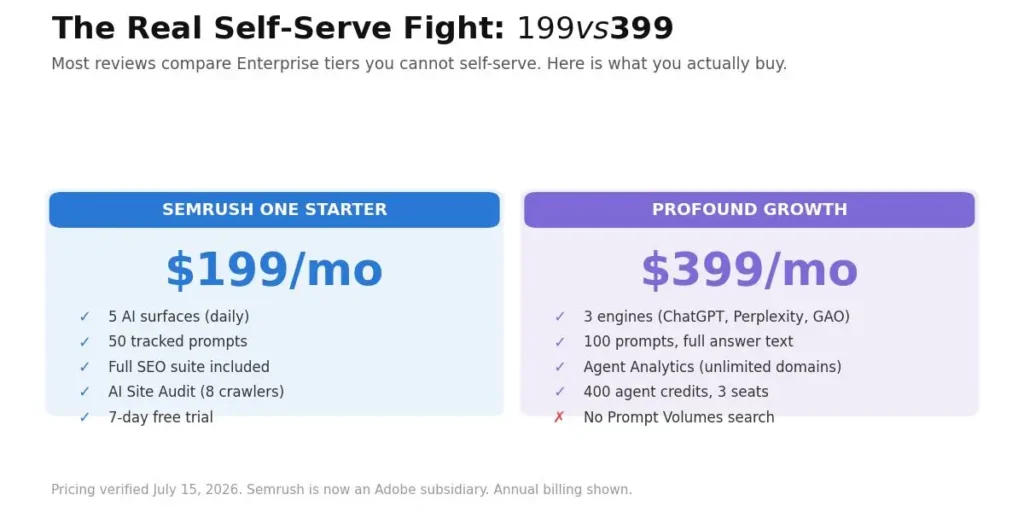
Almost all of them compare a product tier that most readers cannot buy. The features justifying Profound’s premium are Enterprise-gated, which means the real self-serve fight is $199 Semrush One against $399 Profound Growth.
Line up what those two plans actually deliver.
Semrush One Starter, $199: five AI surfaces, 50 daily prompts, 500 tracked keywords, full SEO suite, AI Site Audit, 5 monitored websites, 7-day trial.
Profound Growth, $399: three engines, 100 prompts, full answer text, Agent Analytics, 400 agent credits, 3 seats, exports, no Prompt Volumes search, no API, one language, one region.
At that comparison, the purpose-built argument thins out fast. You are paying double for deeper responses on fewer engines while losing the entire SEO layer.
The reviews telling you Profound wins on data depth are describing Enterprise.
The reviews telling you that Semrush is Google-centric with 2,500 curated prompts describe a 2025 product that no longer exists. There is a second thing worth saying plainly. Neither platform improves your AI visibility.
Both measure it. The citations, the mentions, the earned coverage: that is still content and PR work you or an agency have to do. Independent research keeps pointing the same direction.
Roughly 94% of AI citations come from non-brand-owned sources, and your own site accounts for something like 5 to 10% of what engines reference. No dashboard fixes that. Third-party authority does.
So here is the non-obvious conclusion. For most readers of this comparison, the correct answer is neither tool yet.
Buy the cheapest credible measurement layer, spend the difference on earning mentions in the sources AI engines already trust, and upgrade your tooling when you have something worth measuring.
If you are choosing a platform before you have a content operation, you are solving the wrong problem in the wrong order.
Can You Use Semrush and Profound Together, and Should You?
You can, and above a certain team size, it is the right answer. Profound ships Semrush integration nodes for its Agents, pulling domain metrics, backlinks, and keyword data directly into Profound workflows.
That integration is a quiet admission from Profound itself: it is not trying to replace Semrush. The stack logic is clean. Semrush handles the crawl layer: keywords, backlinks, technical health, Google rankings, AI crawler accessibility.
Profound handles the conversation layer: full answers, sentiment framing, crawler behavior, referral attribution. Budget reality check though. Semrush One Pro+ at $299 plus Profound Growth at $399 puts you at roughly $700/month before extra seats.
That is a serious line item for a solo publisher and a rounding error for a Fortune 500. So run it in sequence rather than parallel. Start with Semrush One, establish an AI visibility baseline, fix your crawler accessibility, and publish consistently for six months.
Add Profound when your executives start asking about ChatGPT share of voice by name, or when AI referrals cross a threshold you actually care about. If you have under $500/month, go with one tool. For a defined AEO budget with a named owner, running both is the better choice.
Semrush vs Profound: Which One Should You Actually Buy?
Buy Semrush One if you are a solo publisher, freelancer, small agency, or in-house SEO team where AI visibility is one channel among several. At $199/month, you get five AI surfaces, daily prompt tracking, and a complete SEO suite.
Nothing else in the category delivers that combination at that price. Buy Profound Growth at $399/month if you already own an SEO stack you are happy with, you want to read actual AI responses instead of a score, and you need server-level AI crawler attribution. Take the trial before you commit.
Buy Profound Enterprise if AI search is a board-level metric; you need coverage for Claude, Copilot, or Grok; you want Prompt Volumes search; you operate across multiple languages and regions; or your procurement team requires SOC 2 and SSO.
Buy Semrush Enterprise AIO if you already sit within Adobe’s ecosystem, need multi-market and multi-brand tracking, and want AI visibility measured alongside Google organic in a single reporting layer.
Skip both if your site gets under a few thousand visits a month. At that stage, AI visibility tracking is an expensive way to measure a number you cannot yet move. Publish more, earn third-party mentions, and revisit this decision in six months.
Beginners should start with Semrush’s free AI Visibility Checker and Profound’s free AEO report. Both cost nothing, take minutes, and will tell you whether you have a problem worth paying to solve.
Frequently Asked Questions
For AI-only depth, yes. Profound tracks up to 10 answer engines, shows full AI responses, and provides server-level crawler analytics. Semrush covers five surfaces plus a complete SEO suite for half the price.
Profound Starter is $99/month for ChatGPT tracking and 50 prompts. Growth is $399/month for three engines and 100 prompts. Both are billed yearly with two months free. Enterprise pricing is custom.
Semrush tracks ChatGPT, Gemini, Google AI Overviews, AI Mode, and Perplexity in the AI Visibility Toolkit. Coverage for Claude, Grok, and DeepSeek requires Semrush Enterprise AIO, which is custom-priced through sales.
Adobe owns Semrush. The $1.9 billion all-cash acquisition closed on April 28, 2026, at $12.00 per share. Semrush is now a wholly owned Adobe subsidiary and was delisted from the NYSE.
Only if AI search is a funded channel with a dedicated owner. Semrush One Pro+ plus Profound Growth runs roughly $700/month. Most solo publishers and small agencies should start with Semrush One alone.
Pricing and feature limits verified against Semrush and Profound official documentation on July 15, 2026. AI search platforms change fast, so confirm current terms before purchasing.

Is an SEO Specialist and AI Tools Researcher with over 4 years of hands-on experience in search engine optimization. As the founder of Smart AI Helper Pro, he tests and reviews AI writing, SEO, and marketing tools to help creators and business owners grow faster with practical, research-backed strategies.