
Why Does Domain Authority Differ Between Semrush and Moz? (2026 Explained)
By SM Mehedi Hasan

Domain Authority differs between Semrush and Moz because they are not the same metric. Moz publishes Domain Authority, while Semrush publishes Authority Score. Each uses a different backlink database, a different formula, and Semrush adds organic traffic and spam checks that Moz weighs far less.
If you have ever checked the same website in both tools and seen a 20-point gap, you are not doing anything wrong. The gap is built into how each tool works.
Below is the full breakdown of why Domain Authority differs between Semrush and Moz, how each score is actually calculated in 2026, and which number you should trust for real decisions.
Table Of Contents
ToggleWhat Is Domain Authority, and Does Semrush Even Use It?
Domain Authority is a Moz metric, and Semrush does not actually have one. This single fact clears up most of the confusion before we go any deeper.
Moz created Domain Authority (DA) as a 1 to 100 score that predicts how likely a domain is to rank in Google compared to other sites.
Semrush built its own equivalent and named it Authority Score (AS). Ahrefs has a third version called Domain Rating (DR).
So when someone says “my Domain Authority is different on Semrush,” they are usually comparing Moz DA against Semrush AS. Two different scores, two different formulas, sitting on the same 0 to 100 scale.
That shared scale is exactly what tricks people into expecting the numbers to match.
Honestly, most articles skip this part and jump straight to “different algorithms.” But if you do not know that Semrush never reports a true Domain Authority figure, the rest never clicks into place.
Why Does Domain Authority Differ Between Semrush and Moz?
Domain Authority differs between Semrush and Moz for five core reasons: different metrics, different backlink databases, different formulas, different update schedules, and one big extra ingredient inside Semrush that Moz mostly leaves out.
Here is the short version before we expand each one:
- Different metric entirely – Moz DA versus Semrush AS, not DA versus DA.
- Different link databases – each tool crawls the web with its own bot and finds different backlinks.
- Different formulas – Moz leans almost fully on links, Semrush blends links with traffic and spam signals.
- Different refresh timing – the two tools update on different schedules, so you often compare an old number against a fresh one.
- Organic traffic weighting – Semrush bakes in estimated organic traffic, Moz does not.
Most people assume the tools are measuring the same thing slightly differently. They are not. They are answering two related but separate questions about your site.
How Does Moz Calculate Domain Authority?
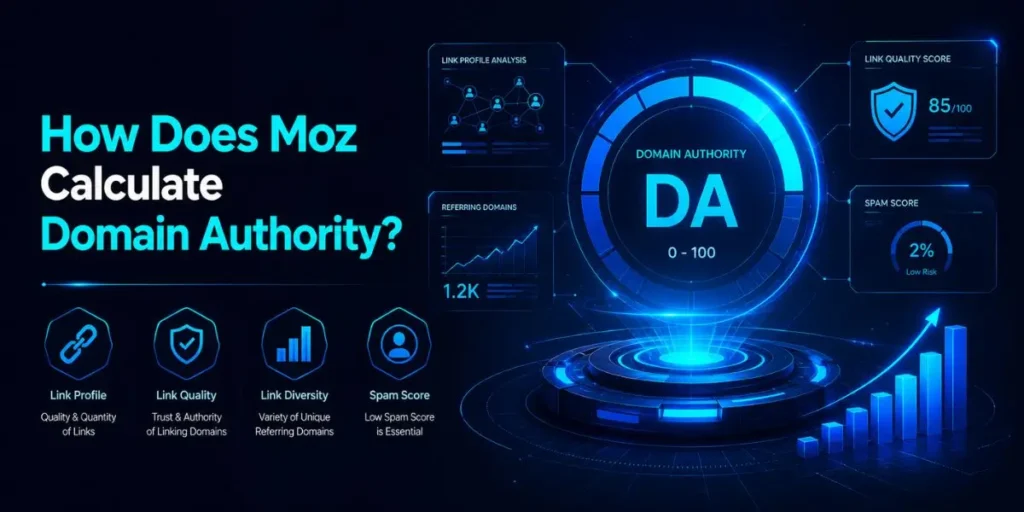
Moz calculates Domain Authority using a machine learning model trained on real Google search results, built almost entirely around your backlink profile.
The model studies which sites rank across many queries, then learns which link signals best predict that ranking success.
The main inputs Moz leans on:
- Linking root domains – how many unique websites link to you, which carries far more weight than raw link count.
- Total backlinks – the full volume of links pointing at your domain, weighted by quality.
- Link quality – a link from a strong, relevant site counts for much more than a link from a weak or unrelated one.
- Overall link profile health – diversity and trust patterns across your links.
Moz pulls this data from its Link Explorer index, which sits at roughly 45.8 trillion backlinks and around 1 billion domains as of early 2026.
The score runs on a logarithmic scale, so climbing from DA 20 to 30 is far easier than pushing from 70 to 80.
One detail people forget: Domain Authority is not a Google ranking factor. Google has repeatedly clarified that it does not use Domain Authority at all. It is a third-party proxy, useful for comparison, not a signal Google reads.
In My Experience
Honestly, when I first started tracking DA for client sites, I expected it to move the week after a link landed. It did not.
Moz refreshes Domain Authority on roughly monthly cycles, so a strong link I built in week one often showed up in the score weeks later.
Once I stopped refreshing the dashboard every day and started reading DA as a slow monthly trend, the metric became genuinely useful instead of frustrating. The lesson stuck: DA tells you direction over months, not progress over days.
How Does Semrush Calculate Authority Score?
Semrush calculates Authority Score using eight weighted factors grouped into three categories: Link Power, Organic Traffic, and Natural Profile (spam signals). The third and second categories are what set it apart from Moz.
Here is how Semrush structures it, based on its own documentation:
- Link Power – the quantity and quality of referring domains, where a link from a high-AS site counts more than one from a low-AS site.
- Organic Traffic – the estimated monthly organic search traffic your domain pulls from Google.
- Natural Profile (spam checks) – six separate signals that flag manipulation, such as no organic rankings, an unnatural ratio of dofollow domains, an imbalance between links and traffic, too many referring domains on the same IP or IP network, and a duplicate backlink profile shared with another domain.
Semrush pulls its link and traffic data from its own database, which holds roughly 43 trillion backlinks and 808 million domains as of January 2026. Like Moz, it runs on a logarithmic 0 to 100 scale.
So the gap starts to make sense. A site can have a clean, link-heavy profile that earns a solid Moz DA, yet score lower on Semrush because it has thin organic traffic or trips one of those spam checks. Two formulas, two verdicts.
Pro Tip
Want a fast sanity check before you panic over a low Authority Score? Look at your organic traffic trend first.
Because Semrush weighs traffic heavily, a new or recently launched site almost always shows a lower AS than its link profile alone would suggest. The fix is rankings and traffic over time, not more links.
What Are the Real Reasons the Two Scores Do Not Match?
The two scores do not match because the tools disagree on what data to collect and how to weigh it. Below are the specific mechanics, broken down so you can see exactly where each gap comes from.
Why Do Semrush and Moz Find Different Backlinks?
Semrush and Moz find different backlinks because each one crawls the web with its own bot and stores results in its own index. No SEO tool discovers every link on the internet. Each finds a different slice.
When the underlying link data differs, the authority calculation built on top of it differs too.
A link that Moz has indexed might be missing from Semrush for days or longer, and the reverse happens just as often.
Studies comparing link discovery have consistently shown the tools surfacing different referring domain counts for the very same website.
And the timing matters. If Moz has crawled a fresh batch of your new links but Semrush has not caught up yet, your two scores will drift apart purely on data freshness.
Does Organic Traffic Change the Score?
Yes, and this is the single biggest reason the numbers split. Semrush folds estimated organic traffic directly into Authority Score, while Moz Domain Authority is built almost entirely on links.
Picture a brand-new site that earned a handful of strong editorial links but has not started ranking yet. Moz might reward those quality links with a respectable DA.
Semrush sees almost no organic traffic and holds the Authority Score down. Same site, same day, two very different stories, and traffic is the reason. This is also why Semrush AS tends to run lower than Moz DA across the board.
Independent benchmarks suggest Authority Score sits roughly 15 to 20 percent below the equivalent Moz figure on average, largely because of that traffic requirement.
How Often Does Each Tool Update?
Moz refreshes Domain Authority on roughly monthly cycles, while Semrush updates its data more frequently. That alone produces temporary gaps that have nothing to do with your actual site strength.
If you check Moz the week before its refresh and Semrush the week after a data update, you are comparing a stale snapshot against a current one.
People treat this as a real difference on their site. Often, it is just two clocks ticking at different speeds.
Here is a clean side-by-side of where the two metrics actually diverge:
| Factor | Moz Domain Authority | Semrush Authority Score |
|---|---|---|
| Metric name | Domain Authority (DA) | Authority Score (AS) |
| Main driver | Backlink profile and linking root domains | Link power plus organic traffic |
| Organic traffic used | No | Yes, weighted heavily |
| Spam filtering | Light, via Spam Score separately | Built in, six spam signals |
| Data source | Link Explorer index | Semrush backlink and traffic database |
| Update cadence | Roughly monthly | More frequent |
Why Does Spam Filtering Differ?
Spam filtering differs because Semrush bakes it straight into Authority Score, while Moz keeps its Spam Score as a separate signal that does not directly drive DA.
So a site with a slightly manipulated link profile can keep a decent Moz DA yet take a hit on Semrush AS.
This is a feature, not a flaw, on the Semrush side. The built-in spam checks make Authority Score harder to inflate with low-quality link schemes.
If your two scores diverge sharply and your link profile is aggressive, Semrush is probably the one telling you the harder truth.
Can You Convert a Semrush Authority Score to a Moz DA?
You cannot convert them officially, because there is no published formula linking the two. But there is a rough, observed pattern you can use as a loose guide.
Across many sites, Semrush Authority Score tends to land about 15 to 20 percent below the matching Moz DA, mostly due to the organic traffic factor.
Benchmarks suggest an Authority Score near 50 roughly lines up with a Moz DA in the 40 to 43 range.
Here is a rough translation table. Treat it as directional, not exact:
| Semrush Authority Score | Approx. Moz DA | What it usually signals |
|---|---|---|
| 10 to 20 | 15 to 28 | New or small site, light traffic |
| 30 to 45 | 38 to 52 | Growing site with real link traction |
| 50 to 65 | 55 to 70 | Established brand, steady organic traffic |
| 70 plus | 75 plus | Strong, mature authority in its niche |
Compared to treating the two numbers as interchangeable, this kind of loose mapping keeps you honest.
The danger comes when an agency reports the higher of the two scores to a client and presents it as a single “Domain Authority.” That is comparing apples to a slightly different apple.
In My Experience
The thing that surprised me most was how often the gap traced back to one cause: traffic. I had a content site sitting at DA 41 on Moz, but stuck near AS 28 on Semrush. My first instinct was a link problem. It was not.
The site was newly relaunched and barely ranking, so Semrush had almost no organic traffic to feed into its formula.
Three months later, after rankings climbed, the Authority Score rose to match the link profile while the Moz DA barely moved. The two tools were not fighting. They were measuring two different stages of the same growth.
Which Score Should You Actually Trust?
Trust the score that matches your goal, because each one answers a different question. There is no single “correct” number, and chasing both at once wastes effort.
Use this quick decision guide:
- For client reporting and broad benchmarking, Moz Domain Authority is the most recognized name, so clients understand it instantly.
- For judging real site strength and spotting manipulation, Semrush Authority Score is harder to game and reflects traffic, so it leans closer to real-world performance.
- For comparing yourself to competitors, pick one tool and stay inside it, because cross-tool comparisons are meaningless.
- For link vetting, Moz Spam Score plus Semrush AS together give you a stronger read than either alone.
The mistake is bouncing between tools month to month. If you track DA in Moz one month and AS in Semrush the next, you are not measuring progress. You are measuring two different rulers.
How Do These Scores Fit Into AI Search and AEO in 2026?

Domain Authority and Authority Score still matter in 2026, but they now sit beside a newer concern: whether AI engines actually cite your site.
Neither DA nor AS directly controls AI Overviews, ChatGPT answers, or Perplexity citations. Search has shifted hard toward AI Overviews, generative answers, and zero-click results.
Strong domain authority still helps, because the same backlinks and trust signals that lift these scores also tend to make AI engines treat your content as a credible source. The link strength is shared, even if the metric is not.
What changed is that authority alone no longer guarantees visibility. A site can hold a high Moz DA and still get skipped in an AI Overview if its content is not structured to be quoted.
This is where answer engine optimization comes in: clear definitions, direct first-sentence answers, clean headings, and quotable facts.
So the smart 2026 play is to treat DA and AS as health checks on your link foundation, then layer AEO on top so AI engines can actually pull your answers. The score builds the base. The structure earns the citation.
Common Pitfalls When Comparing Semrush and Moz Scores
Most score confusion comes from a handful of repeatable mistakes. I have made several of these myself, so here is what to watch for and why each one happens.
- Comparing DA against AS as if they are the same metric – they share a 0 to 100 scale but measure different things, which is the root cause of nearly every “why are they different” question.
- Panicking over a single drop – both scores recalibrate as the tools update their models and indexes, so a small dip often reflects a refresh, not a real loss.
- Chasing the number instead of the inputs – buying links to push a score usually backfires, especially on Semrush, where spam checks catch the manipulation.
- Ignoring the traffic factor – a low Authority Score on a new site is almost always a traffic issue, not a link issue, yet people keep building more links.
- Reporting the higher score to look good – mixing tools to cherry-pick the best number erodes trust the moment a client checks the other tool.
- Forgetting the logarithmic scale – expecting the jump from 60 to 70 to take the same effort as 20 to 30 sets you up for disappointment.
The common thread: each mistake comes from treating these scores as exact truths rather than directional proxies. Once you accept that, the pressure drops and the data gets useful.
How to Reconcile Both Scores in Your SEO Workflow
- Pick one tool as your primary tracker. Choose Moz or Semrush as your single source of truth for monthly tracking. This removes the cross-tool noise that causes most false alarms, because you are now reading one consistent ruler instead of two.
- Record both scores once per month, on the same day. Log DA and AS together on a fixed date. Same-day logging cancels out the update-timing gap, so any real difference you see is structural, not just a stale snapshot.
- Check your organic traffic trend next to the scores. Pull your traffic graph alongside the two numbers. If AS lags DA, weak traffic is usually the cause, which tells you to focus on rankings rather than more links.
- Audit your link profile with both spam signals. Run Moz Spam Score and review Semrush Natural Profile flags together. Looking at both catch manipulations, either tool might miss on its own, so your link vetting gets sharper.
- Set competitor benchmarks inside one tool only. Compare your chosen score against the top three to five sites ranking for your target keyword, all inside the same tool. This gives you a real target instead of an arbitrary number to chase.
- Review trends quarterly, not daily. Step back every three months to read the direction. Because both scores move slowly and update on cycles, the quarterly review shows genuine progress while the daily checking shows only noise.
Workflow Example
Input: A client site shows Moz DA 38 and Semrush AS 24, and the client is worried the AS number means something is broken.
Process: I logged both scores on the same day, then pulled the organic traffic graph. Traffic was low because the site relaunched four months earlier.
I confirmed the link profile was clean using Moz Spam Score and Semrush Natural Profile flags, so manipulation was ruled out. I set the benchmark against the top five ranking competitors inside Semrush only.
Output: A clear diagnosis. The DA and AS gap was a traffic-stage gap, not a link problem. The action plan focused on publishing and ranking content to grow organic traffic, with link building as a secondary track.
Result: Over the next quarter, organic traffic climbed, Semrush AS rose from 24 to 33 to close the gap with Moz DA, and the client stopped treating the two numbers as a contradiction. One diagnosis replaced months of guessing.
Pro Tip
If you only have time for one habit, screenshot both scores on the first of every month and drop them in a simple sheet.
After three months, you will have a trend that tells you more than any single-day reading ever could, and trends are what protect you from reacting to normal score noise.
Frequently Asked Questions
Because Semrush does not report Domain Authority at all. It shows Authority Score, a separate metric that adds organic traffic and spam checks to the link data. Different formula, different number, same 0 to 100 scale.
Neither is the official truth, since Google uses neither. Semrush AS is harder to manipulate because it factors traffic and spam, while Moz DA is more widely recognized for client reporting. Pick one and stay consistent.
No, not directly. They use different data and formulas. Authority Score usually runs about 15 to 20 percent lower than the matching Moz DA, so treat any cross-tool comparison as rough at best.
No. Google has repeatedly confirmed it does not use Domain Authority or Authority Score. Both are third-party proxies that estimate ranking potential based on signals that overlap with Google’s, not signals Google reads.
Usually, it’s because of an organic traffic dip or a routine data update on the tool’s side. Since Semrush weighs traffic and refreshes regularly, the score can move even when your backlink profile stays exactly the same.

Is an SEO Specialist and AI Tools Researcher with over 4 years of hands-on experience in search engine optimization. As the founder of Smart AI Helper Pro, he tests and reviews AI writing, SEO, and marketing tools to help creators and business owners grow faster with practical, research-backed strategies.