
How Accurate Is Ahrefs Traffic Checker? An Honest 2026 Breakdown
By SM Mehedi Hasan

Ahrefs traffic checker gives you an estimate, not a measurement. Its own study found a median deviation of 49.5% from Google Search Console, while an independent AuthorityHacker test measured 22.5%.
The takeaway: it is reliable for comparing websites, but never trust the exact number on-screen.
If you have ever typed a competitor’s domain into Ahrefs and wondered whether that “85,000 monthly visits” figure is real, you are asking the right question.
So, how accurate is the Ahrefs traffic checker once you move past the marketing claims? Short version: accurate enough to make smart decisions, wrong enough that treating it as fact will burn you.
The rest of this guide shows you exactly where the line sits and how to work around it.
Table Of Contents
ToggleSo, How Accurate Is the Ahrefs Traffic Checker, Really?
Ahrefs is one of the most accurate organic traffic estimators available, but its numbers can still be off by roughly half on a typical site. Two well-known studies tell the story.
Ahrefs ran its own research on 1,635 random websites, comparing their U.S. organic traffic estimates against real Google Search Console data.
The median deviation was 49.52%. In plain terms, the estimate is often off by about half of the true value, in either direction.
But that is not the whole picture. An independent study by AuthorityHacker tested six SEO tools against real Google data and found Ahrefs to be the most accurate, with an average discrepancy of just 22.5%.
Same tool, very different headline number. That gap confuses a lot of people, so let’s settle it.
Why Do Two Studies Show Such Different Numbers (22.5% vs 49.5%)?
The two numbers differ because the studies measured different things on different samples. Neither one is “wrong”; they just answer slightly different questions.
Here is the side-by-side, mobile-friendly, so you can scan it on your phone:
| Factor | AuthorityHacker Study | Ahrefs Study |
|---|---|---|
| Sample size | 50 websites | 1,635 websites |
| Metric used | Average discrepancy | Median deviation |
| Result | 22.5% | 49.5% |
| Correlation with GSC | 0.99 | 0.76 |
So one used a small, hand-picked sample and reported an average. The other used a much larger random sample and reported a median, which is less susceptible to skew from outliers.
Larger and more random usually means closer to real-world behavior, which is why the 49.5% figure is the more honest day-to-day expectation.
And here is the part most articles skip entirely. Both studies are several years old, and the search landscape in 2026 looks nothing like it did when they ran. More on that below, because it changes everything.
What Is the Difference Between “Accurate” and “Consistent”?
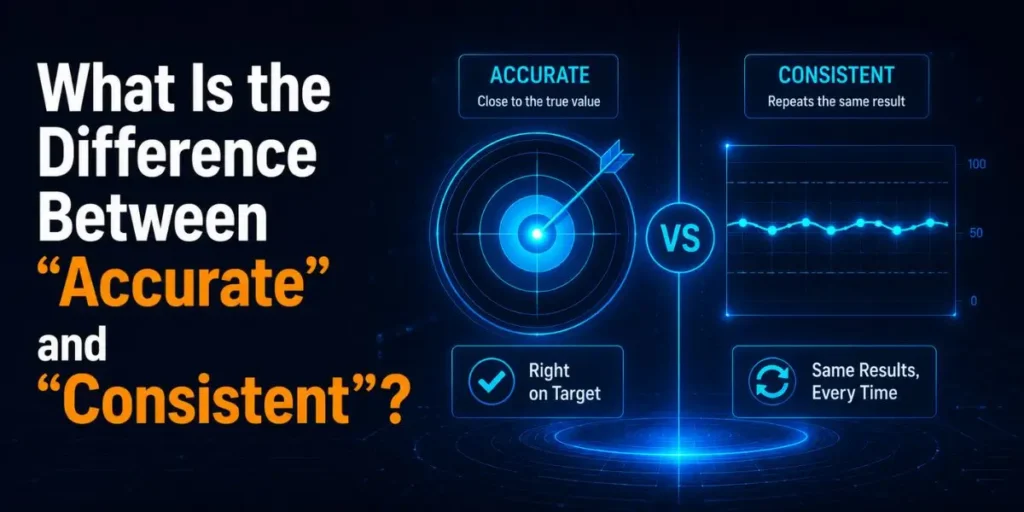
This is the single most useful idea for using Ahrefs correctly: accuracy and consistency are not the same thing. Ahrefs is shaky on accuracy but strong on consistency.
Accuracy is how close the estimate is to the actual value. Consistency means that bigger sites reliably appear bigger, and smaller sites reliably appear smaller, even if the individual numbers are off.
Ahrefs scores a 0.76 correlation with Search Console data in its own study, which is close to a perfect 1.0. That tells you something practical.
If Ahrefs says Competitor A gets triple the traffic of Competitor B, that ranking relationship is very likely true, even though both raw numbers might be inflated or deflated.
Most people assume the goal is an exact visitor count. It usually is not. You want to know who is winning, what is growing, and which pages pull weight.
For those questions, consistency matters more than precision, and that is exactly where Ahrefs shines.
When Is Ahrefs Most and Least Accurate?
Accuracy swings hard depending on the type of site you check, so context decides everything. Some sites land within 5% of reality, others are off by over 1,000%.
Most accurate situations:
- Large, established sites with stable rankings and lots of indexed keywords
- Content sites that live mostly on organic search traffic
- Domain-level estimates rather than single-page estimates
- Sites in competitive niches where Ahrefs has dense keyword data
Least accurate situations:
- New or tiny sites with under 1,000 monthly visitors, where the data sample is thin
- Brand-heavy sites where most traffic comes from people typing the name directly
- Single URLs, which depend on far fewer keywords than a whole domain
- Sites that rank for keywords Ahrefs has not discovered yet
Quick tip: when you check a small site, and the number looks suspiciously low, it probably is. Ahrefs tends to undercount young sites because it hasn’t yet crawled enough of their ranking keywords.
Do AI Overviews Change Ahrefs’ Accuracy in 2026?
Yes, and this is the part almost no competing article will tell you: AI Overviews are quietly making position-based traffic estimates less accurate, especially for informational content.
To see why, you have to understand how the number is built.
Ahrefs calculates traffic with a simple chain:
- Find every keyword a site ranks for.
- Pull each keyword’s monthly search volume.
- Check the site’s ranking position for each keyword.
- Apply an expected click-through rate for that position.
- Add up the estimated clicks across all keywords.
Step four is the weak link in 2026. That whole model assumes a stable relationship between ranking position and clicks. For years, ranking #1 meant a predictable slice of clicks. AI Overviews broke that assumption.
The data is blunt. Ahrefs’ own analysis found that AI Overviews cut clicks to top-ranking pages by 34.5%, a figure later updated in December 2025 across 300,000 keywords.
Seer Interactive tracked 25 million impressions and saw organic click-through rate on AI Overview queries fall by around 61%. NP Digital measured the #1 position dropping from roughly 24.9% click-through to 18.6%.
Now connect the dots. The famous 49.5% accuracy figure comes from a May 2022 study, well before AI Overviews existed.
When a query now triggers an AI Overview, the real CTR is far lower than the position-based model expects, so the estimate can overstate traffic on informational keywords.
Transactional and branded keywords are less affected, since AI Overviews appear less often there.
So in 2026, the type of keyword a site ranks for changes how much you should trust the estimate. That nuance is missing from nearly every guide on this topic, and it is the difference between using the tool wisely and being misled by it.
In My Experience
Honestly, when I first started checking my own sites against Search Console, the pattern jumped out fast.
On an older content site with consistent rankings, Ahrefs landed within a sensible range, close enough that I trusted the trend line completely.
The site that threw me off was a smaller brand-driven business. Ahrefs showed only a fraction of its real traffic because most visitors were typing the brand name directly into Google or arriving via email, none of which Ahrefs can see.
The “organic search only” limitation is easy to forget until it bites you.
What caught me off guard recently was watching informational pages hold their rankings while real clicks slid, exactly the AI Overview effect.
The Ahrefs estimate stayed flat because the position stayed flat, but Search Console told the truer, sadder story. That single comparison changed how I read every estimate now.
How Can You Make Ahrefs Numbers More Accurate?

You can correct most of the errors with a simple ratio borrowed from Ahrefs itself. Follow these steps in order:
- Open Google Search Console for a site you own and note its real organic clicks for a recent month.
- Check that same site in Ahrefs for the matching period and note the estimate.
- Divide the real number by the Ahrefs number to get your personal correction ratio.
- Apply that ratio to competitors in the same niche to get a more grounded figure.
Here is why this works. Ahrefs is inconsistent in absolute terms but highly consistent relative to itself, especially within one industry.
So the gap between reality and estimate for your site usually mirrors that of similar competitors.
Worth knowing: this applies only to sites in the same niche with similar traffic profiles. Apply your blog’s ratio to a giant e-commerce competitor, and the correction falls apart.
Workflow Example: Sanity-Checking an Estimate
A real flow beats theory, so here is one I run before quoting any competitor number to a client.
- Input: A competitor domain showing 120,000 estimated monthly organic visits in Ahrefs.
- Process: I pull my site’s GSC number (e.g., 40,000 real clicks) and compare it with its Ahrefs estimate (e.g., 60,000). That gives a correction ratio of 0.67. Both sites sit in the same niche.
- Output: I multiply the competitor’s 120,000 by 0.67, landing around 80,000 as a more realistic figure.
- Result: Instead of presenting an inflated 120,000, I report a defensible range of roughly 75,000 to 90,000, and I flag that informational-heavy keywords may push it lower thanks to AI Overviews.
The whole check takes five minutes and saves you from building a strategy on a number that was never real to begin with.
Common Mistakes That Make Ahrefs Look "Wrong"
Most of the time, Ahrefs isn’t broken; the user is reading it incorrectly. These are the slip-ups I see constantly.
- Treating the estimate as an exact count. A site shown at 50,000 might really sit anywhere from 30,000 to 80,000. It is a range, not a receipt.
- Confusing Traffic Value with revenue. Traffic Value is what the organic traffic would cost in Google Ads, not what the site earns. People mix these up daily.
- Comparing Ahrefs to Google Analytics directly. Analytics counts all traffic types. Ahrefs estimates organic search only, so the two will never match, and that is normal.
- Judging a site from one snapshot. Rankings move, seasons shift, algorithms update. One reading can mislead. Always check the trend over several months.
- Forgetting the country filter. A global number can hide the fact that most visitors come from a region your business does not even serve.
Each of these makes the tool look inaccurate when the real issue is interpretation.
What Can the Ahrefs Traffic Checker Not Measure At All?
Ahrefs only estimates organic search traffic, so entire channels are invisible to it. This is a hard limit, not a bug.
It cannot see direct traffic, social media visits, email clicks, paid ad traffic counted as visits, or referral traffic from other sites.
A site getting half its visitors from a newsletter or a viral social post will look far smaller in Ahrefs than it truly is.
For your own site, Google Search Console and Google Analytics remain the only fully accurate sources. Ahrefs earns its value on the one thing those tools cannot do: estimating traffic for sites you do not own.
Is Ahrefs Still Worth It for Traffic Data in 2026?
For competitor research, yes, it remains the most trusted estimator despite the accuracy caveats. No rival tool offers a clearer comparative view of who is winning in organic search.
The cost is real, though, so here is the current 2026 lineup at a glance:
| Plan | Monthly Price | Best For |
|---|---|---|
| Starter | $29 | Light, occasional checks |
| Lite | $129 | Solo owners, backlink focus |
| Standard | $249 | Serious SEO and agencies |
| Advanced | $449 | Larger teams, more history |
There is also a free traffic checker at ahrefs.com/traffic-checker (no login required), plus Ahrefs Webmaster Tools, which is free for verified site owners.
For casual curiosity, there are plenty of free options. For regular professional work, Standard is where the tool earns its price.
Use the data as a compass, not a GPS. It points you in the right direction, and in 2026, you still have to factor in AI Overviews before you fully trust the route.
Frequently Asked Questions
It is reasonably accurate for comparison but not for exact counts. Ahrefs’ own study found a median deviation of 49.5% from Google Search Console, while AuthorityHacker measured 22.5%. Trust the ranking between sites, not the precise number.
Because they measure different things. Google Analytics counts all traffic, including direct, social, and paid visits, while Ahrefs estimates only organic search traffic. The two figures will never match, and that difference is completely normal.
In Ahrefs’ own comparison, yes. Ahrefs showed a median deviation of 49.5%, compared with 68.4% for Semrush on the same websites. Both are estimates, so treat either as a guide for comparison rather than the exact truth.
Yes. Ahrefs estimates rely on position-based click-through rates, and AI Overviews have cut clicks to top results by 34.5% or more. This makes estimates of reliability for informational keywords in 2026 less reliable than older studies suggest.
It uses the same data as the paid version but shows limited results, usually top keywords and a rough estimate. It is fine for a quick gut check, though serious competitor research needs a paid plan for full keyword and history data.

Is an SEO Specialist and AI Tools Researcher with over 4 years of hands-on experience in search engine optimization. As the founder of Smart AI Helper Pro, he tests and reviews AI writing, SEO, and marketing tools to help creators and business owners grow faster with practical, research-backed strategies.