Semrush vs Peec AI: Which One Actually Earns Its Price in 2026?
By SM Mehedi Hasan
Semrush is the better buy if you need SEO and AI visibility on a single bill, while Peec AI wins when AI search is part of someone’s daily job. Semrush One starts at $199/month with 50 tracked prompts. Peec AI Starter costs $95/month for 50 prompts and unlimited team seats.
Choosing between Semrush vs Peec AI is not really a features fight. It’s a question about who does the work. One tool is a 55-tool marketing platform that bolted on a serious AI visibility layer. The other is a Berlin startup that only tracks AI answers and refuses to do anything else.
I’ve spent the last stretch of 2026 pulling both platforms apart, cross-checking their public limits against what the vendors actually publish, and watching how fast each one ships. The pricing gap is small. The workflow gap is enormous.
| Tool | Starting Price | Exclusive Deal |
|---|---|---|
| Semrush AI Visibility Toolkit | $99/mo per domain | No trial on the standalone add-on |
| Semrush One (Starter) | $199/mo | 7-day free trial, ~17% off annual billing |
| Peec AI (Starter) | $95/mo | 7-day free trial, no credit card, 15% off annual |
If you want one login for SEO and AI search, go with Semrush One. If you want maximum prompt tracking per dollar and free seats for your whole team, Peec AI is the better value.
If you only need to know whether ChatGPT mentions you at all, the standalone Semrush AI Visibility Toolkit is the cheapest honest entry point.
Table Of Contents
ToggleWhat’s the Real Difference Between Semrush and Peec AI?
Semrush starts with a giant database and reports down to you, while Peec AI starts with your prompts and builds up. That single design choice explains almost every disagreement between the two products. Semrush runs an enormous prompt index.
Their <a href=”https://www.semrush.com/news/463141-semrush-releases-expanded-2026-ai-visibility-index-analyzing-126-million-ai-search-prompts/” rel=”nofollow”>2026 AI Visibility Index</a>, published June 26, analyzed 126 million U.S. AI search prompts collected between January and April 2026.
You get benchmarks, topic demand, and competitor context out of the box. Peec AI doesn’t have an index like that. You choose prompts, Peec runs them daily on real browser sessions, stores every chat, and turns those stored chats into visibility, position, sentiment, and citation data.
But that difference cuts both ways. Semrush hands you market context you could never build yourself. Peec hands you evidence you can open, read, and argue with. Most reviews frame this as “all-in-one versus specialist,” which is lazy.
The sharper framing is estimated versus observed. Semrush’s headline AI numbers are modeled from a sample. Peec’s numbers come from answers it actually collected on your behalf.
So the question isn’t which tool is better. It’s whether your reporting needs an estimate of the market or proof of your own performance.
Semrush: Best for SEO Authority and AI Visibility on One Bill
Semrush is the platform most U.S. marketing teams already have a login for, and in 2026 it stopped treating AI search as a side feature. The AI Visibility Toolkit is now a real product layer with its own reports, limits, and price tag. The company also changed hands.
Adobe<ahref=”https://news.adobe.com/news/2026/04/adobe-completes-semrush-acquisition” rel=”nofollow”>completed its acquisition of Semrush Holdings on April 28, 2026</a>, in an all-cash deal at $12.00 per share. Semrush now ships as an Adobe company, which matters more for buyers than most reviews admit.
What Are Semrush’s Key Features for AI Visibility?
- Visibility Overview is built on a global prompt index and includes AI Visibility score, mentions, monthly audience, cited sources, and cited pages. Setup time is close to zero, which is the whole point.
- Prompt Research, which treats AI prompts like keywords. You get AI Topic Volume, Topic Difficulty, intent, and the brands already winning those prompts. Nothing in Peec competes with this.
- Brand Performance, covering AI sentiment, share of voice, and narrative drivers. The Questions Panel shows the full unedited AI response behind the report, which is noticeably more useful than a sentiment score alone.
- Daily Prompt Tracking for your own custom prompts, with SERP snapshots so you can open the actual ChatGPT Search or Google AI Mode result.
- AI Search Site Audit, which flags crawl and access problems that stop LLMs from reading your pages properly.
- AI Competitor Research, benchmarking your mentions and sentiment against named rivals inside the same dashboard.
Who Is Semrush Best For?
Semrush fits marketing leads, agency account teams, and in-house SEOs who already report to someone else. If your month ends with a deck rather than a content sprint, this is your tool.
It also fits solo publishers who genuinely need keyword research, backlinks, rank tracking, and AI visibility, and cannot justify two subscriptions. That’s a real constraint, and Semrush One Starter answers it directly.
Agencies with fewer than five clients get decent mileage from Starter. Beyond fifteen clients, you’re looking at Pro+ or Advanced, and the math changes fast.
What Are Semrush’s Pros and Cons?
Pros:
- One login for SEO, content, backlinks, local, ads, and AI visibility
- Prompt Research has no real equivalent in dedicated GEO tools.
- Brand Performance reporting is the most executive-friendly output in this category.
- Enormous underlying dataset, which grounds the AI layer in real market context
- Adobe ownership means the roadmap is now funded by a company with serious enterprise reach.
Cons:
- Pricing stacks badly. Extra domains cost another $99/month each, and extra users on the AI Visibility Toolkit cost $99/month per seat.
- Extending prompt tracking costs an extra $60/month for 50 more prompts.
- The standalone AI Visibility Toolkit has no free trial.
- Headline AI metrics are modeled estimates, and Semrush says so
- Prompt Tracking and Brand Performance cover different engine sets, so you must know which report you’re in
- AI search data has no API endpoints yet, even on plans that include API access.
🧠 In My Experience With Semrush
Honestly, when I first opened the Visibility Overview, the speed was the selling point. Zero setup, a number on screen, a competitor list already populated. For a client call the next morning, that’s worth real money.
The trouble showed up when I tried to explain the number. Peec’s own <a href=”https://peec.ai/comparison/peec-vs-semrush” rel=”nofollow”>teardown of the global index</a> documented a case where Semrush showed Revolut at roughly 10,000 mentions against Chime’s 4,200 in the U.S., even though J.D.
Power data puts Chime ahead of every national bank on new checking accounts opened in Q3 2025. And that gap has a boring explanation: the index mixes branded and non-branded prompts. When somebody asks “Revolut finance services,” of course Revolut appears.
That isn’t competitive visibility; it’s a mirror. Compared with Peec’s stored-chat model, Semrush’s aggregate view is faster to produce and harder to defend. I found myself using the global index to open a conversation and custom prompt tracking to actually settle it.
Expert Verdict: Pick Semrush if AI visibility has to live inside an existing search workflow and get explained to people who don’t log in. Pick Peec AI if the person reading the data is the same person fixing the pages.
Peec AI: Best for Daily Prompt Tracking and Source-Level Action
Peec AI does one thing. You define prompts, it runs them every day across your chosen engines, and it keeps every answer so you can audit what changed.
The company is young and moving fast. Founded in Berlin in early 2025 by Daniel Drabo, Tobias Siwonia, and Marius Meiners, Peec raised a
<ahref=”https://techcrunch.com/2025/11/17/as-consumers-ditch-google-for-chatgpt-peec-ai-raises-21m-to-help-brands-adapt/” rel=”nofollow”>$21 million Series A led by Singular in November 2025</a>, bringing total funding to $29 million. By May 2026,
<ahref=”https://techcrunch.com/2026/05/23/peec-one-of-berlins-rising-startups-more-than-doubled-annualized-revenue-in-months-to-10m-sources-say/” rel=”nofollow”>TechCrunch reported the company had passed $10 million in annualized revenue</a> and opened a New York office.
What Are Peec AI’s Key Features in 2026?
- Daily prompt runs on real browser sessions rather than API calls. Peec simulates what a user actually sees, which sidesteps the accuracy drift that API-based trackers inherit.
- Domain and URL-level source data. Semrush tells you Reddit matters in your category. Peec gives you the specific thread you can read.
- Citation Gap Analysis, now its own page, showing exactly where competitors appear and you don’t.
- Query Fanouts, shipped July 6, 2026, exposing the searches an engine silently runs before writing its answer. You can filter by Search, Shopping, or Synthetic and see which brands the engines name inside those hidden searches.
- AI Shopping Analytics, shipped June 17, 2026, giving SKU-level visibility, win rate, position, and the price ChatGPT quotes for your product against your actual catalog price.
- Crawl Insights, tracking how GPTBot and ClaudeBot move through your site, with log connectors for WordPress, Cloudflare, Vercel, AWS CloudFront, Google Cloud, and Akamai.
- Automatic branded vs non-branded classification plus intent tags (informational, transactional, commercial), which turns the exact weakness in Semrush’s index into a two-click filter.
- Unlimited seats on every paid plan, plus CSV export, Data Studio connector, and MCP access.
Who Is Peec AI Best For?
Peec AI suits teams where one person owns AI visibility as a weekly channel. GEO specialists, content ops leads, and agencies selling AI search as an active service, not a line item in a monthly report.
It also fits cross-functional teams badly served by seat pricing. If strategy, content, and client-side stakeholders all need the same dashboard, unlimited seats stops being a nice-to-have and starts being the reason you buy.
E-commerce brands deserve a special mention here. AI Shopping Analytics is currently ChatGPT-only, but nothing in Semrush’s stack answers the question: “Which of my SKUs does ChatGPT recommend, and at what price.”
What Are Peec AI’s Pros and Cons?
Pros:
- More tracked prompts per dollar at the entry tier: 50 prompts for $95 versus 25 prompts for $99
- Unlimited users on every paid plan, which quietly saves agencies hundreds per month
- URL-level citation detail and gap analysis you can act on the same day
- CSV, Data Studio, and MCP export on all plans, not gated behind Enterprise
- Genuine 7-day free trial with no credit card
- Ships constantly. Query Fanouts, AI Shopping, Crawl Insights, and Brand Insights all landed between May and July 2026
Cons:
- Every self-serve tier caps you at three engines, whether you pay $95 or $495. This is the single most misunderstood fact about Peec pricing
- Extra engines are paid add-ons, so full multi-model coverage stacks up quickly.
- Claude and GPT-5 Search sit behind Enterprise
- No keyword research, no backlink index, no rank tracking, no content writer
- It measures. It does not optimize. Nothing here writes a page or fixes a schema error.
- Less useful for brand-new sites with no existing AI presence to measure
🧠 In My Experience With Peec AI
The thing that surprised me most was how much the stored-chat model changes arguments. When visibility drops, you open the actual answer and read what the model said. There’s nothing to litigate.
I ran into an issue with the engine cap, though. Every comparison article I read implied that Peec covers more platforms than Semrush, and, technically, seven are available across ChatGPT, Google AI Mode, AI Overviews, Copilot, Perplexity, Gemini, and Grok. You pick three.
On Starter, on Pro, and on Advanced. So the honest read is that Peec offers wider choice, not wider coverage. Semrush’s Brand Performance covers Google AI Mode, ChatGPT, SearchGPT, Perplexity, and Gemini without you having to choose anything, though its Prompt Tracking module is narrower again.
Testing this alongside Semrush made the split obvious. Peec answers “what changed and where,” fast. Semrush answers “what does the market look like,” fast. Neither answers both.
Expert Verdict: Pick Peec AI if you’ll open the tool more than once a week and act on what you find. Pick Semrush if the tool exists to produce a number that other people read.
Which Tool Tracks More AI Engines?
Semrush covers more engines by default, but Peec AI lets you choose which three you care about. That’s a genuinely different trade, and the marketing on both sides muddies it.
Semrush’s product overall touches ChatGPT, Gemini, Perplexity, SearchGPT, Google AI Mode, and AI Overviews. The catch is that coverage varies by report. Prompt Tracking is narrower than Brand Performance, so a channel present in one place may be missing in another.
Peec’s self-serve tiers give you a menu of seven and a budget of three. Enterprise unlocks up to eleven, including Claude Sonnet 4, GPT-5 Search, DeepSeek, Qwen, and Mistral. DeepSeek, Qwen, and a Gemini 3 Flash preview all arrived in the June 2026 releases.
Why does the engine question matter so much?
Because<ahref=”https://www.semrush.com/news/463141-semrush-releases-expanded-2026-ai-visibility-index-analyzing-126-million-ai-search-prompts/” rel=”nofollow”>Semrush’s own Index found</a> ChatGPT cites an average of 15 sources per response while Gemini cites about 3.
A brand can dominate one and vanish in the other. If you need broad default coverage without configuration → go with Semrush. For deliberate depth on the three engines your buyers actually use → Peec AI is the better choice.
Which Tool Gives You More Trustworthy Data?
Peec AI gives you more defensible data, and Semrush gives you more contextual data. Both statements are true simultaneously, which is why this comparison confuses people.
Semrush is transparent about the fact that several headline metrics are modeled or estimated. Estimated Traffic, Search Volume, and Share of Voice aren’t available inside Prompt Tracking at all. Treat the index as directional planning input, not proof.
Peec’s numbers come from chats it collected and stored. When a trend moves, a dotted prompt-change marker on the chart tells you whether the movement was real or whether you edited the prompt set. That’s a small feature that solves a genuinely annoying problem.
But there’s a limitation worth naming: neither tool sees what your customers see. AI answers are personalized, and both platforms are sampling a moving target. Anyone claiming otherwise is selling something.
Here’s the non-obvious part. The measurement problem is bigger than either vendor. Semrush’s companion survey found that 45% of marketing leaders cannot accurately measure brand visibility in AI answers, and only 9% have tools that cover every relevant metric across platforms.
If your reporting needs market benchmarks and topic demand → go with Semrush. For data you can trace back to a specific answer on a specific day → Peec AI is the better choice.
Which Tool Wins on Source and Citation Detail?
Peec AI wins this one clearly, and it isn’t close. Semrush shows you which domains influence AI answers. Peec shows you which URLs.
Semrush’s Cited Sources, Cited Pages, and Source Opportunities reports tell you Reddit and YouTube shape your category, and which competitors get picked up where you don’t. That’s useful for prioritizing.
Peec goes further. Domain view, URL view, and a distinction between sources used and sources cited, because an engine can lean on a page without linking it. Its Actions workflow then groups similar gaps into a next step.
The July 2026 release added brand-mention filters on the Domains and URLs tables with AND/OR logic. You can now find every page that mentions a competitor but not you, in about four clicks. That’s an outreach list, not a report.
Semrush’s own Index reinforces why this matters: on Gemini, the overlap between brands mentioned and domains cited can be as low as 30%. Getting named and getting cited are two separate fights.
If you want to know which sources matter in your space → Semrush answers that in one screen. For turning a citation gap into a Monday morning outreach list → Peec AI is the better choice.
How Does Semrush vs Peec AI Pricing Actually Compare?
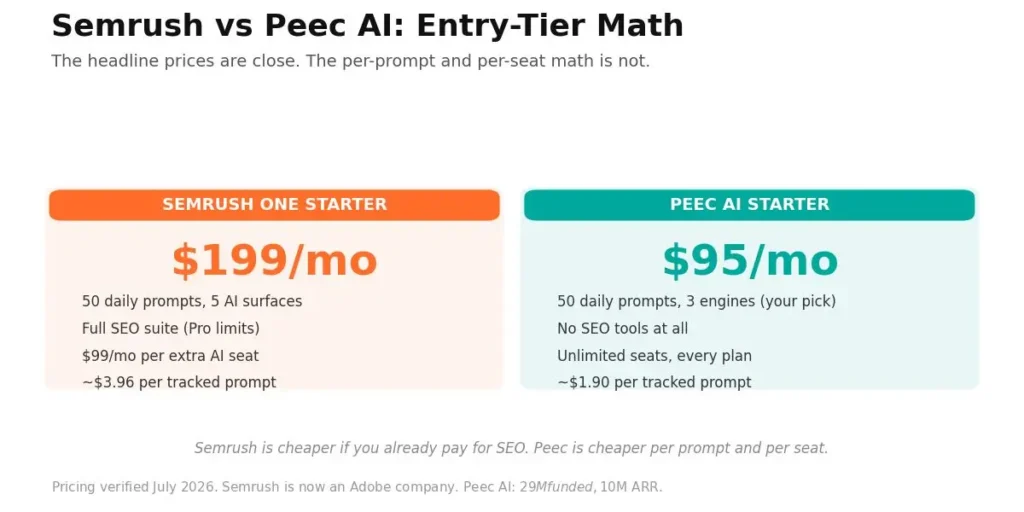
At the entry tier, Peec AI gives you twice as many prompts for $4 less, but Semrush bundles an entire SEO suite for $104 more. The headline prices are almost identical, and almost meaningless.
Semrush AI Visibility Toolkit, $99/month per domain. You get 1 domain for Brand Performance, 25 tracked prompts, 300 daily queries in AI Analysis, 1,000 daily queries in Prompt Research, AI Search Checks for up to 100 pages, and CSV export limits. No free trial.
Semrush One Starter, $199/month ($165.17 billed annually). Everything in the SEO Pro plan plus the AI Visibility Toolkit, 50 tracked prompts, 500 keywords, 140+ countries, and 17 languages. Buying Pro plus the toolkit separately costs $238.95, so the bundle saves roughly $40.
Semrush One Pro+, $299/month ($248.17 annually). SEO Guru limits: 100 tracked prompts, 1,500 keywords, historical data, multi-location tracking.
Semrush One Advanced, $549/month ($455.67 annually). SEO Business limits, 200 tracked prompts, 5,000 keywords, plus API and MCP access.
Peec AI Starter, $95/month. 50 prompts, 3 models of your choice, unlimited users, daily tracking, 1 project.
Peec AI Pro, $245/month. 150 prompts, 3 models, unlimited users, 2 projects.
Peec AI Advanced, $495/month. 350 prompts, 3 models, unlimited users, 5 projects, multi-country, Data Studio integration.
Peec AI Enterprise, custom. Unlimited projects, up to 11 models, API access, SSO.
Now the part nobody puts in the table. Semrush’s AI Visibility Toolkit charges $99 per additional user. Three people needing access means $297/month, not $99. Peec charges nothing for seats on any plan.
And Semrush’s per-prompt extension is $60/month for 50 more prompts. Peec’s equivalent move is upgrading a tier, which also buys you projects and countries.
Run the entry-level math, and it’s stark. Semrush’s toolkit works out to roughly $3.96 per tracked prompt per month. Peec Starter lands near $1.90. That’s a 2x difference before you add a single teammate.
But flip it. If you’d otherwise pay $139.95 for Semrush Pro anyway, Semrush One Starter costs you an incremental $59 for AI visibility. Peec costs a full $95 on top of that. Suddenly, Semrush looks cheap.
If you already pay for Semrush SEO → Semrush One is the obvious upgrade. For teams with a separate SEO stack, or more than two people needing dashboard access → Peec AI is the better choice.
What Does the Adobe Acquisition Mean for Semrush Buyers?
Adobe now owns Semrush, and no competing comparison article mentions it. The deal closed April 28, 2026, valued at roughly $1.9 billion in an all-cash transaction at $12.00 per share.
Why should a solo publisher in Ohio care about an enterprise software acquisition? Three practical reasons, and none of them are speculation. First, direction.
Adobe folded Semrush into its CX Enterprise stack alongside Adobe Experience Manager, Adobe LLM Optimizer, and Adobe Commerce. Semrush’s roadmap now serves enterprise brand visibility, and small-team features are unlikely to be the priority. Second, terminology.
Adobe’s framing introduced a three-way split: SEO, GEO, and Agentic Search Optimization. If your client decks still say “SEO” in 2027, you’ll be behind the vocabulary your buyers are using.
Third, and most useful, urgency. Adobe’s own data shows AI traffic to U.S. retail sites surged 1,324% between October 2024 and May 2026, with travel up 2,215% across the same window. That’s the number that justifies the line item.
Honestly, I expected this to be a footnote. It isn’t.
Acquisitions historically bring pricing reviews, and Semrush already has a documented habit of raising prices at renewal. Locking annual billing at today’s rate is a defensible move right now.
Peec has no such overhang. It’s independent, VC-funded, and shipping weekly. That’s a strength today and a risk later, because independent startups in hot categories get bought.
What Did Peec AI Ship in 2026 That Reviews Missed?
Peec AI shipped four significant products between May and July 2026, and every comparison article ranking for this query predates all of them. Check the dates yourself. Most were last updated between January and May.
Contrary to what most reviews say, Peec is no longer just a plain prompt tracker. Here’s what actually landed:
- Brand Insights went generally available May 20, 2026. Per-brand deep dives on visibility, sentiment, position, and share of voice, with a heat map and strongest/weakest model highlights.
- AI Shopping Analytics launched June 17, 2026. Connect a Shopify domain, a CSV file, or a Google Merchant Center feed, and get SKU-level visibility, win rate, position, and the price that ChatGPT quotes back to shoppers.
- The Chats table hit general availability on June 4, 2026, with filtering by brand and sorting by mention and source counts.
- Query Fanouts shipped July 6, 2026, as its own page, exposing the hidden search engines run before answering.
That same July release also fixed a URL citation rate that had been double-counting in some cases and corrected it retroactively across all historical data. Vendors rarely admit that publicly, and I’d rather see it than not. Crawl Insights deserves its own mention.
It tracks GPTBot and ClaudeBot through your server logs via WordPress, Cloudflare, Vercel, AWS CloudFront, Google Cloud, or Akamai. Semrush’s AI Search Site Audit checks whether your pages are readable. Peec checks whether the bots actually came.
If you buy today’s shipped features → Peec AI is moving faster. For a roadmap backed by a public company’s balance sheet → Semrush is the safer institutional bet.
Which Tool Fits Your Team Size and Workflow?
The deciding question is not budget. It’s whether anyone on your team will open the dashboard on a Tuesday for no particular reason. Semrush suits a marketing lead who translates data for other people. Monthly reporting cadence, competitor context, a clean story for leadership.
It rolls out easily because half your team already knows the interface. Peec suits a named owner. Somebody who reviews source changes weekly, spots a competitor breakout, and turns it into a content brief or an outreach email. Without that person, Peec is an expensive chart.
Solo publishers and small affiliate sites face a harder call. You probably need keyword research more than you need prompt-level sentiment, which would push you toward either Semrush One Starter or classic Pro. Agencies split by service model. Selling reports? Semrush.
Selling AI visibility as an active retainer? Peec, the unlimited seats alone will cover the difference once your third client lands. There’s evidence this integration question matters more than the tool choice.
Semrush found that among organizations that fully integrate SEO and AI visibility into a single workflow, 81% reported increased traffic or leads from AI platforms, compared with just 36% of teams running them separately.
Who Should Buy Neither Tool?
Plenty of sites should buy neither, and no comparison article will tell you that because both vendors run affiliate programs. So let me be the one to say it. If your site has fewer than 50 pages and no meaningful organic presence, both tools will show you zeros with excellent styling.
Peec is explicitly weaker for new brands, because it measures existing visibility rather than predicting future visibility.
Should you skip them if you’re pre-revenue? Probably. Semrush’s free <a href=”https://www.semrush.com/free-tools/ai-search-visibility-checker/” rel=”nofollow”>AI Visibility Checker</a> and manual prompt spot-checks will answer “does ChatGPT know I exist” for zero dollars.
Neither tool writes content. Neither fixes your schema. Neither builds the third-party citations that AI engines lean on. They diagnose, and diagnosis without capacity to act is just anxiety with a subscription fee. Here’s the insight most competing articles miss entirely.
Semrush’s Index found that in News and Media, the top three brands hold 82.9% of total category visibility, while in Finance, the top three hold 41.4%, and in Industrial, 42.2%. Category concentration decides your odds before your tool does.
So check your category first. If your industry’s top three own 80% of AI visibility, no dashboard changes that. If it’s fragmented at 40%, tracking will recoup its cost quickly.
Can You Use Semrush and Peec AI Together?
Yes, and for mid-market teams it’s often the right answer, though it means $294/month minimum. Semrush becomes the hub, Peec becomes the specialist layer.
The workflow that actually functions: Semrush’s Prompt Research to discover which prompts exist and carry demand, then those prompts loaded into Peec for daily tracking, stored chats, and URL-level gap analysis. Semrush’s Site Audit handles technical AI readiness.
Peec’s Crawl Insights confirms whether the bots showed up. One checks the door is unlocked, the other checks who walked through it. Content creation stays with Semrush, since Peec has none. Outreach targeting stays with Peec, since Semrush stops at the domain level.
For most solo operators and small teams, this stack is overkill. Pick one, use it properly for six months, and add the second only when the first stops answering your questions.
How Do They Handle Multi-Country and Language Tracking?
Semrush wins on breadth of locations, Peec wins on cost per country, and both will surprise you if you assume “unlimited” means what you think it means. Semrush One Starter advertises 140+ countries and 17 languages, and the broader platform offers granular location targeting inherited from its SEO side.
For a U.S. brand expanding into Canada and the UK, that’s more than enough. Peec charges nothing extra for countries or languages. Their pricing FAQ is explicit: cost is tied to prompts and models, not regions. On paper, that sounds unbeatable.
But read the tier limits. Starter gives you 1 country per project. Pro and Advanced give you 3. Enterprise unlocks unlimited. So “no extra cost for countries” is true, and “you can only track one on the entry plan” is true as well.
One thing that caught me off guard: Peec’s June 2026 release added country as a breakdown dimension in Brand Insights, meaning you can now slice any brand’s visibility by market rather than relying on a single blended number. Semrush handles this through separate report filters instead.
There’s also an honesty detail worth noting. When a country isn’t supported by a given model, Peec now says so in the chat view rather than silently falling back to another region. That fix shipped in May 2026, and it’s the kind of thing you only appreciate after a confusing report.
If you’re a U.S.-only brand → the country question is irrelevant, so decide on prompts and seats instead. For multi-market brands running three or fewer regions → Peec AI costs less. Beyond that, Semrush scales more predictably.
How Should You Test Both Before Committing?
Run both trials in the same week on the same 15 prompts, then compare what each tool tells you to do next. Most people test features. Test decisions instead.
Here’s the sequence I’d use:
- Write 15 non-branded prompts your buyers would actually type. Not “best Semrush alternative.” Something like “best AI visibility tracker for a small agency.” If your brand name appears in the prompt, delete it.
- Start the Peec AI trial first. Seven days, no credit card, and daily tracking begins immediately. Load all 15 prompts on day one so you collect a week of chats.
- Start the Semrush One trial in parallel. Seven days standard. Run the same 15 prompts through Prompt Tracking, then open Prompt Research and see whether Semrush suggests prompts you hadn’t considered.
- On day four, compare source data. Ask both tools the same question: where are competitors cited and I’m not? Note whether the answer is a domain or a URL you can open.
- On day six, try to build one report. Export from each. Semrush’s AI search data has no API endpoints yet, so check whether the export you need actually exists before you commit.
- On day seven, ask the real question. Which tool produced a task you could assign to somebody on Monday?
That last step decides it. And the answer is rarely about features. A word of caution on trials. The standalone Semrush AI Visibility Toolkit at $99 has no free trial at all, so if that’s the plan you’re eyeing, you’re testing Semrush One and buying something narrower. Budget accordingly.
Peec’s trial has a quieter limitation. Seven days of daily tracking gives you seven data points, which is enough to see visibility but not enough to see a trend. Judge the workflow, not the graph.
Final Verdict: Semrush vs Peec AI, Which Should You Choose?
Choose Semrush One if you’re budget-conscious about total tool spend and need SEO plus AI visibility together. At $199/month, it replaces two subscriptions, and if you were paying $139.95 for Pro anyway, AI visibility costs you $59 more. For solo publishers and small agencies, that math wins.
Choose Peec AI if AI search is already proven for you and someone owns it weekly. At $95/month, you get double the prompts, unlimited seats, URL-level source data, and a product that ships faster than anything else in the category. For content teams and GEO specialists, that’s the better dollar.
Choose the standalone Semrush AI Visibility Toolkit at $99 only if you have a separate SEO stack and a single domain. Add a second domain or a second teammate, and Peec becomes cheaper immediately.
Beginners should start with Semrush. The learning curve is real, but the free tools, the knowledge base, and the familiar interface lower the entry cost. Peec assumes you already know what a good prompt looks like.
Advanced practitioners should start with Peec AI. You’ll outgrow modeled estimates within a month, and you’ll want the stored chats to defend your own decisions.
Teams of one person: Semrush. Teams of three or more, where everyone needs access: Peec AI, purely on-seat economics.
My honest read after all of it? Semrush is the safer purchase, and Peec is the better product at what it does. Those aren’t the same thing, and which one matters depends entirely on whether you’re buying a tool or buying a report.
Frequently Asked Questions
For daily prompt tracking, URL-level citations, and gap analysis, yes. For market benchmarks, prompt research, and executive reporting, Semrush wins. Peec is the specialist. Semrush is the platform.
Peec AI Starter costs $95/month for 50 prompts, 3 models, and unlimited users. Pro is $245, Advanced is $495. Annual billing saves 15%. A 7-day free trial needs no credit card.
Yes. Semrush tracks ChatGPT, Gemini, Perplexity, SearchGPT, Google AI Mode, and AI Overviews, though coverage varies by report. Prompt Tracking is narrower than Brand Performance, so check which module you’re using.
Yes, but you’ll have no keyword research, backlink data, rank tracking, or content tools. Peec only measures AI visibility. Most teams pair it with an SEO platform rather than replacing one.
No. Adobe completed the acquisition on April 28, 2026, at $12.00 per share. Semrush is an Adobe company, and its roadmap now sits within Adobe’s CX Enterprise portfolio.
Peec AI, in most cases. Semrush charges $99/month per additional AI Visibility Toolkit user and $99 per extra domain. Peec includes unlimited seats on every paid plan.

Is an SEO Specialist and AI Tools Researcher with over 4 years of hands-on experience in search engine optimization. As the founder of Smart AI Helper Pro, he tests and reviews AI writing, SEO, and marketing tools to help creators and business owners grow faster with practical, research-backed strategies.