Which Type of Company Is Semrush Best For? (2026 Breakdown by Business Type)
By SM Mehedi Hasan

Semrush is best for marketing agencies, ecommerce brands, SaaS and B2B companies, and in-house marketing teams that treat organic search as a real revenue channel. Priced from $139.95/month with more than 55 tools, it pays off fastest when SEO, content, and paid search run together, not for solo bloggers on tight budgets.
So before you put $140 to $500 a month on a card, the real question is not “is Semrush good.” Is Semrush good for a company like mine? Those are very different questions, and most reviews blur them together.
This breakdown answers it by company type, with current 2026 pricing, the new Adobe ownership factor, and a clear map of who gets the most value and who quietly overpays.
Table Of Contents
ToggleWhat type of company is Semrush best for?
Semrush is best for companies where search visibility directly drives leads or sales, and where more than one person works on marketing.
That covers agencies, e-commerce stores, SaaS and B2B firms, content publishers, and mid-size in-house teams. The common thread is simple: enough search-driven revenue to justify a premium, all-in-one platform. Most people assume Semrush is “an SEO tool,” so they judge it like one.
But it is closer to a full marketing intelligence platform now, with SEO, content, PPC, social, local listings, PR through Prowly, and a newer AI visibility layer that tracks how brands show up inside ChatGPT, Gemini, and Google AI Overviews.
The more of those channels you actually run, the cheaper Semrush feels per dollar.
Here is the quick fit map before we go deep on each one:
| Company type | Fit for Semrush | Why it works (or doesn’t) |
|---|---|---|
| Marketing agency | Excellent | Multi-client management, white-label reports, lead tools |
| Ecommerce brand | Strong | Product keyword research, competitor and ad tracking |
| SaaS / B2B | Strong | Content depth, intent data, AI visibility tracking |
| In-house mid-size team | Strong | One platform replaces three or four point tools |
| Content publisher / blog network | Good | Keyword scale and content scoring, watch the cost |
| Local business | Mixed | Local toolkit is solid, but cheaper options exist |
| Solo blogger / startup on a budget | Weak | Powerful, but most features go unused at this stage |
Is Semrush good for small businesses and startups?

Semrush works for small businesses, but only the ones serious enough about marketing to use most of what they pay for.
For a five-person company already publishing content and running Google Ads, Semrush Pro at $139.95/month earns its place fast. For a brand-new startup still finding its first 100 customers, it is usually too many tools, too soon.
If you are a small business, this matters because the price is not really the problem. The wasted capacity is. Pro gives you 5 projects and tracking for up to 500 keywords, plus site audits and competitor research.
A tiny site touches maybe a fifth of that. You end up paying premium rates for a dashboard you barely fill.
Honestly, I expected the entry plan to feel “starter friendly,” and it does not. The learning curve is real.
There are dozens of reports, and a small business owner without an SEO background can spend a week just figuring out which numbers to trust.
Pro tip: Before committing, run the 7-day free trial with one focused goal, such as “find 20 keywords my competitor ranks for that I don’t.”
If you cannot get value from that single task in a week, a cheaper tool like Mangools or SE Ranking will likely serve you better right now.
That said, growing small businesses with a budget over roughly $250/month and a content plan often find Semrush Guru is the cleaner long-term choice, because the Content Marketing Toolkit and historical data start to pull their weight.
Is Semrush worth it for freelancers and solo SEOs?
Semrush is worth it for freelancers who bill clients for SEO or content work, since the tool pays for itself with even one retained client.
For a freelancer doing SEO purely on their own small site, the math gets harder, and lighter tools cover the basics for a third of the cost.
When I was juggling a few client sites at once, the single thing that justified Semrush was the speed of competitive research.
Pull a competitor URL, see their top pages, their keyword gaps, and their backlink sources, all in a few minutes. That is billable insight you can hand a client the same day.
But here is the honest catch. Semrush Pro includes only one user seat. So a freelancer who later brings on a partner or VA has to jump to Guru, which adds seats and cost. Plan for that step early if you expect to grow.
Compared to the freelancer tools I have tried before, Semrush wins on depth and loses on simplicity.
If your clients pay for “show me proof and a plan,” Semrush gives you both. If you just need quick keyword ideas, you are overbuying.
Why do marketing agencies rely on Semrush?
Agencies rely on Semrush because it manages many clients in one place and turns raw data into reports that clients actually understand.
The Guru and Business plans add multi-seat access, white-label reporting, and the Agency Growth Kit, which is built specifically for client acquisition and retention.
For agencies, the value stack looks like this:
- Multi-client projects. Run separate dashboards for each client without logging in and out of different tools.
- White-label and branded reports. Hand clients clean, logo-stamped reports instead of screenshots, which protects your perceived value.
- Agency Growth Kit and Agency Partners. Generate leads, earn a Semrush agency certification, and automate client reporting, usually as an add-on, for around $90 to $100/month.
- Share of Voice and Competitive Intelligence. Show clients exactly where they sit against rivals, which is the kind of story that renews contracts.
Unlike what most reviews say, the Business plan is not just “Guru with bigger numbers.” It unlocks API access, which is what lets larger agencies pipe Semrush data into their own dashboards and client portals.
For a shop running 20 or more accounts, that automation alone can save a part-time salary.
One more thing worth flagging: Semrush MCP access recently opened up to regular paid users, not just enterprise accounts.
That means an agency can now connect Semrush data straight into AI assistants like Claude or ChatGPT and pull keyword, competitor, and backlink insights through a chat interface, using the included API credits.
How do e-commerce companies use Semrush?
E-commerce companies use Semrush mainly for product and category keyword research, competitor and ad spying, and tracking visibility across thousands of product pages.
It fits online stores well because purchase-intent keywords and competitor pricing pages are exactly the data Semrush is built to surface.
If you sell products online, this matters because organic and paid search are often your two biggest revenue channels, and Semrush covers both.
You can see which keywords push traffic to a competitor’s bestselling product, then build pages to compete for the same buyers.
Semrush also ships an Ecommerce Booster tool and ad research features, so you can study a rival’s Google Shopping and PPC strategy instead of guessing.
For a store spending real money on ads, that intelligence often returns more than the subscription costs. This works well, except when your store is tiny and brand-new.
The traffic estimates and competitive data are most accurate for sites with meaningful volume, so a store with a handful of products and little history will see thinner, less reliable numbers.
Is Semrush best for SaaS and B2B companies?
Semrush is one of the best fits for SaaS and B2B companies, because those businesses live or die on content, organic visibility, and now AI search presence.
Long buying cycles reward exactly the kind of topical depth and keyword intelligence Semrush specializes in.
After leaning on it for content-heavy B2B work, the feature that earned its keep was the Keyword Magic Tool paired with intent filtering.
You can separate “ready to buy” searches from “just researching” searches, then build content for each stage of a long B2B funnel.
The newer angle is AI visibility, and this is where SaaS and B2B pull ahead. More software buyers now start with ChatGPT, Gemini, or Google AI Overviews.
Semrush One bundles an AI Visibility Toolkit that tracks how often your brand gets mentioned and cited in those answers, updated daily against the prompts you choose to monitor.
For a category where being “the recommended tool” inside an AI answer can win a deal, that tracking is genuinely useful. What I did not expect was how much B2B teams use the PR side.
Semrush owns Prowly, a PR and media outreach platform, which lets B2B brands pitch journalists and earn the authority links that move the needle in competitive niches.
Can local businesses benefit from Semrush?
Local businesses can benefit from Semrush, but only the ones investing seriously in local search, and even then, the value depends on the add-ons.
The Listing Management tool distributes your name, address, and phone data to major directories and tracks reviews, starting around $20 per location per month on top of your base plan.
Most people assume “local business equals cheap tool,” and for a single-location shop, that is often true.
A solo plumber or one café rarely needs a full Semrush subscription when free tools like Google Business Profile and a $30 rank tracker cover the basics.
Where Semrush starts to make sense is for a multi-location local brand, such as a dental group with eight offices or a regional restaurant chain.
Managing consistent listings, monitoring map-pack rankings, and handling reviews across all locations from one dashboard saves real hours.
If you run a local agency serving these businesses, the calculation flips entirely. Then, Semrush is not an expense for one storefront; it is the engine you use to service many local clients at once.
Why do enterprises and Fortune 500 brands choose Semrush?
Enterprises choose Semrush for its data scale, API access, custom limits, and the ability to govern many brands and markets from one platform.
Semrush serves users from scaling startups through Fortune 500 companies, and the Business and Enterprise tiers are where large organizations actually operate. For an enterprise, this matters because the bottleneck is rarely a feature. It is scale and integration.
Large teams need high report limits, multiple seats, white-label client or stakeholder reporting, and API access to feed internal business intelligence systems. Custom Enterprise plans add tailored data limits and dedicated support on top of that.
The bigger 2026 story is ownership. Adobe completed its acquisition of Semrush on April 28, 2026, in a deal valued at roughly $1.9 billion, and Semrush now operates as a wholly owned subsidiary of Adobe.
For enterprises already inside the Adobe ecosystem, this points toward deeper future integration with tools like Adobe Experience Manager, Adobe Commerce, and Adobe Experience Platform.
So if you are an enterprise weighing a multi-year commitment, the Adobe factor is a genuine plus, since it signals long-term investment and tighter integration with a major customer experience stack. A scrappy startup, by contrast, may care very little about that roadmap today.
What about content publishers and bloggers?
Content publishers get strong value from Semrush at scale, while individual bloggers usually do not.
Publishers running hundreds of articles use the keyword research, topic research, and content scoring tools to plan and grade content at volume, which is exactly what the Guru plan’s Content Marketing Toolkit is designed for.
When I tested the content workflow on a multi-author site, the SEO Writing Assistant was the standout.
It scores drafts on readability, SEO, originality, and tone against the top-ranking pages for your target keyword, which gives a freelance writing team a shared target instead of guesswork.
The thing that surprised me most was how quickly the value drops for a one-person blog. A solo blogger publishing a few posts a month simply does not generate enough volume to justify Guru-level pricing.
The same keyword research can come from cheaper tools without the unused content suite sitting idle.
So the dividing line is not “publisher versus blogger,” it is the scale of output. If you are coordinating writers and tracking a large content library, Semrush earns it. If you are writing solo, it usually does not.
Which Semrush plan fits which company type?
The right Semrush plan depends on team size, number of projects, and which channels you run.
Pro suits freelancers and small teams, Guru fits growing businesses and small agencies, Business serves larger agencies and enterprises, and the Semrush One bundles add AI visibility tracking for brands focused on search across AI platforms.
Here is the 2026 mapping, with monthly list pricing:
| Plan | Monthly price | Best-fit company type |
|---|---|---|
| Pro | $139.95 | Freelancers, startups, small teams |
| Guru | $249.95 | Growing businesses, small agencies |
| Business | $499.95 | Larger agencies, enterprises |
| Enterprise | Custom | Large multi-brand organizations |
And the AI-focused track, which Semrush introduced in late 2025:
| Semrush One tier | Monthly price | Best-fit company type |
|---|---|---|
| Starter | $199 | Freelancers and startups adding AI visibility |
| Pro+ | $299 | Growing businesses and small agencies |
| Advanced | $549 | Larger agencies and enterprises |
Annual billing cuts roughly 17% off these prices across the board, which works out to about two months free. Pro then drops to about $117.33/month, Guru to $208.33, and Business to $416.66.
A smarter way to decide: Pick the plan by the features you will actually use, not the seat count.
Companies routinely overpay for Business when Guru covered them, and underpay for Pro when they really needed Guru’s content tools. Map your channels first, then match the tier.
What type of company should NOT use Semrush?
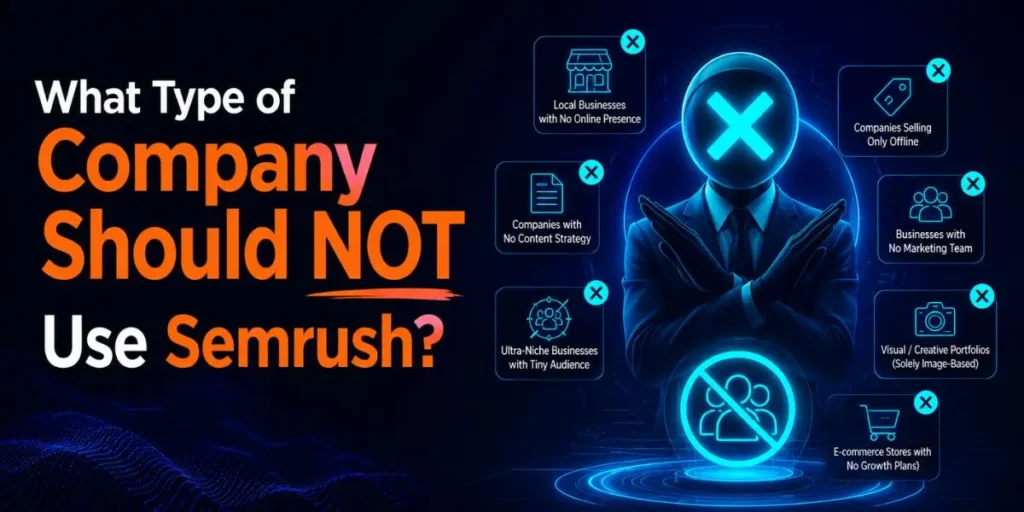
Semrush is the wrong fit for solo bloggers, pre-revenue startups, and single-location local shops with tight budgets.
For these companies, most of the platform goes unused, and the $139.95/month entry price buys capabilities they will not touch for months or years.
Compared to the cheaper tools I have used before, the gap is mostly about right-sizing, not quality.
Mangools starts near $29/month, and SE Ranking starts near $65/month, and both handle core keyword research, rank tracking, and basic audits. For a one-person operation, that is often all the tooling needed.
You should also skip Semrush if your marketing barely touches search.
A business that grows almost entirely through referrals, retail shelves, or paid social with little SEO focus will find Semrush’s strengths mostly irrelevant to how it actually wins customers.
And if the budget is genuinely tight, forcing a premium SEO platform into the plan is a mistake.
Free options like Google Search Console and Google Keyword Planner cover the absolute basics, and you can upgrade to Semrush later when search becomes a real revenue lever.
In My Experience
Honestly, when I first matched Semrush against the size of a client, I assumed a bigger company always meant “go straight to Business.” That turned out to be wrong more than once.
A 12-person SaaS firm I worked with was sized like a Business-plan buyer on paper, but they only ran SEO and content, no PPC, no agency reporting.
Guru covered everything they needed, and the seat limit was never a problem because only two people logged in.
The detail that stuck with me was how much the workflow mattered over the headcount. We almost paid an extra $250 a month for API access and white-label reports the team would never open.
Once we mapped their real channels against the feature gates instead of the employee count, the cheaper tier was obviously correct.
That single habit, choosing by feature use rather than company size, has saved clients more money than any discount code.
Common mistakes companies make when choosing Semrush
Most companies pick the wrong Semrush plan because they shop by price or headcount instead of by the features they will actually use. These mistakes are common, and each one is avoidable once you know why it happens.
- Choosing a tier by employee count, not feature use. Companies see “Business supports five seats” and buy it, when only two people will log in. Map your real channels first, then match the plan.
- Buying Semrush before you have content or traffic. A brand-new site has too little data for the competitive and traffic tools to shine, so early adopters feel underwhelmed. Wait until you have something to analyze.
- Ignoring the add-on costs. Local Listing Management, the Agency Growth Kit, and extra seats stack on top of the base price. The sticker price is rarely the final bill, so budget for the extras you actually need.
- Treating Semrush as “just an SEO tool.” Companies pay for the full platform, then use only keyword research.
If you are not touching content, PPC, social, or AI visibility, a cheaper single-purpose tool may fit better.
- Skipping the free trial and onboarding. The learning curve is steep, and teams that never invest a few hours upfront abandon expensive features. Use the trial with a specific goal before you commit a card.
Each of these traces back to the same root cause, which is matching the tool to a label (“we are an agency,” “we are enterprise”) instead of to the work. Fix the matching, and the value problem usually fixes itself.
A real workflow example: matching Semrush to a company
The clearest way to see who Semrush fits is to walk one decision end-to-end. Here is how the fit check actually plays out for a typical mid-size company.
Input: A 15-person ecommerce brand in the US selling home fitness gear. They run SEO and Google Ads, publish two blog posts a week, and have one marketer plus a part-time agency. The budget is around $300/month for tools.
Process: Start by listing the channels they truly use: organic SEO, paid search, content, and some competitor monitoring. No multi-client reporting, no API needs. That rules out Business.
Pro is tempting on price, but its single-seat and lighter content tools do not fit a team where the marketer and the agency both need access and a real content workflow.
Output: Semrush Guru at $249.95/month, or about $208.33 on annual billing. It gives multiple seats, the Content Marketing Toolkit for their blog cadence, historical data for seasonal fitness trends, and enough project room for their store, plus key competitors.
The leftover budget covers the trial period for AI visibility tracking if they want to test it.
Result: The brand pays for the tier that maps to its actual work, not its headcount.
Within the first month, they use competitor keyword gaps to plan content, track product-page rankings, and study a rival’s ad copy, all inside one platform. The agency pulls reports from the same account, so nobody pays for duplicate tools.
That is the whole logic in one example. The same method works for any company: list the channels, match the feature gates, and ignore the label.
How does the Adobe acquisition change who Semrush is for?
The Adobe acquisition signals deeper enterprise integration and a stronger AI search focus, which mostly benefits larger brands while leaving everyday users on the same plans for now.
Adobe completed the roughly $1.9 billion purchase on April 28, 2026, and Semrush now sits inside Adobe’s customer experience platform. For everyday users, this matters less than the headlines suggest in the short term.
Semrush has said its plans, support, and roadmap continue, so a freelancer or small business on Pro or Guru should not expect sudden changes to their day-to-day tools. For enterprises, the shift is more meaningful.
Adobe is positioning Semrush’s SEO, generative engine optimization, and agentic search optimization data alongside products like Adobe Experience Manager, Adobe Commerce, and the Adobe Experience Platform.
Companies already standardized on Adobe gain a clearer path to one connected stack for content, commerce, and brand visibility. The trend behind the deal is the real signal.
Adobe pointed to AI traffic to US retail sites rising 269% year over year as of March 2026, and the whole acquisition is built around brands staying visible as buyers shift from traditional search to AI answers.
So the company types that will benefit most going forward are exactly the ones investing in AI visibility today: SaaS, ecommerce, B2B, and enterprise brands.
Final practical tip: If AI search visibility is part of your 2026 plan, test Semrush One rather than the classic SEO plans.
It bundles the AI Visibility Toolkit, and given Adobe’s direction, that is the part of the platform most likely to keep gaining investment.
Frequently Asked Questions
Both work well. Agencies benefit most from multi-client management, white-label reports, and the Agency Growth Kit, while in-house teams value having SEO, content, and PPC in one platform instead of several separate tools.
Semrush serves everyone from freelancers to Fortune 500 brands, but the strongest fit is small-to-mid and larger companies that run multiple marketing channels. Very small or pre-revenue businesses often overpay for unused features.
Yes, especially established stores. It handles product keyword research, competitor and ad tracking, and visibility across many product pages. Brand-new stores with little traffic will see thinner, less reliable competitive data.
They can, but it is rarely the best value early on. Cheaper tools like Mangools or SE Ranking cover core needs for a fraction of the cost until search becomes a serious revenue channel.
Not for everyday users yet. Adobe completed the acquisition in April 2026, and Semrush says its plans and support continue. The main changes point toward deeper Adobe integration and AI search features over time.

Is an SEO Specialist and AI Tools Researcher with over 4 years of hands-on experience in search engine optimization. As the founder of Smart AI Helper Pro, he tests and reviews AI writing, SEO, and marketing tools to help creators and business owners grow faster with practical, research-backed strategies.