
Does Ahrefs Get Its Backlinks from Majestic? (How It Works)
By SM Mehedi Hasan
No, Ahrefs does not get its backlinks from Majestic. Ahrefs runs its own crawler, AhrefsBot, to build an independent link index, while Majestic uses its own separate crawler, MJ12bot.
They are competing SEO tools with completely separate databases, which is exactly why their backlink counts for the same site often differ.
Table Of Contents
ToggleAhrefs vs Majestic: Where Does the Data Actually Come From?
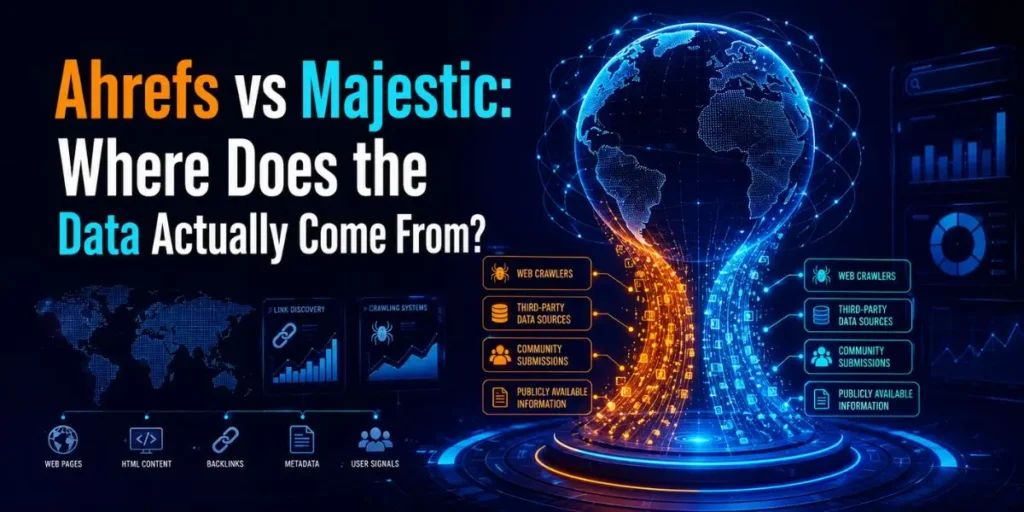
Here is a side-by-side look at how each tool sources its link data. This is the part that makes the “shared data” myth fall apart.
| Factor | Ahrefs | Majestic |
|---|---|---|
| Own crawler | AhrefsBot (since 2013) | MJ12bot (since 2004) |
| Crawl model | Centralized, very high volume | Distributed network |
| Backlink metric | Domain Rating (DR), URL Rating (UR) | Trust Flow (TF), Citation Flow (CF) |
| Data source | Own crawl, no Majestic feed | Own crawl, no Ahrefs feed |
Notice the last row. Each tool builds from its own crawl, full stop. There is no arrow pointing from Majestic into Ahrefs, in either direction.
The metrics also tell the story. If Ahrefs simply repackaged Majestic’s data, both would use the same link-quality score.
Instead, Ahrefs invented DR and UR, while Majestic invented TF and CF years earlier. Two separate teams are solving the same problem in two different ways.
Does Ahrefs Get Its Backlinks from Majestic?
No. Ahrefs does not get its backlinks from Majestic, and the two tools share no data. This is one of those questions that sounds reasonable until you look at how each company actually collects link data.
Both are link databases, both report backlinks, so people assume one borrows from the other.
But they are direct competitors. Sharing raw backlink data would mean handing your rival the one thing that makes your product valuable. Neither company does that.
Here is the short version of how it really works:
- Ahrefs collects link data using its own web crawler called AhrefsBot.
- Majestic collects link data using its own web crawler called MJ12bot.
- The two indexes are built, stored, and updated separately.
- Any difference in their reported numbers comes from the fact that they crawl the web independently.
So if you have ever seen Ahrefs and Majestic report wildly different backlink totals for the same domain, that gap is the proof. Two shared databases would return matching numbers. Two independent crawlers almost never do.
How Does Ahrefs Build Its Backlink Index?
Ahrefs builds its backlink index by crawling the public web with its own bot and storing every link it finds in a proprietary database. There is no third-party link feed involved in the core process.
Here is the flow, step by step:
- AhrefsBot crawls a page. The bot requests a URL the same way a browser would, then downloads the page content while respecting the site’s robots.txt rules. Why it matters: This is the entry point for every link Ahrefs ever shows you.
- The parser extracts the data. From that raw page, Ahrefs extracts links, anchor text, page titles, and other metadata. What you should notice: anchor text and link context come straight from this step, not from any outside source.
- The indexer stores it. The extracted links get added to the Ahrefs Link Index and become visible inside reports like Site Explorer. The result: when you open a backlink profile, you are reading AhrefsBot’s own findings.
- The cycle repeats and refreshes. Ahrefs keeps feeding new URLs into the crawler and updates its index frequently, so the data stays current. What you see after: live links plus links deleted within roughly the last 60 days.
AhrefsBot has been crawling around the clock since 2013, and it is one of the most active crawlers on the entire web. It processes millions of pages per minute, which keeps Ahrefs’ link index large and fresh.
There is a nuance most people skip. Backlink data is only one of Ahrefs’ data sources. Its keyword and traffic estimates also use clickstream data from anonymized browsing panels and Google Keyword Planner as a baseline. But for backlinks specifically, AhrefsBot is the engine. Not Majestic.
Pro tip: If a link is missing in Ahrefs but you know it exists, check whether the linking site blocks AhrefsBot in its robots.txt file. Sites like LinkedIn and Quora restrict crawling, so their links often will not appear, and that has nothing to do with the link being fake.
How Does Majestic Build Its Backlink Index?
Majestic builds its backlink index using MJ12bot, a distributed web crawler it has operated since 2004. That makes Majestic seven years older than Ahrefs as a link tool, and its whole product is built around backlinks alone.
The approach is similar in concept but separate in practice:
- MJ12bot crawls and maps links. Unlike crawlers that cache full-page content, MJ12bot focuses almost entirely on mapping link relationships between sites.
- It runs as a distributed network. The bot does not crawl from one fixed set of IP addresses. It operates from many locations, which is part of why it is so widely seen in server logs.
- The data is split into two indexes. Majestic keeps a Fresh Index for recent crawl data and a Historic Index that stretches back years.
The Historic Index holds trillions of crawled URLs, which is its biggest selling point. - Proprietary metrics get calculated. Trust Flow, Citation Flow, and Topical Trust Flow are all derived from MJ12bot’s crawl data, not from anyone else’s.
One detail worth knowing: MJ12bot will follow nofollow links too, since they still represent a navigational path on the web. That is one reason Majestic’s raw counts can be higher than those reported by other tools.
So both companies do the same job, crawl the web and store links, but they do it with separate bots, separate infrastructure, and separate philosophies about what to count.
Why Do People Think Ahrefs Uses Majestic's Data?

People assume Ahrefs uses Majestic’s data because both tools do nearly the same job and report on the same web. When two products look this similar from the outside, it is natural to guess that one feeds the other.
A few specific things fuel the confusion:
- Similar output. Both show referring domains, anchor text, and a link-quality score. The reports look like cousins.
- Overlapping links. Since both crawl the same internet, a big chunk of the links they find are identical. That overlap reads like shared data when it is really shared reality.
- Industry shorthand. SEOs often say “check it in Ahrefs or Majestic” in the same breath, blurring the line between the two distinct companies.
Now, the non-obvious part that most comparison articles miss entirely. The differences between the two tools are actually the strongest evidence that they do not share data.
In one real test, Majestic reported over 17.7 million backlinks for a site while Ahrefs found roughly 8.5 million for the same domain. If they pulled from one shared well, those numbers would match.
They do not, because each bot crawls a different slice of the web at different speeds and counts links according to different rules. So the gap is not a flaw. It is the fingerprint of two independent systems.
In My Experience
Honestly, when I first started cross-checking the same client domain in both tools, the difference threw me off. I assumed one of them was broken. It was not.
Each tool had simply found links that the other had not yet crawled, and Majestic was holding older historic links that Ahrefs had already aged out of its live view.
What I noticed over repeated audits is that neither tool is “right.” Ahrefs tends to feel fresher for active link-building campaigns because it refreshes so often.
Majestic tends to surface more historical and obscure links, which is useful when auditing a domain’s full link history before buying it.
The one frustration I keep running into is reconciliation. There is no clean way to merge the two datasets without manual deduplication, since they label and count links differently.
If you expect the numbers to line up, you will waste an afternoon. They never will, and now I know why.
Common Pitfalls When Comparing Ahrefs and Majestic Data
Beginners run into the same mistakes when they assume the two tools should agree. Here are the ones I see most often, and how to avoid them.
- Treating one tool’s count as the truth. Neither number is absolute. Both are samples of a web that no crawler can fully capture. Use them as directional signals, not as a final headcount.
- Comparing DR to TF directly. Domain Rating and Trust Flow are built on different formulas, so a DR 50 is not the same as a TF 50. Compare each metric only against itself across sites.
- Panicking over a “missing” link. A link absent from one tool is usually just uncrawled or blocked by robots.txt, not removed. Check the other tool before assuming it disappeared.
- Ignoring nofollow handling. Majestic follows nofollow links, which can inflate its totals when compared to a tool that filters them out. Know what you are counting before you compare.
The root cause of all four is the same belief: that two linked tools should return a single shared answer. Once you accept that they crawl independently, the “errors” stop looking like errors.
Workflow Example: Checking the Same Site in Both Tools
Here is a realistic workflow for verifying a domain’s backlinks without falling for data gaps.
Input: One target domain you want to audit, plus active access to both Ahrefs and Majestic.
Process:
- Pull the referring domains report in Ahrefs and export it.
- Pull the same report in Majestic, using the Historic Index for the fullest picture.
- Line up referring domains, not raw link counts, since domains are more stable across tools.
- Flag the domains that appear in only one tool for manual review.
Output: A merged list of referring domains, with a column noting which tool found each one.
Result: A far more complete link profile than either tool gives alone, plus a clear view of where each crawler’s blind spots are. You stop trusting a single number and start trusting the pattern as a whole.
One more tip: When the two tools disagree hard on a specific link, open the live linking page yourself. The page is the source of truth. The crawlers are just messengers, and one of them is usually a step behind.
Frequently Asked Questions
No. Ahrefs does not buy or license Majestic backlink data. It builds its index entirely from its own crawler, AhrefsBot, and never relies on a competitor’s link feed.
Because each uses its own crawler and counting rules. They crawl different parts of the web at different speeds, so their totals for the same domain rarely match.
It varies by site. Majestic’s Historic Index often shows more total links, while Ahrefs frequently shows fresher live links. Neither is universally larger.
No. AhrefsBot belongs to Ahrefs, and MJ12bot belongs to Majestic. They are separate crawlers from separate companies feeding separate databases.
You can, but you will miss links. For a full audit, cross-checking both gives a more complete profile, since each crawler finds links the other misses.

Is an SEO Specialist and AI Tools Researcher with over 4 years of hands-on experience in search engine optimization. As the founder of Smart AI Helper Pro, he tests and reviews AI writing, SEO, and marketing tools to help creators and business owners grow faster with practical, research-backed strategies.