Will AI Replace Data Scientists? Honest 2026 Career Outlook
By SM Mehedi Hasan
AI will not replace data scientists in 2026, but it is already replacing the ones who refuse to use it. The U.S. Bureau of Labor Statistics projects 34% job growth through 2034, the 4th-fastest of any occupation, even as AI absorbs routine model-building work.
Let me be honest about why you are even reading this. Every few weeks, a new demo goes viral where an AI agent cleans a dataset, trains a model, and spits out a report in under two minutes, and the comments fill up with “data science is dead.”
So the question of whether AI will replace data scientists feels less like a debate and more like a countdown. Here is the part those demos never show you.
The same week one of those clips hit a million views, a senior data scientist quietly pointed out that the AI had picked the wrong evaluation metric and would have shipped a biased model straight into production. Fast is easy. Correct is the whole job.
This guide walks through what AI genuinely does to the role in 2026, what the latest verified numbers say, where the real risk sits (it is not where most articles claim), and exactly how to stay on the right side of the shift.
Table Of Contents
ToggleWill AI replace data scientists in 2026?
No, AI will not replace data scientists in 2026, and the labor data is not subtle about it. The BLS projects data scientist employment to grow 34% between 2024 and 2034, expanding from roughly 245,900 jobs to 328,300, making it the fourth-fastest-growing occupation in the entire U.S. economy, compared with a 3% average across all jobs.
That growth number already assumes heavy AI automation. The BLS did not forecast this in a vacuum; it baked in the reality that tools now write code and tune models, and it still landed on “much faster than average.” You can read the full projection on the BLS Occupational Outlook Handbook.
But a growing field is not the same as a safe seat. What is actually happening is a split. The mechanical layer of the job is being automated hard, while the judgment layer is becoming more valuable and scarcer. Which side of that line your daily work sits on decides everything.
Why does everyone suddenly think AI will replace data scientists?
The panic is real because the capability jump is real, not because the headlines are accurate. When people saw generative tools write working Python, explain a p-value in plain English, and build a dashboard from one sentence, the mental leap to “the whole job is gone” happened in seconds.
Most people assume the fear began with a single product launch. It actually built up in layers. First came code assistants like GitHub Copilot. Then came AutoML platforms such as Google AutoML, H2O.ai, and DataRobot.
By 2026, agent-style tools that chain those steps together made the demos look like a full replacement even when they were not. And honestly, the media loop made it worse.
A headline screaming that a role is finished pulls far more clicks than a careful piece explaining that a role is changing. Fear compounds. The nuance gets buried on page two where nobody scrolls.
Pro Tip: Separate a viral capability demo from a production reality before you panic. A tool that builds a model in a clean, staged demo is not the same tool that survives messy real data, shifting business goals, and a compliance review. The gap between those two is exactly where your salary lives.
What can AI actually do in a data scientist’s job right now?
AI in 2026 genuinely automates the repetitive, well-defined parts of the data science workflow, and pretending otherwise would be dishonest. These are not future promises; they are things happening on real teams today:
- Data cleaning and preprocessing:
detecting missing values, flagging outliers, imputing sensibly, and standardizing formats that used to eat half a day now take minutes. - Exploratory data analysis:
summary statistics, correlation heatmaps, and distribution plots get generated from a single prompt or an auto-profiling pass. - AutoML and model selection:
platforms test dozens of algorithms, tune hyperparameters, and return a deployment-ready model without a human babysitting the grid search. - Code generation:
functional Python, SQL, and R from a plain English description, which speeds up scripting and pipeline scaffolding dramatically. - Standard reporting:
recurring KPI summaries and dashboards can be partly or fully automated, so fewer simple requests land on your desk.
So yes, a real chunk of the traditional junior workflow is now a one-prompt task. That is the uncomfortable truth every honest outlook has to start with. The mistake is stopping there, because task automation and role replacement are two very different things.
What can’t AI do that still needs a human data scientist?
AI cannot decide which problem is worth solving, and that single gap protects the core of the role. Everything AI automates sits downstream of a human deciding what to build and whether the result can be trusted. Here is where machines still fall short in 2026:
- Framing the right question:
AI is excellent at answering questions and poor at formulating them. Deciding to model why customers churn, not just whether they will, is a strategic human act. - Business and domain judgment:
no model knows your pricing just changed, that a new regulation limits data collection, or that the CFO only funds projects framed a specific way. - Causal reasoning and experiment design:
computing a p-value is trivial. Knowing whether the experiment controlled for confounders, and whether the result actually means anything, is not. - Judging when a model is really good:
95% accuracy sounds great until you notice a constant classifier would hit 94% on that class imbalance. Catching that takes the skepticism AI lacks. - Stakeholder trust and communication:
explaining a counterintuitive result to a skeptical VP and getting the org to act on it is diplomacy, not computation. - Ethics, bias, and accountability:
deciding whether a feature introduces proxy discrimination, and owning that decision when a regulator asks, stays firmly human.
Think of AI as a fast, tireless junior analyst. It crunches, plots, and drafts code at superhuman speed. But it needs a skilled human to point it at the right problem, validate what comes back, and take responsibility for the call. That supervising role is the job now.
Which data science tasks are most and least at risk in 2026?
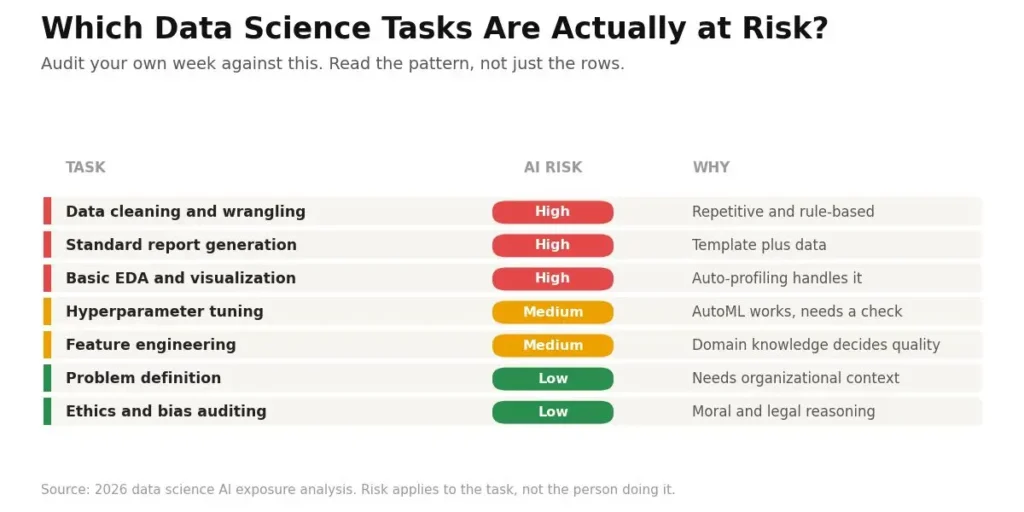
The tasks most at risk are repetitive and rule-based, while the tasks safest from AI require judgment, context, or accountability. The table below maps where the real exposure sits so you can audit your own week against it.
| Task | Automation risk | Why |
|---|---|---|
| Data cleaning and wrangling | High | Repetitive and rule based |
| Standard report generation | High | Template plus data equals automatable |
| Basic EDA and visualization | High | Auto profiling handles it well |
| Hyperparameter tuning | Medium | AutoML works but needs a human check |
| SQL query writing | Medium | AI drafts, human validates logic |
| Feature engineering | Medium | Domain knowledge still decides quality |
| Model architecture design | Low | Requires deep trade off understanding |
| Problem definition | Low | Needs organizational context |
| Stakeholder communication | Low | Human trust and judgment essential |
| Ethics and bias auditing | Low | Requires moral and legal reasoning |
Read the pattern, not just the rows. If your week is mostly the top three, AI is a genuine threat to your current workflow, and you need to move up the stack. If your week is mostly the bottom four, AI is a power tool that makes you faster.
Which role faces the most AI risk: data scientist, analyst, or ML engineer?
Data analysts face the most direct automation pressure, ML and AI engineers the least, and data scientists sit in between, which is why lumping these roles together confuses the whole conversation. Most articles blur them, so people read a data analyst warning and panic about a data scientist career, or the reverse.
| Role | AI exposure | Why |
|---|---|---|
| Data analyst | Higher | Work leans toward reporting, dashboards, and standard queries that tools now generate directly |
| Data scientist | Moderate | Routine modeling is automated, but problem framing, validation, and judgment stay human |
| ML / AI engineer | Lower | Building and running the AI systems themselves is the fastest growing, hardest to automate work |
This is also why the smartest career move in 2026 is often a lateral shift toward the systems side. LinkedIn’s 2025 data flagged AI Engineer as the fastest-growing job of the year, and many companies are filling those roles by drawing on their existing data science teams.
It is not a pivot away from data science; it is a step up the same ladder into the part AI cannot replace.
What does the latest data actually say about data science jobs?
The most recent government data point strongly points toward expansion, not collapse, but many articles are quietly citing outdated numbers. This matters, because the figure you trust shapes the decision you make. Here is what the verified 2024 to 2034 projection actually says.
The number most articles get wrong.
Many popular guides still cite a 36% growth rate and a $108,020 median salary. Those are old. That 36% came from the previous 2023 to 2033 projection cycle, and the $108,020 salary was the May 2023 figure. Repeating them in 2026 is a small honesty problem that quietly undermines the whole article.
The current, verified numbers from the BLS 2024 to 2034 projection are these:
| Metric | Latest verified figure (2024 to 2034) |
|---|---|
| Projected job growth | 34% (much faster than the 3% average) |
| Rank among all occupations | 4th fastest growing in the U.S. |
| Employment change | About 245,900 jobs in 2024 to 328,300 by 2034 |
| New jobs added | Roughly 82,500 over the decade |
| Annual openings | About 23,400 per year on average |
| Median annual wage | $112,590 (May 2024) |
| Median in scientific R&D services | $120,090 (May 2024) |
So the honest headline is not 36%, and it is not doom. It is 34%, verified, with AI automation already priced into the forecast. A field does not get classified as the fourth fastest-growing occupation in the country while it is being automated out of existence.
The uncomfortable finding most positive articles skip
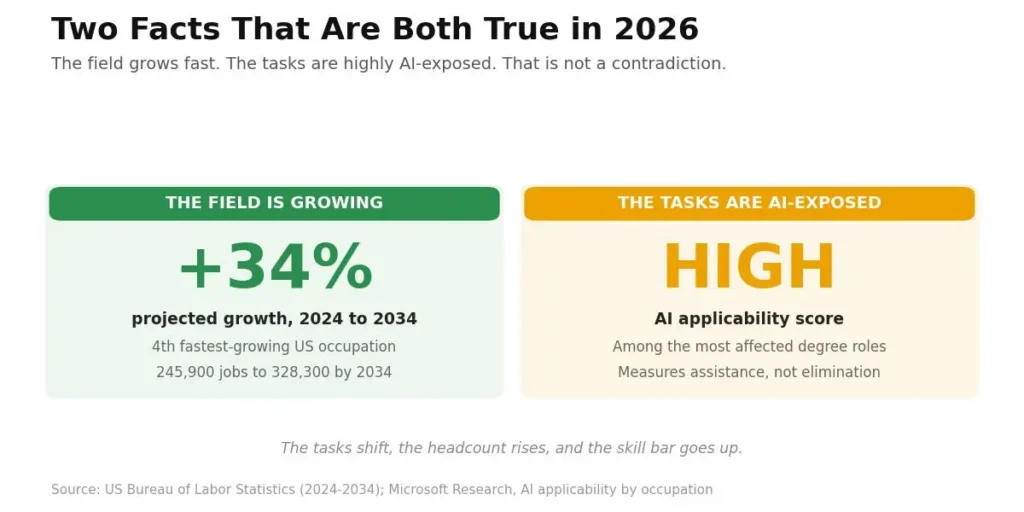
Here is the contrarian part almost every cheerful article avoids. Data scientists actually rank among the highest-education roles most exposed to AI, and ignoring that makes the outlook feel like propaganda rather than the truth. Microsoft researchers analyzed 200,000 anonymized Bing Copilot conversations and built an “AI applicability score” for each occupation.
High-skill, degree-requiring roles such as data scientists, management analysts, and web developers ranked among the most affected, and the study found greater AI applicability for jobs requiring a bachelor’s degree than for those that do not. You can see the paper from Microsoft Research.
Now hold both facts at once, because this is the real picture of 2026. BLS says the field grows 34%. Microsoft says the role’s tasks are highly exposed to AI. Both are true, and they are not a contradiction. Microsoft was explicit that a high applicability score measures how well AI can assist with a job’s tasks, not whether the job disappears.
A role can be deeply AI exposed and still grow fast, as long as the human keeps doing the parts AI cannot. That is precisely what is happening here. The tasks shift, the headcount rises, and the skill bar goes up.
Pro Tip: When an article quotes a data science growth stat, check the projection years. If it says 36% or cites a 2023 to 2033 window, it is running on stale data. The current cycle is 2024 to 2034 at 34%. Using the fresh numbers in interviews and your own writing signals that you actually track the field.
Is the data science job market harder to enter in 2026?
Yes, entry-level data science is genuinely tougher to break into right now, and any outlook that skips this is selling you something. The overall field is expanding, but the bottom rung is thinner than it was a few years ago, for two reasons stacking on top of each other.
First, the 2023 tech hiring correction. Companies overhired during the boom, then pulled back hard, and that pullback hit junior roles first. That was a business cycle, not AI, but the timing let people blame the wrong culprit.
Second, and this is the AI part, a lot of classic junior work (cleaning data, running standard models, building routine dashboards) is exactly what tools now do in one prompt. So the tasks that used to justify hiring three juniors now require one person to supervise the tools.
The floor of the job is where automation bites hardest. The takeaway is not to give up on data science. It is that the entry bar moved up.
A 2026 junior is expected to show business framing, a real portfolio, and AI tool fluency from day one, not just the ability to fit a model on a clean Kaggle dataset. Meet that higher bar and the demand above you is enormous.
How much do data scientists earn in the AI era?
Data scientist pay is rising, not falling, which is the clearest signal that this is a shortage market and not a dying one. The BLS median sits at $112,590 as of May 2024, and specialization pushes it well beyond that. Salaries for a struggling profession do not climb like this.
| Level or context | Typical U.S. pay signal (2024 to 2026) | What drives it |
|---|---|---|
| All data scientists (median) | $112,590 median (BLS, May 2024) | Baseline across the whole occupation |
| Scientific R&D services | $120,090 median (BLS, May 2024) | Higher complexity, deeper domains |
| AI and ML specialized roles | Well above the median, often six figures plus | Scarce skills, AI systems ownership |
| MLOps and deployment | Among the highest paid data skills | Turns models into reliable production systems |
The pattern inside the numbers matters more than any single figure. Pay rises fastest for the skills AI cannot cover on its own: deploying and monitoring systems, owning AI governance, and connecting analysis to business strategy. The closer your work sits to pure model fitting, the flatter your pay curve. The closer it sits to judgment and systems, the steeper it climbs.
Which industries still hire data scientists despite AI?
Data scientists remain in high demand across regulated and high-complexity industries, where human oversight is often a legal requirement rather than a preference.
The World Economic Forum’s Future of Jobs Report 2025 ranks big data specialists among the fastest-growing roles globally, with analytical thinking the single most sought-after core skill. Here is where the hiring is concentrated and why AI has not dented it:
- Healthcare and pharma:
clinical trial analysis, drug discovery, and patient outcome modeling all require domain expertise, and regulation legally mandates human accountability for decisions. - Finance and banking:
fraud detection, credit scoring, and risk models must be defended to regulators, so a human has to be able to explain and own the model. - E-commerce and retail:
recommendation systems, demand forecasting, and pricing optimization remain active, high-value areas of continuous investment. - Climate and energy:
one of the fastest-growing areas, with data scientists modeling climate systems and optimizing renewable grids at scale. - Government and public policy:
census work, public health, and urban planning need professionals who understand both the technical and the policy side.
The common thread across all five is context and accountability. These are exactly the areas where a wrong answer carries legal or human consequences, which is precisely where a supervising human data scientist is non-negotiable.
How is the data scientist role changing instead of disappearing?
The role is not vanishing; it is splitting into two high-demand archetypes, and both pay well. Rather than one generalist doing everything from cleaning to presenting, 2026 is pulling the job toward two poles.
The AI-augmented analyst
This professional uses AI as a force multiplier, completing analytical work several times faster than before. Less time goes to boilerplate, more goes to storytelling, stakeholder management, and business recommendations.
The barrier to entry is lower than ever, but the expectation of measurable business impact is higher.
The AI systems architect
This specialist designs, deploys, monitors, and improves the ML and AI systems that automate the analytical tasks in the first place. It leans on ML engineering, MLOps, model evaluation, and governance. The talent shortage here is severe, and compensation reflects it.
Both paths still stand on the same foundation: statistics, probability, data intuition, and domain sense. That is why learning data science in 2026 is not just still valid; it is arguably a stronger launchpad than before, because it opens two doors instead of one.
Which skills protect your data science career from AI?
The skills that protect you are the ones AI makes more important, not the ones it makes obsolete. As automation handles the floor, value concentrates in judgment, systems, and communication. Here is where to invest:
- AI and ML fluency:
prompt engineering, AutoML management, and LLM orchestration are now baseline expectations in job postings, not bonus skills. - Statistics and causal inference:
AI tools are statistical machines, so you need the math to catch their errors and to know when a result is real. - Data storytelling:
executives act on clear narratives, not raw model outputs. Translating analysis into a decision is one of the highest-leverage skills you can build. - MLOps and deployment:
taking a model from notebook to monitored production, with retraining pipelines, commands the top salaries in 2026. - AI ethics and governance:
understanding bias, fairness, privacy, and rules like the EU AI Act is turning into a dedicated, well-funded function. - Cross-functional collaboration:
the ability to bridge data, product, and business teams is scarce and hard to automate, and it is what moves you from IC to influence.
In My Experience
What surprised me most was how much of the value shifted to the boring part: validation. I leaned on an AutoML tool for a churn model, and it happily handed back a model with a gorgeous ROC curve. Looked ready to ship.
One thing caught me off guard when I actually dug in. The tool had leaked a post-churn feature into the training set, so the model was quietly cheating by using information it would never have at prediction time.
In a demo, that model wins. In production, it collapses the first week. Fixing it took ten minutes of human skepticism that no AutoML pass flagged. That is the whole job in one story.
The AI did the mechanical work in seconds and would have shipped a broken result with total confidence. The value was not building the model; it was knowing to distrust it. Anyone who only knows how to press the AutoML button never catches that leak.
Common pitfalls that put data scientists at real risk
Most people at genuine risk are not victims of AI; they are stuck in habits that AI merely exposes. These are the traps I see most often, and why each one is dangerous in 2026:
- Living only in the automatable layer.
If your entire value is cleaning data and running standard models, that is precisely the layer tools now cover. The fix is to move toward problem framing and validation, deliberately, this quarter. - Trusting AI output without checking it.
Generated code and models are often subtly wrong: data leakage, bad cross-validation splits, mishandled class imbalance. Shipping without review is how you become the person the model embarrasses. - Refusing to use AI on principle.
The opposite mistake. Ignoring AI to prove you do not need it just makes you slower than the colleague who uses it well. Speed on the mechanical parts frees you for the parts that matter. - Skipping the business context.
A technically perfect model that answers the wrong question is worthless. People who cannot connect analysis to a decision are the easiest to automate around. - Chasing tool trends over fundamentals.
Frameworks churn every year. Statistics, experiment design, and clear communication do not. Neglecting the fundamentals to memorize this month’s library is a slow career mistake.
A realistic example: future-proofing a workflow with AI
Here is what the AI-augmented workflow actually looks like on a real task, start to finish, so the advice above stops being abstract. The scenario: a subscription business wants to reduce customer churn.
Input: A messy export of subscription data, support tickets, and usage logs, plus a vague ask from leadership to “do something about churn.”
Process: The human reframes the vague ask into a sharp question, whether early support friction predicts churn, then lets AI handle the grunt work. AutoML runs candidate models, a code assistant scaffolds the pipeline, and an auto-profiling pass surfaces the initial patterns.
The human designs the validation, checks for data leakage, and decides which metric actually reflects business value.
Output: A validated model that flags at-risk accounts, paired with a plain language explanation of the two behaviors driving churn and a recommended intervention, not just a probability score.
Result: Leadership acts on the finding because it arrived as a decision, not a dashboard. The AI compressed days of mechanical work into hours. The human supplied the framing, the skepticism, and the translation, which is exactly the part that earns the salary and the part AI could not have done alone.
Notice what happened to the human’s time. It did not shrink; it moved. Less typing, more thinking. That reallocation, from execution to judgment, is the entire future of the role in one project.
So, is data science still worth it in 2026?
Yes, data science is still worth it in 2026, with one honest condition: you have to treat it as a way of thinking, not a set of button presses. The value proposition is unchanged: turning raw data into decisions that create real value is one of the most sought-after skills in the economy.
Who it is clearly right for: people who like framing ambiguous problems, who enjoy the detective work of validating a result, and who want to sit where data meets business decisions. For them, AI is the best assistant the field has ever had.
Who should think twice: anyone hoping for a role that is purely mechanical, with no interest in business context, communication, or judgment. That version of the job is the version AI is genuinely absorbing. But that was never the interesting part of data science anyway.
The professionals earning the most and advancing fastest right now learned solid fundamentals and embraced AI as a multiplier. That combination is the formula. The field is not dying; it is maturing, and the bar for doing it well is rising with it.
Frequently Asked Questions
No. The BLS projects 34% growth from 2024 to 2034, with AI automation already factored in. AI absorbs routine tasks, but problem framing, validation, and judgment stay human, so the role transforms rather than disappears.
AI already automates data cleaning, basic exploratory analysis, standard reporting, and boilerplate code. These are the repetitive, rule-based tasks. Problem definition, ethics auditing, and stakeholder communication carry the lowest risk of automation.
Yes. It is the 4th fastest-growing U.S. occupation, with a rising median wage of $112,590. The entry bar is higher now, but demand for skilled, AI-fluent data scientists outpaces supply.
They handle parts of it, like writing code or selecting models, but not the whole job. They cannot define the right problem, validate results for leakage, judge business trade-offs, or take accountability for a decision.
Validation judgment. Knowing when an AI-generated model is actually trustworthy, catching data leakage and misleading metrics, is the skill AI cannot replicate and the one that separates supervisors from button pressers.
Sources
U.S. Bureau of Labor Statistics, Occupational Outlook Handbook, Data Scientists: bls.gov/ooh/math/data-scientists.htm
Microsoft Research, Working with AI: Measuring the Applicability of Generative AI to Occupations: microsoft.com/en-us/research
World Economic Forum, Future of Jobs Report 2025: weforum.org

Is an SEO Specialist and AI Tools Researcher with over 4 years of hands-on experience in search engine optimization. As the founder of Smart AI Helper Pro, he tests and reviews AI writing, SEO, and marketing tools to help creators and business owners grow faster with practical, research-backed strategies.