
Will Mechanical Engineers Be Replaced by AI? The 2026 Truth
By SM Mehedi Hasan
No, AI will not replace mechanical engineers, and the data backs it up: the U.S. Bureau of Labor Statistics projects 9% job growth through 2034, faster than most careers. What AI does replace is the busywork, drafting, and repetitive calculations, so engineers who use it will outpace those who ignore it.
The question shows up in group chats, LinkedIn comments, and late-night searches by students who just spent four years earning a degree. Will mechanical engineers be replaced by AI? It is a fair worry.
Design tools now spit out geometry on their own, simulation runs in minutes instead of days, and every week another headline says a robot did something a human used to do. But the honest answer for 2026 is more useful than a scary one.
AI is changing what mechanical engineers do each day. It is not erasing the job. This guide walks through what the latest labor data actually shows, which tasks AI can handle right now, what it still cannot touch, and what you should do about it if you want to stay ahead.
Table Of Contents
ToggleWill AI Replace Mechanical Engineers in 2026?
No. AI will not replace mechanical engineers in 2026, and there is no credible signal it will replace the profession this decade. What it replaces is parts of the job: repetitive drafting, first-pass calculations, part searching, and documentation.
The engineer who directs the AI keeps the role. The one who refuses to learn it is the one at real risk. Think of AI the way a shop thinks about a power tool. It cuts faster and makes fewer mistakes, but it still needs a skilled hand, a plan, and someone who signs off on the final part.
That last piece matters more than people expect. Someone has to own the decision when a bracket fails under load or a housing cracks in the field. A model does not carry that weight. An engineer does.
Most people assume replacement looks like a robot sitting at a desk doing the whole job. It does not. It looks like one engineer using AI to do the work of two, which quietly reshapes hiring, not headcount, overnight. That distinction runs through everything below.
What Does the Latest Data Say About Mechanical Engineering Jobs?
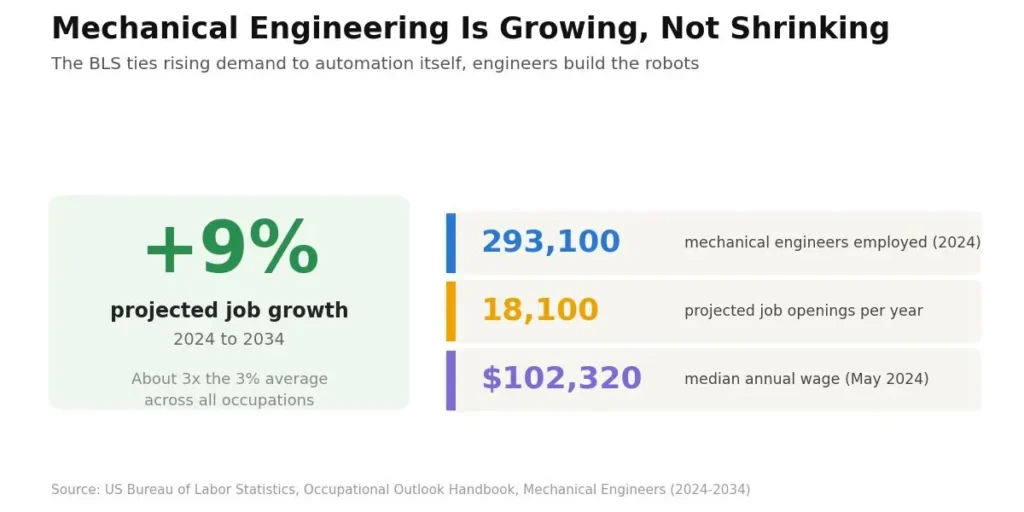
Mechanical engineering is growing, not shrinking. The U.S. Bureau of Labor Statistics projects 9% employment growth for mechanical engineers from 2024 to 2034, which is three times the 3% average across all occupations. That is the opposite of a field being automated away.
Here are the verified numbers straight from the BLS Occupational Outlook Handbook, current as of the 2024 to 2034 projection cycle:
| Metric | Latest Figure |
|---|---|
| Projected job growth (2024 to 2034) | 9% (about 3x the all-occupation average) |
| Jobs held in 2024 | ~293,100 |
| Projected jobs by 2034 | ~319,600 (about +26,500) |
| Average annual openings | ~18,100 per year |
| Median annual wage (May 2024) | $102,320 |
A quick note worth flagging, since a lot of blog posts get it wrong: some articles still quote an “11%” figure for mechanical engineers. That number belongs to industrial engineers. The verified mechanical engineering figure for the 2024 to 2034 window is 9%.
Small detail, but accuracy is the whole point when you are deciding a career around it. And the growth reason is telling. The BLS explicitly ties rising demand to automation and innovation, saying engineers are needed to design, integrate, and maintain the very automated systems people assume will replace them.
When a factory adds robots, it needs mechanical engineers to specify, install, and troubleshoot them. The bigger labor picture agrees.
The World Economic Forum’s Future of Jobs Report 2025 found that while many employers expect AI to reduce headcount in routine roles, they also expect it to create new roles, and most plan to prioritize reskilling over layoffs.
Engineering sits on the favorable side of that split because so much of the work happens in the messy physical world.
Which Mechanical Engineering Tasks Can AI Actually Do Now?
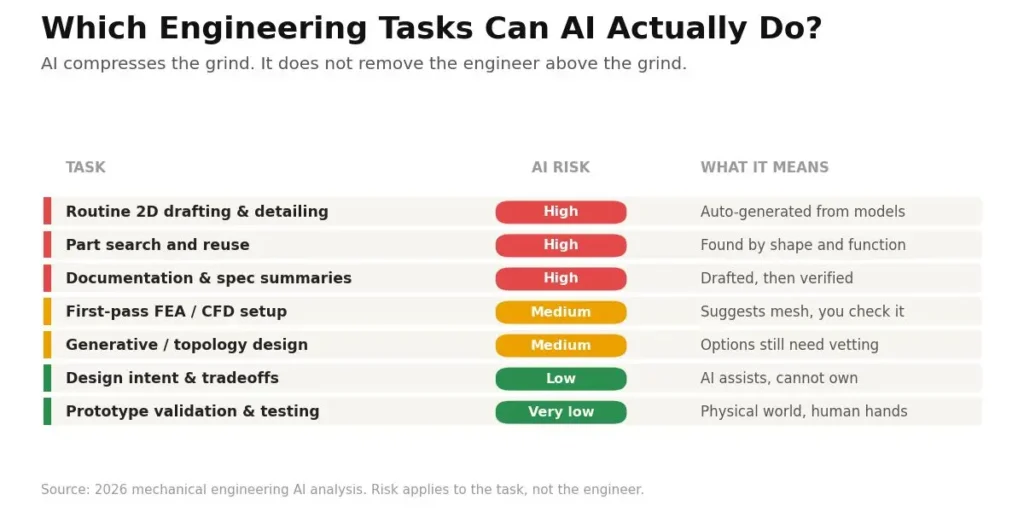
AI already handles a real slice of daily engineering work, and pretending otherwise helps no one. The pattern is consistent: tasks with clear inputs and predictable outputs are the first to be automated or accelerated. Tasks that need judgment, physical context, or accountability are not.
Here is a task-by-task view specific to mechanical engineering in 2026:
| Task | What AI Does in 2026 | Replacement Risk |
|---|---|---|
| Routine 2D drafting and detailing | Auto-generates drawings and dimensions from models | High for the task |
| First-pass FEA / CFD setup | Suggests meshes, boundary conditions, surrogate models | Medium |
| Preliminary stress and thermal checks | Runs quick calculations and shows the work | Medium |
| Generative / topology design | Produces thousands of geometry options from constraints | Medium (still needs vetting) |
| Part search and reuse | Finds existing parts by shape, function, material | High for the task |
| Documentation and spec summaries | Drafts reports, BOM notes, revision logs | High for the task |
| Design intent and tradeoff decisions | Assists, cannot own | Low |
| Prototype validation and testing | Cannot replace physical testing | Very low |
Notice the split. AI is genuinely strong at the retrieval and first-draft work that eats 30% to 50% of an engineer’s week. Generative design is the flashy example: you feed in loads, materials, and constraints, and the system returns geometry options that a human would take days to sketch.
Early adopters using AI copilots within CAD platforms like Siemens NX report meaningful time savings on routine design tasks, though those figures come from vendors and should be read as directional rather than gospel.
So the honest takeaway is that AI compresses the grind. It does not remove the engineer sitting above the grind, deciding which of those thousand generated shapes is actually manufacturable.
What Can AI Not Do in Mechanical Engineering?
AI cannot own a decision, and in engineering, owning decisions is the job. This is the part most “AI will replace everyone” takes quietly skip. A model can suggest a design. It cannot be held responsible when that design ships and fails.
Five things stay firmly human in 2026, and likely well beyond:
- Accountability and liability.
When a part fails, someone signs the failure analysis and the corrective action. In many jurisdictions, a licensed Professional Engineer must personally stamp and seal work, carrying legal responsibility no algorithm can absorb. - Physical-world judgment.
Prototyping, supplier visits, factory-floor troubleshooting, and hands-on testing all need a body in the room and a brain that has felt a part vibrate wrong. AI has never held a warm bearing. - Design intent under real constraints.
Knowing why a part was shaped a certain way, including unwritten manufacturing quirks and past field failures, comes from years on a program. Models retrieve information. They do not hold context across a multi-year project. - Genuinely novel problems.
AI is a pattern matcher. On problems that have never been solved before, where the answer is not sitting in training data, it gets unreliable fast. Breakthrough work still needs human engineers. - Cross-functional negotiation.
Deciding which trade-off is acceptable when procurement, manufacturing, and the client all want different things is an organizational judgment, not a computation.
Honestly, I expected AI simulation tools to be further along here than they are. They are fast and useful, but they still confidently produce results that violate basic physical feasibility, which is exactly why a human has to sanity-check the output before it goes anywhere near production.
Are Entry-Level Mechanical Engineers More at Risk Than Seniors?
Entry-level roles carry the most short-term exposure, and this is the risk almost nobody talks about honestly. The threat to junior engineers is not a robot taking their chair. It is that AI now does much of the routine work that used to be how juniors learned and earned their spot.
When one senior engineer plus an AI copilot can cover the drafting, calculations, and documentation that used to justify hiring two juniors, the math on entry-level headcount changes.
We have already watched a version of this play out in software, where entry-level developer hiring softened noticeably as AI absorbed boilerplate work. Mechanical engineering moves more slowly because of physical and regulatory constraints, but the pressure points are in the same direction.
Here is the non-obvious insight most competing articles miss entirely: the near-term risk in mechanical engineering is not job elimination, it is job compression at the bottom rung and wage pressure on routine roles.
The field is protected less by “AI cannot design” and more by accountability, physical testing, and licensure. Those protections are strongest at the senior end and weakest at the entry level. So if you are early in your career, don’t panic.
It is to skip past pure drafting as your identity as quickly as possible and get to judgment work: simulation literacy, manufacturing awareness, and owning small design decisions end-to-end. The engineers who stall are the ones whose whole value is doing manually what AI now does in seconds.
Which Mechanical Engineers Are Most and Least Likely to Be Replaced?
Specialization decides your exposure more than the job title does. Two people with the same “mechanical engineer” badge can face very different risk depending on what they actually do all day.
Most exposed to task automation:
- Engineers doing mostly repetitive 2D drafting and CAD detailing.
- Roles centered on routine, template-driven calculations.
- Positions focused narrowly on standard documentation and data entry.
- Quality checks limited to routine measurement that machine vision now handles.
Most protected:
- R&D and new-product engineers solving problems without a template
- Systems integration and mechatronics roles bridging mechanical, electrical, and software
- Test, validation, and field-failure engineers working with physical hardware
- Licensed engineers signing safety-critical designs
- Engineers in EVs, robotics, clean energy, and automation, where demand is climbing fastest
The pattern is clean once you see it. The closer your work sits to routine digital output, the more AI compresses it. The closer it sits to physical stakes, safety, or novel problem solving, the safer you are.
Most engineers live somewhere in the middle, which is exactly why adding AI fluency to physical-world skills is the winning position.
What AI Tools Are Mechanical Engineers Using in 2026?
Mechanical engineers in 2026 are mostly using AI features baked into tools they already know, plus a few purpose-built platforms. You do not need to become a data scientist to use them. You need to know what each one is good at and where it lies to you.
- AI copilots inside CAD suites
(Siemens NX and generative design features across major platforms): translate plain-language or constraint inputs into geometry and CAD commands. - Cloud simulation with AI guidance
(platforms like SimScale): speed up FEA and CFD setup and let you compare design variants faster. - Purpose-built engineering AI
(tools like Leo AI): read native CAD files and connect to PDM and PLM systems for part search and knowledge retrieval. - General LLMs
(ChatGPT, Claude, and similar): useful for spec summaries, first-draft documentation, and quick lookups, as long as you verify every technical claim.
One warning here. General chatbots are the most tempting and the most dangerous for engineering because they will confidently produce incorrect material properties or tolerances without blinking. Use them for language and structure, not as a source of truth for numbers.
In My Experience
What surprised me most when I tested AI design and simulation copilots was how convincing the wrong answers looked. I ran a simple bracket optimization through a generative workflow, and the tool returned a genuinely clever geometry in under a minute, lighter than my baseline. Impressive.
Until I looked closer and realized one of the “optimized” features was nearly impossible to machine without custom tooling that would blow the budget.
That one moment captured the whole 2026 reality for me.
The AI did the fast, tedious exploration brilliantly, generating options I would not have bothered to sketch by hand. But it had zero sense of manufacturability, cost, or the fact that the shop only had a 3-axis mill.
A junior engineer who trusted it blindly would have shipped a beautiful part nobody could build. A senior one used it as a starting point, saving an afternoon. Same tool, completely different outcomes, and the difference was entirely human judgment.
Common Pitfalls Engineers Make About AI
Most mistakes here come from either over-trusting AI or ignoring it completely. Both are costly and avoidable. These are the traps I see repeated most often.
- Trusting AI numbers without verification.
AI will hand you a stress value or material property with total confidence. It happens because these models predict plausible text rather than verified physics. Always check assumptions, units, boundary conditions, and safety factors yourself. - Confusing “fast” with “correct.”
A result that arrives in seconds feels authoritative. Speed is not accuracy. Treat every AI output as a draft to validate, never a final answer. - Refusing to learn the tools at all.
Some engineers dismiss AI as hype and skip it entirely. That is the actual career risk. The engineer who ignores AI gets outproduced by the one who uses it well, and managers notice the gap on the timeline. - Letting AI do your thinking, not just your typing.
Juniors, especially, tend to use AI to skip the reasoning. You lose the judgment you are supposed to be building. Use it to remove busywork, not to avoid learning. - Ignoring manufacturability and cost.
Generative design loves elegant geometry the shop cannot make. Always run AI output through a DFM and cost sanity check before it goes anywhere.
How Should You Prepare for AI as a Mechanical Engineer?
- Audit your current tasks against the risk table above.
Cause: you cannot protect yourself from a risk you have not named.
Action: list what you do in a normal week and mark each task as routine-and-automatable or judgment-heavy.
Result: you will see exactly how exposed your role is right now. - Learn one AI tool inside your existing workflow first.
Cause: broad “learn AI” advice goes nowhere.
Action: pick the AI features already inside your CAD or simulation software and use them on a real project this month.
Result: you build usable fluency instead of abstract knowledge. - Double down on the human-only skills.
Cause: these are what keep you valuable as AI absorbs the routine.
Action: deepen your DFM, GD&T, simulation literacy, and requirements-writing skills, and start owning small design decisions end-to-end.
Result: you move up the value chain, away from the automatable bottom. - Build a verification habit.
Cause: unchecked AI output is a liability with your name on it.
Action: for every AI result, verify assumptions, units, and feasibility before using it.
Result: you become the engineer who catches the errors, which is exactly the skill that stays in demand. - Show proof of your AI competency.
Cause: employers are actively screening for it.
Action: complete a relevant AI or simulation course and put concrete AI-assisted projects on your resume and LinkedIn.
Result: you signal that you direct AI rather than compete with it.
Workflow Example: Redesigning a Bracket With AI
Here is the full flow, not just theory, using a realistic 2026 task.
- Input: A mounting bracket that is heavier than the target and slow to iterate by hand. Requirements: hold a defined load, fit an existing bolt pattern, and be machinable on a 3-axis mill.
- Process: Feed the loads, material, and constraints into a generative design tool. It returns roughly a dozen geometry options in minutes. Run a quick AI-assisted FEA pass on the top three to compare stress and mass.
- Output: Three viable candidates, each lighter than the original, with first-pass stress results attached.
- Result: You reject one for a feature the shop cannot machine, verify the remaining two by hand-checking the FEA assumptions and safety factor, and pick the winner. Total time saved: most of a day. Total judgment calls made by AI: zero. Every decision that mattered was yours.
Pro Tips for Staying Ahead
Worth knowing early: treat AI fluency the same way engineers treated CAD in the 1990s. The ones who adopted CAD first set the productivity standard for a generation. The same window is open now, and it will not stay open.
One habit that pays off fast is keeping a personal “verification checklist” for AI output: units, boundary conditions, material assumptions, safety factor, and manufacturability. Run every AI result through it. It takes two minutes, and it is the difference between looking sharp and shipping a failure.
And do not chase every new tool. Pick the AI features inside the software you already use, get genuinely good with them, then expand. Depth in one workflow beats a shallow tour of ten shiny platforms every time.
So, Will Mechanical Engineers Be Replaced by AI?
The short version stays the same: no. AI is not replacing mechanical engineers, and verified data indicate the opposite: 9% projected growth through 2034 and median pay above $102,000.
What is changing is the daily work. Routine drafting, first-pass calculation, and documentation are being absorbed. Judgment, physical testing, accountability, and novel design are not. The engineers who thrive through 2030 will be the ones who treat AI as a power tool and keep their hand on the wheel.
The ones at real risk are not being replaced by AI at all. They are being outcompeted by other engineers who learned to use it first. That is the choice in front of you, and the good news is it is entirely yours to make.
Frequently Asked Questions
No. The BLS projects 9% growth for mechanical engineers through 2034. AI automates drafting and routine calculations, but design judgment, physical testing, and safety accountability stay human. Engineers who adopt AI gain the advantage.
Engineers who mostly do repetitive 2D drafting or routine template calculations face the greatest task disruption. Those in R&D, systems integration, testing, and licensed safety-critical design are the most protected from replacement.
Yes, AI runs first-pass stress, thermal, and fluid checks quickly. But engineers must verify assumptions, boundary conditions, units, and safety factors before trusting any result. Treat AI output as a draft, never a final answer.
Yes. Median pay was $102,320 in 2024, growth beats most fields at 9% through 2034, and demand spans EVs, robotics, and clean energy. Adding AI skills makes you more valuable, not less.
CAD intent modeling, DFM and GD&T, simulation literacy, requirements writing, and AI-tool fluency. Judgment, verification, and physical-world problem-solving are the skills AI cannot replicate and that employers value most.

Is an SEO Specialist and AI Tools Researcher with over 4 years of hands-on experience in search engine optimization. As the founder of Smart AI Helper Pro, he tests and reviews AI writing, SEO, and marketing tools to help creators and business owners grow faster with practical, research-backed strategies.