
Will AI Replace Truck Drivers? Self-Driving Trucks in 2026
By SM Mehedi Hasan
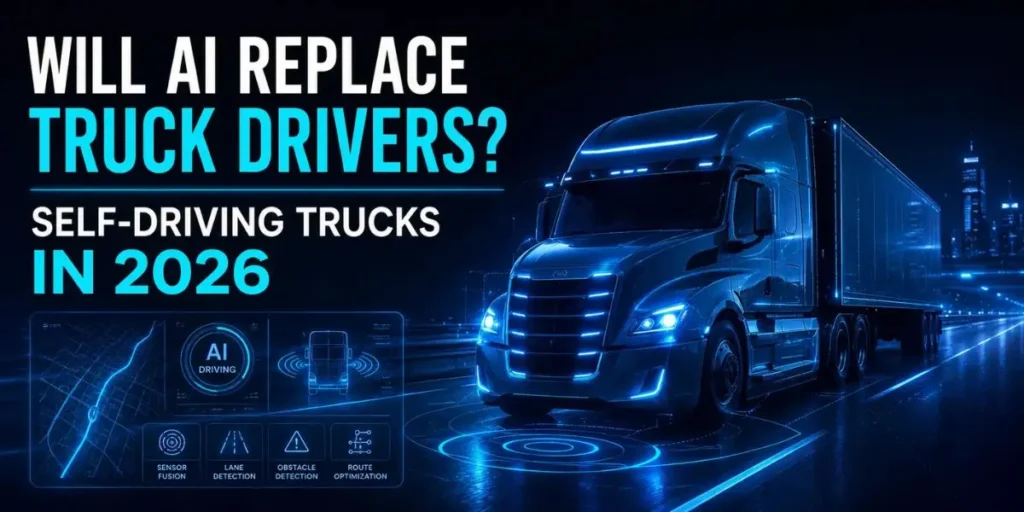
No, AI will not replace truck drivers in 2026, and full replacement remains years away. Fewer than 200 driverless trucks operate on U.S. highways today, compared with roughly 2.2 million drivers. Aurora leads with 250,000 incident-free miles, yet regulation, loading docks, and city streets still demand human hands.
If you have read a tech headline in the past ten years, you have probably been told the trucker’s job is about to vanish. That prediction has been “two years away” since 2016.
So let me do something the headlines rarely do: separate what is actually running on real highways in 2026 from what a press release wants you to believe.
Table Of Contents
ToggleWill AI replace truck drivers in 2026?
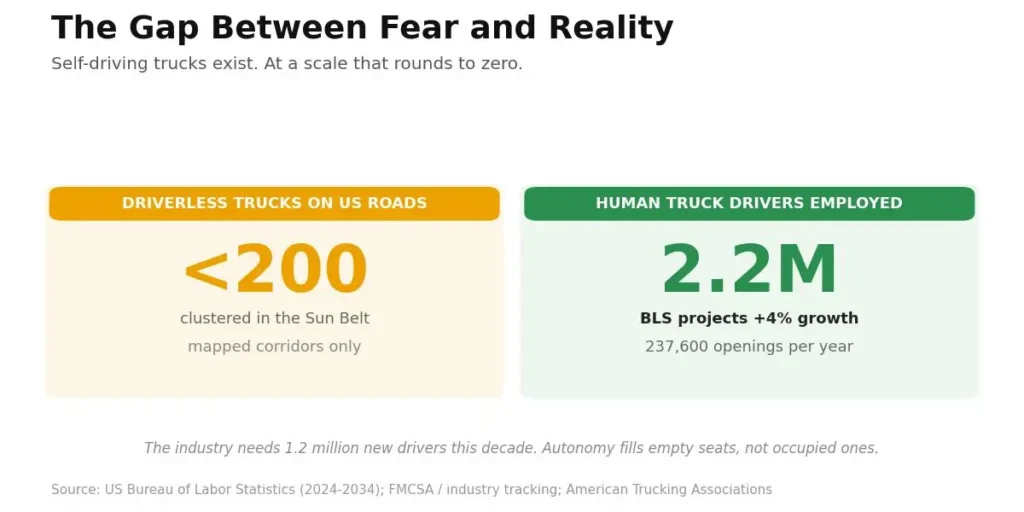
No, and the gap between fear and reality is enormous. As of early 2026, fewer than 200 driverless trucks operate on U.S. public highways, almost all of them clustered in the Texas Triangle and the wider Sun Belt, according to industry tracking from FMCSA rulemaking watchers.
Set that against roughly 2.2 million heavy and tractor-trailer drivers the U.S. Bureau of Labor Statistics counts on the job, and the “replacement” narrative starts to look like a rounding error.
Most people assume the technology is the bottleneck. It isn’t, at least not entirely. The bigger brakes are regulation that still assumes a human in the loop, freight tasks that have nothing to do with steering, and a public that does not yet trust a 40-ton machine with no one behind the wheel.
Here is the part worth sitting with. The BLS projects heavy and tractor-trailer driver employment to grow 4% from 2024 to 2034, with about 237,600 openings every year on average. That is a workforce being told to expect more jobs, not fewer, during the exact decade autonomy is supposed to erase it.
How many self-driving trucks are actually on the road right now?
Only a few hundred, spread across four serious players, and every one of them runs inside a narrow, pre-mapped operating zone. The honest answer to “who is doing this for real” is a short list, so here is where the leaders actually stand in 2026 rather than where their marketing decks place them.
| Company | Status in 2026 | Where it runs | Key verified milestone |
|---|---|---|---|
| Aurora Innovation | Driverless commercial ops live | Texas, New Mexico, Arizona | 250,000+ incident-free driverless miles (Apr 2025 to early 2026) |
| Kodiak AI (Nasdaq: KDK) | Driverless in industrial zones | Permian Basin, West Texas | Scaled 2 to 20 driverless trucks in a year; 28 by Q1 2026 |
| Gatik | Driverless middle-mile at scale | TX, AZ, Arkansas | 60,000 driverless orders incident-free |
| Waabi | Driverless launch delayed | Texas (pilots) | Raised ~$1B, pushed full driverless timeline back |
What is Aurora Innovation doing in 2026?
Aurora is the clear front-runner, and it is the only company its own CFO describes as running driverless freight on public roads. The company launched its first driverless lane between Dallas and Houston in April 2025 and has since logged more than 250,000 incident-free driverless miles across Texas, New Mexico, and Arizona.
It extended operations along a 1,000-mile corridor from Fort Worth to Phoenix, a stretch that legally exceeds what one human driver can cover under hours-of-service limits.
What surprised me digging into Aurora’s filings was the scale-back. The company grew to 10 driverless trucks in December 2025, then deliberately shrank the fleet in early 2026 to prep its second-generation hardware kit. That is not a company in a mad sprint.
That is a company being careful. Aurora targets more than 200 driverless trucks across the Sun Belt by the end of 2026, and in May 2026 it signed a driverless deal with McLane, a Berkshire Hathaway distribution giant, for the Dallas-Houston run.
Where does Kodiak stand?
Kodiak took a different road, and it is a smart one. Instead of chasing highways first, Kodiak went live hauling frac sand for Atlas Energy Solutions across private and lease roads in the West Texas Permian Basin.
The company went public in September 2025 on the Nasdaq under ticker KDK, and it scaled from two driverless trucks to 20 by the end of 2025, which it calls the world’s largest deployment of customer-owned driverless trucks.
By the first quarter of 2026, Kodiak had 28 driverless trucks and 74% quarter-over-quarter revenue growth, though it remained firmly pre-profit, reporting a $37.9 million quarterly operating loss.
Its long-haul highway launch is targeted for the second half of 2026. Notice the pattern: even the leaders are still spending far more than they earn.
What about Gatik and Waabi?
Gatik quietly became the most boring success story in the field, and boring is the goal here. Since mid-2025, its box trucks have completed 60,000 fully driverless orders without incident, running short middle-mile routes between distribution centers and stores for Walmart, Kroger, and other Fortune 50 retailers in Texas, Arizona, and Arkansas.
Short, fixed, repeatable routes are exactly where autonomy works. Waabi tells the opposite story, and it is instructive. The startup raised roughly $1 billion in early 2026 and had planned a fully driverless truck by the end of 2025.
That launch slipped to “the next few quarters,” and the company pivoted energy toward robotaxis with Uber. When a well-funded leader misses its own driverless deadline, that tells you more about the difficulty than any optimistic forecast does.
What are the SAE levels, and where do trucks actually sit?
Self-driving is measured on a six-level scale from the Society of Automotive Engineers, and every commercial truck program today targets Level 4, not the sci-fi Level 5.
Understanding this scale is the fastest way to cut through hype, because a company saying “autonomous” can mean anything from cruise control to a truck with no driver in a fenced mine.
| SAE level | What it means | Human role |
|---|---|---|
| Level 2 | Steering plus speed assist together | Driver monitors constantly |
| Level 3 | Car drives, human is backup | Must be ready to take over |
| Level 4 | Fully self-driving in a set zone | None needed inside that zone |
| Level 5 | Self-driving everywhere, any condition | None, ever |
Here is the nuance most articles skip. Level 4 is not “drives anywhere.” It means the truck handles everything, but only inside a tightly defined operating design domain: specific mapped highways, specific weather, specific hours.
Aurora’s trucks are Level 4 on a Phoenix-to-Fort Worth corridor and would be useless on a snowy mountain pass in Colorado. Level 5, the “any road, any weather” dream, does not exist commercially and is not close to it.
Why hasn’t AI replaced truck drivers already?
Because driving the truck was never the hard part of trucking. The industry has poured billions into autonomy over a decade, and the remaining barriers are stubborn in ways that raw computing power alone does not solve.
- The physical world is messy.
Piloting a heavy rig through rain, dust storms, construction zones, and unmarked detours involves edge cases that a language model never faces. Aurora had to specifically validate its trucks against dust storms before extending into Arizona. - Trucking is not just driving.
Securing cargo, backing into a tight dock, handling paperwork, and talking to warehouse crews all require hands and judgment. No autonomous system touches any of that. - The long tail of weird.
A fallen tree, a cop waving traffic through a red light, a flooded underpass. Rare events are common across millions of miles, and each one is a puzzle for AI. - Regulation assumes a human.
As of 2026, no U.S. state permits fully driverless commercial trucking on all road types. The rulebook was written for people.
Who is liable when a driverless truck crashes?
Nobody has fully answered this yet, and that unanswered question alone is slowing deployment more than any software bug. In a normal wreck, a driver is negligent, and their carrier’s insurer pays.
Remove the driver, and blame shifts toward the truck maker or the software developer under product-liability law, which forces a complete redesign of commercial transport insurance.
Insurers hate uncertainty, and this is a mountain of it. Until courts and regulators settle who pays when an autonomous truck causes harm, carriers face real financial exposure adopting the technology at scale. This is the quiet reason many fleets are watching rather than buying.
What does “driverless” actually mean in 2026?
It often does not mean an empty cab, and this distinction gets buried in almost every headline. When Aurora runs its McLane freight “driverless,” there is still a human observer sitting in the cab under an agreement with truck maker Paccar.
That person does not operate the vehicle, but they are physically there. So the word “driverless” in 2026 spans a spectrum: a genuinely empty Gatik box truck on a two-mile middle-mile loop, versus an Aurora highway rig with a non-operating observer aboard.
Both get called “driverless” in press releases. If you only read the headline, you would think the cab is empty in every case. It usually is not, at least not yet, on the long highway routes people worry about most.
Is the truck driver shortage real, or a myth?
It is real, structural, and it reframes the entire replacement debate. The American Trucking Associations pegs the current shortfall at around 60,000 unfilled positions, and its revised April 2026 outlook raised the 2028 projection to 175,000.
The ATA estimates the industry needs to hire 1.2 million new drivers over the next decade, roughly 120,000 every year, just to cover retirements and freight growth. And it gets tighter.
A March 2026 federal rule sharply restricted non-domiciled CDLs, and states felt it fast: Texas reported a 31% drop in CDL renewals in April versus a year earlier, with California down 26%.
When you overlay 90%-95% annual turnover at large carriers and an average driver age near 46, the picture is a shrinking workforce from the top and a struggle to refill from the bottom.
This is why companies like Kodiak frame autonomy as filling the “hardest to recruit” long-haul lanes rather than firing existing drivers. Automation is being pitched as a solution to a hole in the labor supply, not to a surplus of workers. That framing changes everything about how the technology gets deployed.
Which trucking jobs are most and least at risk from AI?
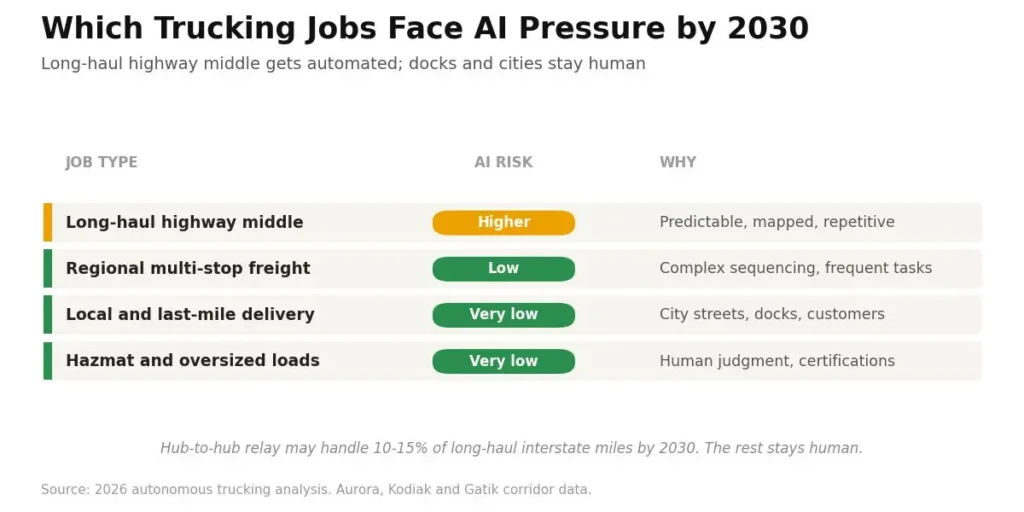
Long, straight, repetitive highway hauls face the most pressure, while anything involving cities, docks, or specialized cargo stays firmly human.
The realistic near-term model is not “robots take over” but “hub-to-hub relay,” where autonomous trucks handle the boring middle of the interstate while people handle both ends.
| Job type | AI risk by 2030 | Why |
|---|---|---|
| Long-haul highway middle-mile | Higher | Predictable, mapped, repetitive routes |
| Local and last-mile delivery | Very low | City streets, docks, customer contact |
| Hazmat and oversized loads | Very low | Human judgment and certification required |
| Regional multi-stop freight | Low | Complex sequencing, frequent human tasks |
The counterintuitive twist is that hub-to-hub models can create local driving jobs at the transfer points, even as they automate the interstate stretch.
Analysts estimate this relay approach might handle only 10% to 15% of long-haul interstate miles by 2030, leaving the overwhelming majority of trucking untouched. If you drive anything that involves a loading dock or a downtown, the machines are not coming for your seat this decade.
In My Experience
The thing that caught me off guard while tracking this space was how far the filings sit from the headlines. I spend a lot of time reading company investor letters and BLS tables side by side, and the contrast is stark.
A splashy article says “the end of truckers,” then the same company’s 8-K quietly reports a fleet of 20 trucks and a $37 million quarterly loss. I ran into this most sharply with Aurora’s 2026 fleet reduction.
If you only read the press coverage, the story was pure acceleration. Reading the shareholder letter, I found a company that deliberately shrank its live fleet to validate new hardware.
That gap between the confident public story and the cautious operational reality is the single most useful thing I have learned from watching autonomous trucking. The technology is real and improving, but the people building it are moving far more slowly and carefully than the outrage cycle suggests.
What is the realistic timeline for self-driving trucks?
Expect gradual corridor-by-corridor expansion through 2035, not a sudden switch. The named milestones already on the calendar give a clearer picture than any round-number forecast, so here is roughly how the next decade is shaping up based on current deployments and regulation.
By the end of 2026, expect a few hundred driverless trucks total, concentrated on Sun Belt interstates in good weather, with Aurora targeting 200-plus and Kodiak launching long-haul in the second half of the year.
Through 2028, driver-assist features like adaptive cruise and lane-keeping become standard on most new trucks, while true driverless stays confined to mapped corridors.
Around 2030, hub-to-hub relay corridors mature enough to handle a slice of long-haul miles between fixed terminals. By 2035, even optimistic projections have autonomy handling only a fraction of total freight, with the driver shortage still the more urgent industry story.
How is AI already helping truck drivers right now?
AI is quietly transforming trucking today, and almost none of it involves removing the driver. This is the part of the story that actually affects the 2.2 million people currently on the job, and it is mostly good news for them.
- Route optimization trims empty miles and reroutes around traffic and weather, which can lift a driver’s paid miles and earnings.
- Predictive maintenance reads engine data to flag a failing part before it strands someone on the interstate, meaningfully reducing breakdowns.
- Electronic logging and compliance tools warn drivers before an hours-of-service violation occurs, rather than after a fine.
- Safety systems like automatic emergency braking, lane-departure alerts, and fatigue detection reduce crashes caused by human tiredness.
- Load matching pairs drivers with freight that fits their route and home-time needs, easing the retention crisis.
These are augmentation tools, not replacement tools. They make the existing job safer and less miserable, which is a big reason the BLS still projects growth rather than decline.
How can truck drivers stay ahead of automation?
Focus on the skills machines cannot touch, and do it in this order for the strongest protection.
- Earn specialized endorsements.
Get hazmat, tanker, or oversized-load certification. These niches sit decades away from automation and often pay $10,000 to $20,000 more per year than standard freight. - Master last-mile and urban delivery.
Build a reputation for tight dock backing, city navigation, and clean customer handoffs. No autonomous system handles this orchestration. - Get comfortable with the tech.
Learn the fleet apps, ELDs, and telematics dashboards. Drivers who partner with the tools become the ones employers fight to keep. - Protect a clean safety record.
In an industry with 90%-plus turnover, reliability and a spotless record make you genuinely hard to replace. - Watch the corridors, not the headlines.
Track which specific lanes go driverless. If autonomy reaches your route, pivot early toward regional or specialized work.
Pro tip: Before paying for any endorsement, call two or three local carriers and ask which certifications they are actively hiring for this quarter. Demand shifts by region, and you want to train toward the shortage nearest you.
A trick worth knowing: If your carrier offers free telematics or fleet-software training, take it even if it feels optional. Those are the exact skills that turn a driver into an “autonomous fleet coordinator,” a role that pays more and did not exist five years ago.
What do people get wrong about AI and trucking?
Plenty, and most mistakes come from trusting the headline over the filing. These are the traps I see most often, along with why they happen and how to sidestep them.
- Confusing “tested” with “deployed.”
A company demoing a driverless truck once is not the same as running paid freight daily. Always ask how many trucks are in commercial service and where they are. The demo is marketing; the deployment count is reality. - Assuming Level 4 means “anywhere.”
Level 4 trucks operate only within narrow, mapped zones and under specific conditions. People hear “self-driving” and picture a truck that goes anywhere. Check the operating design domain before you believe the range. - Reading “driverless” as “empty cab.”
Many long-haul “driverless” runs still carry a non-operating observer. The word is doing heavy lifting in press releases, so read past it. - Ignoring the shortage.
Treating automation as a job-killer overlooks the fact that the industry is short tens of thousands of drivers. Autonomy is aimed at a labor gap, not a labor surplus, which changes who it actually affects.
What does a real hub-to-hub autonomous route look like?
Here is a concrete walkthrough of how a driverless freight run actually flows in 2026, using the Dallas-to-Houston model that Aurora runs for McLane. Seeing the full sequence makes it clear why humans are still central, even in a “driverless” lane.
Input: A trailer of restaurant freight arrives at a Dallas terminal located right off the freeway. A human driver docks it and completes the paperwork and cargo checks.
Process: The Aurora-equipped tractor takes the trailer and autonomously drives the roughly 240-mile stretch of interstate to Houston, with a non-operating observer aboard. It maintains legal speed, manages spacing, and handles highway conditions without human input for the long middle.
Output: At the Houston terminal, again right off the freeway, the autonomous system hands the trailer to a local McLane driver.
Result: The human driver runs the complex final miles into the city, backs into each customer dock, and manages the face-to-face delivery. The truck moved freight around the clock on the boring middle; the people handled both ends where judgment and hands are required.
That relay is the very near future of trucking. Not an empty highway of robot trucks, but a division of labor where machines handle the monotonous middle, and humans keep the parts that need a human touch.
Frequently Asked Questions
No. The BLS projects 4% job growth through 2034, and autonomy is expected to handle only a small share of long-haul interstate miles by 2030, mostly on fixed corridors while human jobs continue.
Yes, but very few. Gatik runs empty-cab middle-mile trucks, and Aurora runs highway freight with a non-operating observer aboard. Fewer than 200 driverless trucks operate on U.S. highways as of early 2026.
Aurora Innovation leads with over 250,000 incident-free driverless miles and a target of 200-plus trucks by year-end. Kodiak, Gatik, and Waabi follow with different strategies and smaller commercial footprints.
Often, yes. Many “driverless” long-haul routes keep a non-operating human observer aboard for safety and regulatory reasons. Truly empty cabs so far appear mainly on short, fixed middle-mile routes.
It cuts both ways. The roughly 60,000-driver shortage gives companies a reason to automate the hardest-to-fill lanes, but that same gap means autonomy fills empty seats rather than displacing working drivers.
Sources
- U.S. Bureau of Labor Statistics, Heavy and Tractor-Trailer Truck Drivers, Occupational Outlook Handbook
- TechCrunch, Aurora lands McLane deal for driverless truck routes in Texas.
- FreightWaves, Kodiak AI Q1 2026 earnings, 28 driverless trucks
- PYMNTS, Gatik autonomous trucks complete 60,000 driverless deliveries
- TechCrunch, Waabi raises $1B and expands into robotaxis with Uber.
- PLS Logistics, Truck Driver Shortage 2026

Is an SEO Specialist and AI Tools Researcher with over 4 years of hands-on experience in search engine optimization. As the founder of Smart AI Helper Pro, he tests and reviews AI writing, SEO, and marketing tools to help creators and business owners grow faster with practical, research-backed strategies.