
Will AI Replace Sales Jobs? What Reps Need to Know in 2026
By SM Mehedi Hasan
No, AI will not replace sales jobs in 2026, but it is already replacing sales tasks, and the U.S. Bureau of Labor Statistics now names AI in sales activities as a reason the sales workforce is projected to shrink through 2034. Transactional SDR roles face the real risk. Enterprise closers stay safe.
Table Of Contents
ToggleWill AI Replace Sales Jobs in 2026?
AI will not replace the sales profession in 2026, but it is quietly deleting the parts of the job that were always repetitive. Prospect research, list building, first-touch emails, meeting scheduling, CRM logging, call summaries. Those tasks are getting automated fast.
The rep who does mostly those tasks is exposed. The rep who closes complex deals is not. Most reps ask the wrong version of the question. It is not whether sales survives. It is which sales roles get squeezed first, and whether you are on the right side of that line.
That distinction is the whole story, and the data below shows exactly where the line sits. Here is the honest split. If your average deal is under $10,000 and your cycle closes in under 30 days, an AI tool plus one strong closer can already outperform a small team.
If you sell a six-figure platform into a large account with seven stakeholders and a nine-month cycle, AI is nowhere close to taking your seat. Same job title, completely different risk level.
What Does the Latest Data Actually Say About AI and Sales Jobs?
The data points in two directions at once, which is why the headlines feel contradictory. Government labor projections show sales shrinking. Global workforce reports show sales growing.
Both are correct because they count different jobs in different economies. Here is what each source actually says, checked against the primary reports rather than the recycled version everyone quotes.
Does the Bureau of Labor Statistics Blame AI for the Sales Decline?
Yes, and this is the part most articles get wrong. The BLS projects overall employment in sales occupations to decline from 2024 to 2034, even though roughly 1.8 million sales openings are expected each year due to retirements and career changes (BLS Occupational Outlook Handbook).
Plenty of writers stop there and say the drop is not AI-related. But read the actual projections release. The BLS states plainly that “the integration of AI systems in sales activities, such as in routine calls, chats, and analysis of sales, are expected to limit demand for many sales workers, leading to employment declines” (BLS Employment Projections 2024-34).
So the federal labor agency is naming AI as a direct driver, not dodging it. Retail trade is projected to lose more jobs than any other sector over the decade. That is a real signal, and it is worth trusting more than any vendor blog.
Why Does the WEF Say Sales Jobs Are Growing?
Because the World Economic Forum is counting shop salespersons across the whole planet, not U.S. B2B reps. The Future of Jobs Report 2025 projects 170 million new roles and 92 million displaced by 2030, a net gain of 78 million.
Salespersons do appear on the list of roles growing the most in absolute numbers. Sounds reassuring. Here is the catch almost every competing article skips. That growth is driven by retail shop workers in fast-growing developing economies, sitting right next to farmworkers and delivery drivers.
It is population and consumption growth abroad, not demand for American software sellers. Quoting that stat to a U.S. account executive as proof that their job is safe misreads the report.
The same WEF study also finds that 39% of core job skills will change by 2030, which is the part reps should actually plan around. So when you line up the two sources, they agree. Routine, low-complexity selling is shrinking in mature markets.
Skilled, consultative selling is not. The numbers only look like a contradiction if you read the summary instead of the source.
The role-by-role picture is where it gets useful. Here is how the main U.S. sales roles are actually projected to move through 2034, straight from the BLS.
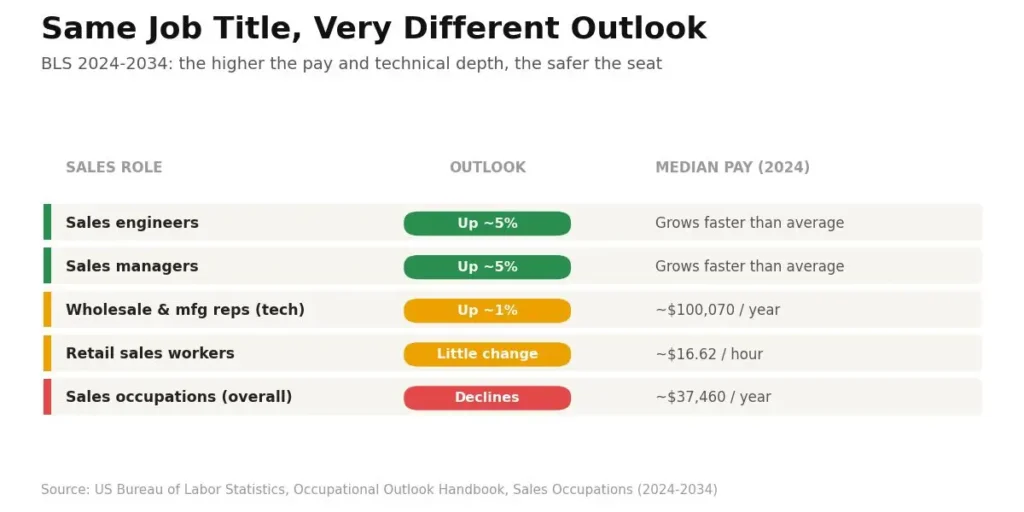
| Sales role | 2024-34 outlook | Pay / note |
|---|---|---|
| Retail sales workers | Little or no change | ~$16.62/hr median (2024) |
| Sales occupations (overall group) | Projected to decline | ~$37,460/yr median (2024) |
| Wholesale & manufacturing reps (technical) | Up about 1% | ~$100,070/yr median (2024) |
| Sales managers | Up about 5% | Faster than average growth |
| Sales engineers | Up about 5% | Faster than average growth |
Notice the pattern. The higher the pay and the more technical the sale, the safer the outlook. Sales engineers and sales managers are projected to grow faster than the average job, while frontline retail and the overall group flatten or fall (BLS: wholesale & manufacturing reps; BLS: sales engineers). AI is hollowing out the bottom of the org chart, not the top.
Which Sales Tasks Is AI Already Taking Over?
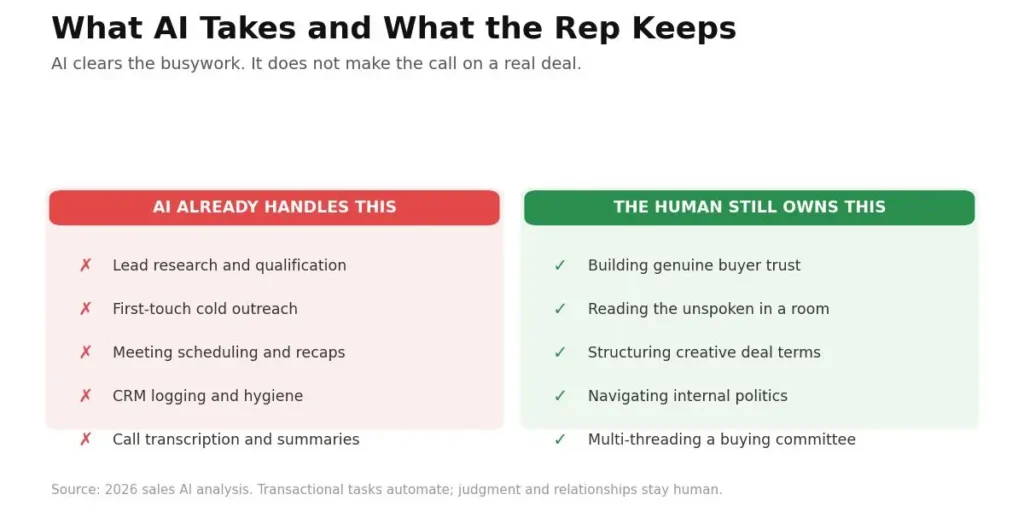
Start with the tasks, because tasks get automated long before whole jobs do. These are the ones AI already handles well enough that reps have quietly stopped doing them by hand in 2026:
- Lead research and qualification: pulling firmographics, scoring intent, and flagging accounts worth a call.
- First-touch outreach: drafting cold emails and multi-step sequences personalized from public signals.
- Meeting scheduling and follow-up: booking, reminding, and sending recap notes without a human touching it.
- CRM hygiene: logging calls, updating deal stages, and cleaning contact fields automatically.
- Call intelligence: transcribing, summarizing, and surfacing next steps from recorded conversations.
- Forecasting support: spotting stalled deals and pipeline gaps a rep would miss under quota pressure.
So what is left for the human? The judgment layer. Deciding which of those flagged accounts is genuinely worth nine months of effort. Reading the room when a champion goes quiet. Restructuring a deal when procurement blows up the timeline. AI clears the busywork, but it does not make the call.
In My Experience
Honestly, when I first handed prospecting to an AI SDR tool, I expected the meetings it booked to be junk. They were not. The volume jumped, and the top-of-funnel research was cleaner than what a rushed junior rep produces. What caught me off guard was the failure mode.
The tool fed on a stale contact list and torched a sending domain in about two weeks, because a chunk of the emails bounced and the sender reputation cratered. That taught me the real lesson of 2026. AI does not fail loudly by writing bad copy.
It fails quietly by scaling whatever garbage data you feed it. A rep who understands data quality became more valuable that quarter, not less. The tool did the typing. The human still had to know which inputs were trustworthy, and that gap is exactly where the surviving jobs live.
Which Sales Jobs Are Most at Risk From AI?
The rule is simple. The more your day runs on repeatable, templated steps, the more exposed you are. The more it runs on judgment and relationships, the safer you are. Here is the risk map for 2026, sorted from most to least exposed.
| Risk level | Roles | Why it lands there |
|---|---|---|
| High | Transactional SDRs, cold outbound, retail floor, data entry | Fully templated workflows AI runs for $500-$2,000/month |
| Medium | Inside sales, qualification-heavy roles, SMB account managers | Parts automate; the human handles exceptions and objections |
| Low | Enterprise AEs, sales engineers, solution consultants | Trust, technical depth, and multi-stakeholder navigation |
The entry-level rung is the part that worries me most. A Cengage survey found that 76% of employers hired fewer or the same number of entry-level workers in 2025, up from 69% the year before, and 46% cited AI and emerging tech as a reason.
SDR and BDR seats have always been the front door into a sales career. If AI is thinning that door, the classic path of grinding two years as an SDR to earn an AE seat gets harder to walk.
And there is a structural trap hiding in that. If companies automate the entry role away, where does the next generation of enterprise closers come from? Nobody starts closing million-dollar deals on day one.
This is the question the cheerful “AI just augments everyone” takes never answer, and it is the one a 22-year-old breaking into sales should think hardest about.
Which Sales Jobs Are Safe From AI?
Complex selling is safe, and for reasons that are structural rather than sentimental. When a deal involves seven stakeholders, a procurement team paid to say no, and a nine-month cycle, the job stops being about information and starts being about trust, politics, and creative problem-solving.
That is not a data task. Compared to the transactional end, these roles get more valuable as AI spreads, because the routine work around them disappears and the hard part becomes the whole job.
Think enterprise account executives, sales engineers who pair technical depth with persuasion, solution consultants, and strategic account managers who multi-thread across a buying committee.
But here is the honest limitation on the safe side too. “Safe” does not mean unchanged. A safe rep in 2026 is still expected to run AI-assisted research, arrive at every call better prepared, and cover more accounts than they did three years ago. The seat survives. The way you sit in it does not.
When Will AI Actually Change Your Sales Job? (2026-2028 Timeline)
Vague answers like “in a few years” help nobody. Here is a grounded timeline based on how fast the tooling and the labor data are actually moving, not on hype.
Right Now (2026)
Task automation is already normal. McKinsey’s State of AI report finds that 88% of companies use AI in at least one function, up from 78% a year earlier, yet only about 23% have scaled an agentic system in any area.
Translation: most teams are experimenting rather than replacing. The busywork is going, the headcount mostly is not, yet.
The Next Two Years (2026-2027)
This is the attrition phase. Companies stop backfilling SDR seats rather than running layoffs.
AI was cited in roughly 55,000 U.S. layoffs across all fields in 2025, according to Challenger, Gray & Christmas, and while none of that is limited to sales, the mechanism is the same everywhere: a rep leaves in January and never gets replaced. Team structures get leaner and quieter, not dramatic.
Beyond 2028
The org chart itself gets redrawn. Fewer pure task roles, more full-cycle reps who prospect, demo, and close with AI doing the heavy lifting underneath.
The AI SDR software market alone is projected to grow from about $4.27 billion in 2025 to over $18 billion by 2032, which tells you where the money and the pressure are heading. Reps who built AI fluency early move up. Reps who waited compete with a tool that never sleeps and costs a fraction of a salary.
How Are Sales Teams Being Restructured Around AI?
The shape of the team is changing faster than the headcount, and that is the shift reps feel before any layoff notice is issued. Three moves are visible across most B2B orgs in 2026, and each one rewrites what a career ladder looks like.
Leaner outbound.
Companies keep fewer pure SDR seats and ask each remaining rep to cover more accounts, with AI handling list-building, sequencing, and first replies on their behalf.The rise of the full-cycle rep.
More orgs are pushing toward AEs who prospect, qualify, demo, and close in one seat because AI now absorbs the grunt work that used to justify splitting those steps across people.New roles around the tooling.
RevOps, sales engineering, and an emerging AI-enablement function are growing, because someone has to own the data, the prompts, and the systems that the rest of the team now runs on.
Most people assume a leaner team is simply a cheaper team, and stop there. The less obvious point is that leaner teams are also more fragile. When three reps become one rep plus AI, one departure or one bad data pipeline hits harder, with no bench to absorb it.
That fragility is quietly creating demand for the exact people who can steady an AI-heavy motion, which is why data-literate reps are getting hired even as raw headcount flattens.
For your own planning, read the restructuring as a signal about direction rather than a verdict on your job. Fewer task roles, more hybrid coverage, and a rising premium on anyone who makes an AI-assisted team actually work. Position yourself as that person, and the reorg becomes a path to promotion instead of a pink slip.
What Can AI Still Not Do in Sales?
For all the progress, there is a hard ceiling on what today’s AI can do in a real-world deal. These are the gaps that keep skilled reps employed:
- Build genuine trust.
AI can simulate empathy in an email. Buyers can tell the difference, and in high-stakes deals, they act on it. - Read the unspoken.
When a CFO’s words say “interesting” but their body language says “no,” a human catches it. AI is pattern-matching a transcript; it misses the room. - Structure creative deals.
Custom pricing, phased rollouts, and concessions that unlock a stuck negotiation come from judgment, not a template. - Navigate internal politics.
Multi-threading across a buying committee and building real consensus is relationship work AI cannot fake. - Own the consequence.
When a deal is worth a quarter of your number, someone has to carry the risk of the call. Buyers want that someone to be a person.
There is also a demand-side reason humans stay. Buyers keep saying they want more human contact as automation rises, not less, especially when the purchase is expensive or risky. The moment a deal feels consequential, people want a person across the table. AI has not changed that instinct, and there is no sign it will by 2027.
How Should Sales Reps Future-Proof Their Careers in 2026?
The biggest threat is not AI erasing your role outright. It is a rep who uses AI well, quietly outperforming you. Build these five capabilities, roughly in this order:
1. AI prompting fluency.
Learn to brief a model like you would a sharp intern: give it the output format, the deal context, and the exact task. Every seller now runs two conversations before a close, one with the buyer and one with the AI. Get good at both.
Know when a CRM field is wrong, when a contact list is stale, and why a bad input poisons every downstream step. This is the single skill that saved my domain reputation, and it is the one AI cannot do for you.
3. A consultative framework.
Pick one: MEDDIC, Challenger, or SPIN, and go deep. These encode the complex problem-solving AI cannot replicate, and they are what separate a closer from an order-taker.
4. Multi-threading and executive alignment.
Building consensus across a buying committee compounds over time and gets more valuable as transactional selling disappears.
5. Emotional intelligence.
The hardest skill to teach and the hardest to automate. AI can mimic warmth. It cannot earn a hesitant buyer’s confidence in a live negotiation.
Pro tip: if you are an SDR right now, do not try to out-prospect the AI. You will lose that race. Instead, accelerate your path to AE or pivot toward RevOps, sales engineering, or an AI enablement role. The advice to grind two years in a seat is dated, and your timeline should be too.
Worth adding here: treat AI output as a strong first draft, never a finished product. The reps who get burned are the ones who send raw AI emails at scale. The ones who win use it to prepare faster, then add the human layer the buyer actually responds to.
What Should a Rep Do in the Next 90 Days?
Skills lists are easy to nod at and hard to act on. So here is a concrete, time-boxed example of how a mid-career rep turns the advice above into a real adaptation plan, shown as a full workflow from input to result.
Input: A B2B account executive, five years in, strong at closing but doing everything manually. Worried, no AI workflow, spending 30% of the week on admin and research.
Process: Days 1-30, adopt one AI tool for research and call summaries only, and audit CRM data weekly to build the data-quality habit.
Days 31-60, move first-draft outreach and pre-call prep to AI, then edit every output by hand so nothing ships raw. Days 61-90, pick one consultative framework, apply it to the three biggest open deals, and start multi-threading a second contact into each.
Output: Admin time drops from roughly 30% of the week to under 15%. Pre-call prep that took an hour takes fifteen minutes. Two extra hours a week go back into live selling and relationship work.
Result: The rep is no longer competing with AI on speed. They are using it to show up sharper on the human work AI cannot touch, which is exactly the profile the labor data says survives. That is the whole game in one quarter.
What Common Mistakes Do Reps Make When Adapting to AI?
Watching reps adopt AI in 2026, the same avoidable errors show up again and again. Here is what goes wrong and how to sidestep each one.
- Sending raw AI emails at scale.
Why it happens: the output looks good enough. Why it hurts: generic AI copy trains buyers to ignore you and can flag your domain as spam. Fix: always add a human layer before hitting send. - Feeding tools stale data.
Why it happens: reps assume the AI cleans the input. It does not. A bad list produces bounces that damage sender reputation for months. Fix: verify contacts before any campaign. - Trusting AI lead scores blindly.
Why it happens: a confident 87% close probability feels authoritative. Fix: treat the score as one input among many, and keep your own read on the account. - Over-automating the whole funnel.
Companies that replaced humans wholesale, then watched quality slip and had to pull staff back to fix it, learned this the hard way. Fix: automate tasks, not relationships. - Waiting for the company to mandate AI.
Why it hurts: the reps building fluency now will be ahead of you by the time it is required. Fix: start experimenting on your own this month.
How Will AI Change Sales Pay and Quotas?
This is the quiet worry under every AI conversation, and it deserves a straight answer. When AI makes a rep more efficient, the natural fear is that quotas rise while pay stays flat, or that teams simply shrink.
What is actually happening splits by segment. At the transactional end, the economics are brutal: an AI tool plus one closer can replace a small team at a fraction of the cost, so those seats and their commission pools are genuinely shrinking. At the complex end, the story flips.
Reps who free up hours of admin and pour them into more accounts and better-run deals tend to grow their number, and their earnings with it. The practical takeaway is unglamorous but real. AI does not set your comp. Your segment does.
If you are selling simple, high-volume products, expect pressure on headcount and pay. If you are closing complex deals and using AI to cover more ground, you are more likely to see your ceiling rise, not fall. Where you sit on that line is worth more attention than the tools themselves.
Frequently Asked Questions
No. AI replaces sales tasks like lead scoring, outreach, and CRM logging, not the whole job. Transactional roles are shrinking, while consultative and enterprise roles remain in demand. Sales is being reshaped, not eliminated.
Transactional SDRs, cold outbound reps, retail floor sales, and data-entry roles face the highest risk, since their workflows are fully templated and run on AI tools for a few hundred dollars a month.
Yes, but treat it as a fast launchpad, not a long stay. A Cengage survey found that 46% of employers cite AI as a reason for fewer entry-level hires, so aim to move into an AE or RevOps role within 12 to 18 months.
AI prompting fluency, data literacy, a consultative framework like MEDDIC, multi-threading, and emotional intelligence. Shift from tasks AI copies to judgment calls it cannot make, such as negotiation and deal strategy.
Yes. The U.S. Bureau of Labor Statistics projects sales occupations to decline through 2034 and directly cites AI in sales activities, such as routine calls and analysis, as a reason demand for many sales workers is falling.
Bottom line: AI is not coming for sales as a whole. It is coming for the tasks, and the reps whose entire job was those tasks. Move toward the work AI cannot do, and 2026 becomes an opening rather than a threat.

Is an SEO Specialist and AI Tools Researcher with over 4 years of hands-on experience in search engine optimization. As the founder of Smart AI Helper Pro, he tests and reviews AI writing, SEO, and marketing tools to help creators and business owners grow faster with practical, research-backed strategies.