
Will AI Replace Finance Jobs? The 2026 Industry Outlook
By SM Mehedi Hasan
No, AI will not replace finance jobs in 2026, but it is already replacing finance tasks. Goldman Sachs estimates AI could displace roughly 15 million US workers over a decade, yet BLS projects financial analyst jobs to grow 6% through 2034. The skill bar is rising, not the exit door.
Ask ten finance professionals whether AI will replace finance jobs and you will get ten nervous answers. The honest one starts with a distinction almost every headline skips.
AI is coming for tasks, not whole careers, and in 2026, US data finally shows that split in hard numbers rather than vibes. So this outlook does something the panic articles avoid.
It separates what could be automated from what is actually being cut, then walks through the roles that are shrinking, the ones that are growing, and what US banks themselves are saying out loud, role by role. Every number here is dated and sourced because, in this debate, a stale figure is worse than no figure.
Table Of Contents
ToggleWill AI Replace Finance Jobs in 2026?
No, not as whole jobs, but yes as specific tasks, and that gap decides who keeps their seat. On the published evidence, AI is not wiping out finance roles across the board. It is eliminating the routine slices inside those roles, and the people who only did the routine slices are the ones feeling it first.
Here is the word that trips everyone up: exposure. When a study says a job is “exposed” to automation, it means a machine could technically do part of the work. It does not mean the job disappears. Most of the scary numbers you have seen measure exposure and are then quoted as if they measured layoffs.
Take the most misquoted figure in the whole debate. In June 2026, Goldman Sachs raised its estimate to roughly 15 million US workers (about 9% of the workforce) potentially displaced over a decade-long AI transition, up from an earlier estimate of 6%-7%.
That same Goldman report also notes that about 85% of US job growth over the last 80 years came from entirely new roles technology created. Displacement and creation are happening at once.
Most people assume a slowing job market proves AI is eating finance whole. But the mechanism is quieter than a wave of layoffs. Employers are not always firing people, they are quietly not backfilling the seats that open. That is a very different threat, and it needs a different response.
What Does the Latest 2026 Data Say About AI and Finance Jobs?
The latest data show routine finance work is automating quickly while judgment work holds steady, and the US labor market cooled sharply in mid-2026. Six major research houses anchor this debate, and not one of them forecasts that finance jobs will vanish.
They just measure different things, which is exactly why their numbers seem to contradict each other.
| Study (dated) | What it measured | Headline finding |
|---|---|---|
| WEF Future of Jobs, Jan 2025 | Employer plans to 2030 across 55 economies | 170M roles created vs 92M displaced, a net gain of 78M; covers all trends, not AI alone |
| Goldman Sachs, Jun 2026 | Displacement over a 10-year AI transition | ~15M US workers (about 9%) could be displaced; an "apocalypse" called unlikely |
| Citi GPS, Jun 2024 | Automation potential of banking work | ~54% of banking jobs have high automation potential; a further ~12% could be augmented |
| IMF, Jan 2024 | Share of employment exposed to AI | ~40% of global jobs exposed, ~60% in advanced economies; about half may benefit |
| McKinsey, Jun 2023 | Share of work-activity time automatable | Gen AI plus other tech could automate activities absorbing 60-70% of employee time |
| Bloomberg Intelligence, Jan 2025 | Survey of 93 bank technology chiefs | Banks expect up to 200,000 job cuts over 3-5 years, a net ~3%, framed as "transformation" |
The WEF’s Future of Jobs 2025 report also flags something worth pinning: nearly 40% of the skills required on the job will change by 2030. And its fastest-declining list is mostly clerical, bank tellers, data entry clerks, cashiers, and administrative assistants.
Notice which roles are missing from that list. Citi’s 2024 financial report ranked banking’s automation potential higher than that of any other industry it studied. But the same report made a point people skip: past technology waves, from ATMs to online banking, changed the finance workforce mix without shrinking total employment. History rhymes here more than it repeats.
Why Do the Headline Numbers Get Misread?
They get misread because three different questions produce three different numbers, and reporters swap them. Exposure asks whether AI could do the work. Expectation asks whether employers plan to cut. Outcome forecasts ask what the net effect will be after new jobs are counted.
Quote an exposure figure as a job-loss forecast, and you have manufactured a panic that the study never claimed. A quick way to stay honest: always date a Goldman number.
Their 2023 figure said “300 million jobs exposed.” Their June 2026 figure said “15 million US workers displaced over a decade.” Same bank, different questions, wildly different meaning. If someone quotes one without the date, they probably do not know which is which.
Which Finance Jobs Is AI Actually Replacing?
AI is replacing high-volume, low-judgment finance work first: bookkeeping, data entry, reconciliations, first-draft documents, KYC checks, and routine customer service. Every item on that list shares one property. The work is repetitive, rules-based, and easy to check, which is precisely what current AI does well.
Here is where the automation is landing hardest, based on what companies have actually deployed:
- Bookkeeping and data entry.
Invoice reading, journal entries, and accounts payable now run through software with little human touch. This is the clearest case of routine finance work shrinking. - Reconciliations and back-office processing.
Bloomberg Intelligence’s bank-tech survey flagged back office, middle office, operations, and KYC as most exposed, essentially any job built on repeating the same cognitive task. - First-draft documents.
Goldman’s CEO said in early 2025 that AI can draft about 95% of an S-1 IPO prospectus in minutes, work that once took a six-person team two weeks. His kicker: the last 5% is where the value moved. - Customer service at scale.
Klarna’s AI assistant handled 2.3 million chats in its first month, which the company claims is the equivalent of 700 agents. But by May 2025, Klarna admitted that the AI-first push had produced lower-quality service and resumed hiring humans. That reversal is the cautionary footnote executives now quote. - Routine credit review.
Fintech lenders now read transaction history and score creditworthiness in seconds, compressing the junior-analyst hours that used to sit between a lending decision and its execution.
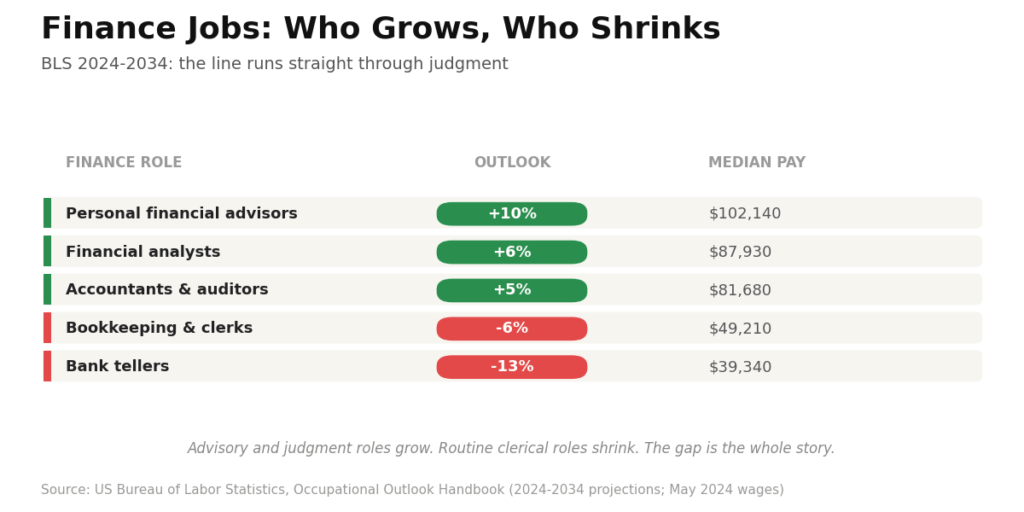
The US labor statistics confirm the pattern with cold precision. These are not forecasts from a vendor blog; they are the government’s own occupational projections through 2034.
| US finance role | BLS outlook 2024-34 | Median pay 2024 | AI exposure |
|---|---|---|---|
| Bank tellers | -13% (declining) | $39,340 | Very high |
| Bookkeeping / accounting clerks | -6% (declining) | $49,210 | Very high |
| Financial clerks (overall) | -5% (declining) | High-school entry | High |
| Accountants & auditors | +5% (growing) | $81,680 | Medium |
| Financial analysts | +6% (growing) | ~$88,000 | Medium |
| Personal financial advisors | +10% (growing) | $102,140 | Low-Medium |
| Data scientists / actuaries | 20%+ (fast growth) | Six figures | Low (AI-adjacent) |
Read that table as a map, not a verdict. The teller role is projected to fall 13% through 2034, the sharpest decline in the group, as branches thin out and self-service spreads. Bookkeeping clerks fall 6% for the same reason. Meanwhile, analysts grow 6%, and accountants grow 5%. The line runs straight through judgment.
Which Finance Jobs Are Safest From AI in 2026?
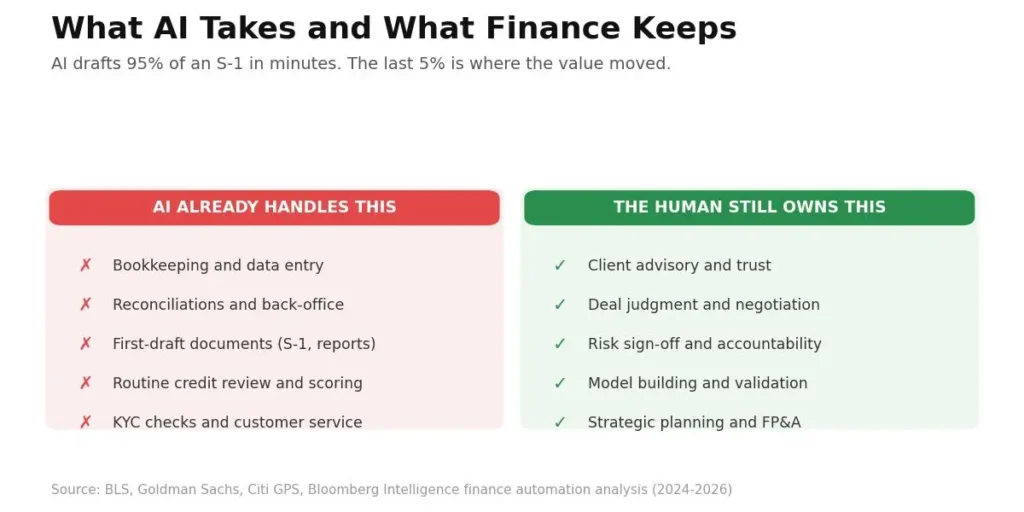
The safest finance jobs share three traits: a client must trust the work, a regulator must sign it off, or a judgment call moves real money. None of those three can be handed to a model that cannot be held accountable, and accountability is the whole point in finance.
The roles that sit off every high-exposure list, and often grow because of AI, include:
- Client advisory and relationships.
Trust, accountability, and the hard conversation when a portfolio drops. Personal financial advisors are projected to grow by 10% through 2034, the fastest among the core finance groups. - Deal judgment and negotiation.
The S-1 draft is a commodity now. The decision about price, structure, and timing is not. That “last 5%” is where senior bankers live. - Risk ownership and sign-off.
A model can estimate; an accountable human approves. Regulators require a name on the decision, and a model cannot be that name. - Building and validating the models.
Someone has to construct, test, and govern the AI itself. Data scientists, actuaries, and operations research analysts are all projected to grow 20% or more this decade. - Controllers and senior FP&A.
Strategic planning, scenario judgment, and cross-functional storytelling stay human because they depend on business context AI does not hold.
One precision note, because honesty matters more than a clean story. No canonical study publishes an official “safe jobs” list.
What the evidence supports is narrower: advisory, deal-making, and senior risk judgment appear on none of the high-exposure lists, and Citi’s own report expects roughly 12% of banking jobs to be augmented rather than replaced. Safe is the wrong word. Durable is the right one.
What New Finance Jobs Is AI Creating?
AI is creating finance roles almost as fast as it retires the routine ones: model validation, AI risk and governance, embedded analytics, and AI-augmented planning. This is the half of the story the panic coverage skips, and it is backed by the same evidence that scares people.
The WEF’s net gain of 78 million roles and Goldman’s observation that 85% of US job growth over 80 years came from new positions both point in one direction. New job categories, not just fewer old ones.
Compared to what I have seen in past technology shifts, the new finance roles are unusually specific this time, and several are already showing up in job listings:
- Model validation and model risk.
Every AI model that touches money now needs a human to test it, stress-test it, and certify it. Banks are moving exactly this work into their teams, because a regulator wants a name behind the machine. - AI governance and compliance.
Someone has to make sure AI tools are auditable, fair, and explainable. Robert Half’s 2026 data flags regulatory technology as one of the skills hiring managers will pay a premium for, and this is where it lands. - AI-augmented FP&A analysts.
The forecasting job did not disappear; it leveled up. Analysts now run thousands of scenarios instead of three, and the skill that matters is interpreting the output, not building the spreadsheet by hand. - Fraud, AML, and risk analytics.
As AI scans 100% of transactions instead of a sample, banks need people to investigate what it flags. The volume of alerts goes up, and so does demand for the humans who triage them. - Finance-to-AI translators.
A small but growing role: people fluent enough in both finance and AI to sit between the quants and the business. This is where the 56% wage premium concentrates.
The US occupational data quietly confirms the shift. BLS projections rank information security analysts among the fastest-growing occupations in the economy, at 28.5% through 2034, with data scientists, actuaries, and operations research analysts all growing by 20% or more.
Finance runs on exactly these skills, so the roles feeding AI systems are expanding while the roles feeding paper are contracting. This works well, except for one honest catch: the new jobs and the lost jobs do not always land on the same people.
A displaced bookkeeping clerk cannot step into a model-validation seat overnight, and that reskilling gap is the real cost of this transition. Job creation is a macro comfort. It is not an automatic personal safety net, which is exactly why the future-proofing steps below matter.
What Do US Banks Actually Say About AI Job Cuts?
US bank leaders have stopped hiding it: AI will shrink parts of the workforce, mostly through attrition rather than mass layoffs. In June 2026, Bloomberg compiled their comments, and the candor was striking. These are not activist predictions; they are the CEOs themselves.
According to Fortune’s reporting, JPMorgan CEO Jamie Dimon said AI “will eliminate jobs.” Citigroup CEO Jane Fraser told staff some roles “will no longer be required.”
Goldman Sachs President John Waldron described parts of operations as a “human assembly line” ripe for automation. Between JPMorgan, Goldman, Citi, and Barclays, those four banks employ more than 670,000 people, so even a modest reshaping carries enormous weight.
But notice how they plan to do it. Dimon pointed to attrition, redeployment, retraining, and early retirement rather than dramatic layoff rounds. That model lets banks quietly lower headcount by slowing replacement hiring and shrinking analyst classes, while normal turnover does the rest.
JPMorgan’s own leadership has signaled that operations and account services headcount could fall by about 10% over five years. The clearest AI-linked shift is compositional.
McKinsey’s QuantumBlack lead noted banks are cutting junior analyst classes by as much as two-thirds, while sourcing about 62% of their AI talent from those same junior pools.
So the bottom rung is getting narrower at the exact moment banks need people who can build with AI. That tension is the real story of 2026. There is a contrarian data point worth holding onto, though.
The Yale Budget Lab’s research director said financial-activities layoff data showed no unusual increase in 2026, suggesting AI is hitting employment through slower hiring and attrition first, not broad-based cuts. Both things can be true. The headcount is drifting down without a single dramatic announcement.
In My Experience: Watching the Junior Rung Thin Out
Honestly, when I first started tracking this beat, I expected the story to be dramatic firings. It was not. What I kept seeing instead was job listings that simply never got reposted after someone left, and analyst classes that came in a third smaller than the year before with no press release attached.
What surprised me most was where the fear sat. It was not the senior bankers who were worried; it was the recent grads and the career changers who had banked on entry-level reconciliation and reporting work as a foot in the door.
That door did not slam. It just narrowed, quietly, one un-backfilled seat at a time, which is somehow harder to plan around than a clean layoff.
Are Entry-Level Finance Jobs Disappearing?
Entry-level finance jobs are compressing, not vanishing, and this is the sharpest verified harm in the whole debate. The routine work that once filled a junior analyst’s first two years, formatting, reconciliation, and first drafts, is exactly what AI does well, so the bottom rung is getting narrower even where the ladder still stands.
Stanford’s “Canaries in the Coal Mine” study, released in August 2025 using US payroll data, found that workers aged 22 to 25 in the most AI-exposed occupations experienced a 13% relative decline in employment, later revised to 16% in later versions.
Older workers in the same jobs, and young workers in less-exposed roles, stayed stable or grew. The squeeze is specific to the young and the routine. The broader US signals rhyme with that finding.
As of mid-2026, Gen Z unemployment sat near 8.3%, roughly double the national rate, and the New York Fed put the jobless rate for recent college graduates around 5.6%.
A June 2026 employer survey found one in three companies had replaced some entry-level roles with AI rather than hiring for them. In finance specifically, banks are trimming junior analyst classes by as much as two-thirds.
But the ladder is not gone; its bottom rung just moved up. The catch is a genuine paradox worth sitting with: banks are shrinking junior classes while sourcing most of their AI talent from those same junior pools.
They still need young people; they just need them to arrive already able to build with AI rather than learn on reconciliation work. The apprenticeship did not end. Its entry price went up.
How Will AI Change Finance Salaries and Hiring in 2026?
AI is pushing finance pay in two directions at once: down for routine roles, up sharply for anyone who pairs finance judgment with AI fluency. This is the single most actionable trend in the whole outlook, because it tells you exactly where to invest your effort.
Robert Half’s 2026 Salary Guide found 84% of financial-services hiring managers plan to offer higher pay for candidates with in-demand skills, specifically AI and machine-learning fluency, data analytics, regulatory technology, and cybersecurity.
That is not a soft preference. That is a wage signal pointing at a specific skill stack. PwC’s Global AI Jobs Barometer, published in mid-2025, backs this with scale. Across nearly a billion job ads, roles requiring AI skills carried an average wage premium of 56%, up from 25% a year earlier.
The premium more than doubled in twelve months. Compared to almost any other career lever available to a finance professional right now, that is a steeper return than a second degree. And here is the counterintuitive part.
The roles losing pay ground are the ones people assume are “safe” because they are steady: teller work at a $39,340 median, clerical bookkeeping at $49,210. Steady is not the same as protected.
The roles gaining are the volatile-sounding analytical and advisory ones, where the business-and-financial median already sits near $80,920, compared with a national median of $49,500.
Pro tip: do not chase an AI certificate in isolation. The PwC premium attaches to AI skills used inside a domain. An analyst who can audit an AI-built model is worth more than a generalist who can only prompt one. Stack the tool on top of the judgment, never instead of it.
How Can You Future-Proof a Finance Career Against AI?
Future-proofing a finance career in 2026 comes down to a five-step stack that the wage data actually rewards. Work through them in order, because each one builds on the last.
- Learn AI tools inside your finance domain.
Prompt-assisted research, Excel-plus-Python workflows, and AI first drafts you can audit line by line. Tool skill without domain skill is a commodity, so anchor every tool to real finance work. - Own at least one judgment call.
Valuation, credit decisions, or risk trade-offs. Pick a decision AI can inform but cannot be held accountable for, and become the person who makes it. This is what keeps you off the exposure lists. - Build verifiable proof.
Two or three models you constructed end-to-end beat any resume bullet. A discounted cash flow you can defend line by line is the classic first artifact, and it signals judgment plus tooling in one shot. - Aim at durable domains.
Risk, regulated work, deal support, and advisory sit off the high-exposure lists. If you are early in your career, steer toward the seats that require a signature and a relationship. - Treat reskilling as continuous.
The WEF expects nearly 40% of job skills to change by 2030. A one-time course will not hold. Budget a few hours a week, permanently, the way you would budget for sleep.
Workflow Example: An Analyst and AI Building an Earnings Model
Here is a realistic 2026 workflow showing where the human and the AI sit, from start to finish.
Input: A fresh quarterly SEC filing lands, plus three years of the company’s historicals and a set of sell-side notes. The analyst needs a revised earnings model and a one-page view by end of day.
Process: The analyst points an AI tool at the filing to extract line items, normalize the historicals, and draft variance commentary in minutes, work that used to eat an entire afternoon.
Then the analyst does the part AI cannot: challenges the revenue assumptions against what management actually said on the call, flags a one-time item the model treated as recurring, and adjusts the discount rate for a risk the filing buried in a footnote.
Output: A defensible model and a one-pager, produced in roughly half the old time, with the analyst’s judgment stamped on every assumption that matters.
Result: The analyst ships more work of higher quality, and the role’s value shifts from typing to thinking. The AI did not replace the analyst. It deleted the busywork and exposed whether the analyst could actually judge a number, which is now the whole job.
Common Pitfalls: What People Get Wrong About AI and Finance Jobs
Most bad career decisions in this moment come from a handful of repeatable mistakes. Each one has a clear cause and a clear fix.
- Reading “exposed” as “eliminated.”
This is the root error. Exposure means a task could be automated, not that your job is gone. Fix it by always asking which of the three questions a number answers: exposure, expectation, or outcome. - Quoting undated statistics.
Goldman’s 300 million and Goldman’s 15 million refer to different amounts from different years. An undated figure is a rumor. Attach a date or drop the number. - Assuming steady roles are safe roles.
Clerical and teller work feels stable but carries the highest exposure to automation and the weakest pay trajectory. Predictable is not the same as protected. - Collecting AI certificates with no domain.
The wage premium rewards AI skill used inside finance, not floating on its own. Pair every tool with a real judgment call or the certificate depreciates. - Waiting for a layoff to react.
The 2026 mechanism is attrition, not announcements. If you wait for a pink slip as your signal, you have already missed two years of un-backfilled seats. Move before the market tells you to.
One more, because it is the one nobody wants to hear: do not assume seniority protects you. Employment lawyers tracking this wave note that automation is now reaching middle-office roles higher up the chain than previous technology shifts did. The exposure climbed the org chart. Plan accordingly.
Where Does AI Still Fail in Finance Work?
AI still fails in finance wherever accountability, context, or regulation is required, and those three show up in almost every decision that matters. This is not a comforting slogan; it is the practical reason the judgment layer is holding while the typing layer collapses.
Knowing exactly where AI breaks is how you position yourself above the break line. The first failure is accountability. You cannot hold a model responsible for a decision.
When a loan goes bad, or a filing is wrong, a regulator wants a human name on the sign-off, and a bank wants someone who can be questioned under oath. AI can inform that decision all day. It cannot own it, and ownership is the entire job in regulated finance.
The second failure is confident wrongness. AI models still hallucinate, producing numbers that look clean and are simply invented. In a casual chat, that is annoying.
In a financial model feeding a real trade or a board deck, it is a landmine, and it means every AI output needs a human who can spot the number that does not belong. The more fluent the draft, the harder the error is to catch.
Context is the third gap. A filing might bury a one-time gain that inflates the quarter, or management might signal caution on an earnings call that never makes it into the numbers. A human analyst who listened to the call catches it. A model working from the document alone often does not, because it has no sense of what the business actually meant.
Klarna is the case study executives now quote back to each other. Its AI assistant handled 2.3 million chats in a single month and seemed to prove that automation could run customer service on its own.
Then quality slipped, and by May 2025 the company resumed hiring humans. The lesson landed hard across finance: automation that degrades the work gets rolled back, and the human quality floor beneath it is real.
Here is the contrarian insight most coverage misses. As AI gets better at drafting, the human review layer gets more valuable, not less. A rough draft invites scrutiny. A polished, confident, subtly wrong draft slips through unless someone genuinely understands the numbers. So the safest place to stand is not away from AI. It is directly on top of it, as the person who catches what it gets wrong.
What Is the 2026-2027 Outlook for Finance Jobs?
The 2026-2027 outlook is churn, not collapse: fewer routine seats, more analytical and advisory ones, and a rising skill bar across the board. The US job market cooled hard in mid-2026, and AI is part of the reason, but so is a broader slowdown that has nothing to do with algorithms.
The June 2026 jobs report showed the US economy adding just 57,000 jobs, with prior months revised down by 74,000. Unemployment ticked to 4.2%, but partly because more than 500,000 people stopped looking for work entirely.
Younger workers felt it most, with Gen Z unemployment near 8.3%, roughly double the national rate. A June 2026 employer survey found one in three companies had replaced some entry-level roles with AI rather than hiring.
But context saves the story from doom. Goldman’s own economists point out the US economy creates about 30 million jobs a year while destroying 29 million, and a 5% pickup in job creation would be enough to reabsorb every AI-displaced worker.
The buffer exists. It just has to hold through the transition, and history suggests it usually does.
Pro tip for the next two years: watch hiring velocity, not layoff headlines. Attrition-driven decline shows up as jobs that quietly never reopen, so the early signal is a thinning of postings in your function, not a dramatic cut.
If reconciliation and first-draft roles are vanishing from the listings you follow, that is your cue to move up the judgment ladder before you are asked to.
Frequently Asked Questions
Not wholesale. BLS projects financial analyst jobs to grow 6% through 2034. AI automates data prep and first drafts, but the judgment and client layers of the role are not on any study’s fast-decline list.
Routine and clerical roles. BLS projects bank tellers to decline 13% and bookkeeping clerks 6% through 2034. Bloomberg’s bank survey flags back office, operations, KYC, and customer service as most exposed.
No study names a “safe” list, but advisory, deal judgment, senior risk sign-off, and model-building appear on none of the high-exposure lists. Personal financial advisors are projected to grow 10% through 2034.
They are compressing, not vanishing. Banks are cutting junior analyst classes by up to two-thirds, and a Stanford study found that young workers in the most AI-exposed jobs saw a 13% relative decline in employment.
Yes. PwC found that AI-skill jobs carry a 56% wage premium, and 84% of financial services hiring managers plan to pay more for AI fluency. Learn the tools inside a finance domain, not instead of one.
It said about 15 million US workers could be displaced across a decade-long transition, not permanently unemployed. Goldman explicitly called an AI “job apocalypse” unlikely, citing decades of technology-created job growth.
The bottom line for 2026: AI is not the end of finance careers; it is the end of finance busywork. Learn to direct the tools, own the calls they cannot make, and keep a dated fact handy the next time someone tells you the robots are taking every seat. They are not. But they are moving the ones worth having.

Is an SEO Specialist and AI Tools Researcher with over 4 years of hands-on experience in search engine optimization. As the founder of Smart AI Helper Pro, he tests and reviews AI writing, SEO, and marketing tools to help creators and business owners grow faster with practical, research-backed strategies.