Will AI Replace Insurance Agents? The 2026 Verdict
By SM Mehedi Hasan

No, AI will not replace insurance agents through 2034. The U.S. Bureau of Labor Statistics projects 4% job growth, with about 568,800 agents working in 2024, even as roughly 90% of insurers now run some form of AI.
Automation absorbs the paperwork; licensed advice, complex claims, and client trust stay human.
I spent weeks poking at AI quoting bots, claims assistants, and agent copilots before writing this. The pattern held every time. These tools fly through the boring 80% of the job, and then stall the second a client says something the script never saw coming.
Most headlines treat this like a countdown to extinction. The labor data tells a calmer, more useful story. So let me walk you through what the numbers, the regulators, and the tools actually show, and where a human still wins.
Table Of Contents
ToggleWill AI replace insurance agents in 2026?
No, AI will not replace insurance agents in 2026, and the employment math backs that up. The BLS projects insurance sales agent jobs to grow 4% from 2024 to 2034, about as fast as the average for all occupations, with roughly 47,000 openings each year over the decade (BLS Occupational Outlook Handbook).
Here is the part the doom pieces skip. A growing job market and heavy AI adoption are happening at the same time. Insurers are pouring money into automation, yet a 2025 industry labor study found 74% of companies expected to grow revenue over the following year rather than cut staff because of AI.
And the reason is simple. AI is eating tasks, not roles. When a bot handles the intake form, the agent is still the one who reads the client, spots the coverage gap, and closes the case. The job is shifting toward advice, not shrinking toward zero.
What does the employment data actually say?
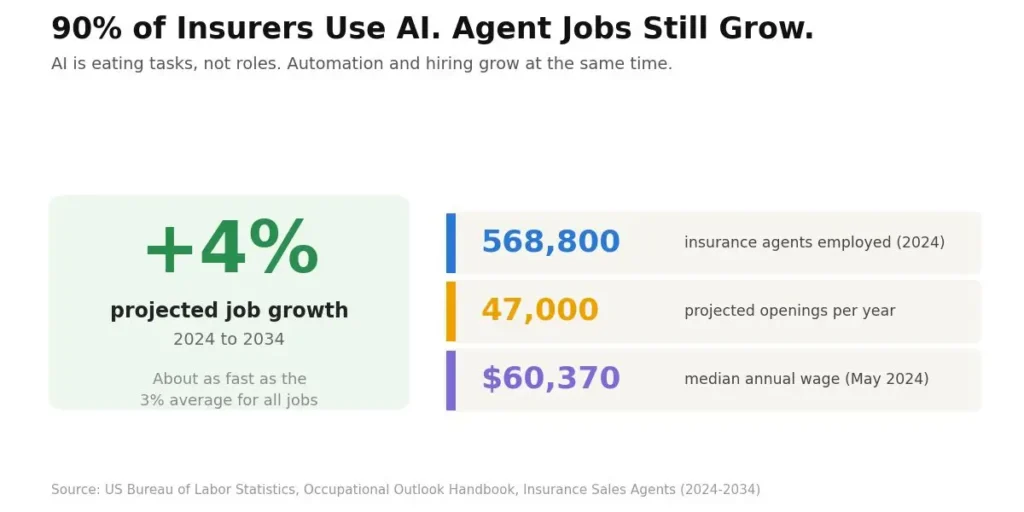
The data says demand is steady, pay sits above the national median, and the role is nowhere near collapse.
Insurance selling stays profitable for carriers only with a steady flow of new customers, which keeps agents in demand even as tools change. Here is the current snapshot straight from federal wage and projection data.
| Metric (BLS, 2024) | Figure | What it signals |
|---|---|---|
| Agents employed (2024) | ≈ 568,800 | Large, stable workforce base |
| Projected growth 2024–34 | +4% | About as fast as average |
| Annual openings | ≈ 47,000 / year | Steady, replaceable demand |
| Median annual wage | $60,370 | Above the $49,500 all-jobs median |
| Top 10% of earners | Over $135,660 | Advice and a book of business pay |
| Bottom 10% | Under $36,390 | Entry and part-time range |
Zoom out to the whole sector, and the story holds. The insurance agencies and brokerages industry employed roughly 1,003,900 workers in 2024 and is projected to reach about 1,051,300 by 2034, a net gain of around 47,400 jobs.
That is measured, positive growth for an industry supposedly on the verge of being automated out of existence. One detail matters more than the headline number.
The BLS notes that growth will likely be strongest for independent agents, while demand softens where clients research and buy online without help. That single line predicts exactly where AI pressure lands, and it is not on the trusted advisor.
Which insurance tasks is AI already automating?
AI is already automating the repetitive, rules-based parts of an agent’s day, and doing it in seconds instead of hours. These are the tasks that never needed judgment in the first place:
- Claims intake and first notice of loss:
Bots collect details, verify data, and open the file 24/7. - Quoting and data entry:
Forms get read, fields get filled, quotes get generated without manual typing. - Fraud detection:
Machine learning flags odd patterns and language in claim notes early. - Underwriting support:
AI summarizes fat submission packets into structured risk snapshots for faster review. - After-hours service:
Virtual assistants answer routine questions, book callbacks, and route the rest.
The scale here is real. In late 2025, one carrier’s AI tool had processed over a million underwriting submissions across 40+ lines of business (Insurance Business). But notice what is on that list, and what is not. Every item is prep work. None of it is the decision, the relationship, or the sign-off.
Here is a tip most vendors will not tell you. The faster AI clears your admin pile, the more your income depends on the skills a bot cannot fake. That is a good trade for a strong agent and a hard one for an order-taker.
How much of an agent’s job can AI realistically handle?
AI can realistically handle most of the routine workload, but it stalls well before the whole job is done, and adoption data shows how early this still is. Yes, the speed gains are dramatic. Modern underwriting tools compress hours of document review into minutes, and AI copilots make underwriters roughly three times faster on standard risks. That sounds like a threat until you look at how mature the deployment actually is.
Most carriers are not running autonomous AI. They are piloting it. An AM Best survey of 152 rated carriers and managing general agents found that only 20% called themselves first movers, 63% had a formal AI policy in place, and just 13% felt confident measuring AI’s return on investment (Risk & Insurance).
Heavy investment, cautious rollout, and a human still checking the work. So the realistic split looks like this. AI takes the volume, the prep, and the pattern-spotting. The human takes the judgment call, the exception, and the sign-off.
Grant Thornton found that 52% of insurance leaders are already reporting AI-driven revenue growth, which suggests the tools are working. It does not tell you the agents are gone. Growing revenue usually means more clients to serve, not fewer people serving them.
Worth flagging one non-obvious risk here. The bigger near-term threat to agents is not unemployment; it is commission pressure. If AI cuts the cost of servicing a policy, some carriers may lean on that to trim payouts rather than headcounts. The seat stays. The economics of it are what agents should watch.
Which insurance agent roles face the most AI risk?
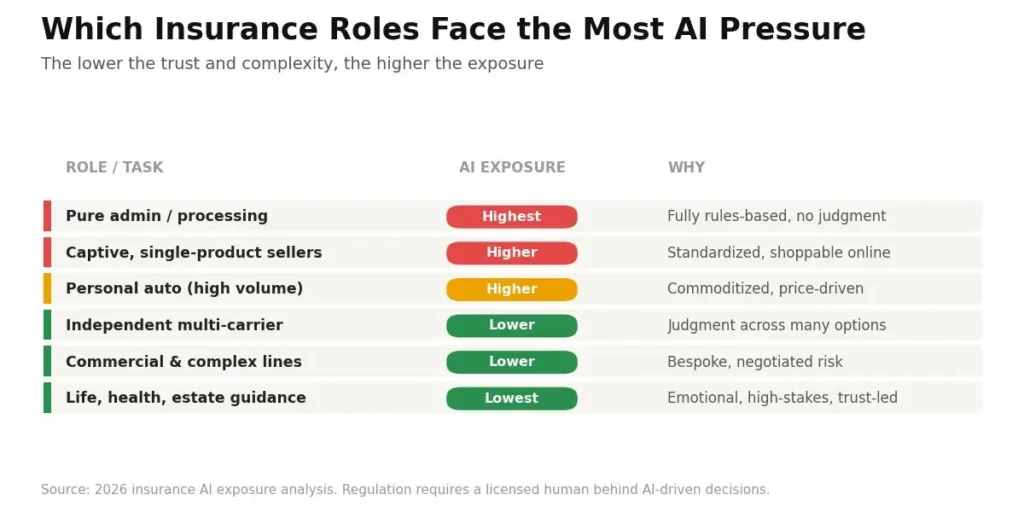
The roles most exposed to AI are the transactional, standardized ones, and the safest are relationship-heavy and complex. Replacement risk is not evenly spread across the profession, which is why blanket “agents are doomed” takes miss so badly.
This is roughly how the exposure breaks down:
| Role or task | AI exposure | Why |
|---|---|---|
| Pure admin / processing | Highest | Fully rules-based, no judgment |
| Captive, single-product sellers | Higher | Standardized, shoppable online |
| Personal auto, high volume | Higher | Commoditized, price-driven |
| Independent multi-carrier advisors | Lower | Judgment across many options |
| Commercial and complex lines | Lower | Bespoke, negotiated risk |
| Life, health, estate guidance | Lowest | Emotional, high-stakes, trust-led |
Compared with the flat predictions floating around online, this is the honest picture. If your whole value is reading a rate off a screen, software already does that faster. If your value is guiding a family through a life insurance decision they are scared to make, no model is coming for that seat.
Which AI tools are reshaping insurance work in 2026?
The AI tools reshaping insurance in 2026 cluster around four jobs: quoting, claims, underwriting, and service. None of them replace the agent outright. Each one strips a slow task off the agent’s plate and hands back time. Here is how the main categories break down and where they actually help.
| Tool category | What it does | Where it helps agents |
|---|---|---|
| Quoting copilots | Auto-fills forms, runs fast quotes | Kills manual data entry |
| Claims triage bots | Opens claims, sorts by urgency | Frees agents for the hard cases |
| Underwriting summarizers | Turns submissions into risk snapshots | Speeds review and back-and-forth |
| Voice and chat assistants | Handle 24/7 routine questions | Covers after-hours, routes the rest |
| Fraud and risk models | Flag odd patterns early | Cleaner book, faster payouts |
A quick word of caution from testing these. The demos always look flawless. Real accounts are messier, and the tool that dazzles in a sales call often needs a human babysitter in production. Pick one workflow, run it hard, and only then expand. The agencies that win start narrow and verify everything.
Why can’t AI fully replace insurance agents?
AI cannot fully replace insurance agents because the core of the job is judgment, empathy, and legal accountability, none of which can be automated cleanly. A model can price a policy.
It cannot sit with a client after a house fire, weigh a messy claim for which nobody wrote a rule, or carry the license and liability that regulators require a human to hold.
Four things keep a person in the chair:
- Empathy at the worst moment:
People filing a death or disaster claim want a human, not a chatbot. - Edge cases:
Unusual risks and disputed payouts sit outside the training data by definition. - Accountability:
licensing, suitability, and fiduciary duty attach to a named person, not an algorithm. - Trust for big decisions:
Clients buy from someone they believe will pick up the phone next year.
In My Experience
What surprised me most was how confidently these tools fail. I ran a mid-complexity scenario through an AI quoting assistant: a small business owner with a home office, a leased vehicle, and one prior claim. On paper, easy.
In practice, the bot bundled coverage that technically fit and quietly missed a gap a decent agent would flag in ten seconds. It did not hedge. It did not say “check this with a licensed agent.” It just answered, fast and wrong.
That is the real risk with these systems, and it is also the exact reason a human stays in the loop. Speed without a sanity check is not a replacement. It is a liability with a nice interface.
One more thing caught me off guard. The tools were great at answering the question I asked and useless at the question I should have asked. A client rarely walks in knowing exactly what they need.
They walk in with a life event: a new baby, a new business, a parent moving in. Reframing that mess into the right coverage is judgment work, and every bot I tested waited to be told what to do instead of noticing what was missing. That reframing skill is the moat, and it is quietly the hardest thing to automate.
How does AI regulation affect agents and consumers?
Regulation is actively protecting the human role because U.S. rules increasingly require individuals to be accountable for AI-driven insurance decisions. This is the angle most “will AI replace agents” articles ignore, and it changes the whole verdict.
At its center is the NAIC Model Bulletin on the Use of Artificial Intelligence Systems by Insurers, adopted in December 2023. By late 2025, more than 20 states plus Washington, D.C. had adopted it, with some variations (Fenwick). It requires insurers to run a documented AI governance program with built-in testing, oversight, and human accountability.
Three consequences flow directly to agents and their clients:
- Consumer notice:
Insurers are expected to tell people when AI meaningfully affects a decision that impacts them. - State-specific law:
Colorado’s AI Act (SB24-205), passed in May 2024, adds governance and anti-discrimination testing duties for insurers. - Real legal exposure:
In October 2025, homeowners sued State Farm over AI-influenced claim handling, a sign courts are now testing this directly.
Put plainly, the regulatory trend is human-in-the-loop by design. When an AI recommendation carries compliance, fairness, and payout consequences, someone licensed has to own it. That someone is an agent or a human decision-maker, not the model.
Worth knowing if you sell across state lines: the rules are not uniform yet. Colorado, New York, California, and Texas run their own approaches on top of the NAIC framework, and the NAIC began piloting a formal AI evaluation tool in early 2026.
So an agency operating in five states may face five slightly different expectations. That patchwork is friction for carriers, but it is job security for the humans who have to navigate it.
What do consumers actually think about AI insurance agents?
Consumers are warming to AI in insurance fast, but their comfort collapses the moment AI moves from helping to deciding. That gap is the clearest signal yet of where human agents stay protected.
The shift in acceptance is real. Consumer support for AI in insurance nearly doubled in a single year, from 20% in 2025 to 39% in 2026 (Insurance Business). People clearly do not mind a bot quoting a policy or answering a routine question at midnight.
But here is where it flips. Comfort drops sharply when AI stops assisting and starts making the call on coverage or a claim. Money and risk change the emotional math.
Someone comparing car insurance rates is happy to click through a bot. That same person, staring at a denied claim after a flood, wants a human who will fight for them. For agents, that split is a gift.
It maps almost perfectly onto the high-value work: the emotional, high-stakes, trust-heavy moments consumers refuse to hand to a machine. Meet people there, and the bot becomes your assistant instead of your rival.
How can insurance agents stay relevant alongside AI?
- Learn the tools before they learn your clients.
Get hands-on with an AI copilot or quoting assistant so you know its blind spots, not just its buttons. - Push admin onto automation.
Route intake, reminders, and data entry to AI so your calendar fills with advice, not typing. - Double down on the human 20%.
Complex cases, claims support, and relationship reviews are where your margin and your moat live. - Verify every AI output.
Treat the bot’s answer as a draft, then apply your license and judgment before it reaches a client. - Specialize where trust is highest.
Move toward life, commercial, and complex lines that resist commoditization.
Why this order matters: each step builds on the last. You cannot delegate to a tool you do not understand, and you cannot specialize in advice while you are still drowning in forms. Clear the admin first, then climb.
Common pitfalls agents make with AI
Most AI stumbles in insurance come from trusting the tool too much or too little, and both hurt. From watching how agencies actually adopt these systems, the same mistakes repeat:
- Blind trust:
shipping AI output straight to a client without review. It happens because the answer looks polished. Fix it by treating every response as a first draft. - Boiling the ocean:
trying to automate ten workflows at once. Two well-run use cases beat five abandoned ones. Start narrow. - Ignoring disclosure rules:
using AI in client-facing decisions without knowing your state’s notice expectations. Check the rules before you deploy, not after. - Automating the relationship:
letting a bot handle the moments that build loyalty. Keep the human on emotional and high-stakes touchpoints.
Workflow example: AI-assisted quote, human close
Here is a realistic flow that shows where the machine hands off to the person.
- Input:
A new lead requests auto and renters coverage through the agency website at 11 p.m. - Process:
The AI assistant captures details, pulls prior data, runs a preliminary quote, and flags a coverage gap on the renters policy. - Output:
By morning, the agent has a structured summary, a draft quote, and the flagged gap ready to review. - Result:
The agent verifies, corrects the gap the bot only flagged, calls the client to explain the tradeoff, and closes a better policy in one conversation instead of three.
The bot saved two hours of setup. The agent saved the client from an underinsured renters policy. That split is the whole future in one example.
So what is the 2026 verdict?
The 2026 verdict is clear: AI is a copilot, not a replacement, for insurance agents. The federal projections show steady job growth through 2034.
Adoption surveys show insurers going all-in on AI at the same time, with a 2025 industry survey finding that around 90% of insurers are somewhere on the generative AI journey, and 55% are in early or full deployment.
Both things are true at once, and that is the point. McKinsey’s analysis even found early AI leaders in insurance generating far stronger shareholder returns than laggards (McKinsey).
The winners are not agencies that fired their people. They are agencies whose people got faster, sharper, and more available because the software carried the busywork.
So the honest answer to the question in the title: not replaced, redefined. The agents who treat AI as a threat will feel like one. The agents who treat it as leverage will quietly outwork everyone who did not.
Frequently Asked Questions
No. The BLS projects 4% job growth for insurance sales agents through 2034. AI will automate routine tasks, but licensed advice, complex claims, and trust keep humans in the role well beyond 2030.
Pure admin, data processing, and single-product transactional selling face the highest AI exposure. Independent advisors, commercial specialists, and life or health agents face the least, because their work depends on judgment and relationships.
Not on its own. U.S. regulation, including the NAIC Model Bulletin adopted by most states, expects a licensed, accountable human behind AI-driven insurance decisions. AI can assist, but a person must own the outcome.
Yes, increasingly. Agents who use AI to clear admin and focus on advice will outperform those who avoid it. You do not need to code, but you do need to run the tools and verify their output.
For simple, standardized policies, AI quotes are often fine. For complex needs, life events, or higher coverage, a licensed agent can catch gaps a bot may miss, as regulators and industry data both note.
Data verified against BLS Occupational Outlook Handbook (May 2024 wage data; 2024–34 projections), the NAIC Model Bulletin on AI, Conning’s 2025 AI survey, AM Best, and McKinsey. Figures reflect the most recent available U.S. sources as of 2026.

Is an SEO Specialist and AI Tools Researcher with over 4 years of hands-on experience in search engine optimization. As the founder of Smart AI Helper Pro, he tests and reviews AI writing, SEO, and marketing tools to help creators and business owners grow faster with practical, research-backed strategies.